
Chemistry
(a) Explain with a diagram the preparation of aqueous ammonia.
(b) Why drying agents such as P2O5 and CaCl2 are not used to dry NH3 ?
Ammonia
53 Likes
Answer
(a) The diagram below shows the preparation of aqueous ammonia:
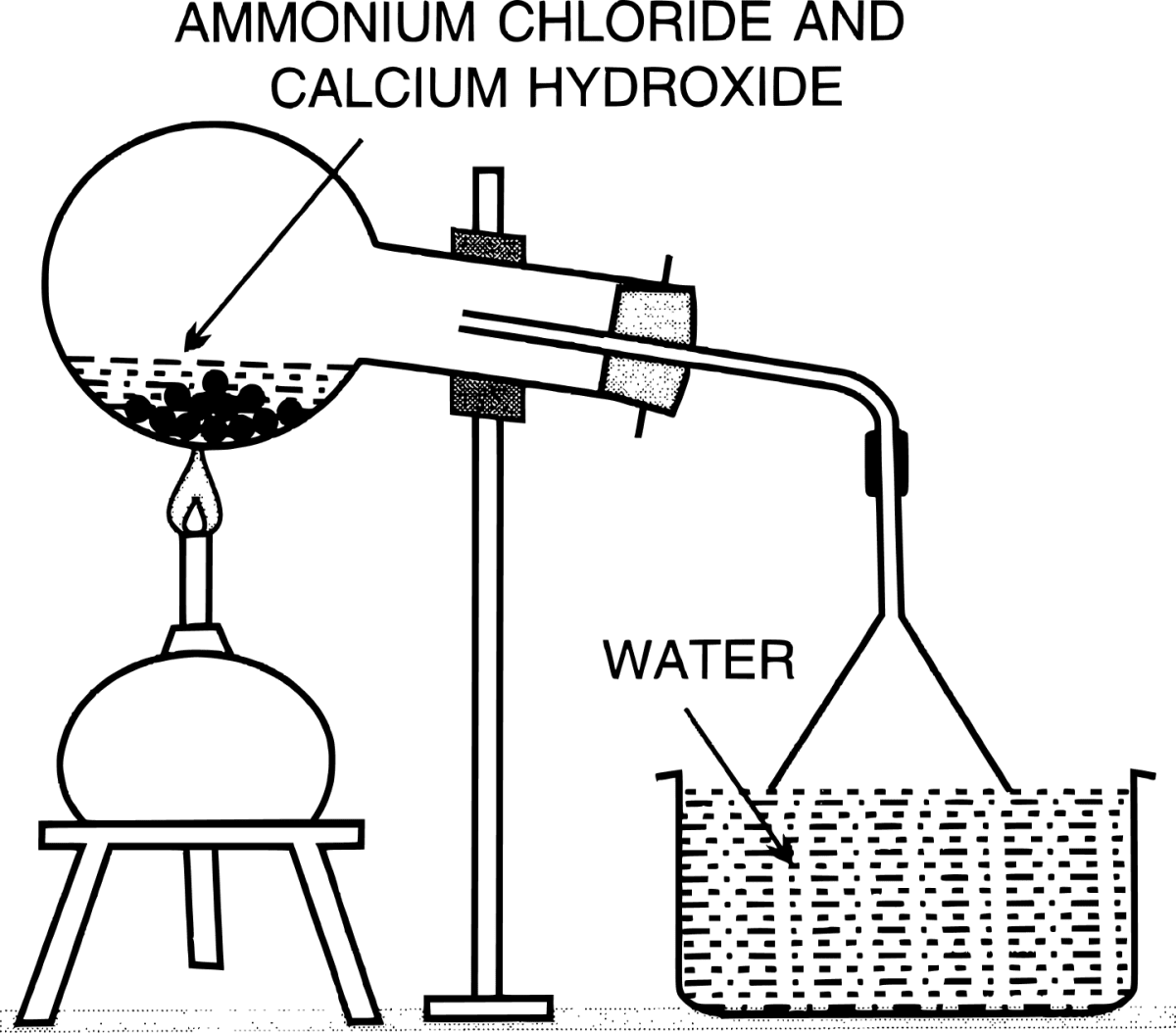
Procedure : Water is taken in a container and only a small portion of the mouth of the funnel is dipped in water.
As ammonia dissolves in water at a higher rate than it's production in the flask, the pressure in the funnel above water level decreases for a moment and water rushes into the funnel.
As a result, the rim of the funnel loses it's contact with water. Since, ammonia produced pushes the water down, the funnel comes in contact with water again. In this way, ammonia dissolves in water without back suction of water.
(b) Ammonia being basic in nature reacts chemically with P2O5 and CaCl2
6NH3 + P2O5 + 3H2O ⟶ 2(NH4)3PO4
4NH3 + CaCl2 ⟶ CaCl2.4NH3
Hence, P2O5 and CaCl2 are not used to dry NH3
Answered By
36 Likes
Related Questions
(a) State the type of bonding present in ammonia, show by a diagram.
(b) What is the formula of liquid ammonia? Account for the basic nature of this compound.
(a) Write a balanced chemical equation for the lab preparation of ammonia.
(b) How is ammonia dried and collected in the laboratory?
(c) Ammonia cannot be collected over water. Give reason.
A substance 'A' was heated with slaked lime and a gas 'B' with a pungent smell was obtained. Name the substances A and B and give a balanced equation.
Ammonia is manufactured by Haber's process —
(a) Under what conditions do the reactants combine to form ammonia? Give a balanced equation for the reaction.
(b) In what ratio by volume, are the above gases used?
(c) State one possible source of each reactant used in Haber Process.
(d) State whether the formation of ammonia is promoted by the use of high pressure or low pressure?
(e) Mention two possible ways by which ammonia produced is removed from unchanged gases.
(f) What is the function of
(i) finely divided iron,
(ii) molybdenum
in the above process?
(g) What is the percentage formation of ammonia?
(h) How can this percentage formation be increased?