
Chemistry
(a) On which factors does purification of metals depend?
(b) Name the methods used for purification.
(c) With a labelled diagram explain electro-refining of a particular metal.
Metallurgy
30 Likes
Answer
(a) Purification of metal depends on:
- nature of metal
- nature of impurities present in the metal and
- purpose for which the metal is to be used.
(b) Methods used for purification are :
- Distillation
- Liquation
- Electro refining
(c) The below labelled diagram shows the electro-refining of a particular metal:
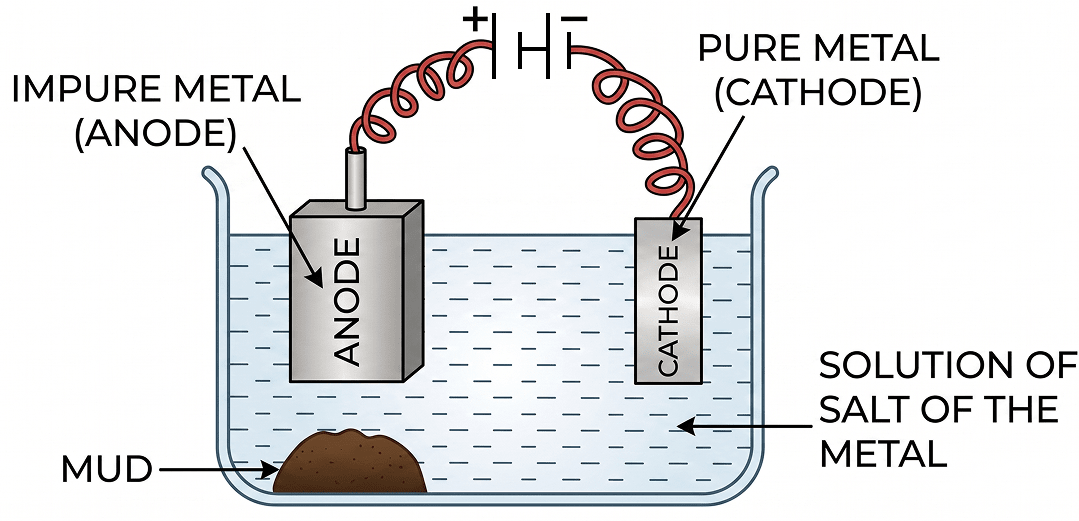
An electrolytic cell is used in electro-refining to refine impure metal using electrical energy to drive a chemical reaction. The cell consists of an electrolyte, two conducting electrodes (cathode and anode) in a non-conducting vessel. The impure metal is made the anode, and a thin sheet of pure metal is the cathode. The electrolyte is a salt solution of the metal to be refined, with a small amount of sulphuric acid added to increase conductivity. On passing electric current, metal ions are reduced to metal at the cathode. Equivalent mass of anode dissolves from the anode and goes into the solution as metal ions.
At anode: M - ne- ⟶ Mn+
At cathode: Mn+ + ne- ⟶ M [M is a metal]
Pure metal deposits at cathode while impurities settle down and form anode mud.
Answered By
18 Likes
Related Questions
State why aluminium is extracted from it's oxide by electrolysis while copper, lead, iron by reducing agents and mercury and silver by thermal decomposition.
How are the metals like sodium, potassium and calcium obtained. Give equations.
State the position of aluminium in the periodic table.
(a) Give the chemical names and formulae of the main ores of
(i) aluminium,
(ii) iron and
(iii) zinc.
(b) Which impurities are present in bauxite?
(c) What is red mud, how is it removed?