
Mathematics
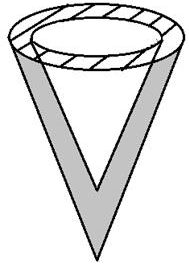
A solid metallic cone, with radius 6 cm and height 10 cm, is made of some heavy metal. In order to reduce its weight, a conical hole is made in the cone as shown and it is completely filled with a lighter metal B. The conical hole has a diameter of 6 cm and depth 4 cm. Calculate the ratio of the volume of metal A to the volume of the metal B in the solid.
Mensuration
1 Like
Answer
Given,
Radius of cone (R) = 6 cm
Height of cone (H) = 10 cm
Radius of conical hole (r) = = 3 cm
Height of conical hole (h) = 4 cm.
Volume of complete cone =
Volume of conical hole =
Volume of cone (with only metal A) = Volume of complete cone - Volume of conical hole
= 1508.57 - 150.85
= 1357.71 cm3.
Hence, ratio of the volume of metal A to the volume of the metal B in the solid = 9 : 1.
Answered By
3 Likes
Related Questions
A test tube consists of a hemisphere and a cylinder of the same radius. The volume of the water required to fill the whole tube is cm3, and cm3 of water is required to fill the tube to a level which is 4 cm below the top of the tube. Find the radius of the tube and the length of its cylindrical part.
A solid is in the form of a right circular cone mounted on a hemisphere. The diameter of the base of the cone, which exactly coincides with hemisphere, is 7 cm and its height is 8 cm. The solid is placed in a cylindrical vessel of internal radius 7 cm and height 10 cm. How much water, in cm3, will be required to fill the vessel completely?
A certain number of metallic cones, each of radius 2 cm and height 3 cm, are melted and recast into a solid sphere of radius 6 cm. Find the number of cones used.
A conical tent is to accommodate 77 persons. Each person must have 16 m3 of air to breathe. Given the radius of the tent as 7 m, find the height of the tent and also its curved surface area.