
Physics
(a) Write an expression for the heat energy liberated by a hot body.
(b) Some heat is provided to a body to raise its temperature by 25°C. What will be the corresponding rise in temperature of the body as shown on the Kelvin scale?
(c) What happens to the average kinetic energy of the molecules as ice melts at 0°C?
Calorimetry
9 Likes
Answer
(a) The expression for the heat energy liberated by a hot body is:
ΔQ = mcΔT
where
m = mass of substance,
c = specific heat capacity of substance,
ΔT = change in temperature
(b) Rise in temperature will be the same on both Celsius and Kelvin scale as a degree (or temperature difference) is same on both the Celsius and Kelvin scales i.e.,
Δt °C = ΔT K
(c) When ice melts at 0°C, average kinetic energy of the molecules will remain the same. If heat is coming into a substance during a phase change, then this energy is used to break the bonds between the molecules of the substance.
Answered By
4 Likes
Related Questions
Write reactions of a nucleus 11X23 when it loses
(a) one proton
(b) one β particle
(c) one α particle
What is meant by electrical resistance of a conductor? State how resistance of a conductor is affected when
(a) a low current passes through it for a short duration and
(b) a heavy current passes through it for about 30 s.
The diagram below shows a magnetic needle kept just below the conductor AB which is kept in North South direction.
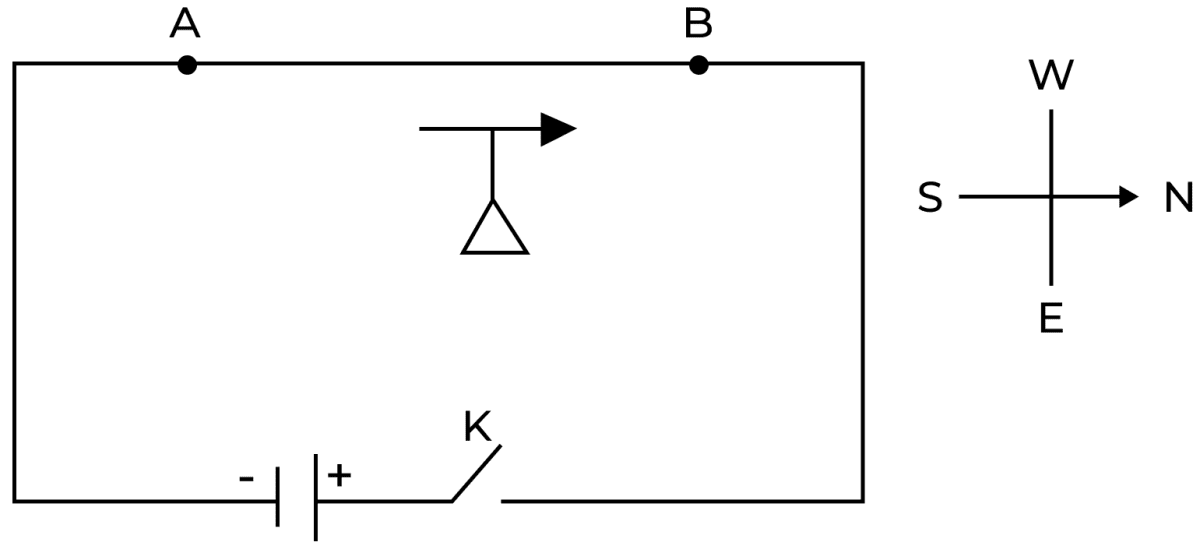
(i) In which direction does the needle deflect when the key is closed ?
(ii) Why is the deflection produced?
(iii) What will be the change in the deflection if the magnetic needle is taken just above the conductor AB ?
(iv) Name one device which works on this principle.
(a) Water falls from a height of 150 m. If the specific heat capacity of water is 4.2 kJ kg-1 °C-1 and g = 10 ms-2, then find the rise in temperature of water.
(b) What is determined by the temperature of a body?