
Chemistry
Answer the following questions with respect to the given figure.
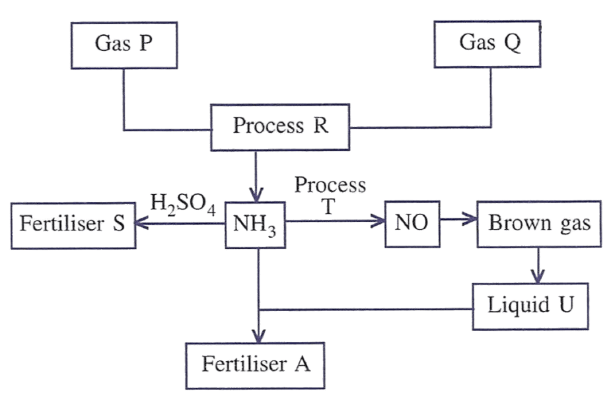
(a) Identify gas P and gas Q.
(b) Give a balanced equation to convert ammonia into gas P by a method other than decomposition. State the property of ammonia used in carrying out the conversion.
(c) Name fertiliser S and give a balanced equation for its preparation.
(d) Name process T and state the conditions that enable conversion of ammonia to nitric oxide.
(e) Give a balanced equation for the conversion of brown gas to liquid U.
(f) Name fertiliser A.
(g) Name process R.
Ammonia
16 Likes
Answer
(a) Gas P — Nitrogen [N2] and Gas Q — Hydrogen [H2]
(b) 2NH3 + 3CuO ⟶ 3Cu + 3H2O + N2 (g)
Ammonia acts as a reducing agent reducing copper oxide to copper and itself is oxidised to nitrogen gas.
(c) Fertiliser S is Ammonium sulphate
2NH3 + H2SO4 ⟶ (NH4)2 SO4
(d) Process T is Ostwald's process Conditions that enable conversion of ammonia to nitric oxide are 800°C temperature and platinum as catalyst.
(e) 4NO2 (g) + H2O (l) + O2 (g) ⟶ 4HNO3 (aq.)
(f) Fertiliser A is Ammonium nitrate.
(g) Process R is the Haber's process.
Answered By
12 Likes
Related Questions
With respect to the manufacture of ammonia, answer the following :
(i) Name the process.
(ii) State the ratio of the reactants taken?
(iii) State the catalyst used.
(iv) Give the equation for the manufacture of the gas ammonia.
The following questions are based on the preparation of ammonia gas in the laboratory:
(i) Explain why ammonium nitrate is not used in the preparation of ammonia.
(ii) Name the compound normally used as a drying agent during the process.
(iii) How is ammonia gas collected? Explain why it is not collected over water.
The diagram shows set up for the lab. preparation of a pungent alkaline gas.
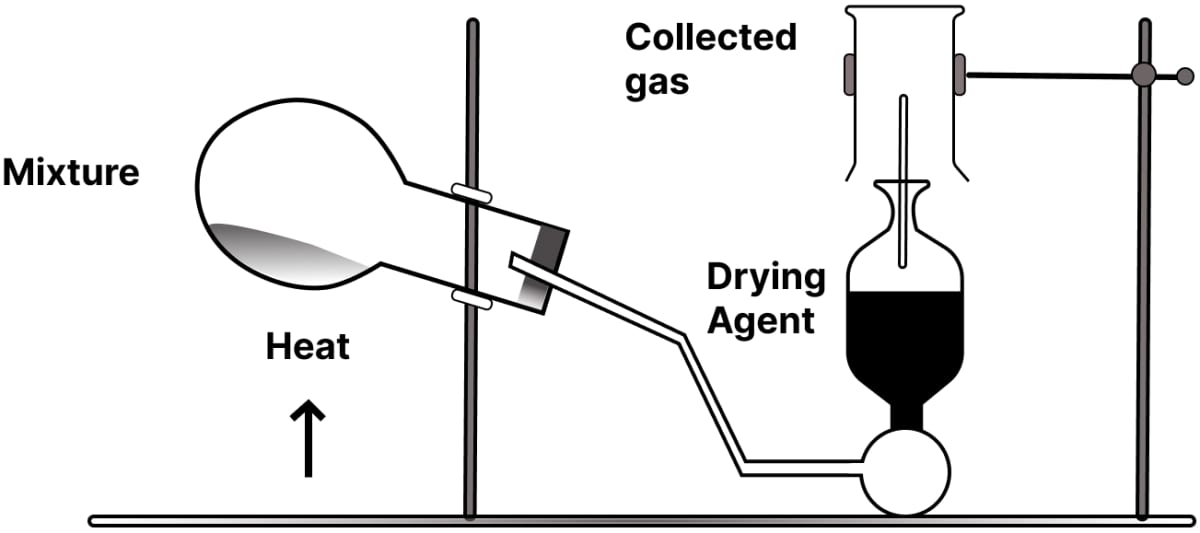
(i) Name the gas collected in the jar.
(ii) Give a balanced equation for the above preparation
(iii) State how the above gas is collected?
(iv) Name the drying agent used.
(v) State how you will find out that the jar is full of the pungent gas?
The diagram given below describes the manufacturing process of a gas.
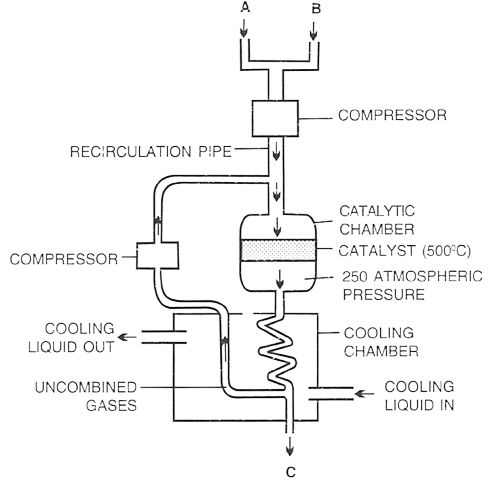
(a) Name the process.
(b) Identify A, B and C.
(c) State the ratio of A and B
(d) Write the equation involved with their respective conditions.
(e) How is the product separated from unreacted reactants ?