
Chemistry
Assertion (A): Iron (II) salt solution when reacted with ammonium hydroxide forms a dirty green precipitate.
Reason (R): Iron salts are brown in colour.
- Both A and R are true and R is the correct explanation of A.
- Both A and R are true but R is not the correct explanation of A.
- A is true but R is false.
- A is false but R is true.
Analytical Chemistry
3 Likes
Answer
A is true but R is false.
Explanation — When Iron (II) salt (Green colour) solution are reacted with ammonium hydroxide, a dirty green insoluble precipitate is formed. Hence the assertion (A) is true.
Iron (II) salts are Green and Iron (III) salts are yellow in colour so reason (R) is false.
Answered By
2 Likes
Related Questions
A student takes Cu, Al, Fe and Zn strips, separately in four test tubes labeled as I, II, III and IV respectively. He adds 10 ml of freshly prepared ferrous sulphate solution to each test tube and observes the colour of the metal residue in each case.
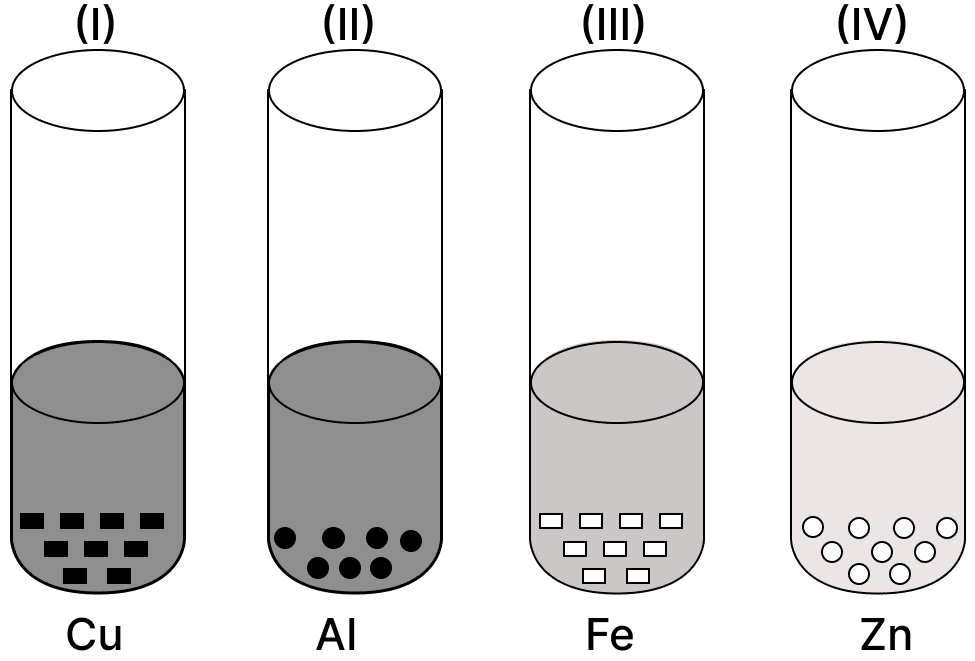
He would observe a black residue in the test tubes:
- (I) and (II)
- (I) and (III)
- (II) and (III)
- (II) and (IV)
Assertion (A): Calcium salt solution does not show any change even after adding an excess of ammonia solution to it.
Reason (R): The low concentration of hydroxide ion in ammonium hydroxide solution which are unable to precipitate the hydroxide ions of calcium
- Both A and R are true and R is the correct explanation of A.
- Both A and R are true but R is not the correct explanation of A.
- A is true but R is false.
- A is false but R is true.
Assertion (A): Hydrogen gas is liberated when metals like Zn, Al, Pb react with caustic alkalies.
Reason (R): Alkalies are soluble in water.
- Both A and R are true and R is the correct explanation of A.
- Both A and R are true but R is not the correct explanation of A.
- A is true but R is false.
- A is false but R is true.
Assertion (A): Oxides of most of the metals are basic in nature.
Reason (R): All metal oxides dissolve in water forming alkalis.
- Both A and R are true and R is the correct explanation of A.
- Both A and R are true but R is not the correct explanation of A.
- A is true but R is false.
- A is false but R is true.