
Mathematics
Case Study I Ritesh bought a new well-furnished two-bedroom flat in a society. The layout of the flat is shown in the figure alongside. The builder claims that the areas of the two bedrooms and the kitchen together is 95 square metres. All the dimensions in the figure are in metre (m).
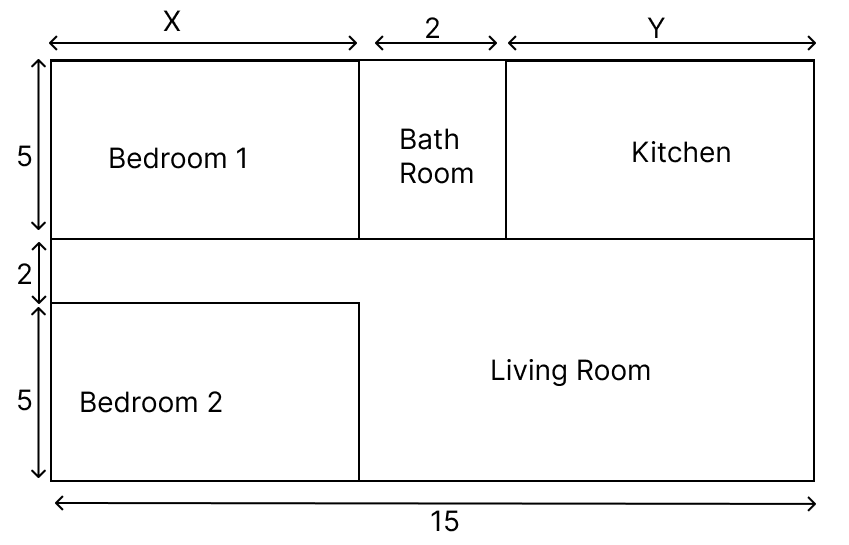
Study the above information and answer the following questions.
Which of the following pair of linear equations represent the given situation?
(a) x + y = 19, 2x + y = 13
(b) x + y = 13, 2x + y = 19
(c) x − y = 19, 2x − y = 13
(d) x + y = 13, 2x − y = 19The perimeter of the outer boundary of the layout is:
(a) 54 m
(b) 27 m
(c) 50 m
(d) 52 mTotal area of bedroom 1 and kitchen is:
(a) 60 m2
(b) 70 m2
(c) 65 m2
(d) 95 m2The area of the living room is:
(a) 50 m2
(b) 60 m2
(c) 70 m2
(d) 75 m2The cost of laying tiles on the floor of the kitchen at the rate of ₹200 per sq m is:
(a) ₹ 7,000
(b) ₹ 6,000
(c) ₹ 5,200
(d) ₹ 5,000
Linear Equations
3 Likes
Answer
1. Given,
From picture,
x = Length of Bedroom 1, y = Length of kitchen
Length of bathroom = 2
Equations:
Length of rectangular flat = x + y + 2
In rectangle, opposites sides are equal.
⇒ x + y + 2 = 15
⇒ x + y = 15 - 2
⇒ x + y = 13 ….(1)
Area = length × breadth
From figure,
Area of each Bedroom = 5 × x
Area of Kitchen = 5 × y
Given,
Area of two bedrooms and kitchen is 95.
⇒ 2 × (5 × x) + 5 × y = 95
⇒ 10x + 5y = 95
⇒ 5(2x + y) = 95
⇒ 2x + y =
⇒ 2x + y = 19
⇒ 2x + y = 19 ….(2)
Subtracting equation (1) from (2), we get :
⇒ 2x + y - (x + y) = 19 - 13
⇒ x = 6 m.
Substituting value of x in equation (1), we get :
⇒ 6 + y = 13
⇒ y = 13 - 6 = 7 m.
Hence, Option (b) is the correct option.
2. From figure,
⇒ Breadth = 15 m
⇒ Length = 5 + 2 + 5 = 12 m
Perimeter = 2(l + b)
= 2(12 + 15)
= 2 × 27
= 54 m.
Hence, Option (a) is the correct option.
3. Given,
Area of bedroom1 = l × b
= x × 5
= 6 × 5
= 30 m2.
Area of kitchen = l × b
= y × 5
= 7 × 5
= 35 m2.
Area of Bedroom 1 + Kitchen = 30 + 35 = 65 m2.
Hence, option (c) is the correct option.
4. From figure,
Area of bedroom 2 = l × b = 5 × x = 5 × 6 = 30 m2.
Area of bedroom2 + living room = l × b
= 15 × 7
= 105 m2.
Area of living room = 105 - area of bedroom2 = 105 - 30 = 75 m2.
Hence, option (d) is the correct option.
5. Given,
Area of kitchen = l × b
= y × 5
= 7 × 5
= 35 m2.
Cost of laying tiles on the floor of the kitchen at the rate of ₹ 200 per sq m = 35 × 200 = ₹ 7,000.
Hence, Option (a) is the correct option.
Answered By
1 Like
Related Questions
42 mangoes are to be distributed among some boys and girls. If each boy is given 3 mangoes, then each girl gets 6 mangoes; and if each boy gets 5 mangoes, then each girl gets 3 mangoes. The number of boys and girls will be :
boys = 4, girls = 6
boys = 6, girls = 4
boys = 7, girls = 3
boys = 3, girls = 7
If ∠A = 2x°, ∠B = (6y + 10)°, ∠C = (2x + y)° and ∠D = (x + 10)° are the angles of a quadrilateral, then the values of x and y will be :
x = 40°, y = 20°
x = 20°, y = 40°
x = 45°, y = 15°
x = 15°, y = 45°
Case Study II
There are two mobile-phone companies – P and Q, that offer different plans. Company P charges a monthly fee of ₹ 40 plus ₹ 0.5 per minute of talk time. Company Q charges a monthly service fee of ₹ 30 plus ₹ 1 per minute of talk time.
Based on this information answer the following questions:
The linear equation which expresses the plan of company P is :
(a) y = 0.5x + 40
(b) y = 40x + 0.5
(c) y = x + 40.5
(d) y = 40 − 0.5xThe linear equation which expresses the plan of company Q is:
(a) y = 30x + 1
(b) y = x + 30
(c) y = x − 30
(d) y = 30x − 1How many minutes of talk time would yield equal expenditure from both companies?
(a) 10 minutes
(b) 15 minutes
(c) 20 minutes
(d) 25 minutesManisha took the plan of company P and used 400 minutes of talk time. She spent:
(a) ₹240
(b) ₹430
(c) ₹220
(d) ₹215If in a month, Anurag wants to use only 300 minutes of talk time, then which company’s plan is better for him?
(a) Company P
(b) Company Q
(c) Both offer the same plan
(d) Can’t be determined
Case Study III
Tanusha went to a bank to withdraw money. She asked the cashier to give her ₹ 100 and ₹ 500 rupee notes only. The cashier agreed. Tanusha got x, ₹ 100-rupee notes and y, 500-rupee notes.Based on this information, answer the following questions.
If Tanusha withdrew ₹ 15,000, then the above information can be represented by the linear equation:
(a) x + 5y = 150
(b) 5x + y = 150
(c) x + 5y + 150 = 0
(d) x + y = 150If she got 54 notes in all, then the above information can be represented by the linear equation:
(a) 100x + 500y = 54
(b) x + y = 54
(c) 500x + 100y = 54
(d) 100x + y = 54If Tanusha withdraws ₹16 000, then which combination of notes might she get?
(a) ₹500 notes = 30, ₹100 notes = 20
(b) ₹500 notes = 25, ₹100 notes = 25
(c) ₹500 notes = 20, ₹100 notes = 30
(d) ₹500 notes = 30, ₹100 notes = 10If she gets twenty 500-rupee notes and twenty-five 100-rupee notes, then the amount she withdraws is:
(a) ₹10,000
(b) ₹11,000
(c) ₹12,000
(d) ₹12,500Can Tanusha withdraw ₹10,050 under the given conditions?
(a) yes
(b) no
(c) can’t say anything
(d) none of these