
Chemistry
Consider the section of the periodic table given below:
| Group numbers | 1A 1 | IIA 2 | IIIA 13 | IVA 14 | VA 15 | VIA 16 | VIIA 17 | O 18 |
|---|---|---|---|---|---|---|---|---|
| Li | D | O | J | Ne | ||||
| A | Mg | E | Si | H | K | |||
| B | C | F | G | L |
Some elements are given in the above table in their own symbol and position in the periodic table, while others [shaded] are shown with a letter. With reference to the table:
(i) Which is the most electronegative?
(ii) How many valence electrons are present in G?
(iii) Write the formula of the compound between B and H.
(iv) In the compound between F and J, what type of bond will be formed?
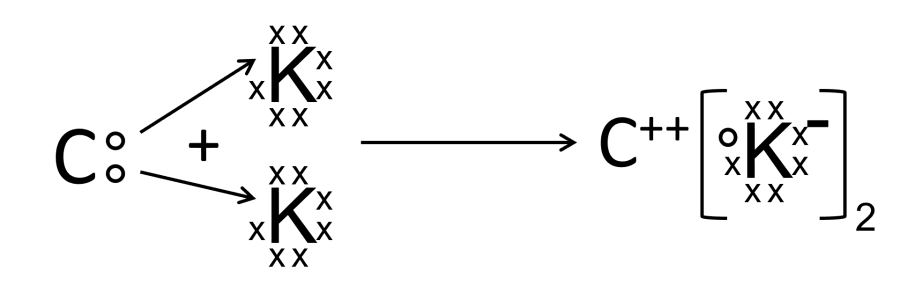
(v) Draw the electron dot structure for the compound formed between C and K.
Periodic Table
177 Likes
Answer
(i) J is the most electronegative.
(ii) G has 5 valence electrons.
(iii) B2H is the name of the compound between B and H.
(iv) Covalent bond will be formed between F and J.
(v) Electron dot structure for the compound formed between C and K is shown below:
Answered By
114 Likes
Related Questions
Give reasons for the following:
Atomic size of an element depends on the nuclear charge of that element.
Give reasons for the following:
Down a group electronegativity should increase with increase in nuclear charge but it is seen that the electronegativity decreases.
Give reasons for the following:
If combining atoms have nearly similar electronegativities the bond between them is covalent.
Arrange the following elements as per the guidelines in brackets.
- Na, Cl, Mg, P [in decreasing order of atomic size]
- C, Li, F, N [in increasing order of electronegativity]
- Cl, Al, Na, S [in increasing order of ionization potential]
- Li, F, C, O [in increasing order of electron affinity]
- Ar, He, Ne [in increasing order of number of electron shells]