
Computer Applications
Define a class to overload the method display() with the following variations:
1. void display() — To display the following pattern:
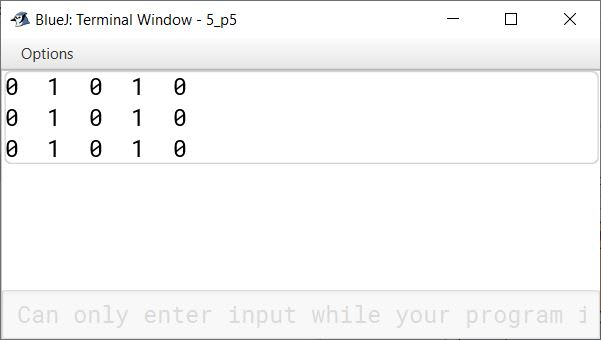
0 1 0 1 0
0 1 0 1 0
0 1 0 1 0
2. int display(int x[]) — To return the smallest element of the array.
Example:
{6, 8, 4, 13, 2, 21}
Smallest element = 2
3. void display(double a, char b) — To calculate and display the area of circle if b is 'C' otherwise calculate and display the area of square if b is 'S'. For any other value of b print "Invalid operation".
Area of circle = πr2
Area of square = side2
public class KboatDisplay
{
    void display() {
        _______(1)_________
            _______(2)_________
                _______(3)_________
                    System.out.print("0  ");
                } else {
                    System.out.print("1  ");
                }
            }
            System.out.println();
        }
    }

    _______(4)_________ {
        int min = x[0];
        _______(5)_________
            _______(6)_________
                min = x[i];
            }
        }
        return min;
    }

    _______(7)_________ {
        _______(8)_________ {
            double area = Math.PI * a * a;
            System.out.println("Area of Circle: " + area);
        } _______(9)_________ {
            double area = a * a;
            System.out.println("Area of Square: " + area);
        } else {
            _______(10)_________
        }
    }
}
User Defined Methods
1 Like
Answer
for (int i = 0; i < 3; i++) {for (int j = 0; j < 5; j++) {if (j % 2 == 0) {int display(int x[])for (int i = 1; i < x.length; i++) {if (x[i] < min) {void display(double a, char b)if (b == 'C' || b == 'c')else if (b == 'S' || b == 's')System.out.println("Invalid operation");
Explanation
public class KboatDisplay
{
    void display() {
        for (int i = 0; i < 3; i++) {
            for (int j = 0; j < 5; j++) {
                if (j % 2 == 0) {
                    System.out.print("0  ");
                } else {
                    System.out.print("1  ");
                }
            }
            System.out.println();
        }
    }

    int display(int x[]) {
        int min = x[0];
        for (int i = 1; i < x.length; i++) {
            if (x[i] < min) {
                min = x[i];
            }
        }
        return min;
    }

    void display(double a, char b) {
        if (b == 'C' || b == 'c') {
            double area = Math.PI * a * a;
            System.out.println("Area of Circle: " + area);
        } else if (b == 'S' || b == 's') {
            double area = a * a;
            System.out.println("Area of Square: " + area);
        } else {
            System.out.println("Invalid operation");
        }
    }
}
Variable Description Table
Method: void display()
| Variable Name | Data Type | Purpose |
|---|---|---|
i | int | Loop counter variable for controlling the number of rows in the pattern (3 rows). |
j | int | Loop counter variable for controlling the number of columns in the pattern (5 columns). |
Method: int display(int x[])
| Variable Name | Data Type | Purpose |
|---|---|---|
x | int[] | Array of integers from which the smallest element is to be found. |
min | int | Stores the smallest value found in the array x. Initialized with the first element of the array. |
i | int | Loop counter variable for iterating through the array elements starting from the second element. |
Method: void display(double a, char b)
| Variable Name | Data Type | Purpose |
|---|---|---|
a | double | Represents the radius of the circle if b is 'C' or 'c', or the side length of the square if b is 'S' or 's'. |
b | char | Determines the operation to perform: 'C' or 'c' for calculating the area of a circle, 'S' or 's' for calculating the area of a square, otherwise triggers an invalid operation message. |
area | double | Stores the calculated area of the circle or square based on the value of b. |
Program Explanation
Let's take a closer look at this Java program to understand how it works:
void display() Method:
- This variation of the
display()method is parameterless and is responsible for printing a specific pattern. - The method uses nested
forloops to achieve this pattern output. The outer loop runs three times (ifrom 0 to 2), which corresponds to the three lines of output. - The inner loop runs five times (
jfrom 0 to 4) on each iteration of the outer loop, printing either "0" or "1" followed by two spaces, depending on whether the current indexjis even or odd. - If the index
jis even, "0 " is printed; if odd, "1 " is printed. This creates the alternating pattern "0 1 0 1 0" on each line. System.out.println()is used at the end of each iteration of the outer loop to move to the next line after completing a pattern line.
int display(int x[]) Method:
- This method takes an integer array as its parameter and returns the smallest element in the array.
- Initially, it assumes that the first element
x[0]is the smallest (min = x[0]). - It iterates over the array elements starting from the second element (
ifrom 1 tox.length-1). - For each element, it compares the current element
x[i]with the current minimummin. - If an element
x[i]is smaller than the current minimum,minis updated to this element. - At the end of the loop,
mincontains the smallest element of the array, which is then returned.
void display(double a, char b) Method:
- This method accepts two parameters: a double
a, and a characterb. - It performs different calculations based on the value of the character
b. - If
bis 'C' or 'c', the method calculates the area of a circle using the formula πa² (Math.PI * a * a) and prints it. - If
bis 'S' or 's', it calculates the area of a square using the formula a², and then prints the result. - For any other character value of
b, it prints "Invalid operation", indicating that the input character is not one of the expected options ('C' or 'S').
Output


Answered By
2 Likes
Related Questions
Method prototype for the method compute which accepts two integer arguments and returns true/false.
- void compute (int a, int b)
- boolean compute (int a, int b)
- Boolean compute (int a,b)
- int compute (int a, int b)
Define a class to overload the method perform as follows:
double perform (double r, double h) — to calculate and return the value of curved surface area of cone
void perform (int r, int c) — Use NESTED FOR LOOP to generate the following format
r = 4, c = 5
output
1 2 3 4 5
1 2 3 4 5
1 2 3 4 5
1 2 3 4 5void perform (int m, int n, char ch) — to print the quotient of the division of m and n if ch is Q else print the remainder of the division of m and n if ch is R
Assertion (A): Static method can access static and instance variables.
Reason (R): Static variable can be accessed only by static method.
- Assertion and Reason both are correct.
- Assertion is true and Reason is false.
- Assertion is false and Reason is true.
- Assertion and Reason both are false.