
Physics
The diagrams given below show two sound boxes A and B with wires of same length (l) and tension (10 kgf) but different cross-sectional areas. Simultaneously, vibrating tuning forks of frequency 300 Hz are placed on the boxes A and B. The paper rider falls off in case of B but not in case of A.
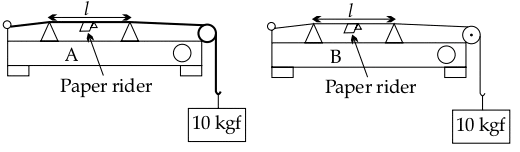
(a) Name and explain the phenomenon responsible for the falling off of the paper rider in B.
(b) The wire A resonates with a tuning fork of frequency ‘f’. Is ‘f’ greater than, less than or equal to 300 Hz? Justify your answer.
Sound
29 Likes
Answer
(a) The phenomenon responsible for falling off the paper rider is resonance.
Resonance is a special case of forced vibrations. When the frequency of the externally applied periodic force on a body is equal to its natural frequency, the body readily begins to vibrate with an increased amplitude. This phenomenon is known as resonance.
(b) A thicker wire will vibrate at a lower resonant frequency than a thinner wire if the length, tension, and material are unchanged. This is because the thicker wire has greater mass per unit length, which lowers its natural frequency of vibration. Therefore, the frequency will be less than 300 Hz.
Answered By
15 Likes
Related Questions
Draw a block and tackle system of pulleys with velocity ratio equal to 3.
A submarine in the sea, sends ultrasonic ping and a stopwatch is started simultaneously. The stopwatch stops on receiving the reflected wave from an obstacle and reads 1 minute 40 seconds. Calculate the distance of the obstacle from the submarine (Speed of sound in water 1500 ms-1)
The diagram shows wiring in a meter room of a building.
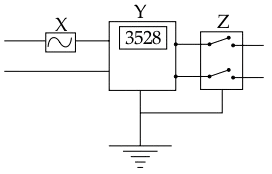
(a) What is the current rating of device X?
(b) What is the difference between the switch Z shown in the diagram and the switches you use to operate different appliances at home?
(c) What is the unit of the physical quantity displayed in Y?
Study the diagram given below and answer the questions that follow :
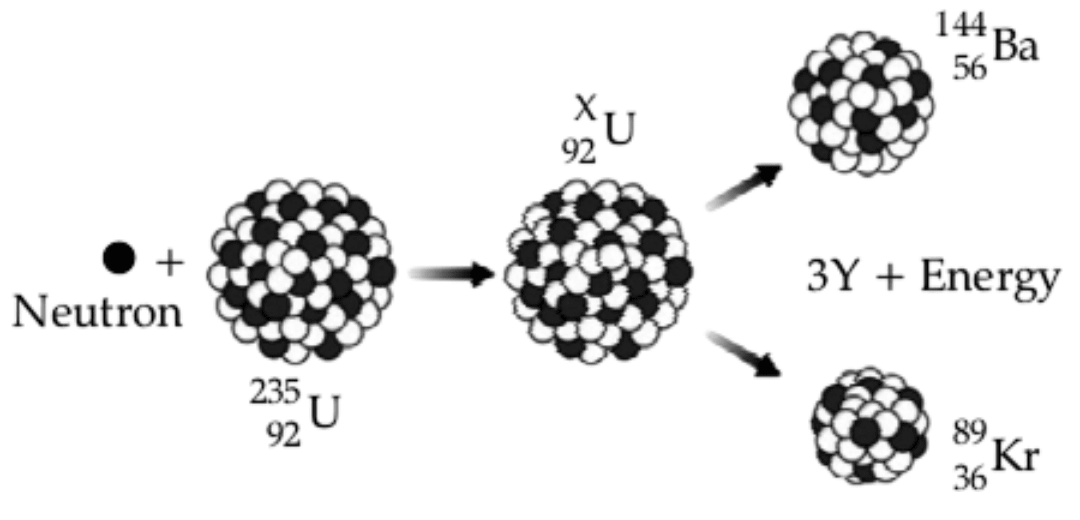
(a) Name the process depicted in the diagram.
(b) What is the value of X?
(c) Identify Y, the missing product of the reaction.