Mathematics
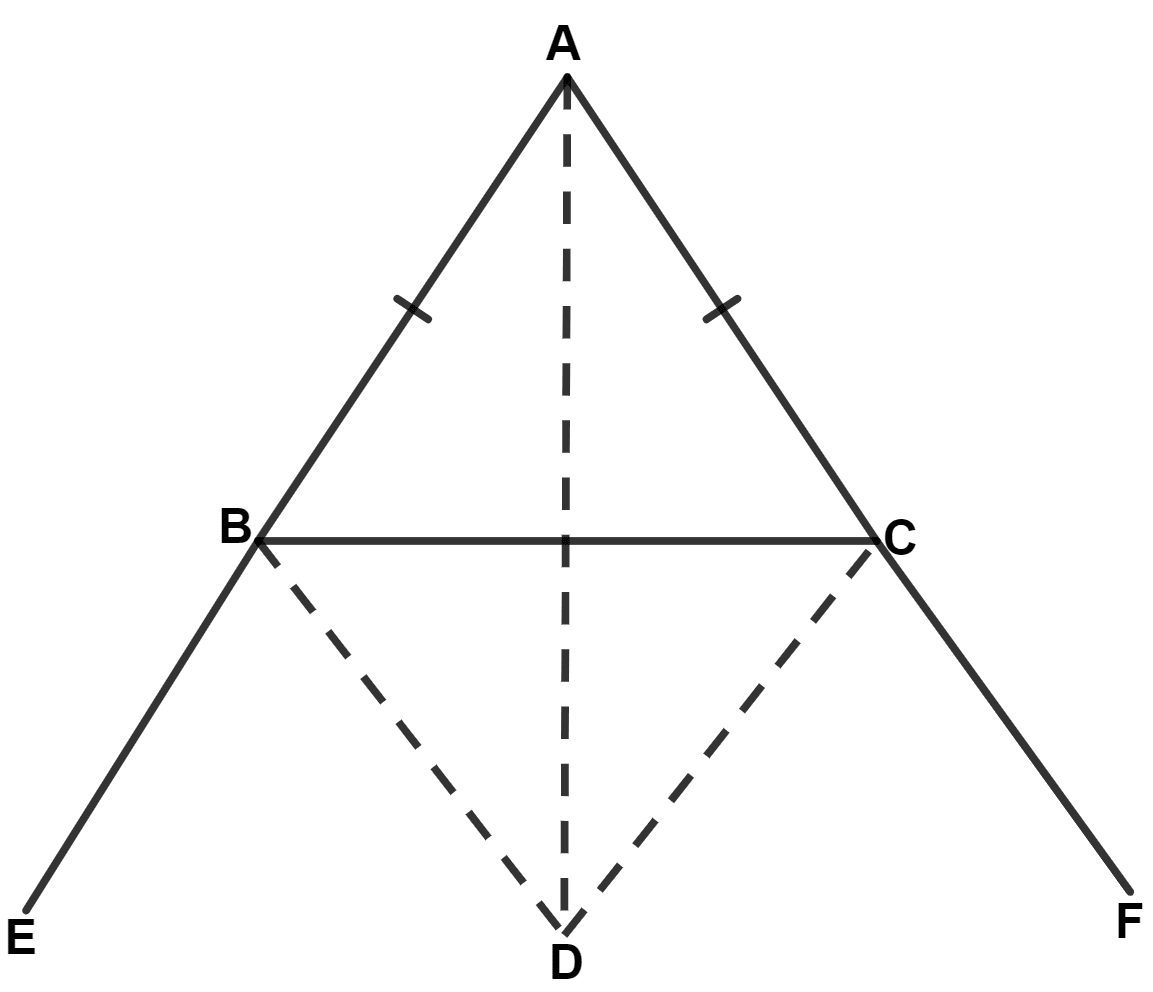
Equal sides AB and AC of an isosceles triangle ABC are produced. The bisectors of the exterior angles so formed meet at D. Prove that AD bisects angle A.
Triangles
7 Likes
Answer
ABC is an isosceles triangle and AB is produced to E and AC is produced to F. BD and CD are bisectors of angle CBE and angle BCF respectively.
In Δ ABC,
⇒ AB = AC (Given)
⇒ ∠ACB = ∠ABC (Angles opposite to equal sides are equal)
Since, ABE is a straight line.
∴ ∠ABC + ∠CBE = 180°
⇒ ∠CBE = 180° - ∠ABC
Since, BD is bisector of ∠CBE,
Since, ACF is a straight line.
∴ ∠BCF + ∠ACB = 180°
⇒ ∠BCF = 180° - ∠ACB
Since, CD is bisector of ∠BCF,
From equations (1) and (2), we get :
⇒ ∠CBD = ∠BCD.
In △ BCD,
⇒ BD = CD (Sides opposite to equal angles are equal)
In △ ABD and △ ACD,
⇒ AB = AC (Given)
⇒ BD = CD (Proved)
⇒ AD = AD (Common side)
∴ △ ABD ≅ △ ACD (By S.S.S. axiom)
We know that,
Corresponding sides of congruent triangle are equal.
∴ ∠BAD = ∠CAD (By C.P.C.T.C.)
Hence, proved that AD bisects ∠A.
Answered By
4 Likes
Related Questions
In quadrilateral ABCD, side AB is the longest and side DC is the shortest. Prove that :
(i) ∠C > ∠A
(ii) ∠D > ∠B
In triangle ABC, side AC is greater than side AB. If the internal bisector of angle A meets the opposite side at point D, prove that : ∠ADC is greater than ∠ADB.
In isosceles triangle ABC, sides AB and AC are equal. If point D lies in base BC and point E lies on BC produced (BC being produced through vertex C), prove that :
(i) AC > AD
(ii) AE > AC
(iii) AE > AD
Given : ED = EC
Prove : AB + AD > BC.