
Physics
Find out and write about the different types of levers.
Machines
2 Likes
Answer
Levers are classified into three categories :
Class I lever
- In class I lever, the fulcrum is between the effort and the load.
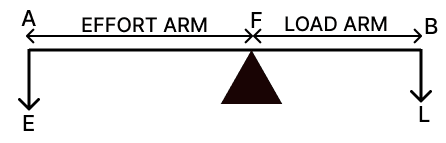
- A class I lever always changes the direction of force, i.e., applying a downward force (effort) on the lever results in an upward movement of the load.
- The mechanical advantage of class I lever can be greater than, equal to or less than 1.
- Scissors, pliers, crow bar, oars of a rowing boat and see-saw are some examples of class I lever.
Class II lever
- In class II lever, the load is between the fulcrum and the effort.
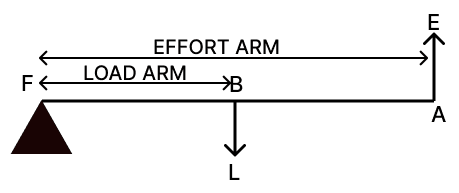
- The effort arm is always longer than the load arm. Therefore, the mechanical advantage is always greater than 1 (MA > 1). Hence, it is used as a force multiplier.
- Some examples of class II lever are bottle opener, wheel barrow and nutcracker.
Class III lever
- In class III lever, the effort is between the fulcrum and the load.
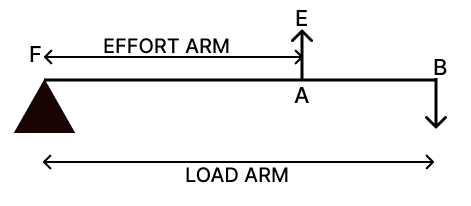
- Here the effort arm is smaller than the load arm. That is the input effort (E) is higher than the load (L). Therefore, its mechanical advantage is smaller than 1 (MA < 1). However, the distance moved by the load is greater than the distance moved by the effort. Hence, it is used as a speed multiplier.
- Tongs, fishing rod, knife and broom are some examples of class III lever.
Answered By
1 Like
Related Questions
What are complex machines?
Look around you, name five machines (simple and complex) that make your work easier.
Name one object around you that is getting work done and one object around you where work done is zero.
Construct a lever using your stationery. What is the effort, load and fulcrum in this case?