
Chemistry
Give equations for the reduction of :
(a) Copper oxide
(b) Iron (III) oxide
(c) Lead (II) oxide
(d) Zinc oxide
Metallurgy
58 Likes
Answer
(a) Reduction of Copper oxide
(b) Reduction of Iron (III) oxide
(c) Reduction of Lead (II) oxide
(d) Reduction of Zinc oxide
Answered By
33 Likes
Related Questions
Write the equation for the reaction that occurs at the cathode during the extraction of aluminium by electrolysis.
Explain why it is preferable to use a number of graphite electrodes as anode instead of a single electrode, during the above electrolysis.
The following is an extract from 'Metals in the Service of man, Alexander and street/Pelican 1976'.
'Alumina (aluminium oxide) has a very high melting point of over 2000°C so that it cannot readily be liquefied. However, conversion of alumina to aluminium and oxygen, by electrolysis, can occur when it is dissolved in some other substance'.
(i) Which solution is used to react with bauxite as a first step in obtaining pure aluminium oxide?
(ii) The aluminium oxide for the electrolytic extraction of aluminium is obtained by heating aluminium hydroxide. Write the equation for this reaction.
(iii) Name the element which serves both as the anode and the cathode in the extraction of aluminium.
(iv) Write the equation for the reaction that occurs at the cathode during the extraction of aluminium by electrolysis.
(v) Give the equation for the reaction which occurs at the anode when aluminium is purified by electrolysis.
The following is a sketch of an electrolytic cell used in the extraction of aluminium :
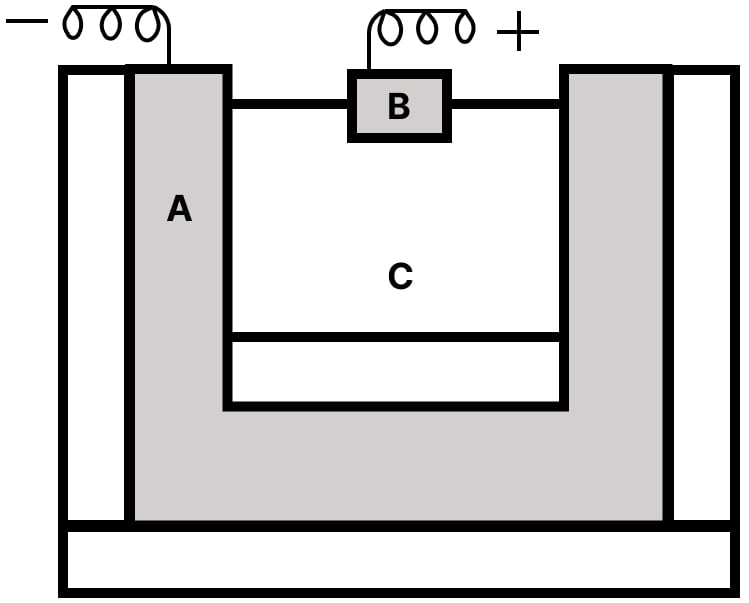
(i) What is the substance of which the electrodes A and B are made?
(ii) At which electrode (A or B) is the aluminium formed ?
(iii) What are the two aluminium compounds in the electrolyte C ?
(iv) Why is it necessary for electrode B to be continuously replaced ?