
Science
Illustrate the law of conservation of energy by discussing the energy changes which occur when we draw a pendulum bob to one side and allow it to oscillate. Why does the bob eventually come to rest? What happens to its energy eventually? Is it a violation of the law of conservation of energy?
Work, Energy & Power
19 Likes
Answer
The law of conservation of energy states that energy can only be converted from one form to another; it can neither be created or destroyed. The total energy before and after the transformation remains the same.
Refer the figure of an oscillating pendulum bob shown below:
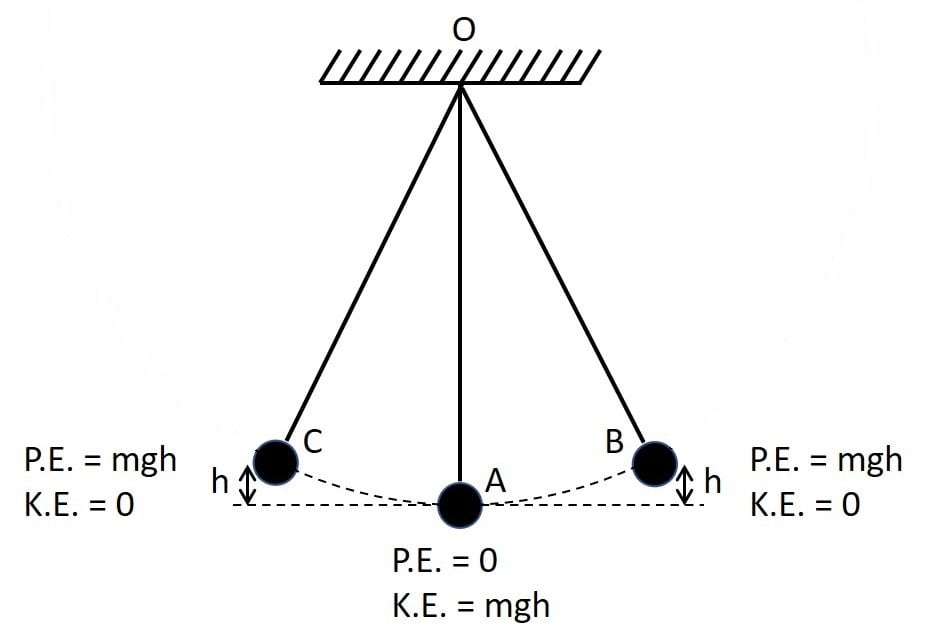
The kinetic energy decreases and the potential energy becomes maximum at B.
After a moment the the to and fro movement starts again.
So, from B to A, again the potential energy changes into kinetic energy and this process repeats again and again.
So, when the bob is in its state of to and fro movement it has potential energy at the extreme position B or C and kinetic energy at resting position A.
It has both the kinetic energy and potential energy at an intermediate position. However, the sum of kinetic and potential energy remain same at every point of movement.
The bob will eventually come to rest due to the frictional resistance offered by air on the surface of bob and pendulum loses its kinetic energy to overcome this friction and finally comes to rest.
The law of conservation of energy is not violated because the kinetic energy lost by the pendulum to overcome the friction is gained by surroundings. Hence, total energy of the system will remain conserved.
Answered By
15 Likes
Related Questions
A person holds a bundle of hay over his head for 30 minutes and gets tired. Has he done some work or not? Justify your answer.
An electric heater is rated 1500 W. How much energy does it use in 10 hours?
An object of mass, m is moving with a constant velocity, v. How much work should be done on the object in order to bring the object to rest?
Calculate the work required to be done to stop a car of 1500 kg moving at a velocity of 60 kmh-1.