Mathematics
In an equilateral triangle ABC; points P, Q and R are taken on the sides AB, BC and CA respectively such that AP = BQ = CR. Prove that triangle PQR is equilateral.
Triangles
7 Likes
Answer
Given,
ABC is an equilateral triangle.
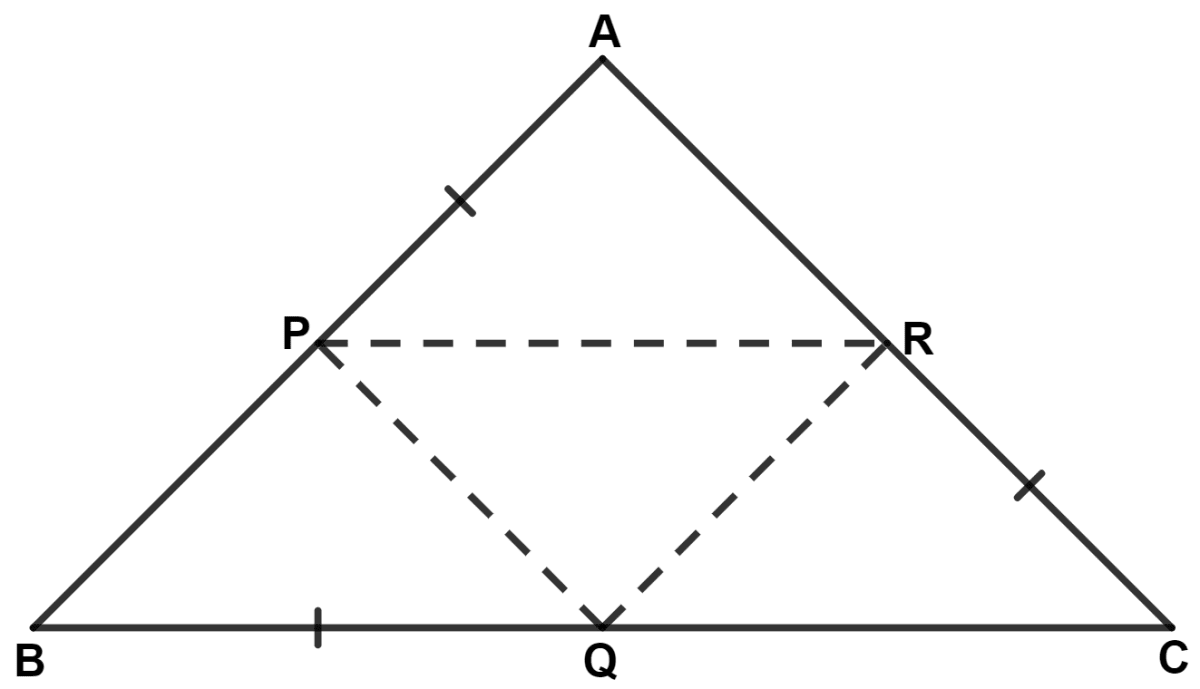
∴ AB = BC = CA ……..(1)
Given,
⇒ AP = BQ = CR ……….(2)
Subtracting equation (2) from (1), we get :
⇒ AB - AP = BC - BQ = CA - CR
⇒ BP = CQ = AR ……….(3)
Since, ABC is an equilateral triangle,
∴ ∠A = ∠B = ∠C ……..(4)
In △ BPQ and △ CQR,
⇒ BP = CQ [From equation (3)]
⇒ ∠B = ∠C [From equation (4)]
⇒ BQ = CR [Given]
∴ △ BPQ ≅ △ CQR (By S.A.S. axiom)
We know that,
Corresponding parts of congruent triangle are equal.
⇒ PQ = QR …….(5)
In △ CQR and △ APR,
⇒ CQ = AR [From equation (3)]
⇒ ∠C = ∠A [From equation (4)]
⇒ CR = AP [Given]
∴ △ CQR ≅ △ APR (By S.A.S. axiom)
∴ QR = PR (By C.P.C.T.C.) ……..(6)
From equation (5) and (6),
PQ = QR = PR.
Hence, proved that PQR is an equilateral triangle.
Answered By
3 Likes
Related Questions
In quadrilateral ABCD, side AB is the longest and side DC is the shortest. Prove that :
(i) ∠C > ∠A
(ii) ∠D > ∠B
In triangle ABC, side AC is greater than side AB. If the internal bisector of angle A meets the opposite side at point D, prove that : ∠ADC is greater than ∠ADB.
In isosceles triangle ABC, sides AB and AC are equal. If point D lies in base BC and point E lies on BC produced (BC being produced through vertex C), prove that :
(i) AC > AD
(ii) AE > AC
(iii) AE > AD
Given : ED = EC
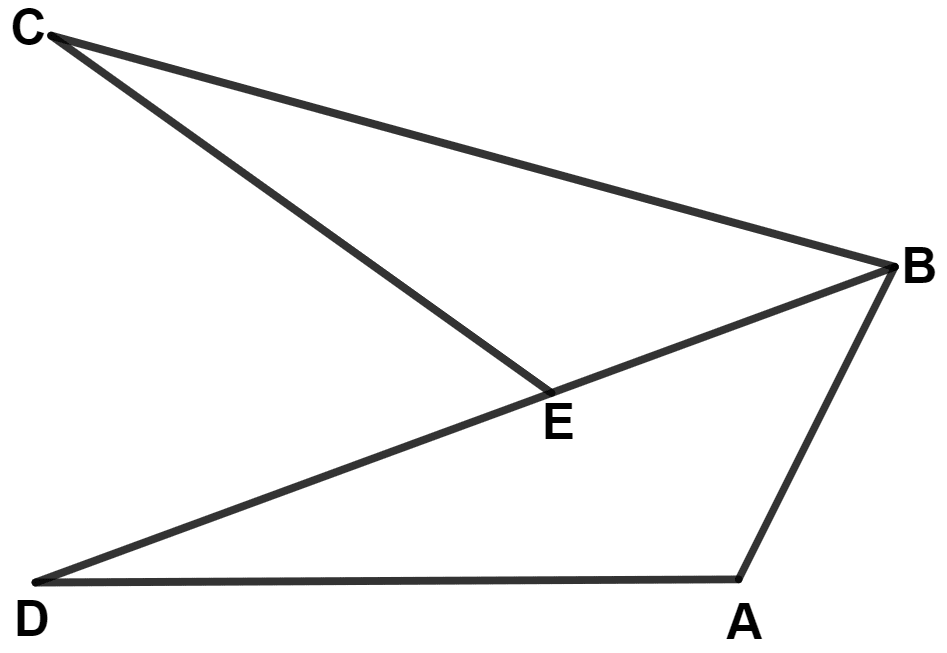
Prove : AB + AD > BC.