
History & Civics
Read the excerpt given below and answer the questions that follow:
“Long years ago we made a tryst with destiny and now the time comes, when we shall redeem our pledge, not wholly or in full measure, but very substantially. At the stroke of the midnight hour, when the world sleeps, India will awake to life and freedom… It is fitting that at this solemn moment we take the pledge of dedication to the service of India and her people and to the still large cause of humanity.”
—Tryst with Destiny Speech by Pt. Jawaharlal Nehru
(a) What happened at the stroke of midnight hour? Which unending quest is Jawaharlal Nehru talking about in the excerpt? Who all strived to end this quest?
(b) Where and when did Jawaharlal Nehru made this historic speech? Name any two famous dignitaries present there?
(c) Name the British Act that led to Jawaharlal Nehru’s speech. State three features of this Act.
India Independence
35 Likes
Answer
(a) At the stroke of the midnight hour, India gained independence from the British rule. The unending quest that Jawaharlal Nehru is talking about in the excerpt is the struggle for India’s independence. Many people strived to end this quest, including freedom fighters, political leaders, and the general public of India
(b) Jawaharlal Nehru made this historic speech, known as the “Tryst with Destiny” speech, on the eve of India’s Independence, towards midnight on 14 August, 1947. He delivered the speech to the Indian Constituent Assembly in the Parliament. Two famous dignitaries present there were Lord Mountbatten and Lady Edwina Mountbatten.
(c) The British Act that led to Jawaharlal Nehru’s speech was the Indian Independence Act of 1947. This Act led to the partition of British India into the two new independent dominions of India and Pakistan. Three features of this Act were:
- It ended British rule in India.
- It provided for the partition of India into two independent dominions, India and Pakistan.
- It granted complete legislative authority upon the respective Constituent Assemblies of the new countries.
Answered By
23 Likes
Related Questions
The attempt of the British to pacify the Congress and the Muslim League was clearly visible in the Cabinet Mission proposals but in reality neither could be pleased. With reference to this, explain:
(a) Any three proposals of the Cabinet Mission.
(b) The reasons for the Muslim League's acceptance and later rejection of the Cabinet Mission Plan.
(c) Why did the Congress refuse to participate in the formation of the Interim Government under the Cabinet Mission Plan?
With reference to the newspaper article answer the questions that follow:
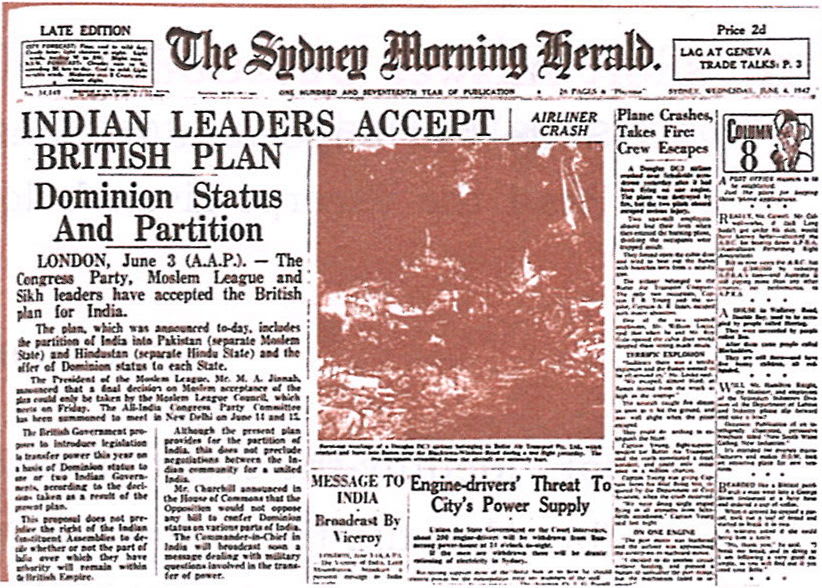
(a) Which Plan is referred to in the given newspaper article? State any two features of this Plan.
(b) How was the Plan supposed to solve the communal problem existing in India?
(c) Why did the Congress accept the Plan? State three reasons to justify its acceptance.
A number of Acts were passed by the British to pacify the demands of the Indians relating to the Government of India. But the Independence Act, 1947 is considered as a unique piece of legislation. Why is it so? Give reasons to support your answer.
Do you think that the Congress had no alternative but to accept the Mountbatten Plan? Support your answer with examples.