
Physics
A rectangular glass block of refractive index 1.5 has an air bubble trapped inside it as shown in the diagram. When seen from the surface AB, it appears to be 4 cm deep.
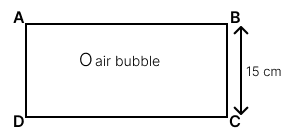
(a) Calculate the actual depth of the air bubble from the surface AB.
(b) For which colour of light, blue or yellow, the apparent depth will be greater?
(c) Turning the glass block upside down, DOES NOT change the apparent depth of the air bubble. State True or False.
Refraction Plane Surfaces
27 Likes
Answer
(a) Given,
Refractive index of glass = 1.5
Apparent depth of air bubble = 4 cm
As,
So, actual depth of the air bubble from the surface AB is 6 cm.
(b) As,
Now, apparent depth will increase, if refractive index decreases and as wavelength increases, refractive index decreases. As wavelength of yellow light is greater than wavelength of blue light so, refractive index for yellow light is smaller than refractive index of blue light.
Hence, for yellow light apparent depth will be greater.
(c) When the block is turned upside down, then the real depth of the bubble is 15 – 6 = 9 cm
And,
So, the statement is false.
Answered By
15 Likes
Related Questions
Curium is a radioactive element with the symbol named in honour of Madam Curie. The graph of number of protons vs number of neutrons for some elements are shown below :
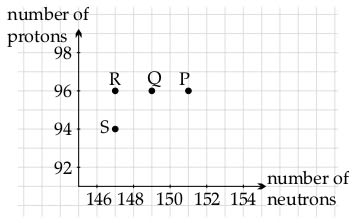
(a) Which point on the graph indicates the element Cm?
(b) Which point on the graph indicates daughter nucleus after Cm undergoes radioactive decay of 1α followed by 2β?
(c) State the mass number of the daughter nucleus.
(a) Out of the three rays (I, J, H) shown in the diagram, which ray will suffer Total Internal Reflection while inside the prism? (Critical angle of the prism is 42°.)
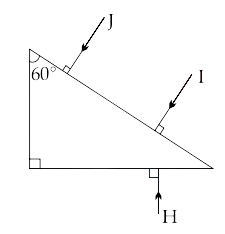
(b) Copy the diagram to complete the path of the ray which you have named in (a) till it comes out of the prism.
(a) An object is placed at 2F position of a convex lens. Draw a ray diagram showing the formation of the image.
(b) How will the size of the image change if we, ONLY replace the lens in the above arrangement with another lens of a greater focal length?
An object is placed in front of a concave lens at a distance of 45 cm from it. If its image is formed at a distance of 30 cm from the lens, calculate the focal length of the lens.