
Mathematics
Sides AB and AC of a triangle ABC are equal. BC is produced through C upto point D such that AC = CD. D and A are joined and produced (through vertex A) upto point E. If angle BAE = 108°; find angle ADB.
Triangles
7 Likes
Answer
In △ ABD,
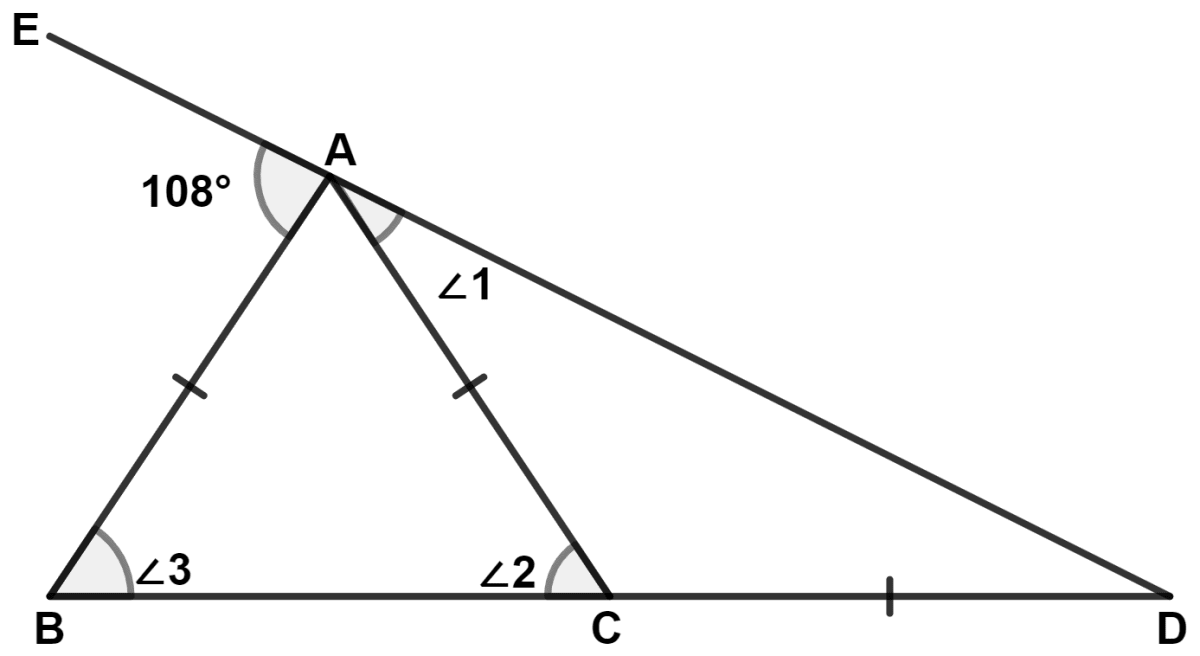
⇒ ∠BAE = ∠3 + ∠ADB (An exterior angle is equal to sum of two opposite interior angles)
⇒ 108° = ∠3 + ∠ADB …..(1)
Given,
⇒ AB = AC
∴ ∠3 = ∠2 (Angles opposite to equal sides are equal)
Substituting value of ∠3 from above equation in (1), we get :
⇒ 108° = ∠2 + ∠ADB ………..(2)
In △ ACD,
⇒ ∠2 = ∠1 + ∠ADC (An exterior angle is equal to sum of two opposite interior angles)
⇒ ∠2 = ∠1 + ∠ADB ……….(3)
Given,
⇒ AC = CD
∴ ∠1 = ∠ADC (Angles opposite to equal sides are equal)
⇒ ∠1 = ∠ADB
Substituting above value of ∠1 in (3), we get :
⇒ ∠2 = ∠ADB + ∠ADB
⇒ ∠2 = 2∠ADB
Substituting above value of ∠2 in (2), we get :
⇒ 108° = 2∠ADB + ∠ADB
⇒ 108° = 3∠ADB
⇒ ∠ADB = = 36°.
Hence, ∠ADB = 36°.
Answered By
5 Likes
Related Questions
In triangle ABC, side AC is greater than side AB. If the internal bisector of angle A meets the opposite side at point D, prove that : ∠ADC is greater than ∠ADB.
In isosceles triangle ABC, sides AB and AC are equal. If point D lies in base BC and point E lies on BC produced (BC being produced through vertex C), prove that :
(i) AC > AD
(ii) AE > AC
(iii) AE > AD
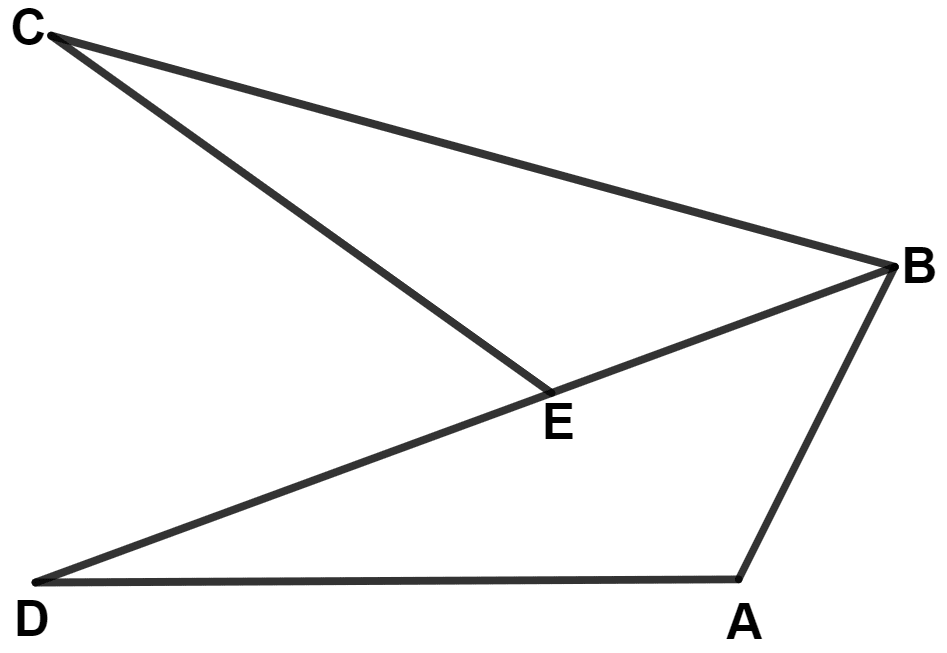
Given : ED = EC
Prove : AB + AD > BC.
A ladder manufacturing company manufactures a foldabel step ladder as shown below :
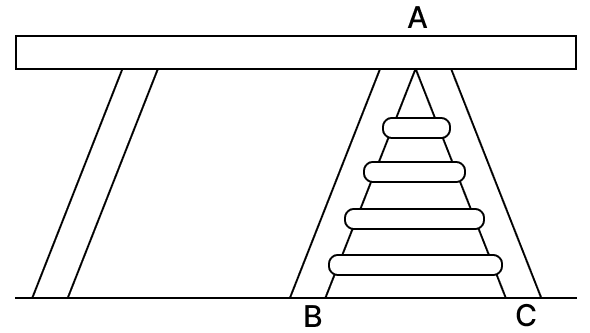
The lengths of legs AB and AC are 120 cm each.
(i) If vertical ∠BAC = 36°, what is the ratio of ∠BAC and ∠ACB ?
(ii) (a) If vertical ∠BAC = 60°, what is the length of BC?
(b) Which type of triangle is △ABC ?