
Chemistry
State why aluminium is extracted from it's oxide by electrolysis while copper, lead, iron by reducing agents and mercury and silver by thermal decomposition.
Metallurgy
46 Likes
Answer
Oxides of highly active metals like potassium, sodium, calcium, magnesium and aluminium have great affinity towards oxygen and so cannot be reduced by common reducing agents like carbon, carbon monoxide or hydrogen.
They are obtained by electrolytic reduction of fused metallic salts (halides and oxides) using inert electrodes.
The metals in the middle of the activity series such as iron, lead, copper, etc., are moderately reactive and are found as sulphides or carbonates in nature. They are obtained by the reduction of their oxides with carbon, carbon monoxide and hydrogen.
Mercury and silver are very less reactive, placed in the end of the reactivity series. The oxides of these metals are reduced to metals by heating alone.
Answered By
30 Likes
Related Questions
An ore on being heated in air forms sulphurous anhydride. Write the process used for the concentration of this ore.
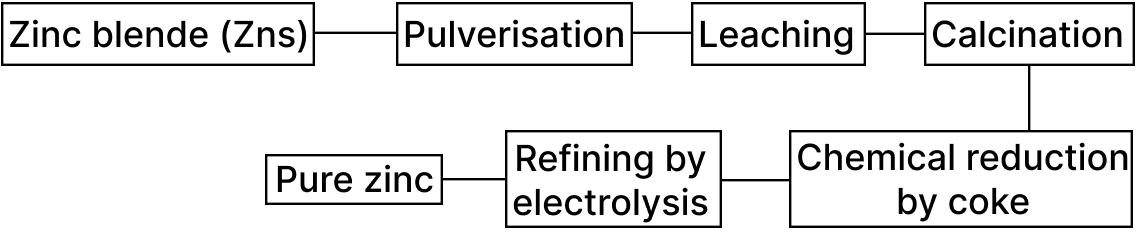
The following flow chart shows the process of extraction of zinc. Out of the 5 steps, 2 steps are incorrect. Identify and correct them.
How are the metals like sodium, potassium and calcium obtained. Give equations.
(a) On which factors does purification of metals depend?
(b) Name the methods used for purification.
(c) With a labelled diagram explain electro-refining of a particular metal.