
Mathematics
The cross-section of a railway tunnel is a rectangle 6 m broad and 8 m high surmounted by a semi-circle as shown in the figure. The tunnel is 35 m long. Find the cost of plastering the internal surface of the tunnel (excluding the floor) at the rate of ₹ 2.25 per m2.

Mensuration
5 Likes
Answer
Given,
Breadth of tunnel (b) = 6 m
Height of tunnel (h) = 8 m
Length of tunnel (l) = 35 m
Let radius of semi-circle be r meters.
From figure,
⇒ 2r = 6
⇒ r = 3 m.
Circumference of semi-circle = πr = m.
Internal surface area of tunnel = Circumference of semi-circle × Length + Area of side interior rectangular walls
= πrl + hl + hl
= πrl + 2hl
=
= 330 + 560
= 890 m2.
Given,
Rate of plastering = ₹ 2.25 per m2.
Total cost = 890 × ₹ 2.25 = ₹ 2002.50.
Hence, cost of plastering internal surface area of tunnel = ₹ 2002.50
Answered By
2 Likes
Related Questions
A conical tent is to accommodate 77 persons. Each person must have 16 m3 of air to breathe. Given the radius of the tent as 7 m, find the height of the tent and also its curved surface area.
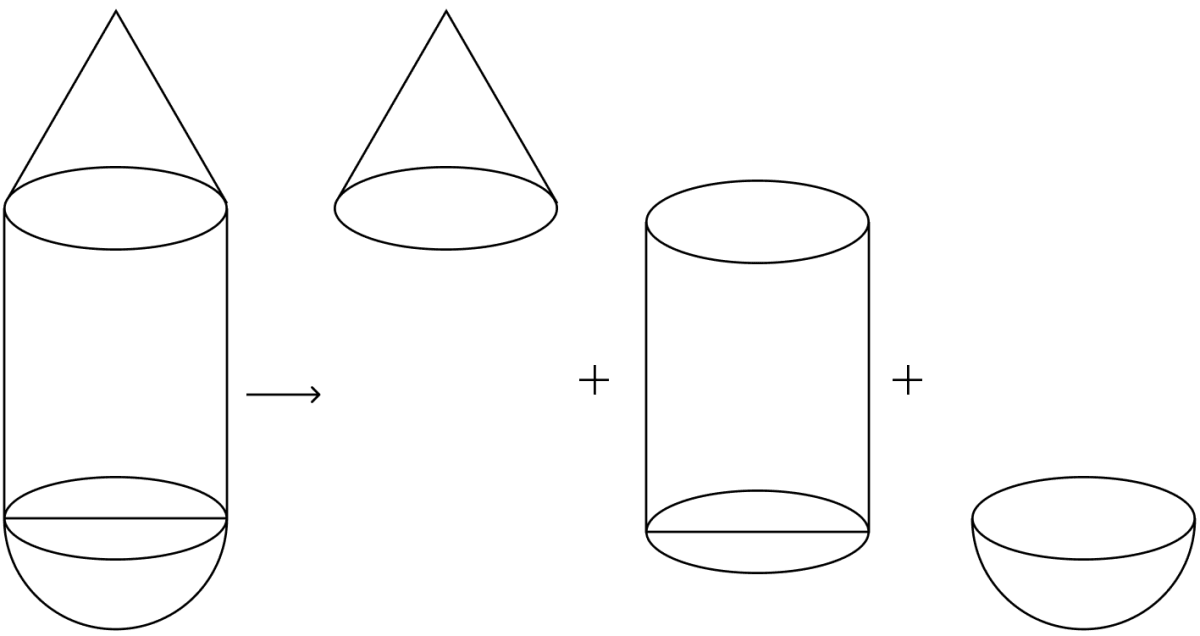
A metallic solid cylinder has one end surmounted by a cone of the same radius and a hemisphere, which is also of same radius as that of the cone. The conical portion, the cylindrical portion and the hemispherical portion are separated as shown below. If the radius of the given solid is r cm and the height of the cone = the height of the cylinder = h cm, find expression for the total surface area of the three parts obtained.
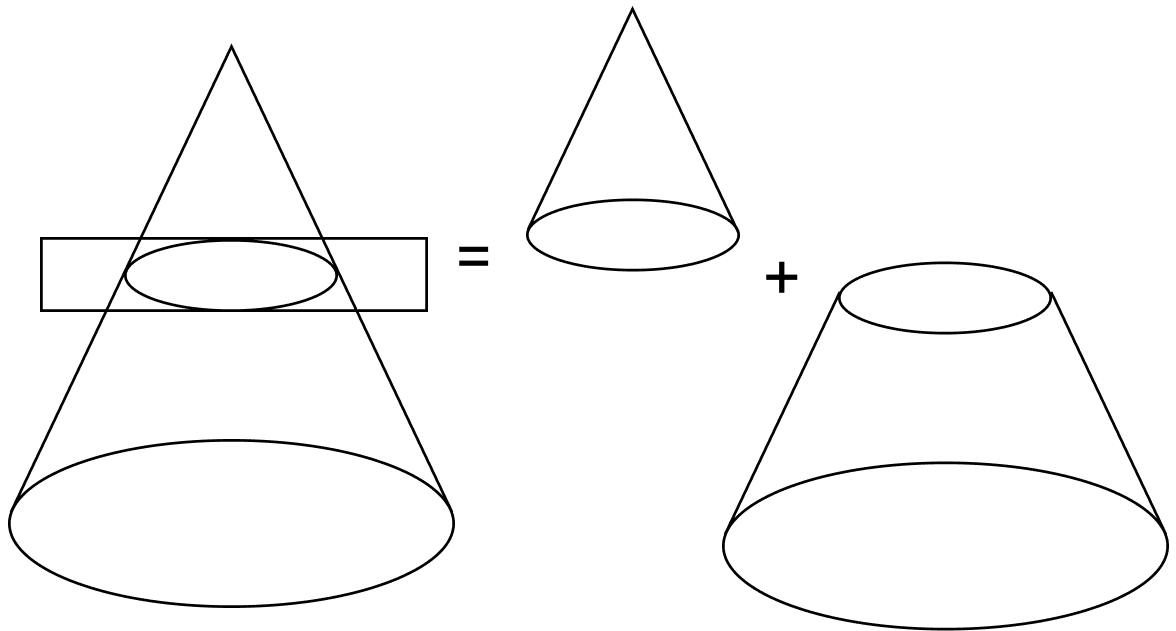
A solid cone of radius 20 cm is cut from its middle, parallel to its base, into two parts as shown. Find :
The ratio between the volumes of the two parts obtained.
In the given figure, ABCDE represents the bowl of a concrete mixer. ABDE can be a part of a cone FDB as shown below where radius OD = 30 cm, OP = 20 cm and PF = 1 m.
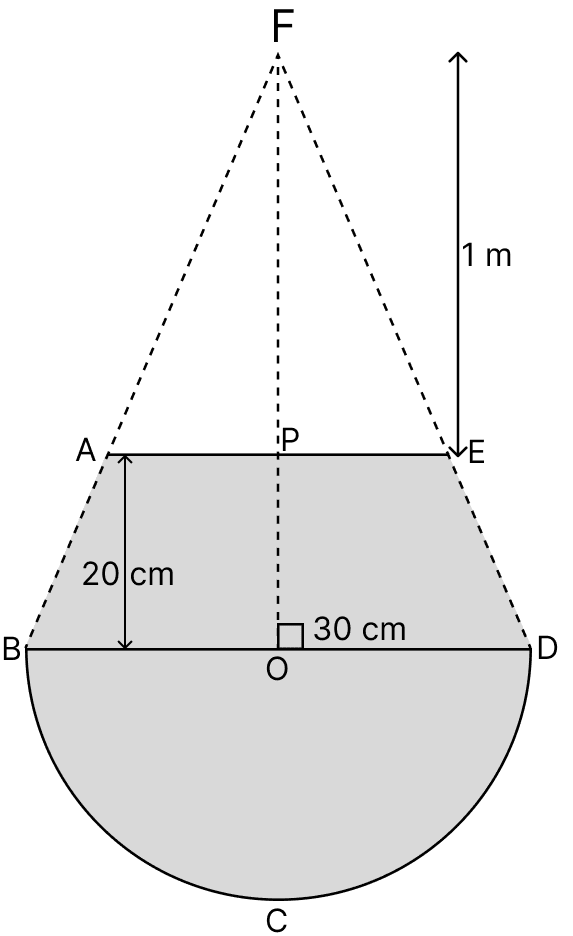
(i) Calculate the value of PE using similarity of triangles.
(ii) Calculate the volume of the part with cross-section ABDE.
(iii) Calculate the volume of the whole concrete mixer to the nearest litre.