
Biology
The diagram below shows two test-tubes A and B. Test-tube A contains a green water plant. Test-tube B contains both a green water plant and a snail. Both test-tubes are kept in sunlight. Answer the questions that follow:

(a) Name the physiological process that releases the bubbles of oxygen.
(b) Explain the physiological process as mentioned above in (a).
(c) What is the purpose of keeping a snail in test-tube B?
(d) Why does test-tube 'B' have more bubbles of oxygen?
(e) Give an example of a water plant that can be used in the above experiment.
Photosynthesis
44 Likes
Answer
(a) Photosynthesis releases bubbles of oxygen.
(b) Photosynthesis is a physiological process by which plant cells containing chlorophyll produce food in the form of carbohydrates by using carbon dioxide, water and light energy. Oxygen is released as a by-product.
(c) The purpose of keeping a snail in test-tube 'B' is to increase the rate of photosynthesis by increasing the concentration of carbon dioxide.
(d) The plant in test tube B has more concentration of CO2 available because the snail releases CO2 during respiration. This increases the rate of photosynthesis in the plant placed in test tube B which leads to the release of more amount of oxygen.
(e) Elodea or Hydrilla.
Answered By
35 Likes
Related Questions
Given below is the diagram of an experimental set-up:

a. What is the objective of this experiment?
b. Will it work satisfactorily? Given reason.
c. What alteration (s) will you make in it for obtaining expected result?
d. Would you take any step before starting the experiment? Describe this step and explain its necessity.
Draw a neat diagram of the stomatal apparatus found in the epidermis of leaves and label the Stoma, Guard cells, Chloroplast, Epidermal cells, Cell wall and Nucleus.
Given below is the diagram of an experimental set-up (final stage). Study the same and answer the following questions :

(a) What is the main aim of the experiment?
(b) Oxygen gas shown in the experiment is released from which of the raw materials ?
(c) How would you confirm the presence of oxygen gas?
(d) Name the chemical substance which can be added in water to enhance the process/rate of release of oxygen gas.
(e) Draw a neat and labelled diagram of the same experiment for its initial stage.
Given below are figures (A) and (B) showing open and closed stomatal apertures respectively.
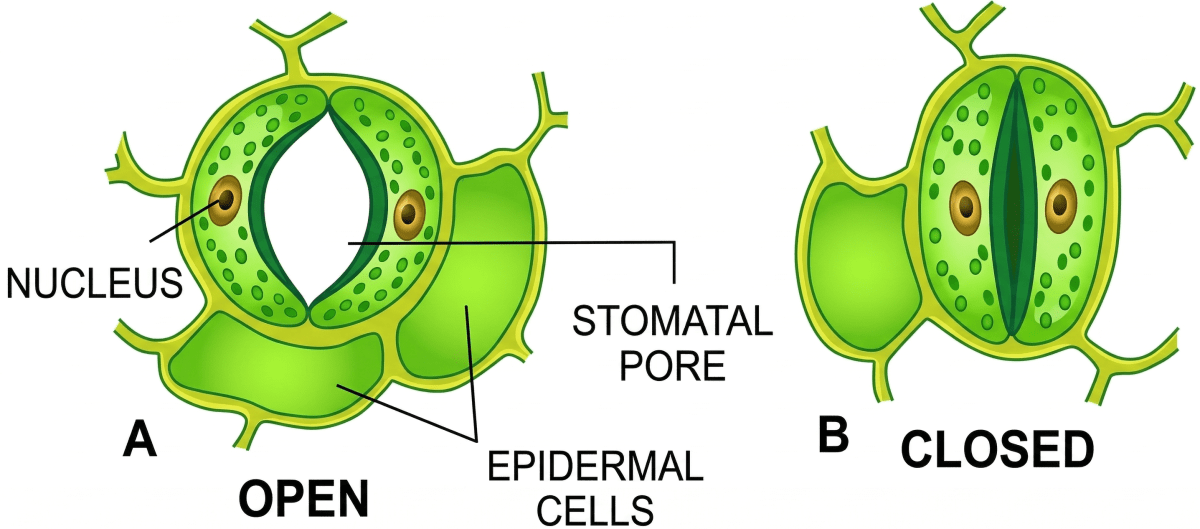
Answer the questions that follow :
(a) When do these stomata open (day/night) ?
(b) What is the condition of the guard cells when the stomata are open (turgid/flaccid) ?
(c) Name the gas taken in and released out through these pores during photosynthesis.
(d) Name the cells of the lower epidermis that contain chloroplasts.
(e) Write two characteristic features of both the inner and outer walls of the guard cells.