
Physics
What are the three types of lever? Explain with diagrams and examples.
Machines
3 Likes
Answer
Three types of lever :
Class I lever
- In class I lever, the fulcrum is between the effort and the load.
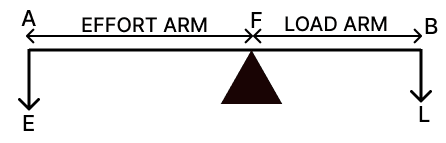
- A class I lever always changes the direction of force, i.e. applying a downward force (effort) on the lever results in an upward movement of the load.
- The mechanical advantage of class I lever can be greater than, equal to or less than 1.
- Scissors, pliers, crow bar, oars of a rowing boat and see-saw are some examples of class I lever.
Class II lever
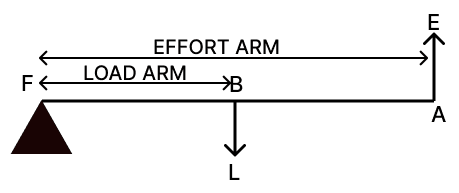
- In class II lever, the load is between the fulcrum and the effort.
- The effort arm is always longer than the load arm. Therefore, the mechanical advantage is always greater than 1 (MA > 1). Hence, it is used as a force multiplier.
- Some examples of class II lever are bottle opener, wheel barrow and nutcracker.
Class III lever
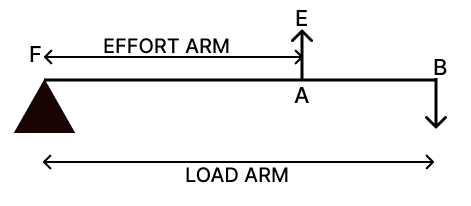
- In class III lever, the effort is between the fulcrum and the load.
- The effort arm is smaller than the load arm so that the input effort is higher than the load. Therefore, its mechanical advantage is smaller than 1 (MA < 1). However, the distance moved by the load is greater than the distance moved by the effort. Hence, it is used as a speed multiplier.
- Tongs, fishing rod, knife and broom are some examples of class III lever.
Answered By
1 Like