
Mathematics
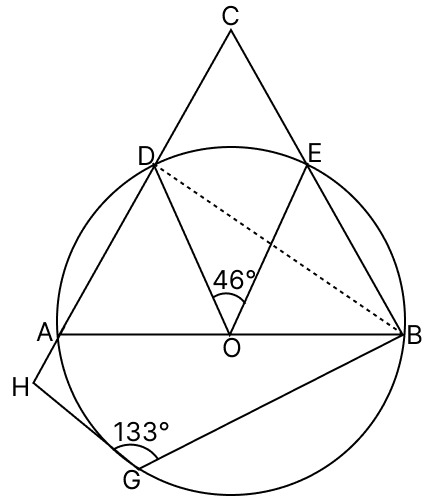
In the adjoining diagram ∠DOE = 46° and ∠BGH = 113°.
(a) Find ∠DBC and ∠DCE.
(b) Prove that CBGH is a cyclic quadrilateral.
Circles
42 Likes
Answer
We know that,
The angle subtended by an arc at the center is double the angle subtended by it at any point on the remaining part of the circle.
∴ ∠DBE = DOE
⇒ ∠DBE = × 46° = 23°
From figure,
⇒ ∠DBC = ∠DBE = 23°.
From figure,
⇒ ∠BDA = 90° [Angle in a semicircle]
⇒ ∠BDC = 180° - ∠BDA [Angles on a straight line]
⇒ ∠BDC = 180° - 90°
⇒ ∠BDC = 90°.
In triangle BDC,
Sum of angles in a triangle = 180°
⇒ ∠BDC + ∠DCB + ∠DBC = 180°
⇒ 90° + ∠DCB + 23° = 180°
⇒ 113° + ∠DCB = 180°
⇒ ∠DCB = 180° - 113°
⇒ ∠DCB = 67°
From figure,
∠DCE = ∠DCB = 67°.
Hence, ∠DBC = 23° and ∠DCE = 67°.
(b) From figure,
⇒ ∠BCH = ∠DCE = 67° [Common angles]
⇒ ∠BGH = 113°
⇒ ∠BGH + ∠BCH = 113° + 67° = 180°.
Since, the sum of opposite sides of quadrilateral is 180°, thus CBGH is a cyclic quadrilateral.
Hence, proved that CBGH is a cyclic quadrilateral.
Answered By
24 Likes
Related Questions
Mr. Rahul deposited ₹ 11,700 in a recurring deposit account for 1 years. The amount deposited by him per month is :
₹ 650
₹ 780
₹ 6,500
₹ 7,800
A retailer purchased an air conditioner (A.C.) for ₹30,000. He marked up its price by 20% and then allows a discount of 10% on the marked price to a customer. If the sale is intra-state and the rate of GST is 28%, find the:
(a) marked price of A.C.
(b) total amount paid by the customer including GST.
(c) tax collected by the central and the state governments respectively.
The table given below shows a record of the weight in kilogram of 200 students of a school.
Weight(kg) Number of students 40 - 45 8 45 - 50 19 50 - 55 24 55 - 60 45 60 - 65 51 65 - 70 31 70 - 75 22 Draw a histogram and find the modal weight.
[Take 2 cm = 5 kg along one axis and 2 cm = 5 students along the other axis]
Prove that :