
Chemistry
Define
(a) Electron affinity.
(b) Catenation.
Periodic Table
1 Like
Answer
(a) The amount of energy released while converting a neutral gaseous isolated atom into a negatively charged gaseous ion (anion) by the addition of electron is called Electron Affinity (E.A.).
(b) The property of self linking of atoms of an element through covalent bonds in order to form straight chains, branched chains and cyclic chains of different sizes is known as catenation.
Answered By
1 Like
Related Questions
What do you see in each of the following reactions:
(a) When excess Ammonia gas is passed through an aqueous solution of Zinc Nitrate.
(b) Copper Sulphate crystals are heated strongly.
(c) Sodium hydroxide is added to Copper Sulphate solution in excess.
The following is a sketch of an electrolytic cell used in the extraction of aluminium :
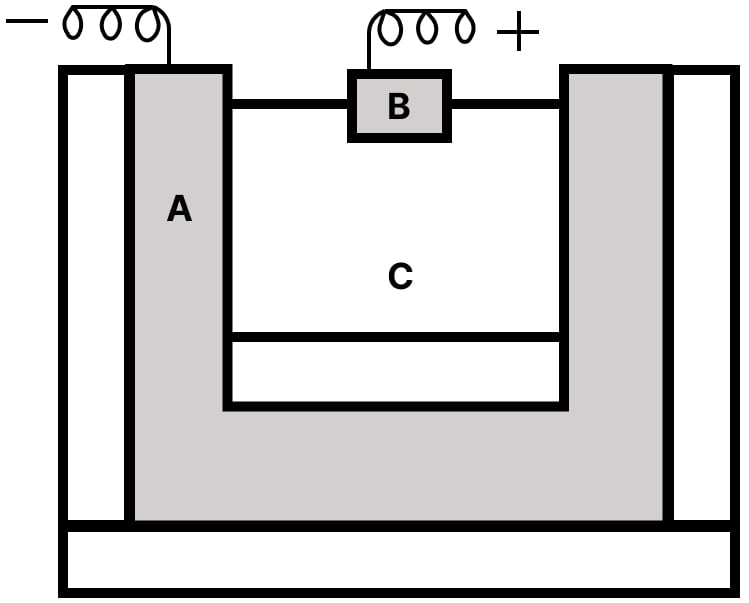
(i) What is the substance of which the electrodes A and B are made?
(ii) At which electrode (A or B) is the aluminium formed ?
(iii) What are the two aluminium compounds in the electrolyte C ?
(iv) Why is it necessary for electrode B to be continuously replaced ?
1250 cc of oxygen was burnt with 300 cc of ethane (C2H6). Calculate the volume of the unused oxygen and the volume of the carbon dioxide formed:
2C2H6 + 7O2 ⟶ 4CO2 + 6H2O
Write a balanced reaction where sulphuric acid shows the following properties:
(a) Oxidising agent
(b) Non Volatile Acid
(c) Dehydrating agent