
Chemistry
What do you see in each of the following reactions:
(a) When excess Ammonia gas is passed through an aqueous solution of Zinc Nitrate.
(b) Copper Sulphate crystals are heated strongly.
(c) Sodium hydroxide is added to Copper Sulphate solution in excess.
Ammonia
3 Likes
Answer
(a) When Ammonia gas is passed through an aqueous solution of Zinc Nitrate:
- A white, gelatinous precipitate of zinc hydroxide, Zn(OH)2, first appears.
Zn(NO3)2 + 2NH4OH ⟶ 2NH4NO3 + Zn(OH)2 ↓ - On passing excess ammonia, the precipitate dissolves and the solution becomes clear and colourless owing to the formation of the soluble tetra-amminezinc(II) complex, [Zn(NH3)4]2+.
(b) The blue crystals of hydrated copper sulphate (CuSO4·5H2O) lose their water of crystallisation, giving off steam and turning into a white powder of anhydrous CuSO4:
(c) Copper(II) sulphate reacts with NaOH to form a blue precipitate of copper(II) hydroxide (Cu(OH)2), which is insoluble in excess NaOH.
CuSO4 + 2NaOH ⟶ Cu(OH)2 ↓ + Na2SO4
Answered By
1 Like
Related Questions
Name a probable cation present based on the following observations:
(a) Green precipitate insoluble in Ammonium Hydroxide.
(b) Gelatinous white precipitate soluble in excess of NaOH solution
Prepare lead sulphate from lead chloride.
The following is a sketch of an electrolytic cell used in the extraction of aluminium :
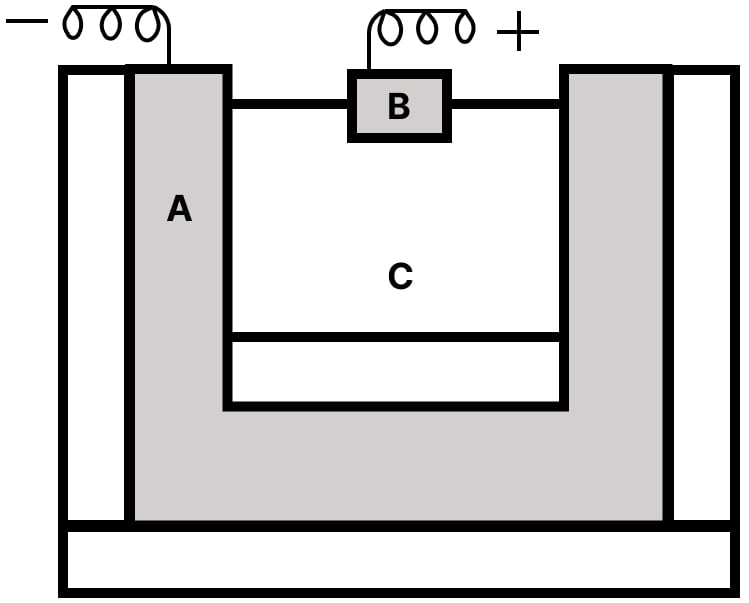
(i) What is the substance of which the electrodes A and B are made?
(ii) At which electrode (A or B) is the aluminium formed ?
(iii) What are the two aluminium compounds in the electrolyte C ?
(iv) Why is it necessary for electrode B to be continuously replaced ?
Define
(a) Electron affinity.
(b) Catenation.