
Physics
The mass of the block P is 5 kg. It is to be moved along an inclined plane AC of length 8 m, which makes an angle of 30° with the horizontal. A force of 50 N is applied on the block to move it through the inclined plane AC, as shown in the diagram.
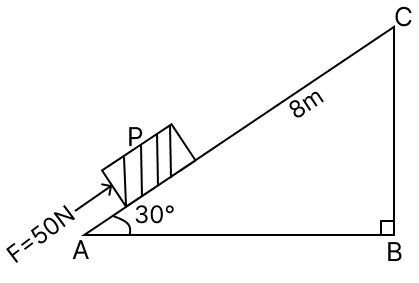
(a) What is the work done by the force along the inclined plane?
(b) Find the gain in potential energy of block P if it is directly lifted to C from the ground. (g = 10 ms-2)
(c) We know that potential energy is gained due to the work done on the body against gravity. Then, in this case, why is the work done on the block and the increase in the potential energy of the block different?
Work, Energy & Power
20 Likes
Answer
(a) W = F x S = 50 x 8 = 400 J
(b) Given, ∠ A = 30 °, AC = 8 cm
in △ABC,
Potential energy gained = mgh = 5 x 10 x 4 = 200 J
(c) This is because while pushing the block along the inclined plane, some energy is wasted to overcome the friction between the block and the inclined plane.
Answered By
9 Likes
Related Questions
Observe the electric circuit below and answer the questions that follow.
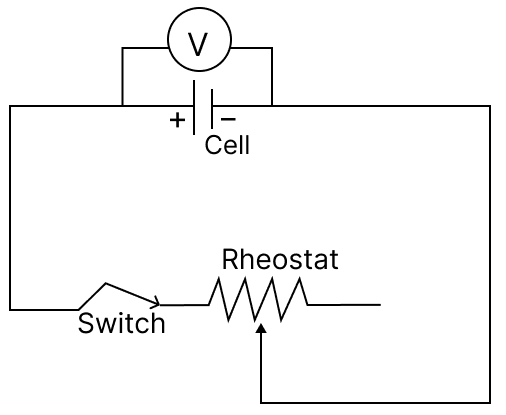
(a) If we increase the current in the above circuit using a rheostat, will the reading of the voltmeter decrease or increase?
(b) Give a reason for your answer in ‘a’.
(c) The present reading of the voltmeter is 2 V, and the current in the circuit is 0.8 A. Calculate the potential drop when the current in the circuit becomes 1 A. Given E = 3 V.
Pavel took an earthen pot which was filled with water up to its brim. The earthen pot was conical in shape and kept with its apex in downward direction.

(a) If the vertical height of the earthen pot is 12 cm, where does its centre of gravity lie?
(b) Pavel poured out all the water from the pot. How will its centre of gravity shift towards the open end or towards its apex?
(c) Pavel wanted to grow a plant in the given pot. So, he filled it completely again with some soil. What will be the new position of its centre of gravity?
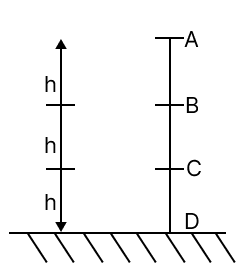
A ball of mass m is dropped freely from point A. It is given that AB = BC = CD = h. If the acceleration due to gravity at the given place is g, then what will be its
(a) potential energy at point A?
(b) kinetic energy at point C?
In a science exhibition, boys of a Secondary school made two types of periscopes. In one of the periscopes, ordinary glass was used as the reflecting material, while in the other, a prism was used. When Anushka put her eyes on the eyepiece of the periscope, she saw that the image formed in one of the periscopes was quite bright, while in the other, it was a little blurred.
(a) In which of the two periscopes, mirror or prism, Anushka saw the image brighter?
(b) Why is one of the images brighter than the other?