
Geography
Picture-based Question.
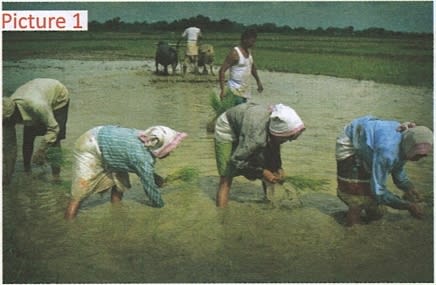
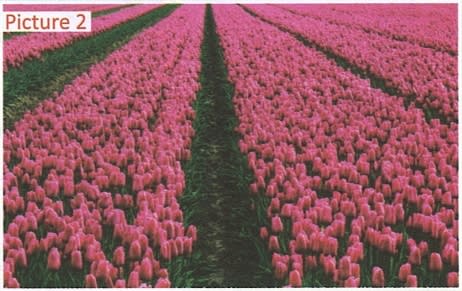
Identify the type of farming shown in:
Picture 1: ……………
Picture 2: ……………Where are these kind of farming practiced?
Picture 1: ……………
Picture 2: ……………Write a brief note describing the farming methods shown in Picture 1 and Picture 2.
Agriculture
2 Likes
Answer
Picture 1: Intensive Farming
Picture 2: Commercial FarmingPicture 1: Monsoon regions of Asia such as India, China, Thailand, Bangladesh and Myanmar
Picture 2: South-east Asian, African and Latin American countries.Picture 1 — Intensive Farming
- This form of farming is practised widely in densely populated regions of the world.
- The size of the farms is small because the farms are usually divided into many parts to satisfy all the members of a large family.
- The fields are cultivated throughout the year—through double cropping, multiple cropping and crop rotation—so that there is enough food for the large family.
- Fields are mostly cultivated manually as they are too small for machines to operate. Moreover, labour is available in plenty and it is difficult for farmers to afford machines. Draft animals such as ox and mule are often used for ploughing the fields or transporting the harvest.
- Food crops such as rice, pulses, wheat, millets and oilseeds are popularly grown.
Picture 2 — Commercial Farming
- Single crop like tulips is grown on a large scale in big farms.
- The entire produce is sold in the market to earn profit.
- It is capital-intensive and aims at producing crops for export.
- Requires skilled labour force.
- Farming is highly mechanised based on the type of crop being cultivated.
Answered By
2 Likes
Related Questions
Across
3 - plants that produce pods with seeds such as peasDown
1 - supply of water to crops through a system of pipes
2 - dead and decomposed remains of organisms that add nutrients to the soil
4 - animal dung used for fertilising soil
Read the passage given below and answer the questions that follow:
Topography refers to the relief features. Levelled landscape always helps in ploughing, irrigating and harvesting crops. Thus, the major farming areas are in the plains. On the other hand, crops such as tea and coffee grow better on hill slopes as they cannot withstand stagnant water. Crops such as rice and jute that require more water are ideally grown in the lowlands. Sometimes broad steps have to be cut on highlands such as mountain slopes, to get the flat terrain required for cultivation of these crops. This is known as terrace cultivation.
- What are the advantages of farming on levelled topography? Which crops can be grown on these?
- Why are tea and coffee grown on hill slopes?
- Why do you think some crops need to be grown on hill slopes?
Why was the Green Revolution not beneficial for all farmers?
Why is there a predominance of food crops in intensive subsistence farming?