
Physics
A scientist lowers a metallic ruler vertically into a transparent oil tank. The ruler touches an object placed at the bottom of the tank and gets wet up to the 25 cm mark. If the refractive index of the glycerin is 1.25:
(a) up to which mark will the ruler get wet, if the scientist lowers it up to the image of the object?
(b) how will this length in (a) change if another liquid of μ > 1.25 is used?
Refraction Plane Surfaces
28 Likes
Answer
(a) Given,
- Actual depth of the object = 25 cm
- Refractive index of the glycerin = μ = 1.25
- The ruler is seen to be touching the object visually, so it is lowered up to the apparent position of the object (i.e., the image due to refraction)
As,
= 20 cm
So, the ruler will get wet up to the 20 cm mark.
(b) As,
Here, apparent depth depends inversely on refractive index (μ) of the medium so if another liquid of μ > 1.25 is used then apparent depth decreases.
Hence, the wet length of the ruler will be less than 20 cm.
Answered By
15 Likes
Related Questions
Advanced optical sensors in air-to-air missiles use fiber optic cables to transmit light signals with minimal loss. This relies on a physical phenomenon that confines light within the fibers, making the system very dependable for guiding the missile precisely.
(a) Name the optical phenomenon that allows light signals to remain confined within the fiber optic cables during transmission.
(b) Explain the two main conditions necessary for this phenomenon to occur.
The diagram below shows a fish in the tank and its image seen in the surface of water.
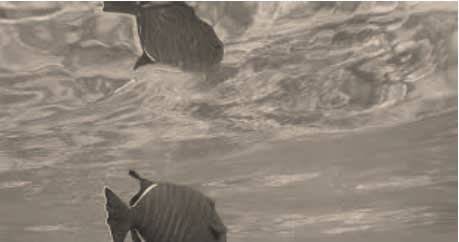
(a) Name the phenomenon responsible for the formation of this image.
(b) A double convex lens with refractive index μ1 inside two liquids of refractive indices μ2 and μ3 are shown in the diagrams below. The refractive indices are such that μ2 > μ1 and μ1 > μ3

How would a parallel incident beam of light refract when it comes out of the lens in each of the cases shown above?
(1) in figure a.
(2) in figure b.
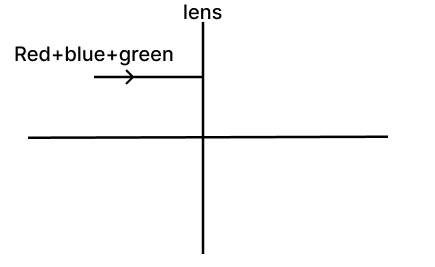
(a) Mixture of red + blue + green is passed through a convex lens as shown in the diagram below. State whether the ray passes through a single point or through different points on the principal axis after refraction.
(b) Name the invisible radiations which are studied using the quartz prism.
(c) State one use of these radiations.
(d) Name one radiation having the wavelength longer than the wavelength of these radiations.
An object is placed at a distance 24 cm in front of a convex lens of focal length 8 cm.
(a) What is the nature of the image so formed?
(b) Calculate the distance of the image from the lens.