
History & Civics
Buddhism spread far and wide without the assistance of sword. With reference to Buddhism answer the following questions:
(a) Explain briefly the main tenet of Buddha's philosophy that afflicts all human beings. Describe the mechanism described by Buddha to attain salvation.
(b) What was impact of Buddhism on the socio-religious life of the people?
(c) What role did Sangha play in the spread of Buddhism?
Jainism & Buddhism
203 Likes
Answer
(a) The main tenet of Buddha's philosophy is the First Noble Truth — "The world is full of suffering." Buddha explained that suffering is univeral, i.e. it affects all human beings through birth, old age, disease, and death.
Buddha explained that a man could attain salvation by following his teachings contained in the Eightfold Path and Four Noble Truths.
Four Noble Truths — The essence of Buddhism lies in Four Noble Truths. They are:
- The world is full of suffering.
- The suffering has a cause.
- Desire is the cause of suffering.
- If desire is stopped, suffering can also be stopped.
Eightfold Path — The way to Nirvana, in Buddhism, or the path that leads to removal of suffering, is known as the Eightfold path. It is also known as Ashtangika Marg or the Middle Path. The Eightfold Path includes:
- Right action — To remain away from theft, luxuries and violence.
- Right thought — To remain away from empty rituals and worldly evils.
- Right belief — To give up desire.
- Right living — Not to have dishonest dealing with others.
- Right speech — Speak the truth and do not think ill of others.
- Right effort — Work for deliverance from sins and for the welfare of others.
- Right recollection — Think about pious things.
- Right meditation — Concentrate on only what is right.
(b) Buddhism led to improvement in social and religious life of people. The hindus started a reform movement within hinduism. The costly yajnas and sacrifice and rigidity of caste system were done with. Buddhism fostered intellectual tradition and exposed the weakness in our society. The weaker section of the society who had been subjected to many atrocities got an opportunity to have their say in matters of political and social life.
(c) Sangha played an important role in the spread of Buddhism as it was established to spread Buddhism and it's teachings. Members of Sangha had to take an oath before joining it. Sangha became very powerful and helped to spread Buddhism far and wide. The members had to follow the ten commandments or Paramita to lead a disciplined life. The Bhikshus and Bhikshunis had to roam around for eight months in a year spreading Buddhism. Many Viharas were made for them to sleep and take rest. In the Viharas, the members led a life of chastity, austerity, devotion and purity.
Answered By
130 Likes
Related Questions
With reference to Jainism answer the following questions:
(a) Who was Mahavira? Why was he called Jina?
(b) State the five vows which a Jain householder has to take.
(c) State the Jains view on Karma and salvation.
With reference to Buddhism, answer the following questions:
(a) Who was Gautama Buddha? How did he achieve enlightenment?
(b) What is known as 'Dharamachakrapravartana'?
(c) Why did Buddha have a large following?
With reference to the given pictures, answer the questions that follow:
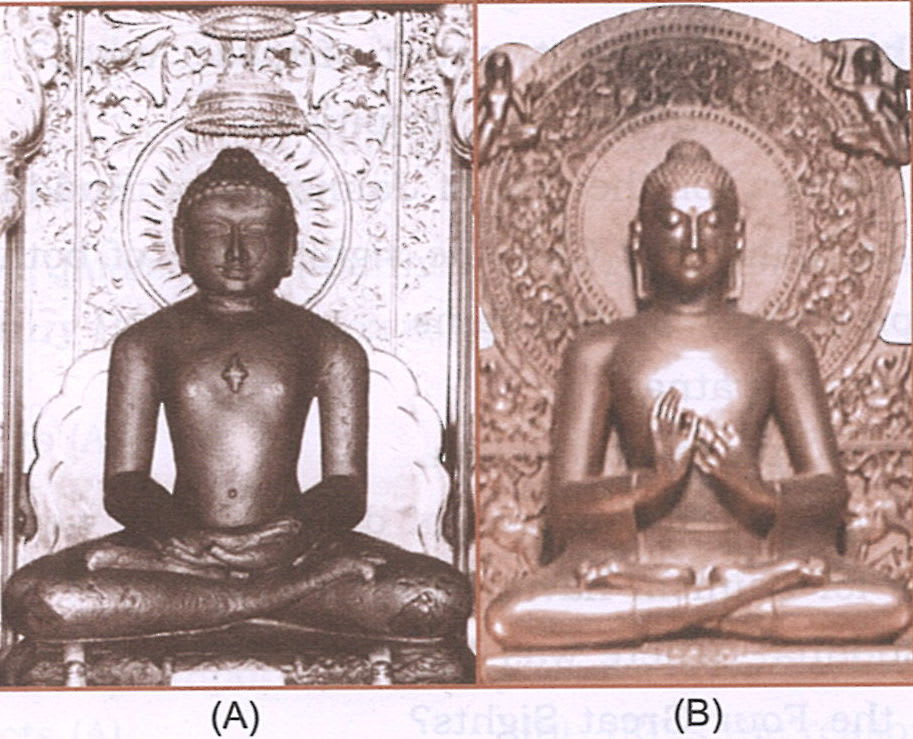
(a) Identify the two preachers, whose images are given. Name the religions founded by them.
(b) Mention three main teachings of each of the two religions founded by these preachers.
(c) Mention any two similarities and two dissimilarities between the two religions founded by them.
The most important precept of Jainism is ahimsa or non-violence. It was popularised by Mahatma Gandhi during India's freedom struggle. Do you think the philosophy of ahimsa is as relevant today as it was in the era of Mahavira?