
History & Civics
With reference to the rise of Capitalism, answer the following questions:
(a) What were the causes for the rise of Capitalism?
(b) What was the impact of Capitalism on the working class?
(c) How did it give rise to Socialism?
Industrial Revolution
120 Likes
Answer
(a) The causes for the rise of Capitalism were:
- Increase in population — People from the rural areas migrated to the urban areas for employment, education, cultural benefits, better freedom and enjoyment.
- Legal Requirement — There was the new enclosure law which required farmers to put fences or hedges around their fields to prevent common grazing on the land. That's why small farmers had to sell their fields as it was expensive to put fences and search for work elsewhere. These factors combined to provide a ready workforce for the new industries.
- Growth of Towns — New manufacturing towns and cities grew dramatically. Many of these cities were located close to the coalfields that supplied fuel to the factories.
- Mass Production — Mass production destroyed the domestic system of production. The growth of industries and use of huge machines gave rise to factories.
- Disappearance of Small Farmers — Small farmers shifted to new industrial towns. They were forced to seek employment in the factories because they were replaced by big landlords.
(b) The impact of Capitalism on the working class is summarised below:
- There was loss of traditional jobs. Women in households earning income from spinning and traditional handloom weavers were impacted as they could no longer compete with mechanised production. Skilled labourers lost their jobs as new machines replaced them.
- People worked long hours under harsh conditions. Factory owners and managers often recruited women and children and paid very low wages.
- Jobs were repetitive and boring. The labourers had to work more than 12 to 14 hours a day and six days a week. Safety was not a matter of concern. They faced strict rules and supervision with their life ruled by the clock.
- Working people moved to cities and cities became over crowded. The working poor lived in crowded areas in the centre of cities in shoddy houses.
- By 1820s, income levels of workers began to improve and people adjusted to the different circumstances and conditions.
(c) The capitalists had their selfish interests and the began to exploit the workers. They paid them low wages and made them work for long hours. They amassed great wealth and began to lead a luxurious life at the cost of the workers. The rich were becoming richer and the poor, still poorer. This gulf went on widening and created social disharmony and ultimately led to rise of Socialism. The evil effects of Capitalism and the spirit of improving the condition of workers gave birth to Socialism.
Answered By
77 Likes
Related Questions
With reference to the picture of a factory given below answer the questions that follow:
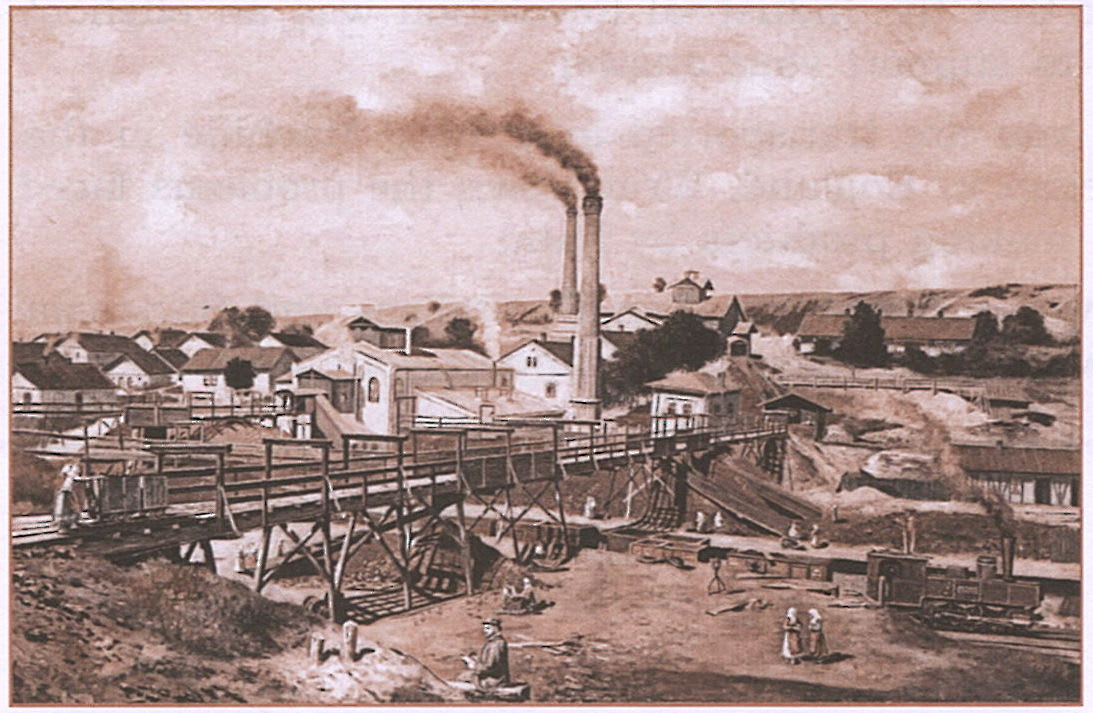
(a) Name the revolution that brought about the existence of this. Where did it begin? Why is it an important event in history?
(b) Explain the two factors responsible for its beginning in that particular country.
(c) Explain how did it lead to the growth of an economic system quite different from the domestic system of production.
The industrial revolution marked a change from handwork to machine work and from domestic system of production to factory system of production. In this context, discuss the role of the following factors in ushering in the Industrial Revolution:
(a) Invention of machines.
(b) Availability of coal and iron.
(c) Improved Transportation.
With reference to Capitalism and Socialism, state the following:
(a) Difference between Capitalism and Socialism in terms of control over means of production and profit.
(b) Two key proponents of Capitalism and Socialism. Give examples of two countries where each economic system is prevalent.
(c) What according to you is better of the two economic systems? Give reasons to support your answer.
With reference to the picture given, answer the following questions:

(a) Identify the person in the picture. Name his long time associate and co-author. Name one famous publication of this person and his associate.
(b) What were the causes for the rise of the economic system propounded by these two individuals?
(c) Briefly describe the type of society they envisioned.