KnowledgeBoat Logo
|
OPEN IN APP

Chapter 7

Factorisation

Class - 10 ML Aggarwal Understanding ICSE Mathematics


Exercise 7

Question 1

Find the remainder (without division) on dividing f(x) by (x - 2) where

(i) f(x) = 5x2 - 7x + 4

(ii) f(x) = 2x3 - 7x2 + 3

Answer

(i) By remainder theorem, on dividing f(x) by (x - a) , remainder = f(a)

∴ On dividing, f(x) = 5x2 - 7x + 4 by (x - 2)

Remainder = f(2)

=5(2)27(2)+4=5(4)14+4=2010=10.= 5(2)^2 - 7(2) + 4 \\[0.5em] = 5(4) - 14 + 4 \\[0.5em] = 20 - 10 \\[0.5em] = 10.

Hence, the value of remainder is 10.

(ii) By remainder theorem, on dividing f(x) by (x - a) , remainder = f(a)

∴ On dividing, f(x) = 2x3 - 7x2 + 3 by (x - 2)

Remainder = f(2)

=2(2)37(2)2+3=2(8)28+3=1628+3=9.= 2(2)^3 - 7(2)^2 + 3 \\[0.5em] = 2(8) - 28 + 3 \\[0.5em] = 16 - 28 + 3 \\[0.5em] = -9.

Hence, the value of remainder is -9.

Question 2

Using remainder theorem, find the remainder on dividing f(x) by (x + 3) where

(i) f(x) = 2x2 - 5x + 1

(ii) f(x) = 3x3 + 7x2 - 5x + 1

Answer

(i) By remainder theorem, on dividing f(x) by (x - a) , remainder = f(a)

∴ On dividing, f(x) = 2x2 - 5x + 1 by (x + 3) or (x - (-3))

Remainder = f(-3)

=2(3)25(3)+1=2(9)+15+1=18+16=34.= 2(-3)^2 - 5(-3) + 1 \\[0.5em] = 2(9) + 15 + 1 \\[0.5em] = 18 + 16 \\[0.5em] = 34.

Hence, the value of remainder is 34.

(ii) By remainder theorem, on dividing f(x) by (x - a) , remainder = f(a)

∴ On dividing, f(x) = 3x3 + 7x2 - 5x + 1 by (x + 3) or (x - (-3))

Remainder = f(-3)

=3(3)3+7(3)25(3)+1=81+63+15+1=2.= 3(-3)^3 + 7(-3)^2 - 5(-3) + 1 \\[0.5em] = -81 + 63 + 15 + 1 \\[0.5em] = -2. \\[0.5em]

Hence, the value of remainder is -2.

Question 3

Find the remainder (without division) on dividing f(x) by (2x + 1) where

(i) f(x) = 4x2 + 5x + 3

(ii) f(x) = 3x3 - 7x2 + 4x + 11

Answer

(i) By remainder theorem, on dividing f(x) by (x - a) , remainder = f(a)

∴ On dividing, f(x) = 4x2 + 5x + 3 by (2x + 1) or 2(x - (-12\dfrac{1}{2}))

Remainder = f(-12\dfrac{1}{2})

=4(12)2+5(12)+3=4(14)52+3=152+3 (On taking L.C.M.)=25+62=32=112.= 4\big(-\dfrac{1}{2}\big)^2 + 5\big(-\dfrac{1}{2}\big) + 3 \\[1em] = 4\big(\dfrac{1}{4}\big) -\dfrac{5}{2} + 3 \\[1em] = 1 - \dfrac{5}{2} + 3 \text{ (On taking L.C.M.)} \\[1em] = \dfrac{2 - 5 + 6}{2} \\[1em] = \dfrac{3}{2} \\[1em] = 1\dfrac{1}{2}.

Hence, the value of remainder is 1 12\dfrac{1}{2}.

(ii) By remainder theorem, on dividing f(x) by (x - a) , remainder = f(a)

∴ On dividing, f(x) = 3x3 - 7x2 + 4x + 11 by (2x + 1) or 2(x - (-12\dfrac{1}{2}))

Remainder = f(12)\big(-\dfrac{1}{2}\big)

=3(12)37(12)2+4(12)+11=3(18)7(14)2+11=3874+9=314+728=558=678= 3\big(-\dfrac{1}{2}\big)^3 - 7\big(-\dfrac{1}{2}\big)^2 + 4\big(-\dfrac{1}{2}\big) + 11 \\[1em] = 3\big(-\dfrac{1}{8}\big) - 7\big(\dfrac{1}{4}\big) - 2 + 11 \\[1em] = -\dfrac{3}{8} - \dfrac{7}{4} + 9 \\[1em] = \dfrac{-3 - 14 + 72}{8} \\[1em] = \dfrac{55}{8} \\[1em] = 6\dfrac{7}{8}

Hence, the value of remainder is 6786\dfrac{7}{8}.

Question 4

Using remainder theorem, find the value of k if on dividing 2x3 + 3x2 - kx + 5 by (x - 2) leaves a remainder 7.

Answer

By remainder theorem, on dividing f(x) by (x - a) , remainder = f(a)

∴ On dividing, f(x) = 2x3 + 3x2 - kx + 5 by (x - 2)

Remainder = f(2)

Given, remainder = 7

2(2)3+3(2)2k(2)+5=72(8)+3(4)2k+5=716+12+52k=7332k=72k=3372k=26k=13\therefore 2(2)^3 + 3(2)^2 - k(2) + 5 = 7 \\[0.5em] \Rightarrow 2(8) + 3(4) - 2k + 5 = 7 \\[0.5em] \Rightarrow 16 + 12 + 5 - 2k = 7 \\[0.5em] \Rightarrow 33 - 2k = 7 \\[0.5em] \Rightarrow 2k = 33 - 7 \\[0.5em] \Rightarrow 2k = 26 \\[0.5em] k = 13

Hence, the value of k is 13.

Question 5

Using remainder theorem, find the value of a if the division of x3 + 5x2 - ax + 6 by (x - 1) leaves the remainder 2a.

Answer

By remainder theorem, on dividing f(x) by (x - a) , remainder = f(a)

∴ On dividing, f(x) = x3 + 5x2 - ax + 6 by (x - 1)

Remainder = f(1)

Given, remainder = 2a

(1)3+5(1)2a(1)+6=2a1+5a+6=2a12a=2a3a=12a=4\therefore (1)^3 + 5(1)^2 - a(1) + 6 = 2a \\[0.5em] \Rightarrow 1 + 5 - a + 6 = 2a \\[0.5em] \Rightarrow 12 - a = 2a \\[0.5em] \Rightarrow 3a = 12 \\[0.5em] a = 4 \\[0.5em]

Hence, the value of a is 4.

Question 6(i)

What number must be subtracted from 2x2 - 5x so that resulting polynomial leaves remainder 2 when divided by 2x + 1 ?

Answer

Let the number to be subtracted be a.

So, polynomial = 2x2 - 5x - a

By remainder theorem, on dividing f(x) by (x - b) , remainder = f(b)

∴ On dividing, f(x) = 2x2 - 5x - a by (2x + 1) or 2(x - (12)\big(-\dfrac{1}{2}\big))

Remainder = f(12)\big(-\dfrac{1}{2}\big)

Given, remainder = 2

2(12)25(12)a=22(14)+52a=212+52a=262a=23a=2a=32a=1.\therefore 2\big(-\dfrac{1}{2}\big)^2 - 5\big(-\dfrac{1}{2}\big) - a = 2 \\[1em] \Rightarrow 2\big(\dfrac{1}{4}\big) + \dfrac{5}{2} - a = 2 \\[1em] \Rightarrow \dfrac{1}{2} + \dfrac{5}{2} - a = 2 \\[1em] \Rightarrow \dfrac{6}{2} - a = 2 \\[1em] \Rightarrow 3 - a = 2 \\[1em] \Rightarrow a = 3 - 2 \\[1em] a = 1.

Hence, the value of a is 1.

Question 6(ii)

What number must be added to 2x3 - 3x2 - 8x so that resulting polynomial leaves the remainder 10 when divided by 2x + 1?

Answer

Given,

⇒ 2x + 1 = 0

⇒ 2x = -1

⇒ x = 12-\dfrac{1}{2}

Let number added be a.

Polynomial = 2x3 - 3x2 - 8x + a

By remainder theorem,

When a polynomial p(x) is divided by (x - a), then the remainder = f(a).

2.(12)33.(12)28.(12)+a=102.(18)3.(14)+(82)+a=1028(34)+4+a=1014(34)+4+a=10134+4+a=1044+4+a=101+4+a=103+a=10a=103a=7\therefore 2.\Big(-\dfrac{1}{2}\Big)^3 - 3.\Big(-\dfrac{1}{2}\Big)^2 - 8.\Big(-\dfrac{1}{2}\Big) + a = 10\\[1em] \Rightarrow 2.\Big(-\dfrac{1}{8}\Big) - 3.\Big(\dfrac{1}{4}\Big) + \Big(\dfrac{8}{2}\Big) + a = 10\\[1em] \Rightarrow -\dfrac{2}{8} - \Big(\dfrac{3}{4}\Big) + 4 + a = 10\\[1em] \Rightarrow -\dfrac{1}{4} - \Big(\dfrac{3}{4}\Big) + 4 + a = 10\\[1em] \Rightarrow \dfrac{-1 - 3}{4} + 4 + a = 10\\[1em] \Rightarrow \dfrac{-4}{4} + 4 + a = 10\\[1em] \Rightarrow -1 + 4 + a = 10\\[1em] \Rightarrow 3 + a = 10\\[1em] \Rightarrow a = 10 - 3\\[1em] \Rightarrow a = 7

Hence, the number to be added = 7.

Question 7(i)

When divided by x - 3 the polynomials x3 - px2 + x + 6 and 2x3 - x2 - (p + 3)x - 6 leave the same remainder . Find the value of 'p'.

Answer

By remainder theorem, on dividing f(x) by (x - b), remainder = f(b)

∴ On dividing, f(x) = x3 - px2 + x + 6 by (x - 3)

Remainder = 33 - p(32) + 3 + 6 = 27 - 9p + 9 = 36 - 9p.

∴ On dividing, f(x) = 2x3 - x2 - (p + 3)x - 6 by (x - 3)

Remainder = 2(3)3 - 32 - (p + 3)(3) - 6 = 2(27) - 9 - 3p - 9 - 6 = 54 - 9 - 3p - 9 - 6 = 30 - 3p

According to question,

369p=303p3630=9p3p6=6pp=1\Rightarrow 36 - 9p = 30 - 3p \\[0.5em] \Rightarrow 36 - 30 = 9p - 3p \\[0.5em] \Rightarrow 6 = 6p \\[0.5em] \Rightarrow p = 1

Hence, the value of p is 1.

Question 7(ii)

Find 'a' if the two polynomials ax3 + 3x2 - 9 and 2x3 + 4x + a, leaves the same remainder when divided by x + 3.

Answer

By remainder theorem, on dividing f(x) by (x - b), remainder = f(b)

∴ On dividing, f(x) = ax3 + 3x2 - 9 by (x + 3) or (x - (-3))

Remainder = f(-3) = a(-3)3 + 3(-3)2 - 9 = -27a + 27 - 9 = 18 - 27a

∴ On dividing, f(x) = f(-3) = 2x3 + 4x + a by (x + 3) or (x - (-3))

Remainder = 2(-3)3 + 4(-3) + a = -54 - 12 + a = a - 66

According to question,

1827a=a66a+27a=66+1828a=84a=8428a=3.\Rightarrow 18 - 27a = a - 66 \\[0.5em] \Rightarrow a + 27a = 66 + 18 \\[0.5em] \Rightarrow 28a = 84 \\[0.5em] \Rightarrow a = \dfrac{84}{28} \\[0.5em] \Rightarrow a = 3.

Hence, the value of p is 3.

Question 7(iii)

The polynomials ax3 + 3x2 - 3 and 2x3 - 5x + a when divided by x - 4 leave the remainder r1 and r2 respectively. If 2r1 = r2, then find the value of a.

Answer

By remainder theorem, on dividing f(x) by (x - b), remainder = f(b)

∴ On dividing, f(x) = ax3 + 3x2 - 3 by (x - 4)

Remainder = f(4) = a(4)3 + 3(4)2 - 3 = 64a + 45

∴ On dividing, f(x) = 2x3 - 5x + a by (x - 4)

Remainder = f(4) = 2(4)3 - 5(4) + a = 128 - 20 + a = 108 + a

According to question,

r1 = 64a + 45

r2 = 108 + a

2r1 = r2

2(64a+45)=108+a128a+90=108+a128aa=10890127a=18a=18127.\therefore 2(64a + 45) = 108 + a \\[0.5em] \Rightarrow 128a + 90 = 108 + a \\[0.5em] \Rightarrow 128a - a = 108 - 90 \\[0.5em] \Rightarrow 127a = 18 \\[0.5em] \Rightarrow a = \dfrac{18}{127}.

Question 8

Using the remainder theorem, find the remainders obtained when x3 + (kx + 8)x + k is divided by x + 1 and x - 2. Hence, find k if the sum of two remainders is 1.

Answer

By remainder theorem, on dividing f(x) by (x - b), remainder = f(b)

∴ On dividing, f(x) = x3 + (kx + 8)x + k by x + 1 or (x - (-1))

Remainder = r1 = f(-1) = -13 + ((-1)k + 8)(-1) + k
= -1 + (8 - k)(-1) + k
= -1 - 8 + k + k
= 2k - 9

∴ On dividing, f(x) = x3 + (kx + 8)x + k by x - 2

Remainder = r2 = (2)3 + (k(2) + 8)2 + k
= 8 + 4k + 16 + k
= 5k + 24

Given, sum of two remainders = 1

∴ r1 + r2 = 1

2k9+5k+24=17k+15=17k=1157k=14k=147k=2.\Rightarrow 2k - 9 + 5k + 24 = 1 \\[0.5em] \Rightarrow 7k + 15 = 1 \\[0.5em] \Rightarrow 7k = 1 - 15 \\[0.5em] \Rightarrow 7k = -14 \\[0.5em] \Rightarrow k = -\dfrac{14}{7} \\[0.5em] k = -2.

The first remainder is 2k - 9 and the second remainder is 5k + 24 and the value of k is -2.

Question 9

By factor theorem, show that (x + 3) and (2x - 1) are the factors of 2x2 + 5x - 3.

Answer

By factor theorem, (x - a) is a factor of f(x), if f(a) = 0.

f(x) = 2x2 + 5x - 3

(x + 3) = (x - (-3)) is a factor of f(x), if f(-3) = 0

f(-3) = 2(-3)2 + 5(-3) - 3
= 2(9) - 15 - 3
= 18 - 18 = 0

2x - 1 = 2(x - 12\dfrac{1}{2}) is a factor of f(x), if f(12\dfrac{1}{2}) = 0

f(12)=2(12)2+5(12)3=2(14)+523=12+523=33=0f\big(\dfrac{1}{2}\big) = 2\big(\dfrac{1}{2}\big)^2 + 5\big(\dfrac{1}{2}\big) - 3 \\[1em] = 2\big(\dfrac{1}{4}\big) + \dfrac{5}{2} - 3 \\[1em] = \dfrac{1}{2} + \dfrac{5}{2} - 3 \\[1em] = 3 - 3 = 0

Since, f(-3) and f(12)\big(\dfrac{1}{2}\big) = 0 , hence, (x - 3) and (2x - 1) are factors of 2x2 + 5x - 3.

Question 10

Without actual division, prove that x4 + 2x3 - 2x2 + 2x - 3 is exactly divisible by x2 + 2x - 3.

Answer

Let, f(x) = x4 + 2x3 - 2x2 + 2x - 3

g(x) = x2 + 2x - 3
= x2 + 3x - x - 3
= x(x + 3) - 1(x + 3)
= (x - 1)(x + 3)

\Rightarrow (x - 1) and (x + 3) are factors of g(x).

In order to prove that f(x) is exactly divisible by g(x), it is sufficient to prove that x - 1 and x + 3 are factors of f(x) i.e. it is sufficient to show that f(1) = 0 and f(-3) = 0.

Now,
f(1) = (1)4 + 2(1)3 - 2(1)2 + 2(1) - 3

= 1 + 2 - 2 + 2 - 3 = 0

f(-3) = (-3)4 + 2(-3)3 - 2(-3)2 + 2(-3) - 3

= 81 - 54 - 18 - 6 - 3 = 0

∴ f(x) is divisible by (x - 1) and (x + 3)

Hence, f(x) is exactly divisible by g(x).

Question 11

Show that (x - 2) is a factor 3x2 - x - 10. Hence, factorize 3x2 - x - 10.

Answer

By factor theorem, (x - a) is a factor of f(x), if f(a) = 0.

f(x) = 3x2 - x - 10

(x - 2) is a factor of f(x), if f(2) = 0

f(2) = 3(2)2 - 2 - 10

= 12 - 12 = 0

Hence, x - 2 is a factor of 3x2 - x - 10.

Now, factorizing 3x2x103x^2 - x - 10,

3x26x+5x10³x(x2)+5(x2)(3x+5)(x2)\Rightarrow 3x^2 - 6x + 5x - 10 \\[0.5em] \Rightarrow 3x(x - 2) + 5(x - 2) \\[0.5em] \Rightarrow (3x + 5)(x - 2)

Hence, 3x2 - x - 10 = (x - 2)(3x + 5).

Question 12

Using factor theorem, show that (x - 2) is a factor of x3 + x2 - 4x - 4. Hence, factorise the polynomial completely.

Answer

By factor theorem, (x - a) is a factor of f(x), if f(a) = 0.

f(x) = x3 + x2 - 4x - 4

(x - 2) is a factor of f(x), if f(2) = 0

f(2)=(2)3+(2)24(2)4=8+484=0f(2) = (2)^3 + (2)^2 - 4(2) - 4 \\[0.5em] = 8 + 4 - 8 - 4 \\[0.5em] = 0

Hence, (x - 2) is a factor of x3 + x2 - 4x - 4.

Now, factorizing x3 + x2 - 4x - 4,

x2(x+1)4(x+1)(x24)(x+1)(x2)(x+2)(x+1)\Rightarrow x^2(x + 1) - 4(x + 1) \\[0.5em] \Rightarrow (x^2 - 4)(x + 1) \\[0.5em] \Rightarrow (x - 2)(x + 2)(x + 1)

Hence, x3 + x2 - 4x - 4 = (x - 2)(x + 1)(x + 2).

Question 13

Show that 2x + 7 is a factor of 2x3 + 5x2 - 11x - 14. Hence, factorise the given expression completely, using the factor theorem.

Answer

By factor theorem, (x - a) is a factor of f(x), if f(a) = 0.

f(x) = 2x3 + 5x2 - 11x - 14

(2x + 7) or 2(x(72))2(x - \big(-\dfrac{7}{2}\big)) is a factor of f(x), if f(72)f\big(-\dfrac{7}{2}\big) = 0

f(72)=2(72)3+5(72)211(72)14=2(3438)+5(494)+(772)14=(3434)+(2454)+(772)14f\big(-\dfrac{7}{2}\big) = 2\big(-\dfrac{7}{2}\big)^3 + 5\big(-\dfrac{7}{2}\big)^2 - 11\big(-\dfrac{7}{2}\big) -14 \\[1em] = 2\big(-\dfrac{343}{8}\big) + 5\big(\dfrac{49}{4}\big) + \big(\dfrac{77}{2}\big) - 14 \\[1em] = \big(-\dfrac{343}{4}\big) + \big(\dfrac{245}{4}\big) + \big(\dfrac{77}{2}\big) - 14

On taking LCM,

=(343+245+154564)=(399+3994)=0= \big(\dfrac{-343 + 245 + 154 - 56}{4}\big) \\[1em] = \big(\dfrac{-399 + 399}{4}\big) \\[1em] = 0

Hence, (2x + 7) is the factor of f(x).

On dividing f(x) by (2x + 7),

2x+7)x2x22x+7)2x3+5x211x142x+72x3+7x22x+72x3+2x211x2x+72x3++2x2+7x2x+72x3++2x24x142x+72x3++2x2+4x+142x+72x3++2x24x×\begin{array}{l} \phantom{2x + 7)}{x^2 - x - 2} \\ 2x + 7\overline{\smash{\big)}2x^3 + 5x^2 - 11x - 14} \\ \phantom{2x + 7}\underline{\underset{-}{}2x^3 \underset{-}{+} 7x^2} \\ \phantom{{2x + 7}2x^3+} -2x^2 - 11x \\ \phantom{{2x + 7}2x^3+}\underline{\underset{+}{-}2x^2 \underset{+}{-} 7x} \\ \phantom{{2x + 7}{2x^3+}{+2x^2-}}-4x - 14 \\ \phantom{{2x + 7}{2x^3+}{+2x^2-}}\underline{\underset{+}{-}4x \underset{+}{-} 14} \\ \phantom{{2x + 7}{2x^3+}{+2x^2-}{-4x}}\times \end{array}

we get, x2 - x - 2 as the quotient and remainder = 0.

2x3+5x211x14=(2x+7)(x2x2)=(2x+7)(x22x+x2)=(2x+7)(x(x2)+1(x2))=(2x+7)(x+1)(x2)\therefore 2x^3 + 5x^2 - 11x - 14 = (2x + 7)(x^2 - x - 2) \\[0.5em] = (2x + 7)(x^2 - 2x + x - 2) \\[0.5em] = (2x + 7)(x(x - 2) + 1(x - 2)) \\[0.5em] = (2x + 7)(x + 1)(x - 2)

Hence, 2x3 + 5x2 - 11x - 14 = (2x + 7)(x + 1)(x - 2)

Question 14

Use factor theorem to factorise the following polynomials completely :

(i) x3 + 2x2 - 5x - 6

(ii) x3 - 13x - 12

(iii) 6x3 + 17x2 + 4x - 12

Answer

(i) f(x) = x3 + 2x2 - 5x - 6

Putting, x = -1 in f(x)

f(1)=(1)3+2(1)25(1)6=1+2+56=77=0f(-1) = (-1)^3 + 2(-1)^2 - 5(-1) - 6 \\[0.5em] = -1 + 2 + 5 - 6 \\[0.5em] = 7 - 7 \\[0.5em] = 0

Since, f(-1) = 0, hence (x + 1) is factor of f(x) by factor theorem.

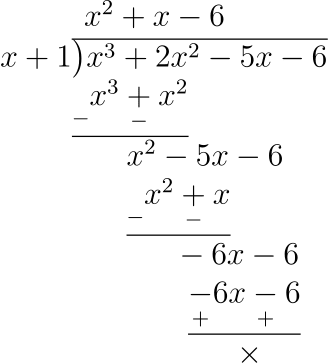
Now, dividing f(x) by (x + 1),

Use factor theorem to factorise x^3 + 2x^2 - 5x - 6. Factorisation, ML Aggarwal Understanding Mathematics Solutions ICSE Class 10.

we get x2 + x - 6 as the quotient and remainder = 0.

x3+2x25x6=(x+1)(x2+x6)=(x+1)(x2+3x2x6)=(x+1)(x(x+3)2(x+3))=(x+1)(x2)(x+3)\therefore x^3 + 2x^2 - 5x - 6 = (x + 1)(x^2 + x - 6) \\[0.5em] = (x + 1)(x^2 + 3x - 2x - 6) \\[0.5em] = (x + 1)(x(x + 3) - 2(x + 3)) \\[0.5em] = (x + 1)(x - 2)(x + 3)

Hence, x3 + 2x2 - 5x - 6 = (x + 1)(x - 2)(x + 3).

(ii) Let f(x) = x3 - 13x - 12

Putting, x = 4 in f(x)

f(4)=(4)313(4)12=645212=6464=0f(4) = (4)^3 - 13(4) - 12 \\[0.5em] = 64 - 52 - 12 \\[0.5em] = 64 - 64 \\[0.5em] = 0

Since, f(4) = 0, hence (x - 4) is factor of f(x) by factor theorem.

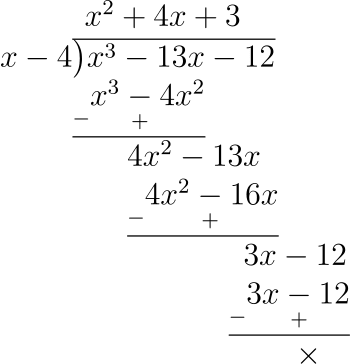
Now, dividing f(x) by (x - 4),

Use factor theorem to factorise x^3 - 13x - 12. Factorisation, ML Aggarwal Understanding Mathematics Solutions ICSE Class 10.

we get x2 + 4x + 3 as quotient and remainder = 0.

x313x12=(x4)(x2+4x+3)=(x4)(x2+3x+x+3)=(x4)(x(x+3)+1(x+3))=(x4)(x+1)(x+3)\therefore x^3 - 13x - 12 = (x - 4)(x^2 + 4x + 3) \\[0.5em] = (x - 4)(x^2 + 3x + x + 3) \\[0.5em] = (x - 4)(x(x + 3) + 1(x + 3)) \\[0.5em] = (x - 4)(x + 1)(x + 3)

Hence, x3 - 13x - 12 = (x - 4)(x + 1)(x + 3).

(iii) Given,

f(x) = 6x3 + 17x2 + 4x - 12

Substituting x = -2 in f(x), we get :

f(-2) = 6(-2)3 + 17(-2)2 + 4(-2) - 12

= 6 × -8 + 17 × 4 - 8 - 12

= -48 + 68 - 8 - 12

= -68 + 68

= 0.

Since, f(-2) = 0, hence (x + 2) is factor of f(x).

Dividing f(x) by (x + 2), we get :

x3x)6x2+5x6x+2)6x3+17x2+4x12x2+4))+6x3+12x2x2+3x5=d)5x2+4x12x2+3x54=)+5x2+10xx2+3x54)+2x+36x12 x2+3x54=zccdvz)+6x+12x2+3x54)+2x+3+dc× \begin{array}{l} \phantom{x - 3x )}{\quad 6x^2 + 5x - 6} \\ x + 2\overline{\smash{\big)}\quad 6x^3 + 17x^2 + 4x - 12} \\ \phantom{x^2 + 4)}\phantom{)}\underline{\underset{-}{+}6x^3 \underset{-}{+} 12x^2 } \\ \phantom{{x^2 + 3x - 5 =d)}} 5x^2 + 4x - 12 \\ \phantom{{x^2 + 3x - 54 =)}}\underline{\underset{-}{+}5x^2 \underset{-}{+}10x } \\ \phantom{{x^2 + 3x - 54)} + 2x + 3 }-6x - 12\ \phantom{{x^2 + 3x - 54 =zccdvz)}}\underline {\underset{+}{-}6x \underset{+}{-}12 } \\ \phantom{{x^2 + 3x - 54)} + 2x + 3 + dc}\times\ \end{array}

We get 6x2 + 5x - 6 as the quotient and remainder = 0.

∴ 6x3 + 17x2 + 4x - 12 = (x + 2)(6x2 + 5x - 6)

= (x + 2)(6x2 + 9x - 4x - 6)

= (x + 2)[3x(2x + 3) - 2(2x + 3)]

= (x + 2)(2x + 3)(3x - 2)

Hence,6x3 + 17x2 + 4x - 12 = (x + 2)(2x + 3)(3x - 2).

Question 15

Use Remainder Theorem to factorise the following polynomials completely :

(i) 2x3 + x2 - 13x + 6

(ii) 3x3 + 2x2 - 19x + 6

(iii) 2x3 + 3x2 - 9x - 10

(iv) x3 + 10x2 - 37x + 26

Answer

(i) Let f(x) = 2x3 + x2 - 13x + 6

Putting, x = 2 in f(x)

f(2)=2(2)3+2213(2)+6=16+426+6=0f(2) = 2(2)^3 + 2^2 - 13(2) + 6 \\[0.5em] = 16 + 4 - 26 + 6 \\[0.5em] = 0

Since, f(2) = 0 , (x - 2) is factor of f(x) by factor theorem.
Dividing, f(x) by (x - 2),

x2)2x2+5x3x2)2x3+x213x+6x22x3+4x2x22x3+45x213xx22x3+5x2+10xx22x3++2x23x+6x22x3++2x24+3x+6x22x3++2x24x×\begin{array}{l} \phantom{x - 2)}{2x^2 + 5x - 3} \\ x - 2\overline{\smash{\big)}2x^3 + x^2 - 13x + 6} \\ \phantom{x - 2}\underline{\underset{-}{}2x^3 \underset{+}{-} 4x^2} \\ \phantom{{x - 2}2x^3+4}5x^2 - 13x \\ \phantom{{x - 2}2x^3+}\underline{\underset{-}{}5x^2 \underset{+}{-} 10x} \\ \phantom{{x - 2}{2x^3+}{+2x^2}}-3x + 6 \\ \phantom{{x - 2}{2x^3+}{+2x^2}{4}}\underline{\underset{+}{-}3x \underset{-}{+} 6} \\ \phantom{{x - 2}{2x^3+}{+2x^2-}{-4x}}\times \end{array}

we get, 2x2 + 5x - 3 as quotient and remainder = 0.

2x3+x213x+6=(x2)(2x2+5x3)=(x2)(2x2+6xx3)=(x2)(2x(x+3)1(x+3))=(x2)(2x1)(x+3)\therefore 2x^3 + x^2 - 13x + 6 = (x - 2)(2x^2 + 5x - 3) \\[0.5em] = (x - 2)(2x^2 + 6x - x - 3) \\[0.5em] = (x - 2)(2x(x + 3) - 1(x + 3)) \\[0.5em] = (x - 2)(2x - 1)(x + 3)

Hence, 2x3 + x2 - 13x + 6 = (x - 2)(2x - 1)(x + 3).

(ii) Let f(x) = 3x3 + 2x2 - 19x + 6

Putting, x = 2 in f(x)

f(2)=3(2)3+2(2)219(2)+6=24+838+6=3838=0f(2) = 3(2)^3 + 2(2)^2 - 19(2) + 6 \\[0.5em] = 24 + 8 - 38 + 6 \\[0.5em] = 38 - 38 \\[0.5em] = 0

Since, f(2) = 0, (x - 2) is factor of f(x) by factor theorem.

Dividing, f(x) by (x - 2),

x2)3x2+8x3x2)3x3+2x219x+6x23x3+6x2x22x3+48x219xx22x3+8x2+16xx22x3++2x23x+6x22x3++2x24+3x+6x22x3++2x24x×\begin{array}{l} \phantom{x - 2)}{3x^2 + 8x - 3} \\ x - 2\overline{\smash{\big)}3x^3 + 2x^2 - 19x + 6} \\ \phantom{x - 2}\underline{\underset{-}{}3x^3 \underset{+}{-} 6x^2} \\ \phantom{{x - 2}2x^3+4}8x^2 - 19x \\ \phantom{{x - 2}2x^3+}\underline{\underset{-}{}8x^2 \underset{-}{+} 16x} \\ \phantom{{x - 2}{2x^3+}{+2x^2}}-3x + 6 \\ \phantom{{x - 2}{2x^3+}{+2x^2}{4}}\underline{\underset{+}{-}3x \underset{-}{+} 6} \\ \phantom{{x - 2}{2x^3+}{+2x^2-}{-4x}}\times \end{array}

we get, 3x2 + 8x - 3 as quotient and remainder = 0.

3x3+2x219x+6=(x2)(3x2+8x3)=(x2)(3x2+9xx3)=(x2)(3x(x+3)1(x+3))=(x2)(3x1)(x+3)\therefore 3x^3 + 2x^2 - 19x + 6 = (x - 2)(3x^2 + 8x - 3) \\[0.5em] = (x - 2)(3x^2 + 9x - x - 3) \\[0.5em] = (x - 2)(3x(x + 3) - 1(x + 3)) \\[0.5em] = (x - 2)(3x - 1)(x + 3)

Hence, 3x3 + 2x2 - 19x + 6 = (x - 2)(3x - 1)(x + 3).

(iii) Let f(x) = 2x3 + 3x2 - 9x - 10

Putting, x = 2 in f(x)

f(2)=2(2)3+3(2)29(2)10=16+121810=2828=0f(2) = 2(2)^3 + 3(2)^2 - 9(2) - 10 \\[0.5em] = 16 + 12 - 18 - 10 \\[0.5em] = 28 - 28 \\[0.5em] = 0

Since, f(2) = 0, (x - 2) is factor of f(x) by factor theorem.

Dividing, f(x) by (x - 2),

x2)2x2+7x+5x2)2x3+3x29x10x22x3+4x2x22x3+47x29xx22x3+7x2+14xx22x3++2x25x10x22x3++2x5x+10x22x3++2x24x×\begin{array}{l} \phantom{x - 2)}{2x^2 + 7x + 5} \\ x - 2\overline{\smash{\big)}2x^3 + 3x^2 - 9x - 10} \\ \phantom{x - 2}\underline{\underset{-}{}2x^3 \underset{-}{+}4x^2} \\ \phantom{{x - 2}2x^3+4}7x^2 - 9x \\ \phantom{{x - 2}2x^3+}\underline{\underset{-}{}7x^2 \underset{+}{-} 14x} \\ \phantom{{x - 2}{2x^3+}{+2x^2}}5x - 10 \\ \phantom{{x - 2}{2x^3+}{+2x}}\underline{\underset{-}{ }5x \underset{+}{-} 10} \\ \phantom{{x - 2}{2x^3+}{+2x^2-}{-4x}}\times \end{array}

we get, 2x2 + 7x + 5 as quotient and remainder = 0.

2x3+3x29x10=(x2)(2x2+7x+5)=(x2)(2x2+5x+2x+5)=(x2)(x(2x+5)+1(2x+5))=(x2)(x+1)(2x+5)\therefore 2x^3 + 3x^2 - 9x - 10 = (x - 2)(2x^2 + 7x + 5) \\[0.5em] = (x - 2)(2x^2 + 5x + 2x + 5) \\[0.5em] = (x - 2)(x(2x + 5) + 1(2x + 5)) \\[0.5em] = (x - 2)(x + 1)(2x + 5)

Hence, 2x3 + 3x2 - 9x - 10 = (x - 2)(x + 1)(2x + 5).

(iv) Let f(x) = x3 + 10x2 - 37x + 26

Putting, x = 1 in f(x)

f(1)=(1)3+10(1)237(1)+26=1+1037+26=3737=0f(1) = (1)^3 + 10(1)^2 - 37(1) + 26 \\[0.5em] = 1 + 10 - 37 + 26 \\[0.5em] = 37 - 37 \\[0.5em] = 0

Since, f(1) = 0 , (x - 1) is factor of f(x) by factor theorem.

Dividing, f(x) by (x - 1),

x1)x2+11x26x1)x3+10x237x+26x1x3+x2x12x3+411x237xx12x3+11x2+11xx12x3++11x226x+26x12x3++11x2+26x+26x12x3++2x24x×\begin{array}{l} \phantom{x - 1)}{x^2 + 11x - 26} \\ x - 1\overline{\smash{\big)}x^3 + 10x^2 - 37x + 26} \\ \phantom{x - 1}\underline{\underset{-}{}x^3 \underset{+}{-}x^2} \\ \phantom{{x - 1}2x^3+4}11x^2 - 37x \\ \phantom{{x - 1}2x^3+}\underline{\underset{-}{}11x^2 \underset{+}{-} 11x} \\ \phantom{{x - 1}{2x^3+}{+11x^2}}-26x + 26 \\ \phantom{{x - 1}{2x^3+}{+11x^2}}\underline{\underset{+}{-}26x \underset{-}{+} 26} \\ \phantom{{x - 1}{2x^3+}{+2x^2-}{-4x}}\times \end{array}

we get, x2 + 11x - 26 as quotient and remainder = 0.

x3+10x237x+26=(x1)(x2+11x26)=(x1)(x2+13x2x26)=(x1)(x(x+13)2(x+13))=(x1)(x2)(x+13)\therefore x^3 + 10x^2 - 37x + 26 = (x - 1)(x^2 + 11x - 26) \\[0.5em] = (x - 1)(x^2 + 13x - 2x - 26) \\[0.5em] = (x - 1)(x(x + 13) - 2(x + 13)) \\[0.5em] = (x - 1)(x - 2)(x + 13)

Hence, x3 + 10x2 - 37x + 26 = (x - 1)(x - 2)(x + 13).

Question 16

If (2x + 1) is a factor of 6x3 + 5x2 + ax - 2, find the value of a.

Answer

f(x) = 6x3 + 5x2 + ax - 2

If, (2x + 1) or 2(x - (-12\dfrac{1}{2})) is a factor of f(x) then f(-12\dfrac{1}{2}) = 0

6(12)3+5(12)2+a(12)2=034+54a22=0\therefore 6\big(-\dfrac{1}{2}\big)^3 + 5\big(-\dfrac{1}{2}\big)^2 + a(-\dfrac{1}{2}) - 2 = 0 \\[1em] \Rightarrow -\dfrac{3}{4} + \dfrac{5}{4} - \dfrac{a}{2} - 2 = 0

On taking L.C.M.,

3+52a84=062a4=0\Rightarrow \dfrac{-3 + 5 - 2a - 8}{4} = 0 \\[0.5em] \Rightarrow \dfrac{-6 - 2a}{4} = 0 \\[0.5em]

On Cross Multiplying,

62a=02a=6a=3.\Rightarrow -6 - 2a = 0 \\[0.5em] \Rightarrow 2a = -6 \\[0.5em] a = -3.

Hence, the value of a is -3.

Question 17

If (3x - 2) is a factor of 3x3 - kx2 + 21x - 10, find the value of k.

Answer

f(x) = 3x3 - kx2 + 21x - 10

If, (3x - 2) or 3(x(23))3(x - \big(\dfrac{2}{3}\big)) is a factor of f(x) then f(23\dfrac{2}{3}) = 0

3(23)3k(23)2+21(23)10=03(827)k(49)+1410=0894k9+4=084k+369=0444k=04k=44k=11.\therefore 3\big(\dfrac{2}{3}\big)^3 - k\big(\dfrac{2}{3}\big)^2 + 21\big(\dfrac{2}{3}\big) - 10 = 0 \\[1em] \Rightarrow 3\big(\dfrac{8}{27}\big) - k\big(\dfrac{4}{9}\big) + 14 - 10 = 0 \\[1em] \Rightarrow \dfrac{8}{9} - \dfrac{4k}{9} + 4 = 0 \\[1em] \Rightarrow \dfrac{8 - 4k + 36}{9} = 0 \\[1em] \Rightarrow 44 - 4k = 0 \\[1em] \Rightarrow 4k = 44 \\[1em] k = 11.

Hence, the value of k is 11.

Question 18

If (x - 2) is a factor of 2x3 - x2 - px - 2, then

(i) Find the value of p.

(ii) with this value of p, factorise the above expression completely.

Answer

(i) f(x) = 2x3 - x2 - px - 2

If, (x - 2) is a factor of f(x), then f(2) = 0

2(2)3(2)22p2=016422p=0102p=02p=10p=5.\therefore 2(2)^3 - (2)^2 - 2p - 2 = 0 \\[0.5em] \Rightarrow 16 - 4 - 2 - 2p = 0 \\[0.5em] \Rightarrow 10 - 2p = 0 \\[0.5em] \Rightarrow 2p = 10 \\[0.5em] p = 5.

Hence, the value of p is 5.

(ii) Putting value of p = 5 in f(x),

f(x) = 2x3 - x2 - 5x - 2

Since, (x - 2) is a factor of f(x), dividing f(x) by (x - 2),

x2)2x2+3x+1x2)2x3x25x2x22x3+4x2x22x3+43x25xx22x3+3x2+6xx22x3++3x2+5x2x22x3++3x2+5x+2x22x3++2x24x×\begin{array}{l} \phantom{x - 2)}{2x^2 + 3x + 1} \\ x - 2\overline{\smash{\big)}2x^3 - x^2 - 5x - 2} \\ \phantom{x - 2}\underline{\underset{-}{ }2x^3 \underset{+}{-} 4x^2} \\ \phantom{{x - 2}2x^3+4}3x^2 - 5x \\ \phantom{{x - 2}2x^3+}\underline{\underset{-}{}3x^2 \underset{+}{-} 6x} \\ \phantom{{x - 2}{2x^3+}{+3x^2+5}}x - 2 \\ \phantom{{x - 2}{2x^3+}{+3x^2+5}}\underline{\underset{-}{ }x \underset{+}{-} 2} \\ \phantom{{x - 2}{2x^3+}{+2x^2-}{-4x}}\times \end{array}

we get, 2x2 + 3x + 1 as quotient and remainder = 0.

2x3x25x2=(x2)(2x2+3x+1)=(x2)(2x2+2x+x+1)=(x2)(2x(x+1)+1(x+1))=(x2)(2x+1)(x+1)\therefore 2x^3 - x^2 - 5x - 2 = (x - 2)(2x^2 + 3x + 1) \\[0.5em] = (x - 2)(2x^2 + 2x + x + 1) \\[0.5em] = (x - 2)(2x(x + 1) + 1(x + 1)) \\[0.5em] = (x - 2)(2x + 1)(x + 1)

Hence, 2x3 - x2 - 5x - 2 = (x - 2)(2x + 1)(x + 1).

Question 19

What number should be subtracted from 2x3 - 5x2 + 5x so that the resulting polynomial has 2x - 3 as a factor?

Answer

Let the number to be subtracted be a.

f(x) = 2x3 - 5x2 + 5x - a

If, (2x - 3) or 2(x - (32\dfrac{3}{2})) is a factor of f(x) then f(32\dfrac{3}{2}) = 0, by factor theorem

2(32)35(32)2+5(32)a=02(278)5(94)+152a=0274454+152a=02745+304a4=0124a=04a=12a=3.\therefore 2\big(\dfrac{3}{2}\big)^3 - 5\big(\dfrac{3}{2}\big)^2 + 5(\dfrac{3}{2}) - a = 0 \\[1em] \Rightarrow 2\big(\dfrac{27}{8}\big) - 5\big(\dfrac{9}{4}\big) + \dfrac{15}{2} - a = 0 \\[1em] \Rightarrow \dfrac{27}{4} - \dfrac{45}{4} + \dfrac{15}{2} - a = 0 \\[1em] \Rightarrow \dfrac{27 - 45 + 30 - 4a}{4} = 0 \\[1em] \Rightarrow 12 - 4a = 0 \\[1em] \Rightarrow 4a = 12 \\[1em] a = 3.

Hence, the number to be subtracted is 3.

Question 20(i)

Find the value of the constants a and b, if (x - 2) and (x + 3) are both factors of the expression x3 + ax2 + bx - 12.

Answer

f(x) = x3 + ax2 + bx - 12

If (x - 2) and (x + 3) or (x - (-3)) are factors of f(x) then, f(2) and f(-3) = 0.

f(2)=23+a(2)2+2b12=08+4a+2b12=04a+2b4=04a+2b=4\therefore f(2) = 2^3 + a(2)^2 + 2b - 12 = 0 \\[0.5em] \Rightarrow 8 + 4a + 2b - 12 = 0 \\[0.5em] \Rightarrow 4a + 2b - 4 = 0 \\[0.5em] \Rightarrow 4a + 2b = 4

On dividing equation by 2,

2a+b=2b=22a  (Equation 1)\Rightarrow 2a + b = 2 \\[0.5em] b = 2 - 2a \text{ \space (Equation 1)}

f(3)=(3)3+a(3)2+(3)b12=027+9a3b12=09a3b39=0\therefore f(-3) = (-3)^3 + a(-3)^2 + (-3)b - 12 = 0 \\[0.5em] \Rightarrow -27 + 9a - 3b - 12 = 0 \\[0.5em] \Rightarrow 9a - 3b - 39 = 0

Putting value of b = 2 - 2a from equation 1,

9a3(22a)39=09a6+6a39=015a45=015a=45a=3b=22a=26=4\Rightarrow 9a - 3(2 - 2a) - 39 = 0 \\[0.5em] \Rightarrow 9a - 6 + 6a - 39 = 0 \\[0.5em] \Rightarrow 15a - 45 = 0 \\[0.5em] \Rightarrow 15a = 45 \\[0.5em] \Rightarrow a = 3 \\[0.5em] \therefore b = 2 - 2a = 2 - 6 = -4

Hence, the value of a is 3 and that of b is -4.

Question 20(ii)

If (x + 2) and (x + 3) are factors of x3 + ax + b, find the values of a and b.

Answer

f(x) = x3 + ax + b

If (x + 2) or (x - (-2)) and (x + 3) or (x - (-3)) are factors of f(x) then, f(-2) and f(-3) = 0.

f(2)=(2)3+(2)a+b=082a+b=0b=2a+8  (Equation 1)\therefore f(-2) = (-2)^3 + (-2)a + b = 0 \\[0.5em] \Rightarrow -8 - 2a + b = 0 \\[0.5em] \Rightarrow b = 2a + 8 \text{ \space (Equation 1)}

f(3)=(3)3+(3)a+b=0273a+b=0\therefore f(-3) = (-3)^3 + (-3)a + b = 0 \\[0.5em] \Rightarrow -27 - 3a + b = 0

Putting value of b = 2a + 8 from equation 1,

273a+2a+8=027a+8=0a19=0a=19b=2a+8=38+8=30\Rightarrow -27 - 3a + 2a + 8 = 0 \\[0.5em] \Rightarrow -27 - a + 8 = 0 \\[0.5em] \Rightarrow -a - 19 = 0 \\[0.5em] \Rightarrow a = -19 \\[0.5em] \therefore b = 2a + 8 = -38 + 8 = -30

Hence, the value of a is -19 and that of b is -30.

Question 21

If (x + 2) and (x - 3) are the factors of x3 + ax + b, find the values of a and b. With these values of a and b, factorise the given expression.

Answer

f(x) = x3 + ax + b

If (x + 2) or (x - (-2)) and (x - 3) are factors of f(x) then, f(-2) and f(3) = 0.

f(2)=(2)3+(2)a+b=082a+b=0b=2a+8  (Equation 1)\therefore f(-2) = (-2)^3 + (-2)a + b = 0 \\[0.5em] \Rightarrow -8 - 2a + b = 0 \\[0.5em] \Rightarrow b = 2a + 8 \text{ \space (Equation 1)}

f(3)=(3)3+(3)a+b=027+3a+b=0\therefore f(3) = (3)^3 + (3)a + b = 0 \\[0.5em] \Rightarrow 27 + 3a + b = 0

Putting value of b = 2a + 8 from equation 1,

27+3a+2a+8=035+5a=05a=35a=7b=2a+8=14+8=6\Rightarrow 27 + 3a + 2a + 8 = 0 \\[0.5em] \Rightarrow 35 + 5a = 0 \\[0.5em] \Rightarrow 5a = -35 \\[0.5em] \Rightarrow a = -7 \\[0.5em] \therefore b = 2a + 8 = -14 + 8 = -6

Putting the values of a and b in f(x) we get,

f(x) = x3 - 7x - 6

Since, (x + 2) and (x - 3) are factors of f(x) hence, (x + 2)(x - 3) = (x2 - x - 6) is also the factor.

On dividing f(x) by x2 - x - 6,

x2x6)x+1x2x6)x37x6x2x6x3+x2+6xx2x62x3+4x2x6x2x62x3+x2+x+6x2x62x3++2x2×\begin{array}{l} \phantom{x^2 - x - 6)}{x + 1} \\ x^2 - x - 6\overline{\smash{\big)}x^3 - 7x - 6} \\ \phantom{x^2 - x - 6}\underline{\underset{-}{ }x^3 \underset{+}{-} x^2 \underset{+}{-} 6x} \\ \phantom{{x^2 - x - 6}2x^3+4}x^2 - x - 6 \\ \phantom{{x^2 - x - 6}2x^3+}\underline{\underset{-}{}x^2 \underset{+}{-} x \underset{+}{-} 6} \\ \phantom{{x^2 - x - 6}{2x^3+}{+2x^2-}}\times \end{array}

we get, (x + 1) as quotient and remainder = 0.

x37x6=(x2x6)(x+1)=(x23x+2x6)(x+1)=(x(x3)+2(x3))(x+1)=(x+2)(x3)(x+1)\therefore x^3 - 7x - 6 = (x^2 - x - 6)(x + 1) \\[0.5em] = (x^2- 3x + 2x - 6)(x + 1) \\[0.5em] = (x(x - 3) + 2(x - 3))(x + 1) \\[0.5em] = (x + 2)(x - 3)(x + 1)

Hence, the value of a = -7 and b = -6;
x3 - 7x - 6 = (x + 2)(x - 3)(x + 1).

Question 22

(x - 2) is a factor of the expression x3 + ax2 + bx + 6. When this expression is divided by (x - 3), it leaves the remainder 3. Find the values of a and b.

Answer

Let f(x) = x3 + ax2 + bx + 6

Given, (x - 2) is factor of f(x), hence, f(2) = 0 by factor's theorem

23+a(2)2+b(2)+6=08+4a+2b+6=04a+2b+14=02a+b+7=0b=72a (Equation 1) \therefore 2^3 + a(2)^2 + b(2) + 6 = 0 \\[0.5em] \Rightarrow 8 + 4a + 2b + 6 = 0 \\[0.5em] \Rightarrow 4a + 2b + 14 = 0 \\[0.5em] \Rightarrow 2a + b + 7 = 0 \\[0.5em] b = -7 - 2a \text{ (Equation 1) }

Given, on dividing f(x) by (x - 3) remainder left is 3

By remainder theorem, remainder = f(3)

33+a(3)2+b(3)+6=327+9a+3b+6=333+9a+3b=3\therefore 3^3 + a(3)^2 + b(3) + 6 = 3 \\[0.5em] \Rightarrow 27 + 9a + 3b + 6 = 3 \\[0.5em] \Rightarrow 33 + 9a + 3b = 3

On dividing equation by 3,

11+3a+b=1\Rightarrow 11 + 3a + b = 1

Putting value of b from equation 1,

11+3a72a=1a+4=1a=3 and b=72a=72(3)=7+6=1\Rightarrow 11 + 3a - 7 - 2a = 1 \\[0.5em] \Rightarrow a + 4 = 1 \\[0.5em] \Rightarrow a = -3 \\[0.5em] \text{ and } b = -7 - 2a = -7 - 2(-3) = -7 + 6 = -1

Hence, the value of a = -3 and b = -1.

Question 23

If (x - 2) is a factor of the expression 2x3 + ax2 + bx - 14 and when the expression is divided by (x - 3), it leaves a remainder 52, find the values of a and b.

Answer

Let f(x) = 2x3 + ax2 + bx - 14

Given, (x - 2) is factor of f(x), hence, f(2) = 0 by factor's theorem

2(2)3+a(2)2+b(2)14=016+4a+2b14=02+4a+2b=0\therefore 2(2)^3 + a(2)^2 + b(2) - 14 = 0 \\[0.5em] \Rightarrow 16 + 4a + 2b - 14 = 0 \\[0.5em] \Rightarrow 2 + 4a + 2b = 0

On dividing equation by 2,

2a+b+1=0b=12a (Equation 1) \Rightarrow 2a + b + 1 = 0 \\[0.5em] \Rightarrow b = -1 - 2a \text{ (Equation 1) }

Given, on dividing f(x) by (x - 3) remainder left is 52

By remainder theorem, remainder = f(3)

2(3)3+a(3)2+b(3)14=5254+9a+3b14=529a+3b+40=529a+3b=123a+b=4\therefore 2(3)^3 + a(3)^2 + b(3) - 14 = 52 \\[0.5em] \Rightarrow 54 + 9a + 3b - 14 = 52 \\[0.5em] \Rightarrow 9a + 3b + 40 = 52 \\[0.5em] \Rightarrow 9a + 3b = 12 \\[0.5em] \Rightarrow 3a + b = 4

Putting value of b from equation 1,

3a12a=4a=5 and b=12a=110=11\Rightarrow 3a - 1 - 2a = 4 \\[0.5em] \Rightarrow a = 5 \\[0.5em] \text{ and } b = -1 - 2a = -1 - 10 = -11

Hence, the value of a = 5 and b = -11.

Question 24

If ax3 + 3x2 + bx - 3 has a factor (2x + 3) and leaves remainder -3 when divided by (x + 2), find the values of a and b. With these values of a and b, factorise the given expression.

Answer

Let f(x) = ax3 + 3x2 + bx - 3

Given, (2x + 3) or 2(x(32))2(x - \big(-\dfrac{3}{2}\big)) is factor of f(x), hence, f(32)\big(-\dfrac{3}{2}\big) = 0 by factor's theorem

a(32)3+3(32)2+b(32)3=027a8+2743b23=0(27a+5412b248)=0\therefore a\big(-\dfrac{3}{2}\big)^3 + 3\big(-\dfrac{3}{2}\big)^2 + b\big(-\dfrac{3}{2}\big) - 3 = 0 \\[1em] \Rightarrow -\dfrac{27a}{8} + \dfrac{27}{4} - \dfrac{3b}{2} - 3 = 0 \\[1em] \Rightarrow \big(\dfrac{-27a + 54 - 12b - 24}{8}\big) = 0

On cross multiplication,

27a12b+30=0\Rightarrow -27a - 12b + 30 = 0

On dividing the equation by 3,

9a4b+10=04b+9a=10( Equation 1)\Rightarrow -9a - 4b + 10 = 0 \\[1em] \Rightarrow 4b + 9a = 10 \text{( Equation 1)}

Given, on dividing f(x) by (x + 2) remainder left is -3

By remainder theorem, remainder = f(-2)

a(2)3+3(2)2+b(2)3=38a+122b3=38a2b+9=38a2b=12\therefore a(-2)^3 + 3(-2)^2 + b(-2) - 3 = -3 \\[0.5em] \Rightarrow -8a + 12 - 2b - 3 = -3 \\[0.5em] \Rightarrow -8a - 2b + 9 = -3 \\[0.5em] \Rightarrow -8a - 2b = -12

On dividing equation by -2,

4ab=64a+b=6\Rightarrow -4a - b = -6 \\[0.5em] \Rightarrow 4a + b = 6

Multiplying equation by 4,

16a+4b=24\Rightarrow 16a + 4b = 24

Subtracting above equation from equation 1,

4b+9a16a4b=10247a=14a=2and b=64a=68=2.\Rightarrow 4b + 9a - 16a - 4b = 10 - 24 \\[0.5em] \Rightarrow -7a = -14 \\[0.5em] \Rightarrow a = 2 \\[0.5em] \text{and } b = 6 - 4a = 6 - 8 = -2.

Putting value of a and b in f(x) we get,

f(x)=2x3+3x22x3=x2(2x+3)1(2x+3)=(x21)(2x+3)=((x)2(1)2)(2x+3)=(x1)(x+1)(2x+3)f(x) = 2x^3 + 3x^2 - 2x - 3 \\[0.5em] = x^2(2x + 3) -1(2x + 3) \\[0.5em] = (x^2 - 1)(2x + 3) \\[0.5em] = ((x)^2 - (1)^2)(2x + 3) \\[0.5em] = (x - 1)(x + 1)(2x + 3)

Hence, the value of a = 2 and b = -2 ; 2x3 + 3x2 - 2x - 3 = (x - 1)(x + 1)(2x + 3).

Question 25

Given f(x) = ax2 + bx + 2 and g(x) = bx2 + ax + 1. If (x - 2) is a factor of f(x) but leaves the remainder -15 when it divides g(x), find the values of a and b. With these values of a and b, factorise the expression

f(x) + g(x) + 4x2 + 7x

Answer

f(x) = ax2 + bx + 2

Given, (x - 2) is a factor of f(x) hence, by factor theorem f(2) = 0

a(2)2+b(2)+2=04a+2b+2=0\therefore a(2)^2 + b(2) + 2 = 0 \\[0.5em] \Rightarrow 4a + 2b + 2 = 0

On dividing equation by 2,

2a+b+1=0b=12a( Equation 1)\Rightarrow 2a + b + 1 = 0 \\[0.5em] b = -1 - 2a \text{( Equation 1)}

g(x) = bx2 + ax + 1

Given, on dividing g(x) by (x - 2), remainder = -15 and by remainder theorem, remainder = g(2)

g(2)=15b(2)2+a(2)+1=154b+2a=1514b+2a=16\therefore g(2) = -15 \\[0.5em] \Rightarrow b(2)^2 + a(2) + 1 = -15 \\[0.5em] \Rightarrow 4b + 2a = -15 - 1 \\[0.5em] \Rightarrow 4b + 2a = -16

On dividing equation by 2,

2b+a=8\Rightarrow 2b + a = -8 \\[0.5em]

Putting value of b = -1 - 2a from equation 1,

2(12a)+a=824a+a=83a=8+2a=63a=2 and b=12a=14=5.\Rightarrow 2(-1 - 2a) + a = -8 \\[0.5em] \Rightarrow -2 - 4a + a = -8 \\[0.5em] \Rightarrow -3a = -8 + 2 \\[0.5em] \Rightarrow a = \dfrac{-6}{-3} \\[0.5em] \Rightarrow a = 2 \\[0.5em] \text{ and } b = -1 - 2a = -1 - 4 = -5.

Putting value of a = 2 and b = -5 in f(x) + g(x) + 4x2 + 7x we get,

(2x25x+2)+(5x2+2x+1)+4x2+7x=2x25x2+4x25x+2x+7x+2+1=x2+4x+3=x2+3x+x+3=x(x+3)+1(x+3)=(x+1)(x+3)(2x^2 - 5x + 2) + (-5x^2 + 2x + 1) + 4x^2 + 7x \\[0.5em] = 2x^2 - 5x^2 + 4x^2 - 5x + 2x + 7x + 2 + 1 \\[0.5em] = x^2 + 4x + 3 \\[0.5em] = x^2 + 3x + x + 3 \\[0.5em] = x(x + 3) + 1(x + 3) \\[0.5em] = (x + 1)(x + 3)

Hence, the value of a = 2 and b = -5;
f(x) + g(x) + 4x2 + 7x = (x + 1)(x + 3).

Multiple Choice Questions

Question 1

When 2x3 - x2 - 3x + 5 is divided by 2x + 1, then the remainder is

  1. 6
  2. -6
  3. -3
  4. 0

Answer

By remainder theorem, on dividing f(x) by (x - a), the remainder left is f(a).

f(x) = 2x3 - x2 - 3x + 5

∴ On dividing f(x) by 2x + 1 or 2(x(12))2(x - \big(-\dfrac{1}{2}\big)), Remainder = f(12)\big(-\dfrac{1}{2}\big)

f(12)=2(12)3(12)23(12)+5=2(18)14+32+5=1414+32+5=11+6+204=244=6f\big(-\dfrac{1}{2}\big) = 2\big(-\dfrac{1}{2}\big)^3 - \big(-\dfrac{1}{2}\big)^2 - 3\big(-\dfrac{1}{2}\big) + 5 \\[1em] = 2\big(-\dfrac{1}{8}\big) - \dfrac{1}{4} + \dfrac{3}{2} + 5 \\[1em] = -\dfrac{1}{4} - \dfrac{1}{4} + \dfrac{3}{2} + 5 \\[1em] = \dfrac{-1 -1 + 6 + 20}{4} \\[1em] = \dfrac{24}{4} \\[1em] = 6

∴ Option 1, is the correct option.

Question 2

If on dividing 4x2 - 3kx + 5 by x + 2, the remainder is -3 then the value of k is

  1. 4
  2. -4
  3. 3
  4. -3

Answer

By remainder theorem, on dividing f(x) by (x - a), the remainder left is f(a).

f(x) = 4x2 - 3kx + 5

∴ On dividing f(x) by x + 2 or (x - (-2)), Remainder = f(-2)

Given, remainder = -3

∴ f(-2) = -3

4(2)23k(2)+5=316+6k+5=36k+21=36k=24k=4\Rightarrow 4(-2)^2 - 3k(-2) + 5 = -3 \\[0.5em] \Rightarrow 16 + 6k + 5 = -3 \\[0.5em] \Rightarrow 6k + 21 = -3 \\[0.5em] \Rightarrow 6k = -24 \\[0.5em] k = -4

∴ Option 2, is the correct option.

Question 3

If on dividing 2x3 + 6x2 - (2k - 7)x + 5 by (x + 3), the remainder is k - 1 then the value of k is

  1. 2
  2. -2
  3. -3
  4. 3

Answer

By remainder theorem, on dividing f(x) by (x - a), the remainder left is f(a).

f(x) = 2x3 + 6x2 - (2k - 7)x + 5

∴ On dividing f(x) by x + 3 or (x - (-3)), Remainder = f(-3)

Given, remainder = k - 1

∴ f(-3) = k - 1

2(3)3+6(3)2(2k7)(3)+5=k154+54+6k21+5=k16k16=k16kk=1615k=15k=3.\Rightarrow 2(-3)^3 + 6(-3)^2 - (2k - 7)(-3) + 5 = k - 1 \\[0.5em] \Rightarrow -54 + 54 + 6k - 21 + 5 = k - 1 \\[0.5em] \Rightarrow 6k - 16 = k - 1 \\[0.5em] \Rightarrow 6k - k = 16 - 1 \\[0.5em] \Rightarrow 5k = 15 \\[0.5em] \Rightarrow k = 3.

∴ Option 4, is the correct option.

Question 4

If x + 1 is a factor of 3x3 + kx2 + 7x + 4, then the value of k is

  1. -1
  2. 0
  3. 6
  4. 10

Answer

By factor theorem, (x - a) is a factor of f(x), if f(a) = 0 .

f(x) = 3x3 + kx2 + 7x + 4

Since, (x + 1) or (x - (-1)) is a factor of f(x),

∴ f(-1) = 0

3(1)3+k(1)2+7(1)+4=03+k7+4=0k6=0k=6\Rightarrow 3(-1)^3 + k(-1)^2 + 7(-1) + 4 = 0 \\[0.5em] \Rightarrow -3 + k - 7 + 4 = 0 \\[0.5em] \Rightarrow k - 6 = 0 \\[0.5em] k = 6

∴ Option 3, is the correct option.

Question 5

What must be subtracted from the polynomial x3 + x2 - 2x + 1, so that the result is exactly divisible by (x - 3)?

  1. –31

  2. –30

  3. 30

  4. 31

Answer

Polynomial : x3 + x2 - 2x + 1

Division by x - 3

⇒ x - 3 = 0

⇒ x = 3.

Let k be subtracted from the polynomial, so resulting polynomial is x3 + x2 - 2x + 1 - k.

Resulting polynomial should be exactly divisible by x - 3,

Thus, substituting x = 3, in polynomial x3 + x2 - 2x + 1 - k, remainder = 0.

⇒ 33 + 32 - 2(3) + 1 - k = 0

⇒ 27 + 9 - 6 + 1 - k = 0

⇒ 31 - k = 0

⇒ k = 31.

Hence, Option 4 is the correct option.

Question 6

A polynomial in 'x' is divided by (x - a) and for (x - a) to be a factor of this polynomial, the remainder should be :

  1. -a

  2. 0

  3. a

  4. 2a

Answer

For (x - a) to be a factor of a polynomial, the remainder should be equal to zero.

Hence, Option 2 is the correct option.

Assertion-Reason Type Questions

Question 1

Given f(x) = ax2 + bx + c, a ≠ 0, b, c ∈ R.

Assertion (A): The factorisation of ax2 + bx + c is possible only if its discriminant = b2 - 4ac < 0.

Reason (R): To factorise ax2 + bx + c, split the coefficient of x into two real numbers such that their algebraic sum is b and their product is ac.

  1. Assertion (A) is true, but Reason (R) is false.

  2. Assertion (A) is false, but Reason (R) is true.

  3. Both Assertion (A) and Reason (R) are correct, and Reason (R) is the correct reason for Assertion (A).

  4. Both Assertion (A) and Reason (R) are correct, and Reason (R) is incorrect reason for Assertion (A).

Answer

Given f(x) = ax2 + bx + c, a ≠ 0, b, c ∈ R.

Discriminant (D) = b2 - 4ac

We know that,

For D ≥ 0, the equation has real roots so factorisation is possible.

So, assertion (A) is false.

To factorise ax2 + bx + c, split the coefficient of x into two real numbers such that their algebric sum is b and their product is ac.

This describes the method of splitting the middle term, which is a valid technique used to factor quadratic expressions over the real numbers — provided real roots exist.

So, reason (R) is true.

Thus, Assertion (A) is false, but Reason (R) is true.

Hence, option 2 is the correct option.

Question 2

Given a polynomial f(x) = 2x3 - 7x2 - 5x + 4

Assertion (A): (x - 1) is not factor of f(x).

Reason (R): f(1) = -6.

  1. Assertion (A) is true, but Reason (R) is false.

  2. Assertion (A) is false, but Reason (R) is true.

  3. Both Assertion (A) and Reason (R) are correct, and Reason (R) is the correct reason for Assertion (A).

  4. Both Assertion (A) and Reason (R) are correct, and Reason (R) is incorrect reason for Assertion (A).

Answer

Given a polynomial f(x) = 2x3 - 7x2 - 5x + 4

By the Factor Theorem, (x - r) is a factor of f(x) if and only if f(r) = 0.

(x - 1) is a factor of f(x) if and only if f(1) = 0.

f(1) = 2 . (1)3 - 7 . (1)2 - 5 . (1) + 4

= 2 - 7 - 5 + 4 = -6.

Thus, (x - 1) is not a factor of f(x).

So, Both Assertion (A) and Reason (R) are correct, and Reason (R) is the correct reason for Assertion (A).

Hence, option 3 is the correct option.

Question 3

Given f(x) = 16x3 - 8x2 + 4x + 7

Assertion (A): When we subtract 1 from f(x), the resulting polynomial is divisible by (2x + 1).

Reason (R): f(12)f\Big(-\dfrac{1}{2}\Big) = 1.

  1. Assertion (A) is true, but Reason (R) is false.

  2. Assertion (A) is false, but Reason (R) is true.

  3. Both Assertion (A) and Reason (R) are correct, and Reason (R) is the correct reason for Assertion (A).

  4. Both Assertion (A) and Reason (R) are correct, and Reason (R) is incorrect reason for Assertion (A).

Answer

Given f(x) = 16x3 - 8x2 + 4x + 7

Subtract 1 from f(x), we get :

g(x) = 16x3 - 8x2 + 4x + 6

By Factor Theorem,

(x - r) is a factor of f(x) if and only if f(r) = 0.

(2x + 1) is a factor of g(x) if and only if g(12)g\Big(-\dfrac{1}{2}\Big) = 0.

g(12)=16×(12)38×(12)2+4×(12)+6=16×(18)8×(14)+4×(12)+6=222+6=0.g\Big(-\dfrac{1}{2}\Big) = 16 \times \Big(-\dfrac{1}{2}\Big)^3 - 8 \times \Big(-\dfrac{1}{2}\Big)^2 + 4 \times \Big(-\dfrac{1}{2}\Big) + 6\\[1em] = 16 \times \Big(-\dfrac{1}{8}\Big) - 8 \times \Big(\dfrac{1}{4}\Big) + 4 \times \Big(-\dfrac{1}{2}\Big) + 6\\[1em] = -2 - 2 - 2 + 6\\[1em] = 0.

So, assertion (A) is true.

f(12)=16×(12)38×(12)2+4×(12)+7=16×(18)8×(14)+4×(12)+7=222+7=1f\Big(-\dfrac{1}{2}\Big) = 16 \times \Big(-\dfrac{1}{2}\Big)^3 - 8 \times \Big(-\dfrac{1}{2}\Big)^2 + 4 \times \Big(-\dfrac{1}{2}\Big) + 7\\[1em] = 16 \times \Big(-\dfrac{1}{8}\Big) - 8 \times \Big(\dfrac{1}{4}\Big) + 4 \times \Big(-\dfrac{1}{2}\Big) + 7\\[1em] = -2 - 2 - 2 + 7\\[1em] = 1

So, reason (R) is true.

Thus, both Assertion (A) and Reason (R) are correct, and Reason (R) is the correct reason for Assertion (A).

Hence, option 3 is the correct option.

Chapter Test

Question 1

Find the remainder when 2x3 - 3x2 + 4x + 7 is divided by

(i) x - 2

(ii) x + 3

(iii) 2x + 1

Answer

(i) By remainder theorem, on dividing f(x) by (x - a), the remainder left is f(a).

f(x) = 2x3 - 3x2 + 4x + 7

∴ On dividing f(x) by x - 2, Remainder = f(2)

f(2)=2(2)33(2)2+4(2)+7=1612+8+7=19f(2) = 2(2)^3 - 3(2)^2 + 4(2) + 7 \\[0.5em] = 16 - 12 + 8 + 7 \\[0.5em] = 19

Hence, the value of remainder is 19.

(ii) By remainder theorem, on dividing f(x) by (x - a), the remainder left is f(a).

f(x) = 2x3 - 3x2 + 4x + 7

∴ On dividing f(x) by (x + 3) or (x - (-3)), Remainder = f(-3)

f(3)=2(3)33(3)2+4(3)+7=542712+7=86f(-3) = 2(-3)^3 - 3(-3)^2 + 4(-3) + 7 \\[0.5em] = - 54 - 27 - 12 + 7 \\[0.5em] = -86

Hence, the value of remainder is -86.

(iii) By remainder theorem, on dividing f(x) by (x - a), the remainder left is f(a).

f(x) = 2x3 - 3x2 + 4x + 7

∴ On dividing f(x) by (2x + 1) or 2(x(12))2(x - \big(-\dfrac{1}{2}\big)), Remainder = f(12)\big(-\dfrac{1}{2}\big)

f(12)=2(12)33(12)2+4(12)+7=2(18)3(14)2+7=1434+5=13+204=164=4f(-\dfrac{1}{2}) = 2(-\dfrac{1}{2})^3 - 3(-\dfrac{1}{2})^2 + 4(-\dfrac{1}{2}) + 7 \\[1em] = 2(-\dfrac{1}{8}) - 3(\dfrac{1}{4}) - 2 + 7 \\[1em] = -\dfrac{1}{4} - \dfrac{3}{4} + 5 \\[1em] = \dfrac{-1 -3 + 20}{4} \\[1em] = \dfrac{16}{4} \\[1em] = 4

Hence, the value of remainder is 4.

Question 2

When 2x3 - 9x2 + 10x - p is divided by (x + 1), the remainder is -24. Find the value of p.

Answer

By remainder theorem, on dividing f(x) by (x - a), the remainder left is f(a).

f(x) = 2x3 - 9x2 + 10x - p

∴ On dividing f(x) by (x + 1) or (x - (-1)), Remainder = f(-1)

f(1)=2(1)39(1)2+10(1)p=2910p=21p\therefore f(-1) = 2(-1)^3 - 9(-1)^2 + 10(-1) - p \\[0.5em] = -2 - 9 - 10 - p \\[0.5em] = -21 - p

Given, remainder = -24

∴ -21 - p = -24

p=2421p=3.\Rightarrow p = 24 - 21 \\[0.5em] p = 3.

Hence, the value of p is 3.

Question 3

If (2x - 3) is a factor of 6x2 + x + a, find the value of a. With this value of a, factorise the given expression.

Answer

By factor theorem (x - b) is a factor of f(x), if f(b) = 0.

f(x) = 6x2 + x + a

Given, (2x - 3) or 2(x - (32)\Big(\dfrac{3}{2}\Big)) is a factor of f(x) hence, f(32)\Big(\dfrac{3}{2}\Big) = 0.

6(32)2+(32)+a=06(94)+32+a=0272+32+a=0302+a=015+a=0a=15.\therefore 6\Big(\dfrac{3}{2}\Big)^2 + \Big(\dfrac{3}{2}\Big) + a = 0 \\[1em] \Rightarrow 6\Big(\dfrac{9}{4}\Big) + \dfrac{3}{2} + a = 0 \\[1em] \Rightarrow \dfrac{27}{2} + \dfrac{3}{2} + a = 0 \\[1em] \Rightarrow \dfrac{30}{2} + a = 0 \\[1em] \Rightarrow 15 + a = 0 \\[1em] a = -15.

Putting, a = -15 in f(x) we get,

f(x) = 6x2 + x - 15

6x2+10x9x152x(3x+5)3(3x+5)(2x3)(3x+5)\Rightarrow 6x^2 + 10x - 9x - 15 \\[0.5em] \Rightarrow 2x(3x + 5) - 3(3x + 5) \\[0.5em] (2x - 3)(3x + 5)

Hence, the value of a is -15;
6x2 + x - 15 = (2x - 3)(3x + 5).

Question 4

When 3x2 - 5x + p is divided by (x - 2), the remainder is 3. Find the value of p. Also factorise the polynomial 3x2 - 5x + p - 3.

Answer

By remainder theorem, on dividing f(x) by (x - a), the remainder left is f(a).

f(x) = 3x2 - 5x + p

∴ On dividing f(x) by (x - 2), Remainder = f(2)

Given, Remainder = 3

∴ f(2) = 3

3(2)25(2)+p=31210+p=3p+2=3p=32p=1\Rightarrow 3(2)^2 - 5(2) + p = 3 \\[0.5em] \Rightarrow 12 - 10 + p = 3 \\[0.5em] \Rightarrow p + 2 = 3 \\[0.5em] \Rightarrow p = 3 - 2 \\[0.5em] p = 1

Putting value of p = 1 in 3x2 - 5x + p - 3,

3x25x+13=3x25x2=3x26x+x2=3x(x2)+1(x2)(3x+1)(x2)3x^2 - 5x + 1 - 3 \\[0.5em] = 3x^2 - 5x - 2 \\[0.5em] = 3x^2 - 6x + x - 2 \\[0.5em] = 3x(x - 2) + 1(x - 2) \\[0.5em] (3x + 1)(x - 2)

Hence, the value of p is 1 and the factors are (3x + 1) and (x - 2).

Question 5

Prove that (5x + 4) is a factor of 5x3 + 4x2 - 5x - 4. Hence, factorise the given polynomial completely.

Answer

By factor theorem (x - b) is a factor of f(x), if f(b) = 0.

f(x) = 5x3 + 4x2 - 5x - 4

Given, (5x + 4) or 5(x - (-45\dfrac{4}{5})) is a factor of f(x) hence, let's find f(-45\dfrac{4}{5}).

f(45)=5(45)3+4(45)25(45)4=5(64125)+4(1625)+44=6425+6425=0\therefore f(-\dfrac{4}{5}) = 5\big(-\dfrac{4}{5}\big)^3 + 4\big(-\dfrac{4}{5}\big)^2 -5\big(-\dfrac{4}{5}\big) - 4 \\[1em] = 5\big(-\dfrac{64}{125}\big) + 4\big(\dfrac{16}{25}\big) + 4 - 4 \\[1em] = -\dfrac{64}{25} + \dfrac{64}{25} \\[1em] = 0

Since, f(-45\dfrac{4}{5}) = 0, hence (5x + 4) is a factor of f(x).

Now, factorising the equation 5x3 + 4x2 - 5x - 4

x2(5x+4)1(5x+4)(x21)(5x+4)(x2(1)2)(5x+4)(x1)(x+1)(5x+4)\Rightarrow x^2(5x + 4) - 1(5x + 4) \\[0.5em] \Rightarrow (x^2 - 1)(5x + 4) \\[0.5em] \Rightarrow (x^2 - (1)^2)(5x + 4) \\[0.5em] \Rightarrow (x - 1)(x + 1)(5x + 4)

Hence, 5x3 + 4x2 - 5x - 4 = (x - 1)(x + 1)(5x + 4).

Question 6

Use factor theorem to factorise the following polynomials completely :

(i) 4x3 + 4x2 - 9x - 9

(ii) x3 - 19x - 30

(iii) 2x3 - x2 - 13x - 6

Answer

(i) f(x) = 4x3 + 4x2 - 9x - 9

Let x = -1, substituting the value of x in f(x),

f(1)=4(1)3+4(1)29(1)9=4+4+99=0f(-1) = 4(-1)^3 + 4(-1)^2 - 9(-1) - 9 \\[0.5em] = -4 + 4 + 9 - 9 \\[0.5em] = 0

Since, f(-1) = 0 hence, (x + 1) is a factor of 4x3 + 4x2 - 9x - 9.

On dividing, 4x3 + 4x2 - 9x - 9 by (x + 1),

x+1)4x29x+1)4x3+4x29x9x+14x3+4x2x+14x34x299x9x+14x34x29x+9x+9x+14x34x299x×\begin{array}{l} \phantom{x + 1)}{4x^2 - 9} \\ x + 1\overline{\smash{\big)}4x^3 + 4x^2 - 9x - 9} \\ \phantom{x + 1}\underline{\underset{-}{}4x^3 \underset{-}{+}4x^2} \\ \phantom{{x + 1}{4x^3}{4x^2-9}}-9x - 9 \\ \phantom{{x + 1}{4x^3}{4x^2-9x}}\underline{\underset{+}{-}9x \underset{+}{-} 9} \\ \phantom{{x + 1}{4x^3}{4x^2-9}{-9x}}\times \end{array}

we get (4x2 - 9) as quotient and remainder = 0.

4x3+4x29x9=(x+1)(4x29)=(x+1)((2x)2(3)2)=(x+1)(2x3)(2x+3)\therefore 4x^3 + 4x^2 - 9x - 9 = (x + 1)(4x^2 - 9) \\[0.5em] = (x + 1)((2x)^2 - (3)^2) \\[0.5em] = (x + 1)(2x - 3)(2x + 3)

Hence, 4x3 + 4x2 - 9x - 9 = (x + 1) (2x - 3)(2x + 3).

(ii) f(x) = x3 - 19x - 30

Let x = -2, substituting the value of x in f(x),

f(2)=(2)319(2)30=8+3830=0f(-2) = (-2)^3 - 19(-2) - 30 \\[0.5em] = -8 + 38 - 30 \\[0.5em] = 0

Since, f(-2) = 0 hence, (x + 2) is a factor of x3 - 19x - 30.

On dividing, x3 - 19x - 30 by (x + 2),

x+2)x22x15x+2)x319x30x+2x3+2x2x+2x3+2x219xx+2x3++2x2+4xx+2x3+2x215x30x+2x3+2x2++15x+30x+22x3++2x24x×\begin{array}{l} \phantom{x + 2)}{x^2 - 2x - 15} \\ x + 2\overline{\smash{\big)}x^3 - 19x - 30} \\ \phantom{x + 2}\underline{\underset{-}{ }x^3 \underset{-}{+} 2x^2} \\ \phantom{{x + 2}{x^3+}}-2x^2 - 19x \\ \phantom{{x + 2}x^3+}\underline{\underset{+}{-}2x^2 \underset{+}{-} 4x} \\ \phantom{{x + 2}{-x^3+2x^2}}-15x - 30 \\ \phantom{{x + 2}{-x^3+2x^2+}}\underline{\underset{+}{-}15x \underset{+}{-} 30} \\ \phantom{{x + 2}{2x^3+}{+2x^2-}{-4x}}\times \end{array}

we get x2 - 2x - 15 as quotient and remainder = 0.

x319x30=(x+2)(x22x15)=(x+2)(x25x+3x15)=(x+2)(x(x5)+3(x5))=(x+2)(x+3)(x5)\therefore x^3 - 19x - 30 = (x + 2)(x^2 - 2x - 15) \\[0.5em] = (x + 2)(x^2 - 5x + 3x - 15) \\[0.5em] = (x + 2)(x(x - 5) + 3(x - 5)) \\[0.5em] = (x + 2)(x + 3)(x - 5)

Hence, x3 - 19x - 30 = (x + 2) (x + 3)(x - 5).

(iii) f(x) = 2x3 - x2 - 13x - 6

Substituting x = -2 in 2x3 - x2 - 13x - 6, we get :

⇒ 2(-2)3 - (-2)2 - 13(-2) - 6

⇒ 2(-8) - 4 + 26 - 6

⇒ -16 - 4 + 20

⇒ -20 + 20

⇒ 0.

∴ x + 2 is a factor of the polynomial 2x3 - x2 - 13x - 6.

Dividing, 2x3 - x2 - 13x - 6 by x + 2, we get :

x+2)2x25x3x+2)2x3x213x6x+2))+2x3+4x2x+2x325x213xx+2)x32+5x2+10xx+2)x32x2(3)3x6x+2)x32x2(31)+3x+6x+2)x32x2(31)2x×\begin{array}{l} \phantom{x + 2)}{\quad 2x^2 -5x - 3} \\ x + 2\overline{\smash{\big)}\quad 2x^3 - x^2 - 13x - 6} \\ \phantom{x + 2)}\phantom{)}\underline{\underset{-}{+}2x^3 \underset{-}{+}4x^2} \\ \phantom{{x + 2}x^3-2}-5x^2 - 13x \\ \phantom{{x + 2)}x^3-2}\underline{\underset{+}{-}5x^2 \underset{+}{-} 10x} \\ \phantom{{x + 2)}{x^3-2x^{2}(3)}}-3x - 6 \\ \phantom{{x + 2)}{x^3-2x^{2}(31)}}\underline{\underset{+}{-}3x \underset{+}{-} 6} \\ \phantom{{x + 2)}{x^3-2x^{2}(31)}{-2x}}\times \end{array}

∴ 2x3 - x2 - 13x - 6 = (x + 2)(2x2 - 5x - 3)

= (x + 2)(2x2 - 6x + x - 3)

= (x + 2)[2x(x - 3) + 1(x - 3)]

= (x + 2)(2x + 1)(x - 3).

Hence, 2x3 - x2 - 13x - 6 = (x + 2)(2x + 1)(x - 3).

Question 7

If x3 - 2x2 + px + q has a factor (x + 2) and leaves a remainder 9 when divided by (x + 1), find the values of p and q. With these values of p and q, factorise the given polynomial completely.

Answer

By factor theorem (x - b) is a factor of f(x), if f(b) = 0.

f(x) = x3 - 2x2 + px + q

Given, (x + 2) or (x - (-2)) is a factor of f(x).

∴ f(-2) = 0

(2)32(2)2+p(2)+q=0882p+q=02p+q=16q=2p+16  (Equation 1)\Rightarrow (-2)^3 - 2(-2)^2 + p(-2) + q = 0 \\[0.5em] \Rightarrow -8 - 8 - 2p + q = 0 \\[0.5em] \Rightarrow -2p + q = 16 \\[0.5em] q = 2p + 16 \text{ \space (Equation 1)}

By remainder theorem, on dividing f(x) by (x - a), the remainder left is f(a).

∴ On dividing f(x) by (x + 1) or (x - (-1)), Remainder = f(-1)

Given, Remainder = 9

∴ f(-1) = 9

(1)32(1)2+p(1)+q=912p+q=93p+q=9qp=9+3qp=12\Rightarrow (-1)^3 - 2(-1)^2 + p(-1) + q = 9 \\[0.5em] \Rightarrow -1 - 2 - p + q = 9 \\[0.5em] \Rightarrow -3 - p + q = 9 \\[0.5em] \Rightarrow q - p = 9 + 3 \\[0.5em] \Rightarrow q - p = 12

Putting value of q = 2p + 16 from equation 1,

2p+16p=12p+16=12p=1216p=4 and q=2p+16=2(4)+16=8+16=8\Rightarrow 2p + 16 - p = 12 \\[0.5em] \Rightarrow p + 16 = 12 \\[0.5em] \Rightarrow p = 12 - 16 \\[0.5em] \Rightarrow p = -4 \\[0.5em] \text{ and } q = 2p + 16 = 2(-4) + 16 = -8 + 16 = 8

Now putting p = -4 and q = 8 in f(x),

f(x) = x3 - 2x2 - 4x + 8

Since, (x + 2) is a factor of f(x), on dividing f(x) by (x + 2),

x+2)x24x+4x+2)x32x24x+8x+2x3+2x2x+2x3+4x24xx+2x3++4x2+8xx+2x3+2x21+4x+8x+2x3+2x2+4x+8x+22x3++2x24x×\begin{array}{l} \phantom{x + 2)}{x^2 - 4x + 4} \\ x + 2\overline{\smash{\big)}x^3 - 2x^2 - 4x + 8} \\ \phantom{x + 2}\underline{\underset{-}{ }x^3 \underset{-}{+} 2x^2} \\ \phantom{{x + 2}{x^3+}}-4x^2 - 4x \\ \phantom{{x + 2}x^3+}\underline{\underset{+}{-}4x^2 \underset{+}{-} 8x} \\ \phantom{{x + 2}{-x^3+2x^21+}}4x + 8 \\ \phantom{{x + 2}{-x^3+2x^2+}}\underline{\underset{-}{ }4x \underset{-}{+} 8} \\ \phantom{{x + 2}{2x^3+}{+2x^2-}{-4x}}\times \end{array}

we get x2 - 4x + 4 as quotient and remainder = 0.

x32x24x+8=(x+2)(x24x+4)=(x+2)(x22×2×x+22)=(x+2)(x2)2\therefore x^3 - 2x^2 - 4x + 8 = (x + 2)(x^2 - 4x + 4) \\[0.5em] =(x + 2)(x^2 - 2 \times 2 \times x + 2^2) \\[0.5em] = (x + 2)(x - 2)^2

Hence, value of p = -4 and q = 8;
x3 - 2x2 - 4x + 8 = (x + 2) (x - 2)2.

Question 8

If (x + 3) and (x - 4) are factors of x3 + ax2 - bx + 24, find the values of a and b. With these values of a and b, factorise the given expression.

Answer

By factor theorem (x - b) is a factor of f(x), if f(b) = 0.

f(x) = x3 + ax2 - bx + 24

Given, (x + 3) or (x - (-3) and (x - 4) are factors of f(x)

∴ f(-3) = 0 and f(4) = 0.

For, f(-3) = 0

(3)3+a(3)2b(3)+24=027+9a+3b+24=09a+3b3=09a+3b=3\Rightarrow (-3)^3 + a(-3)^2 - b(-3) + 24 = 0 \\[0.5em] \Rightarrow -27 + 9a + 3b + 24 = 0 \\[0.5em] \Rightarrow 9a + 3b - 3 = 0 \\[0.5em] \Rightarrow 9a + 3b = 3

On dividing equation by 3,

3a+b=1b=13a  (Equation 1) \Rightarrow 3a + b = 1 \\[0.5em] b = 1 - 3a \text{ \space (Equation 1) }

For f(4) = 0

(4)3+a(4)2b(4)+24=064+16a4b+24=016a4b+88=016a4b=88\Rightarrow (4)^3 + a(4)^2 - b(4) + 24 = 0 \\[0.5em] \Rightarrow 64 + 16a - 4b + 24 = 0 \\[0.5em] \Rightarrow 16a - 4b + 88 = 0 \\[0.5em] \Rightarrow 16a - 4b = -88

On dividing equation by 4,

4ab=22\Rightarrow 4a - b = -22

Putting value of b = 1 - 3a from equation 1,

4a1+3a=227a1=227a=22+17a=21a=217a=3 and b=13a=13(3)=1+9=10\Rightarrow 4a - 1 + 3a = -22 \\[0.5em] \Rightarrow 7a - 1 = -22 \\[0.5em] \Rightarrow 7a = -22 + 1 \\[0.5em] \Rightarrow 7a = -21 \\[1em] \Rightarrow a = -\dfrac{21}{7} \\[1em] \Rightarrow a = -3 \\[0.5em] \text{ and } b = 1 - 3a = 1 - 3(-3) = 1 + 9 = 10

Now putting a = -3 and b = 10 in f(x),

f(x) = x3 - 3x2 - 10x + 24

Since, (x + 3) and (x - 4) is a factor of f(x), hence (x + 3)(x + 4) is also the factor

(x+3)(x4)=x2+3x4x12=x2x12(x + 3)(x - 4) = x^2 + 3x - 4x - 12 \\[0.5em] = x^2 - x - 12

On dividing, f(x) by x2 - x - 12,

x2x12)x2x2x12)x33x210x+24x2x12x3+x2+12xx2x12x3+2x2+2x+24x2x12x3++2x2+2x+24x2x122x3++2x2×\begin{array}{l} \phantom{x^2 - x - 12)}{x - 2} \\ x^2 - x - 12\overline{\smash{\big)}x^3 - 3x^2 - 10x + 24} \\ \phantom{x^2 - x - 12}\underline{\underset{-}{ }x^3 \underset{+}{-} x^2 \underset{+}{-} 12x} \\ \phantom{{x^2 - x - 12}{x^3+}}-2x^2 + 2x + 24 \\ \phantom{{x^2 - x - 12}x^3+}\underline{\underset{+}{-}2x^2 \underset{-}{+} 2x \underset{-}{+} 24} \\ \phantom{{x^2 - x - 12}{2x^3+}{+2x^2-}}\times \end{array}

we get (x - 2) as quotient and remainder = 0.

x33x210x+24=(x2)(x2x12).=(x2)(x24x+3x12)=(x2)(x(x4)+3(x4))=(x2)(x+3)(x4)\therefore x^3 - 3x^2 - 10x + 24 = (x - 2)(x^2 - x - 12). \\[0.5em] = (x - 2)(x^2 - 4x + 3x - 12) \\[0.5em] = (x - 2)(x(x - 4) + 3(x - 4)) \\[0.5em] = (x - 2)(x + 3)(x - 4)

Hence, value of a = -3 and b = 10;
x3 - 3x2 - 10x + 24 = (x - 2)(x + 3)(x - 4).

Question 9

If (2x + 1) is a factor of both the expressions 2x2 - 5x + p and 2x2 + 5x + q, find the values of p and q. Hence, find the other factors of both the polynomials.

Answer

By factor theorem (x - b) is a factor of f(x), if f(b) = 0.

Let, f(x) = 2x2 - 5x + p

Given, (2x + 1) or 2(x - (-12\dfrac{1}{2}) is a factor of f(x)

f(12)=02(12)25(12)+p=02(14)+52+p=012+52+p=062+p=03+p=0p=3\therefore f(-\dfrac{1}{2}) = 0 \\[1em] \Rightarrow 2\big(-\dfrac{1}{2}\big)^2 - 5\big(-\dfrac{1}{2}\big) + p = 0 \\[1em] \Rightarrow 2\big(\dfrac{1}{4}) + \dfrac{5}{2} + p = 0 \\[1em] \Rightarrow \dfrac{1}{2} + \dfrac{5}{2} + p = 0 \\[1em] \Rightarrow \dfrac{6}{2} + p = 0 \\[1em] \Rightarrow 3 + p = 0 \\[1em] p = -3

Putting value of p in f(x)

f(x)=2x25x3=2x26x+x3=2x(x3)+1(x3)=(2x+1)(x3)f(x) = 2x^2 - 5x - 3 \\[0.5em] = 2x^2 - 6x + x - 3 \\[0.5em] = 2x(x - 3) + 1(x - 3) \\[0.5em] = (2x + 1)(x - 3)

Hence, p = -3 and other factor is (x - 3).

Let, g(x) = 2x2 + 5x + q

Given, (2x + 1) or 2(x - (-12\dfrac{1}{2}) is a factor of g(x)

g(12)=02(12)2+5(12)+q=02(14)52+q=01252+q=042+q=02+q=0q=2\therefore g(-\dfrac{1}{2}) = 0 \\[0.5em] \Rightarrow 2\big(-\dfrac{1}{2}\big)^2 + 5\big(-\dfrac{1}{2}\big) + q = 0 \\[0.5em] \Rightarrow 2\big(\dfrac{1}{4}) - \dfrac{5}{2} + q = 0 \\[0.5em] \Rightarrow \dfrac{1}{2} - \dfrac{5}{2} + q = 0 \\[0.5em] \Rightarrow -\dfrac{4}{2} + q = 0 \\[0.5em] \Rightarrow -2 + q = 0 \\[0.5em] q = 2

Putting value of q in g(x)

f(x)=2x2+5x+2=2x2+4x+x+2=2x(x+2)+1(x+2)=(2x+1)(x+2)f(x) = 2x^2 + 5x + 2 \\[0.5em] = 2x^2 + 4x + x + 2 \\[0.5em] = 2x(x + 2) + 1(x + 2) \\[0.5em] = (2x + 1)(x + 2)

Hence, q = 2 and other factor is (x + 2).

Question 10

If a polynomial f(x) = x4 - 2x3 + 3x2 - ax - b leaves remainders 5 and 19 when divided by (x - 1) and (x + 1) respectively, find the values of a and b. Hence, determine the remainder when f(x) is divided by (x - 2).

Answer

By remainder theorem, on dividing f(x) by (x - a), the remainder left is f(a).

f(x) = x4 - 2x3 + 3x2 - ax - b

∴ On dividing f(x) by (x + 1) or (x - (-1)), Remainder = f(-1)

Given, on dividing by (x + 1) remainder = 19,

∴ f(-1) = 19

(1)42(1)3+3(1)2a(1)b=191+2+3+ab=19ab+6=19ab=13a=13+b  (Equation 1) \Rightarrow (-1)^4 - 2(-1)^3 + 3(-1)^2 - a(-1) - b = 19 \\[0.5em] \Rightarrow 1 + 2 + 3 + a - b = 19 \\[0.5em] \Rightarrow a - b + 6 = 19 \\[0.5em] \Rightarrow a - b = 13 \\[0.5em] a = 13 + b \text{ \space (Equation 1) }

∴ On dividing f(x) by (x - 1), Remainder = f(1)

Given, on dividing by (x - 1) remainder = 5,

∴ f(1) = 5

(1)42(1)3+3(1)2a(1)b=512+3ab=52ab=5ab=3\Rightarrow (1)^4 - 2(1)^3 + 3(1)^2 - a(1) - b = 5 \\[0.5em] \Rightarrow 1 - 2 + 3 - a - b = 5 \\[0.5em] \Rightarrow 2 - a - b = 5 \\[0.5em] \Rightarrow -a - b = 3

Putting value of a = 13 + b from equation 1,

(13+b)b=313bb=3132b=32b=16b=162b=8 and a=13+b=138=5\Rightarrow -(13 + b) - b = 3 \\[0.5em] \Rightarrow -13 - b - b = 3 \\[0.5em] \Rightarrow -13 - 2b = 3 \\[0.5em] \Rightarrow 2b = -16 \\[0.5em] \Rightarrow b = -\dfrac{16}{2} \\[0.5em] \Rightarrow b = -8 \\[0.5em] \text{ and } a = 13 + b = 13 - 8 = 5

Putting a = 5 and b = -8 in f(x) we get,

f(x) = x4 - 2x3 + 3x2 - 5x + 8.

On dividing f(x) by (x - 2), remainder = f(2) by remainder theorem

f(2)=(2)42(2)3+3(2)25(2)+8=1616+1210+8=10.f(2) = (2)^4 - 2(2)^3 + 3(2)^2 - 5(2) + 8 \\[0.5em] = 16 - 16 + 12 - 10 + 8 \\[0.5em] = 10.

Hence, the value of a is 5 and b is -8.
On dividing x4 - 2x3 + 3x2 - 5x + 8 by (x - 2) the value of remainder is 10.

Question 11

When a polynomial f(x) is divided by (x - 1), the remainder is 5 and when it is, divided by (x - 2), the remainder is 7. Find the remainder when it is divided by (x - 1)(x - 2).

Answer

By remainder theorem, on dividing f(x) by (x - a), the remainder left is f(a).

Given, when f(x) is divided by (x - 1), remainder = 5

∴ f(1) = 5

Given, when f(x) is divided by (x - 2), remainder = 7

∴ f(2) = 7

Suppose on dividing f(x) by (x - 1)(x - 2),

Quotient = q(x)

Remainder = ax + b

So, f(x) = (x - 1)(x - 2)q(x) + ax + b

Putting x = 1, we get:

f(1)=(11)(12)q(1)+a(1)+b=50+a+b=5a+b=5a=5b  (Equation 1)\Rightarrow f(1) = (1 - 1)(1 - 2)q(1) + a(1) + b = 5 \\[0.5em] \Rightarrow 0 + a + b = 5 \\[0.5em] \Rightarrow a + b = 5 \\[0.5em] a = 5 - b \text{ \space (Equation 1)}

Putting x = 2, we get:

f(2)=(21)(22)q(2)+a(2)+b=70+2a+b=72a+b=7\Rightarrow f(2) = (2 - 1)(2 - 2)q(2) + a(2) + b = 7 \\[0.5em] \Rightarrow 0 + 2a + b = 7 \\[0.5em] \Rightarrow 2a + b = 7

Putting value of a from equation 1,

2(5b)+b=7102b+b=7b=107b=3and a=5b=53=2.\Rightarrow 2(5 - b) + b = 7 \\[0.5em] \Rightarrow 10 - 2b + b = 7 \\[0.5em] \Rightarrow b = 10 - 7 \\[0.5em] \Rightarrow b = 3 \\[0.5em] \text{and } a = 5 - b = 5 - 3 = 2.

Remainder = ax + b = 2x + 3.

∴ The remainder when polynomial is divided by (x - 1)(x - 2) is 2x + 3.

Question 12

The polynomial 3x3 + 8x2 - 15x + k has (x - 1) as a factor. Find the value of k. Hence factorize the resulting polynomial completely.

Answer

⇒ x - 1 = 0

⇒ x = 1.

Given, (x - 1) is a factor of 3x3 + 8x2 - 15x + k.

Thus, on substituting x = 1 in 3x3 + 8x2 - 15x + k, the remainder will be zero.

⇒ 3.(1)3 + 8.(1)2 - 15(1) + k = 0

⇒ 3.1 + 8.1 - 15 + k = 0

⇒ 3 + 8 - 15 + k = 0

⇒ 11 - 15 + k = 0

⇒ k - 4 = 0

⇒ k = 4.

Polynomial = 3x3 + 8x2 - 15x + 4

On dividing (3x3 + 8x2 - 15x + 4) by (x - 1), we get :

x1)3x2+11x4x1)3x3+8x215x+4x1))+3x3+3x2x131x3211x215xx1)x32+11x2+11xx1)31x32+14x+4x1)31x32+11+4x+4x1)31x32+11+1×\begin{array}{l} \phantom{x - 1)}{\quad 3x^2 + 11x - 4} \\ x - 1\overline{\smash{\big)}\quad 3x^3 + 8x^2 - 15x + 4} \\ \phantom{x - 1)}\phantom{)}\underline{\underset{-}{+}3x^3 \underset{+}{-}3x^2} \\ \phantom{{x - 1}31x^3-2}11x^2 - 15x \\ \phantom{{x - 1)}x^3-2}\underline{\underset{-}{+}11x^2 \underset{+}{-} 11x} \\ \phantom{{x - 1)}31x^3-2+1}-4x + 4 \\ \phantom{{x - 1)}31x^3-2+11}\underline{\underset{+}{-}4x \underset{-}{+} 4} \\ \phantom{{x - 1)}31x^3-2+11+1}\times \end{array}

⇒ 3x3 + 8x2 - 15x + 4 = (x - 1)(3x2 + 11x - 4)

= (x - 1)[3x2 + 12x - x - 4]

= (x - 1)[3x(x + 4) - 1(x + 4)]

= (x - 1)(3x - 1)(x + 4).

Hence, 3x3 + 8x2 - 15x + 4 = (x - 1)(3x - 1)(x + 4).

Question 13

While factorizing a given polynomial, using remainder and factor theorem, a student finds that (2x + 1) is a factor of 2x3 + 7x2 + 2x - 3.

(a) Is the student's solution correct stating that (2x + 1) is a factor of the given polynomial ? Give a valid reason for your answer.

(b) Factorize the given polynomial completely.

Answer

⇒ 2x + 1 = 0

⇒ 2x = -1

⇒ x = 12-\dfrac{1}{2}

Substituting x = 12-\dfrac{1}{2} in 2x3 + 7x2 + 2x - 3, we get :

2×(12)3+7×(12)2+2×(12)32×18+7×14+(1)314+7441+744644616410452.\Rightarrow 2 \times \Big(-\dfrac{1}{2}\Big)^3 + 7 \times \Big(-\dfrac{1}{2}\Big)^2 + 2 \times \Big(-\dfrac{1}{2}\Big) - 3 \\[1em] \Rightarrow 2 \times -\dfrac{1}{8} + 7 \times \dfrac{1}{4} + (-1) - 3 \\[1em] \Rightarrow -\dfrac{1}{4} + \dfrac{7}{4} - 4 \\[1em] \Rightarrow \dfrac{-1 + 7}{4} - 4 \\[1em] \Rightarrow \dfrac{6}{4} - 4 \\[1em] \Rightarrow \dfrac{6 - 16}{4} \\[1em] \Rightarrow \dfrac{-10}{4} \\[1em] \Rightarrow -\dfrac{5}{2}.

Since, remainder is not equal to zero.

Hence, (2x + 1) is not a factor of the given polynomial.

Substituting x = 12\dfrac{1}{2} in 2x3 + 7x2 + 2x - 3, we get :

2×(12)3+7×(12)2+2×1232×18+7×14+1314+742842220.\Rightarrow 2 \times \Big(\dfrac{1}{2}\Big)^3 + 7 \times \Big(\dfrac{1}{2}\Big)^2 + 2 \times \dfrac{1}{2} - 3 \\[1em] \Rightarrow 2 \times \dfrac{1}{8} + 7 \times \dfrac{1}{4} + 1 - 3 \\[1em] \Rightarrow \dfrac{1}{4} + \dfrac{7}{4} - 2 \\[1em] \Rightarrow \dfrac{8}{4} - 2 \\[1em] \Rightarrow 2 - 2 \\[1em] \Rightarrow 0.

Since, remainder is equal to zero.

∴ x - 12\dfrac{1}{2} is factor of polynomial,

⇒ x - 12\dfrac{1}{2} = 0

⇒ x = 12\dfrac{1}{2}

⇒ 2x = 1

⇒ 2x - 1 is factor of polynomial.

Dividing 2x3 + 7x2 + 2x - 3 by 2x - 1, we get :

2x1)x2+4x+32x1)2x3+7x2+2x32x1))+2x3+x22x1+2x3+18x2+2x2x1)+2x31+8x2+4x2x1)+2x31+8x2126x32x1)+2x31+8x21+6x+32x1)+2x31+8x21+6×\begin{array}{l} \phantom{2x - 1)}{\quad x^2 + 4x + 3} \\ 2x - 1\overline{\smash{\big)}\quad 2x^3 + 7x^2 + 2x - 3} \\ \phantom{2x - 1)}\phantom{)}\underline{\underset{-}{+}2x^3 \underset{+}{-}x^2} \\ \phantom{{2x - 1}+2x^3 + 1}8x^2 + 2x \\ \phantom{{2x - 1)}+2x^31}\underline{\underset{-}{+}8x^2 \underset{+}{-} 4x} \\ \phantom{{2x - 1)}+2x^31+8x^212}6x - 3 \\ \phantom{{2x - 1)}+2x^31+8x^21}\underline{\underset{-}{+}6x \underset{+}{-} 3} \\ \phantom{{2x - 1)}+2x^31+8x^21+6}\times \end{array}

2x3 + 7x2 + 2x - 3 by 2x - 1 = (2x - 1)(x2 + 4x + 3)

= (2x - 1)[x2 + 3x + x + 3]

= (2x - 1)[x(x + 3) + 1(x + 3)]

= (2x - 1)(x + 1)(x + 3).

Hence, 2x3 + 7x2 + 2x - 3 = (2x - 1)(x + 1)(x + 3).

PrevNext