
Chemistry
(a) A dilute acid B does not normally give hydrogen when reacted with metals but does give a gas when reacts with copper. Identify B. Write equation with copper.
(b) Completed the table:
| Name of process | Inputs | Equation | Output |
|---|---|---|---|
| Ammonia + air | Nitric acid |
(c) What is the property of nitric acid which allows it to react with copper?
(d) State one observation :
(i) Concentrated nitric acid is reacted with - sulphur.
(ii) Lead nitrate is heated strongly in a test tube.
Nitric Acid
19 Likes
Answer
(a) HNO3 (Nitric acid)
3Cu + 8HNO3 ⟶ 3Cu(NO3)2 + 4H2O + 2NO
(b) Completed table is as follows:
Name of process — Ostwald's process
Inputs — Ammonia + air
Equation — 4NH3 + 5O2 4NO + 6H2O + 21.5 Kcals
Output — Nitric acid
(c) When nitric acid undergoes decomposition it yields nascent oxygen. This nascent oxygen oxidises copper allowing it to react with nitric acid. Hence, the oxidising nature of nitric acid helps it to react with copper.
(d) (i) When concentrated nitric acid is reacted with sulphur, dense brown fumes of nitrogen dioxide are observed.
S + 6HNO3 [conc.] ⟶ H2SO4 + 2H2O + 6NO2
(ii) Lead nitrate decomposes on heating to give nitrogen dioxide, oxygen gas and yellow residue of lead oxide which fuses with the glass of the test tube.
2Pb(NO3)2 2PbO + 4NO2 + O2
Answered By
12 Likes
Related Questions
The action of heat on the blue crystalline solid X, gives a reddish brown gas Y, a gas which re-lights a glowing splint and leaves a black residue. When gas Z, which has a rotten egg smell, is passed through a solution of X, a black ppt. is formed.
(a) Identify X, Y and Z.
(b) Write equation for action of heat on X.
(c) Write equation between solution of X and gas Z.
(a) Dilute nitric acid is generally considered a typical acid except for it's reaction with metals. In what way is dilute nitric acid different from other acids when it reacts with metals?
(b) Write the equation for the reaction of dilute nitric acid and conc. nitric acid with copper.
The figure given below illustrates the apparatus used in the laboratory preparation of nitric acid.
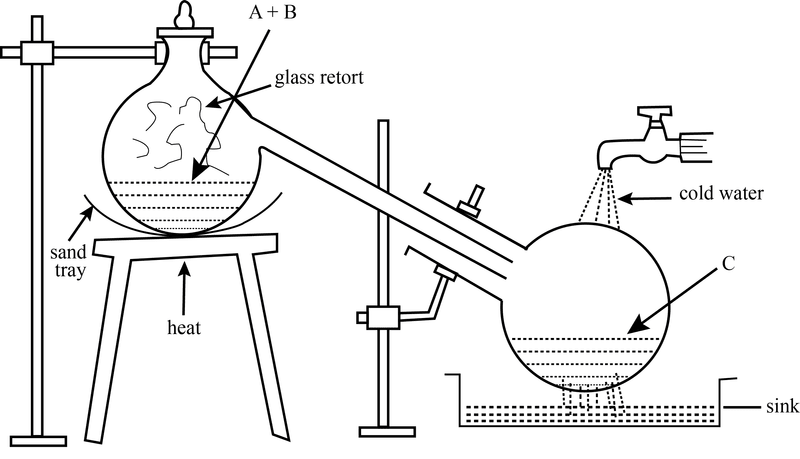
(a) Name A (a liquid), B (a solid) and C (a liquid). (Do not give the formulae).
(b) Write an equation to show how nitric acid undergoes decomposition.
(c) Write the equation for the reaction in which copper is oxidized by concentrated nitric acid.
With respect to the brown ring test for nitrates, explain :
(a) Freshly prepared ferrous sulphate is used.
(b) Brown ring disappear if the test tube is disturbed.
(c) Lead nitrate does not respond properly to the brown ring test.
Hint - Salt solution forming insoluble sulphates interfere with the result of the brown ring test.(d) What is the name and formula of the brown ring formed ?