
Mathematics
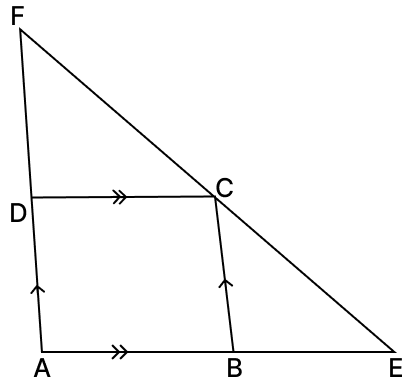
ABCD is a parallelogram. The sides AB and AD are produced to E and F respectively such that AB = BE and AD = DF. Prove that △BEC ≅ △DCF.
Triangles
3 Likes
Answer
Given,
AD = DF ….(1)
AB = BE ….(2)
We know that,
Opposite sides of parallelogram are equal.
∴ AD = BC ….(3)
∴ AB = CD ….(4)
From eq.(1) and (3), we get :
⇒ BC = DF
From eq.(2) and (4), we get :
⇒ BE = CD
We know that,
Opposite angles of a parallelogram are equal.
⇒ ∠ABC = ∠ADC = x (let)
From figure,
Since, AE is a straight line.
⇒ ∠CBE + ∠ABC = 180°
⇒ ∠CBE + x = 180°
⇒ ∠CBE = 180° - x …….(5)
Since, AF is a straight line.
⇒ ∠CDF + ∠ADC = 180°
⇒ ∠CDF + x = 180°
⇒ ∠CDF = 180° - x ……..(6)
From eq.(5) and (6), we get :
⇒ ∠CBE = ∠CDF
In △BEC and △DCF,
⇒ BE = CD (Proved above)
⇒ ∠CBE = ∠CDF (Proved above)
⇒ BC = DF (Proved above)
∴ △BEC ≅ △DCF (By S.A.S axiom)
Hence, proved that △BEC ≅ △DCF.
Answered By
3 Likes
Related Questions
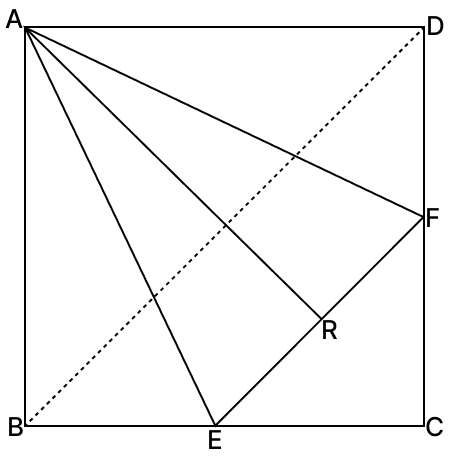
In the given figure, ABCD is a square, EF || BD and R is the mid-point of EF. Prove that:
(i) BE = DF
(ii) AR bisects ∠BAD
(iii) If AR is produced, it will pass through C.
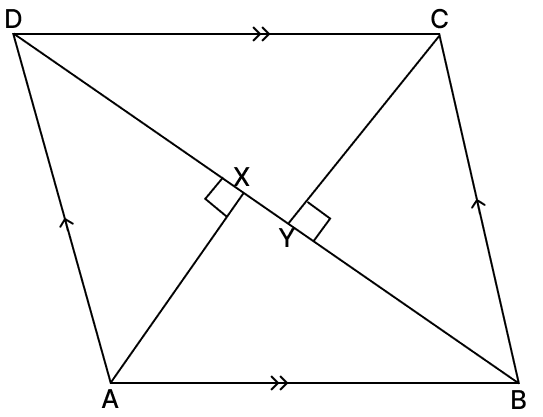
ABCD is a parallelogram in which ∠A and ∠C are obtuse. Points X and Y are taken on diagonal BD such that ∠AXD = ∠CYB = 90°. Prove that : XA = YC.
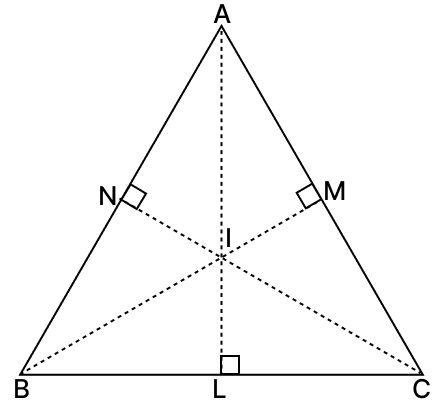
The perpendicular bisectors of the sides of a △ABC meet at I. Prove that : IA = IB = IC.
In a △ABC, AB = AC and ∠A = 50°, find ∠B and ∠C.