Mathematics
If the altitude from one vertex of a triangle bisects the opposite side, prove that the triangle is isosceles.
Triangles
1 Like
Answer
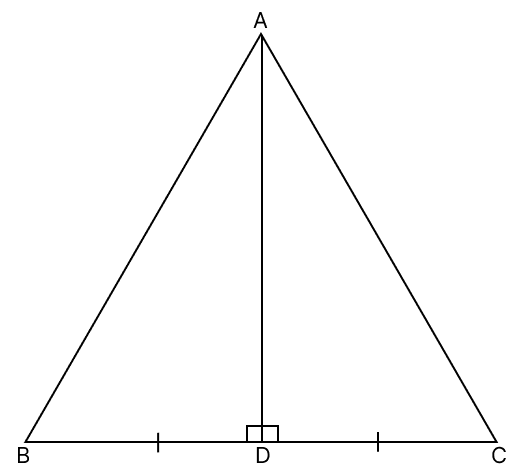
Let ABC be a triangle.
Let AD be a perpendicular from vertex A to base BC, which bisects it, i.e. DB = DC.
In △ADB and △ADC,
⇒ AD = AD (Common side)
⇒ BD = DC (Given)
⇒ ∠ADB = ∠ADC (Each equal to 90°)
∴ △ADB ≅ △ADC (By S.A.S. axiom)
∴ AB = AC (Corresponding parts of congruent triangles are equal)
∴ Triangle ABC is an isosceles triangle.
Hence, proved that the triangle is isosceles, if the altitude from one vertex of a triangle bisects the opposite side.
Answered By
1 Like
Related Questions
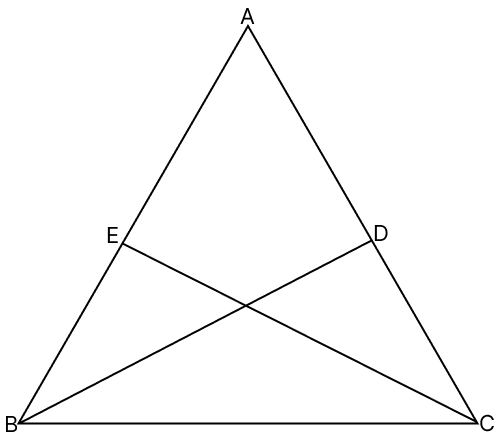
In a △ABC, AB = AC. If the bisectors of ∠B and ∠C meet AC and AB at points D and E respectively, show that :
(i) △DBC ≅ △ECB
(ii) BD = CE
In an isosceles triangle, prove that the altitude from the vertex bisects the base.
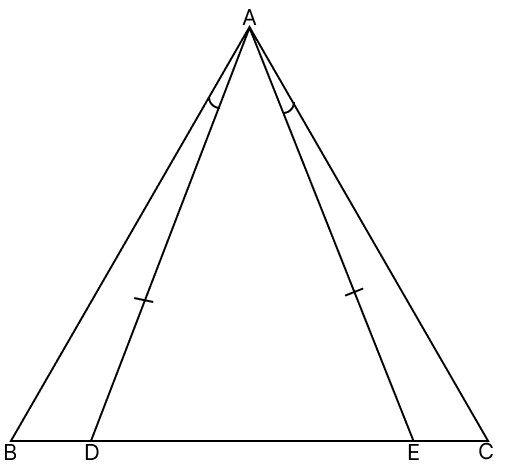
In the given figure, AD = AE and ∠BAD = ∠CAE. Prove that : AB = AC.
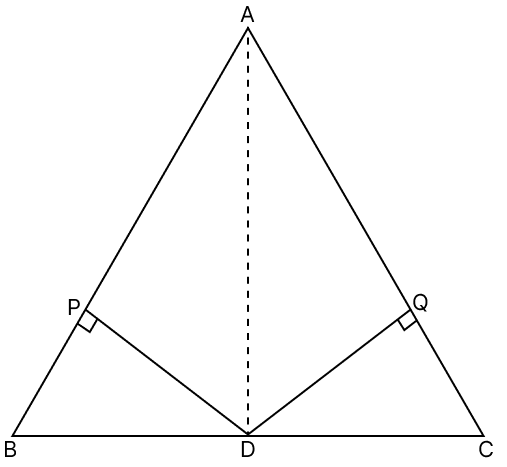
In the given figure, AB = AC; D is the mid-point of BC; DP ⊥ BA and DQ ⊥ CA. Prove that:
(i) DP = DQ
(ii) AP = AQ
(iii) AD bisects ∠A