
Chemistry
Assertion (A): Few drops of dilute hydrochloric acid is added to a solution of iron sulphide, a colourless gas is formed with a rotten egg odour.
Reason (R): The gas formed does not turn moist lead acetate paper silvery black.
- Both A and R are true and R is the correct explanation of A.
- Both A and R are true but R is not the correct explanation of A.
- A is true but R is false.
- A is false but R is true.
Hydrogen Chloride
13 Likes
Answer
Both A and R are true and R is the correct explanation of A.
Reason — When you add dilute acid like HCl to zinc sulphide (ZnS), a colourless H2S gas is formed with the a rotten egg odour. Hence, the assertion (A) is true.
Hydrogen sulphide gas (H2S) does react with moist lead acetate paper. It turns the paper silvery black (or brownish-black) due to the formation of lead sulphide (PbS). Hence, reason (R) is false.
Answered By
8 Likes
Related Questions
The statements below show the results when three metal strips, P, Q, and R, are placed in blue copper sulphate solution.
P — Solution turns green. Q — Solution becomes colourless. R — Solution remains blue.
Which of the following metals could be P, Q, and R?
- P-Al, Q-Zn, R- Fe
- P-Zn, Q-Fe, R- Ag
- P-Fe, Q-Zn, R-Ag
- P- Zn, Q-AI, R– Fe
Study the below diagram and choose the correct option related to the content given below:
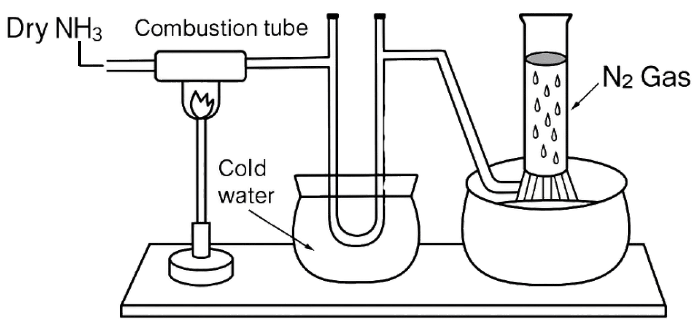
Compound X reacts with ammonia in the combustion tube, which leaves a residue Y. Identify X and Y, as well as the property Z of ammonia demonstrated in this particular reaction.
- X= CuO, Y=black, Z = reducing property.
- X=PbO, Y = yellow, Z=oxidising property.
- X=CuO, Y =yellow, Z =oxidising property.
- X=PbO, Y=black, Z=reducing property.
Assertion (A): Hall Heroult’s process is used to get pure aluminium from its oxide.
Reason (R): Aluminium generally is not found in aluminium oxide form.
- Both A and R are correct.
- A is correct, but R is not a true explanation of A.
- A is correct, and R is a true explanation of B.
- Both A and R are incorrect.
Assertion (A): Alkenes, alkynes and alkanes are examples of homologous series.
Reason (R): Organic compounds of the homologous series have similar structures but different chemical properties.
- Both A and R are true.
- Both A and R are false.
- A is true but R is not the correct explanation of A.
- A is false but R is true.