
Chemistry
The statements below show the results when three metal strips, P, Q, and R, are placed in blue copper sulphate solution.
P — Solution turns green. Q — Solution becomes colourless. R — Solution remains blue.
Which of the following metals could be P, Q, and R?
- P-Al, Q-Zn, R- Fe
- P-Zn, Q-Fe, R- Ag
- P-Fe, Q-Zn, R-Ag
- P- Zn, Q-AI, R– Fe
Electrolysis
10 Likes
Answer
P-Fe, Q-Zn, R-Ag
Reason — P is Fe and Q is Zn, because they are more reactive and present above Cu in activity series, so Fe and Zn displace Cu2+ and forms Fe2+ and Zn2+ respectively. Fe2+ gives pale green colour and the blue colour fades when Zn displaces Cu.
R is Ag, as it is less reactive than Cu and cannot displace Cu, so solution stays blue.
Answered By
5 Likes
Related Questions
Which of the following arrangements is INCORRECT as per the property stated against it?
- Li > Be > N > O (Metallic character)
- CI > F > Br > I (Electron gain enthalpy)
- O2- > F - > Mg2+ > Na+(Ionic radii)
- I > Br > CI > F (Number of shells)
Baking soda (NaHCO3), when added to vinegar, evolves a gas. Which of these statements is true about the evolution of gas?
I. It turns limewater milky.
II. It extinguishes the burning splinter.
III. It acts as a non-metallic oxide
IV. It has a pungent odour.- I and IV
- I and II
- I, II and III
- III and IV
Study the below diagram and choose the correct option related to the content given below:
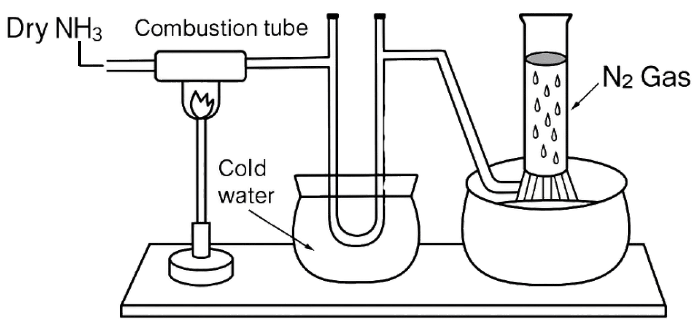
Compound X reacts with ammonia in the combustion tube, which leaves a residue Y. Identify X and Y, as well as the property Z of ammonia demonstrated in this particular reaction.
- X= CuO, Y=black, Z = reducing property.
- X=PbO, Y = yellow, Z=oxidising property.
- X=CuO, Y =yellow, Z =oxidising property.
- X=PbO, Y=black, Z=reducing property.
Assertion (A): Few drops of dilute hydrochloric acid is added to a solution of iron sulphide, a colourless gas is formed with a rotten egg odour.
Reason (R): The gas formed does not turn moist lead acetate paper silvery black.
- Both A and R are true and R is the correct explanation of A.
- Both A and R are true but R is not the correct explanation of A.
- A is true but R is false.
- A is false but R is true.