Mathematics
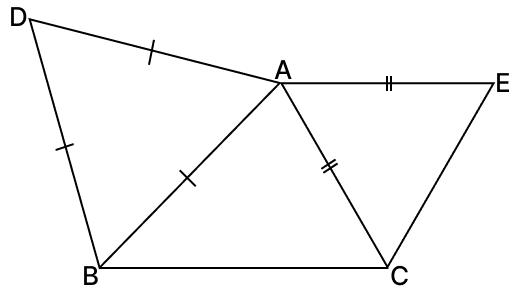
Equilateral triangle ABD and ACE are drawn on the sides AB and AC of △ABC as shown in the figure. Prove that :
(i) ∠DAC = ∠EAB
(ii) DC = BE
Triangles
2 Likes
Answer
(i) Given,
△ABD and △ACE are equilateral triangles.
⇒ ∠DAB = ∠ABD = ∠BDA = ∠EAC = ∠ACE = ∠CEA = 60°
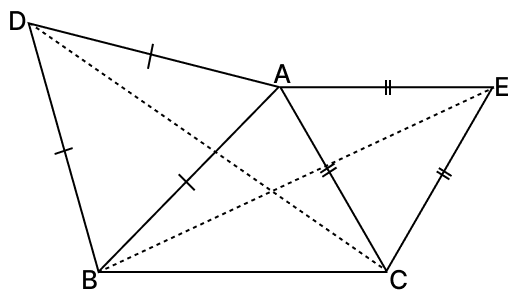
From figure,
∠DAC = ∠DAB + ∠BAC
⇒ ∠DAC = 60° + ∠BAC …..(1)
∠EAB = ∠EAC + ∠BAC
⇒ ∠EAB = 60° + ∠BAC …..(2)
From eq.(1) and (2), we have :
⇒ ∠EAB = ∠DAC
Hence, proved that, ∠EAB = ∠DAC.
(ii) In △DAC and △BAE,
⇒ ∠EAB = ∠DAC (Proved above)
⇒ AD = AB (Sides of an equilateral triangle)
⇒ AC = AE (Sides of an equilateral triangle)
∴ △DAC ≅ △BAE (By S.A.S axiom)
∴ DC = BE (Corresponding parts of congruent triangles are equal)
Hence, proved that DC = BE.
Answered By
3 Likes
Related Questions
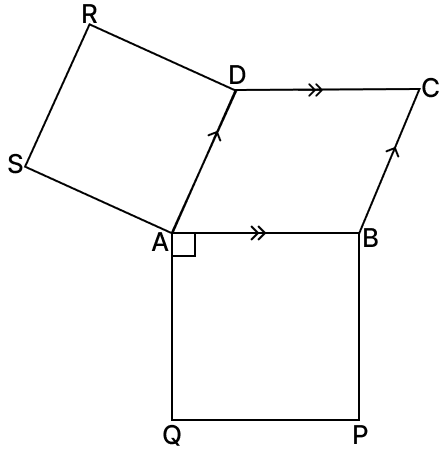
Squares ABPQ and ADRS are drawn on the sides AB and AD of a parallelogram ABCD. Prove that:
(i) ∠SAQ = ∠ABC
(ii) SQ = AC.
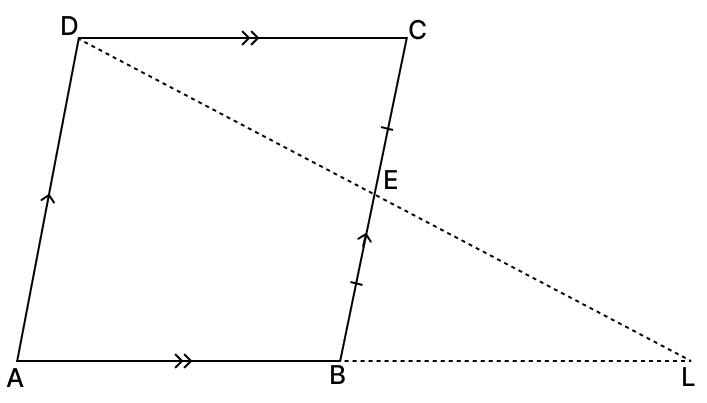
In the given figure, ABCD is a parallelogram, E is the mid-point of BC. DE produced meets AB produced at L. Prove that:
(i) AB = BL
(ii) AL = 2DC
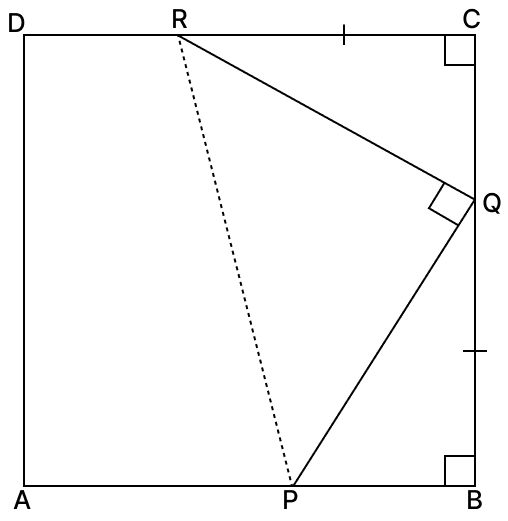
In the given figure, ABCD is a square and P, Q, R are points on AB, BC and CD respectively such that AP = BQ = CR and ∠PQR = 90°. Prove that:
(i) PB = QC
(ii) PQ = QR
(iii) ∠QPR = 45°
In the given figure, ABCD is a square, EF || BD and R is the mid-point of EF. Prove that:
(i) BE = DF
(ii) AR bisects ∠BAD
(iii) If AR is produced, it will pass through C.