
Chemistry
The figure given below illustrates the apparatus used in the laboratory preparation of nitric acid.
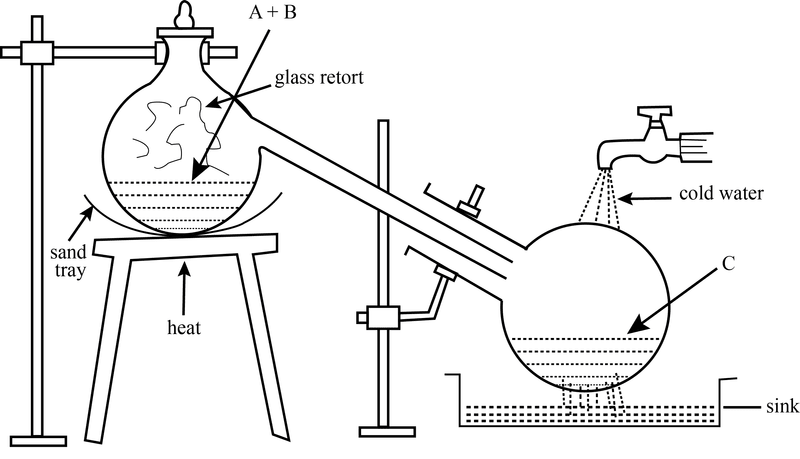
(a) Name A (a liquid), B (a solid) and C (a liquid). (Do not give the formulae).
(b) Write a balanced chemical equation for the above preparation.
(c) Why is an all glass apparatus used ?
(d) The acid prepared is yellow in colour. Why?
(e) How is this colour removed?
Nitric Acid
3 Likes
Answer
(a)
A — Concentrated sulphuric acid,
B — Sodium nitrate or potassium nitrate
C — Nitric acid.
(b)
(c) All glass apparatus is used in the laboratory preparation of nitric acid since the vapours of nitric acid being highly corrosive attack rubber, cork, etc.
(d) Pure nitric acid [HNO3] is colourless and unstable and decomposes slightly even at ordinary temperatures and in the presence of sunlight. The decomposition results in formation of reddish brown nitrogen dioxide [NO2] which remains dissolved in the acid thus imparting a slight yellowish brown colour.
(e) If dry air or CO2 is bubbled through the yellow acid, the latter turns colourless because it drives out NO2 from warm acid which is further oxidised to nitric acid.
Answered By
1 Like
Related Questions
A strong electrolyte is:
- Alcohol
- Potassium hydroxide
- Ammonium hydroxide
- Glucose
The salt which in solution gives a pale green precipitate with sodium hydroxide solution and a white precipitate with barium chloride solution is:
- Iron (III) sulphate
- Iron (II) sulphate
- Iron (II) chloride
- Iron (III) chloride
Match Column A with Column B.
Column A Column B (a) Acid Salt (i) Black in colour (b) Manganese dioxide (ii) Brown ppt. (c) Lead hydroxide (iii) Hydrogen chloride (d) Ferric hydroxide (iv) Calcium hydrogen carbonate (e) Polar compound (v) Soluble in excess sodium hydroxide Complete the following by choosing the correct answers from the bracket:
(a) HCl in the liquefied form is …………… [neutral / acidic]
(b) Organic compounds are generally soluble in ……………[Water / Organic solvents]
(c) An inert electrode used in electrolysis of copper sulphate solution is …………… [Copper/platinum]
(d) Hydrocarbons having triple bond is …………… [alkenes/alkynes]
(e) An acidic gas gives dense white fumes of …………… [NH4OH/NH4C1] with ammonia.