
Chemistry
A strong electrolyte is:
- Alcohol
- Potassium hydroxide
- Ammonium hydroxide
- Glucose
Electrolysis
1 Like
Answer
Potassium hydroxide
Reason — When dissolved in water, a strong electrolyte entirely dissociates into ions, making it an excellent electrical conductor.
| Compound | Type | Electrolyte strength | Explanation |
|---|---|---|---|
| Alcohol | Covalent compound | Non-electrolyte | Does not ionize in water |
| Potassium hydroxide | Ionic compound (Strong base) | Strong electrolyte | Completely dissociates into K+ and OH- in water |
| Ammonium hydroxide | Weak base | Weak electrolyte | Partially ionizes in water |
| Glucose | Covalent organic compound | Non-electrolyte | Dissolves but does not form ions in water |
Answered By
2 Likes
Related Questions
The organic compound prepared when calcium carbide reacts with water:
- Methane
- Ethane
- Acetylene
- Ethene
The IUPAC name of acetylene is:
- Propyne
- Ethene
- Propane
- Ethyne
The salt which in solution gives a pale green precipitate with sodium hydroxide solution and a white precipitate with barium chloride solution is:
- Iron (III) sulphate
- Iron (II) sulphate
- Iron (II) chloride
- Iron (III) chloride
The figure given below illustrates the apparatus used in the laboratory preparation of nitric acid.
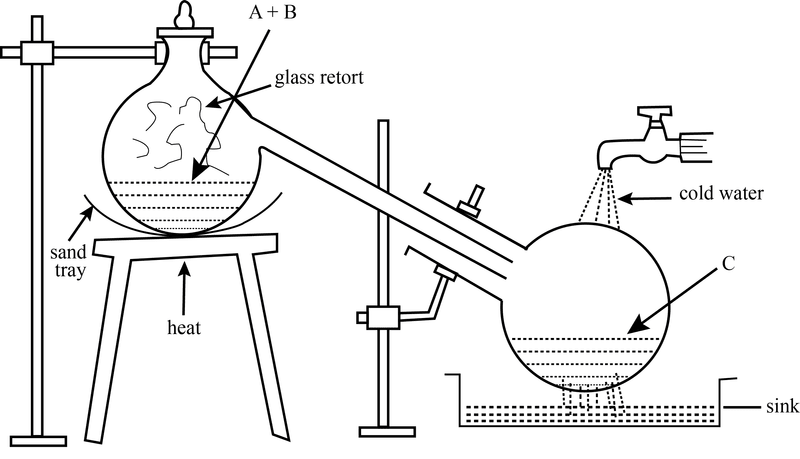
(a) Name A (a liquid), B (a solid) and C (a liquid). (Do not give the formulae).
(b) Write a balanced chemical equation for the above preparation.
(c) Why is an all glass apparatus used ?
(d) The acid prepared is yellow in colour. Why?
(e) How is this colour removed?