
Chemistry
The salt which in solution gives a pale green precipitate with sodium hydroxide solution and a white precipitate with barium chloride solution is:
- Iron (III) sulphate
- Iron (II) sulphate
- Iron (II) chloride
- Iron (III) chloride
Practical Chemistry
2 Likes
Answer
Iron (II) sulphate
Reason — Iron (II) sulphate (FeSO4) reacts with NaOH to give pale green precipitate of ferrous hydroxide.
The sulphate ion (SO42-) from FeSO4 reacts with BaCl2 to form, white precipitate of BaSO4
Ba2+ + SO42- ⟶ BaSO4
Answered By
2 Likes
Related Questions
The IUPAC name of acetylene is:
- Propyne
- Ethene
- Propane
- Ethyne
A strong electrolyte is:
- Alcohol
- Potassium hydroxide
- Ammonium hydroxide
- Glucose
The figure given below illustrates the apparatus used in the laboratory preparation of nitric acid.
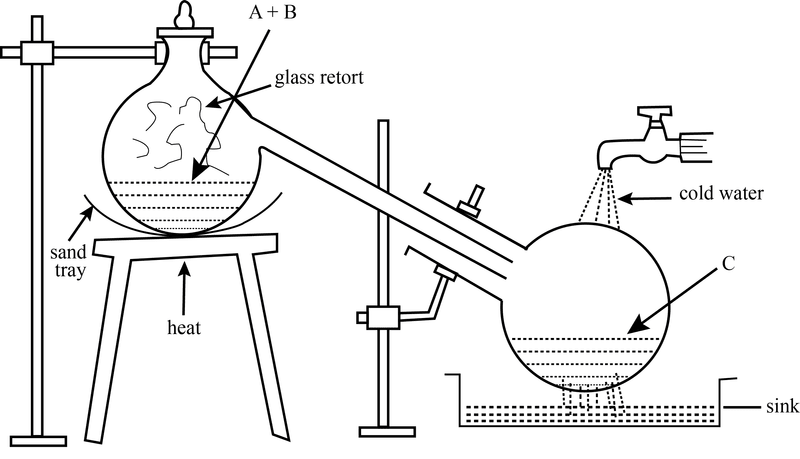
(a) Name A (a liquid), B (a solid) and C (a liquid). (Do not give the formulae).
(b) Write a balanced chemical equation for the above preparation.
(c) Why is an all glass apparatus used ?
(d) The acid prepared is yellow in colour. Why?
(e) How is this colour removed?
Match Column A with Column B.
Column A Column B (a) Acid Salt (i) Black in colour (b) Manganese dioxide (ii) Brown ppt. (c) Lead hydroxide (iii) Hydrogen chloride (d) Ferric hydroxide (iv) Calcium hydrogen carbonate (e) Polar compound (v) Soluble in excess sodium hydroxide