
Mathematics
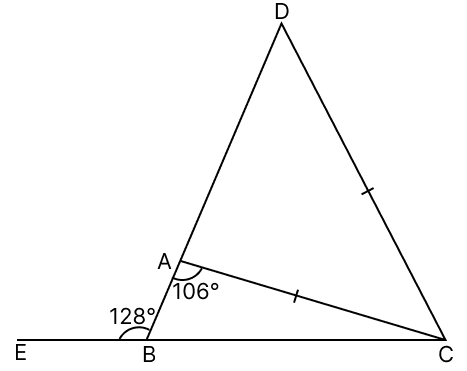
In the given figure, side BA of △ABC has been produced to D such that CD = CA and side CB has been produced to E. If ∠BAC = 106° and ∠ABE = 128°, find ∠BCD.
Triangles
2 Likes
Answer
From figure,
⇒ ∠ABE + ∠ABC = 180° (Linear pair)
⇒ 128° + ∠ABC = 180°
⇒ ∠ABC = 180° - 128°
⇒ ∠ABC = 52°
In △ABC,
By angle sum property of triangle,
⇒ ∠ABC + ∠BAC + ∠ACB = 180°
⇒ 52° + 106° + ∠ACB = 180°
⇒ 158° + ∠ACB = 180°
⇒ ∠ACB = 180° - 158°
⇒ ∠ACB = 22°.
From figure,
⇒ ∠BAC + ∠CAD = 180° (Linear pair)
⇒ 106° + ∠CAD = 180°
⇒ ∠CAD = 180° - 106°
⇒ ∠CAD = 74°.
Given,
CD = CA
⇒ ∠CAD = ∠CDA = 74° (Angles opposite to equal sides in a triangle are equal)
In triangle CAD,
By angle sum property of triangle,
⇒ ∠ACD + ∠CAD + ∠CDA = 180°
⇒ ∠ACD + 74° + 74° = 180°
⇒ ∠ACD + 148° = 180°
⇒ ∠ACD = 180° - 148°
⇒ ∠ACD = 32°.
From figure,
∠BCD = ∠ACB + ∠ACD
= 22° + 32°
= 54°.
Hence, ∠BCD = 54°.
Answered By
2 Likes
Related Questions
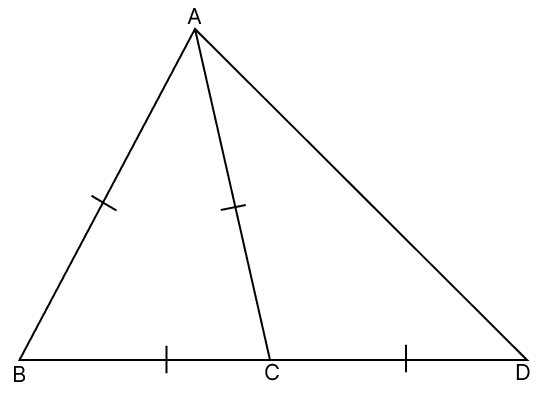
In the given figure, △ABC is an equilateral triangle whose base BC is produced to D such that BC = CD. Calculate :
(i) ∠ACD
(ii) ∠ADC
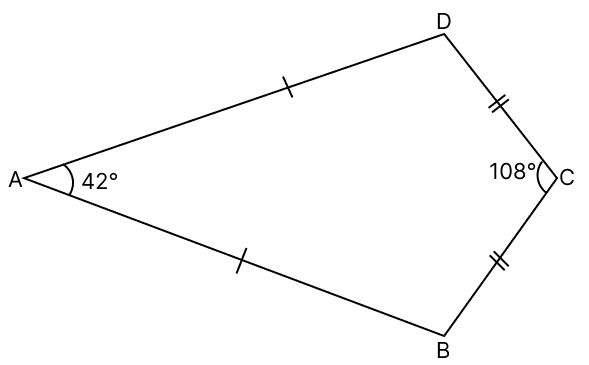
In the given figure, AB = AD; CB = CD; ∠A = 42° and ∠C = 108°, find ∠ABC.
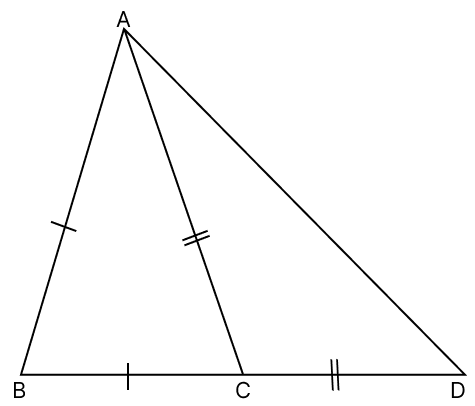
In the given figure, AB = BC and AC = CD. Show that: ∠BAD : ∠ADB = 3 : 1
Show that the perpendiculars drawn from the extremities of the base of an isosceles triangle to the opposite sides are equal.