
Physics
Mechanical advantage is the ratio of load lifted by a machine to the effort applied. Every simple machine has a mechanical advantage. The effort and load of some machines are given. Calculate the MA of each machine.
| Machine | Effort (N) | Load (N) | Mechanical Advantage |
|---|---|---|---|
| A | 20 | 60 | |
| B | 140 | 70 | |
| C | 10 | 100 | |
| D | 5 | 25 | |
| E | 15 | 45 | |
| F | 120 | 60 |
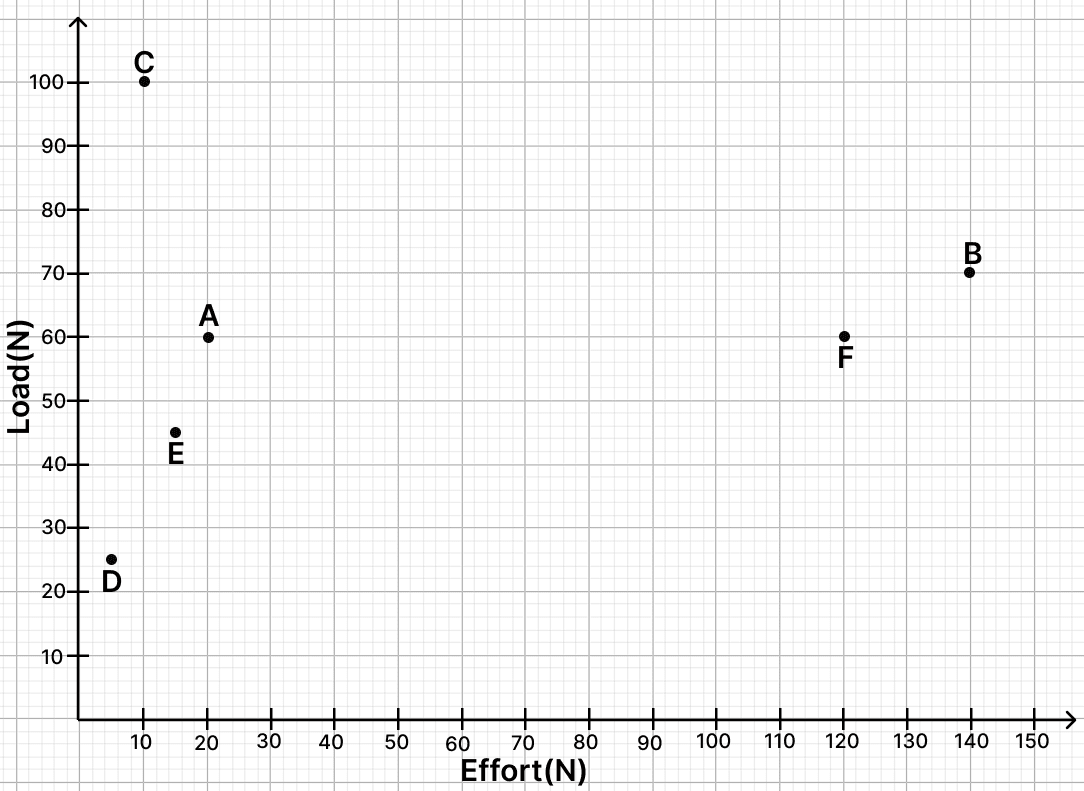
Draw a line graph of the given data. Take effort on X-axis and load on Y-axis.
Machines
3 Likes
Answer
As,
For machine A
So, mechanical advantage of the machine A is 3.
For machine B
So, mechanical advantage of the machine B is 0.5.
For machine C
So, mechanical advantage of the machine C is 10.
For machine D
So, mechanical advantage of the machine D is 5.
For machine E
So, mechanical advantage of the machine E is 3.
For machine F
So, mechanical advantage of the machine F is 0.5.
On summarizing all results in the table :
| Machine | Effort (N) | Load (N) | Mechanical Advantage |
|---|---|---|---|
| A | 20 | 60 | 3 |
| B | 140 | 70 | 0.5 |
| C | 10 | 100 | 10 |
| D | 5 | 25 | 5 |
| E | 15 | 45 | 3 |
| F | 120 | 60 | 0.5 |
The line graph of the given data is shown below :
Answered By
3 Likes
Related Questions
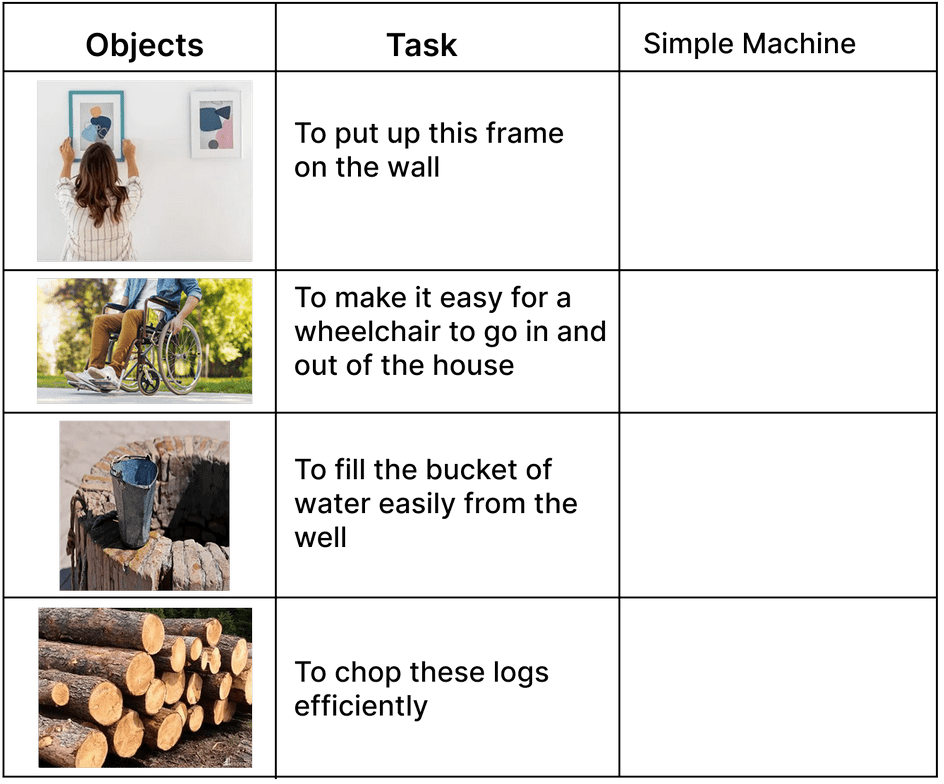
Simple machines can be commonly found in your surroundings. Some objects are given. Which simple machines will you use to get the following tasks done?
Tina and her younger brother are playing in the garden. They see the gardener using a few tools. Tina recognises the wheelbarrow that the gardener is using. She also sees the gardener using a big garden scissor. Meanwhile, she sees that her younger brother is running to pick the axe that is lying around. Tina stops him and tells him it's dangerous.
Now, answer the following questions.
(a) Which simple machine is used in a scissor?
(b) Which simple machine is used in a wheelbarrow?
(c) Which simple machine is used in an axe?
(d) Why did Tina call the axe dangerous? Are there any other machines that shouldn't be used without adult's supervision?
Wedges are made up of two inclined planes. How will you find MA of a wedge?
If you want to increase the MA of a machine, what should be increased or decreased?