
Chemistry
State the 'law of conservation of mass'. State the main points of Landolt's experiment for experimental evidence of the law. State the limitations of the law.
Matter
37 Likes
Answer
Law of conservation of mass
Law of conservation of mass states that whenever a chemical change takes place, the total mass of the reacting substances is exactly equal to the total mass of the products, [provided masses are measured under similar conditions].
Main points of Landolt's experiment
- In an 'H' shaped tube as shown in the figure, Landolt introduced a solution of sodium chloride [NaCl] and silver nitrate [AgNO3] in the limbs of the tube and sealed it and weighed it.
- The solutions were mixed by shaking to obtain a white precipitate of silver chloride.
- The tube was again weighed after the experiment.
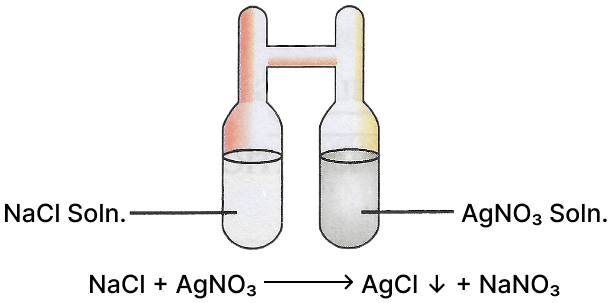
Result : Weight of H tube + reactants = Weight of H tube + products.
Hence, total mass of reactants = total mass of products
Limitations of the law
- Chemical energy stored up in the reactants is released in the form of heat and light.
- Hence, mass is converted to energy and thus mass and energy are to be considered together.
- Hence, a very slight error in the experiment was observed.
Answered By
25 Likes
Related Questions
With reference to inter-conversion of matter - on the basis of kinetic theory - explain in brief the conversion of:
(a) A solid into a liquid
(b) A liquid into vapour [or gas]
(c) Vapour [or gas] into a liquid
(d) A liquid into a solid
With special reference to inter-particle space & inter-particle attraction at the different stages of conversion.
On the basis of kinetic theory explain why, ammonium chloride sublimes and goes from solid state directly into vapour state.
Select the correct answer from A, B, C, D & E for each statement given below:
A: Solid
B: Vaporization
C: Ion
D: Gases
E: Heat
An atom or group of atoms — having a resultant charge.
The state of matter which has — least density & no free surfaces.
In Landolt's experiment — the form in which the chemical energy stored up in the reactants — is released.
The process of change of a liquid into vapour [gas] on heating.
The state of matter, where the inter-particle attraction between particles is maximum.
With reference to the liquid state of matter — answer the following:
On heating the liquid, do the particles gain or lose energy.
The heat energy supplied to the liquid is absorbed by its molecule & stored as which form of energy.
How does the stored energy, have effect on inter-particle space.
State why the inter-particle attraction decreases to negligible.
At what point will the particles become free and escape as gas.