
The volume of a cuboid is 4800 cm3. If its length is 24 cm and breadth is 20 cm; its height is :
5 cm
10 cm
12 cm
15 cm
Answer
Given:
The length of the cuboid = 24 cm.
The breadth of the cuboid = 20 cm.
Let h be the height of the cuboid.
The volume of a cuboid is 4800 cm3.
As we know that volume of cuboid = length x breadth x height
⇒ 24 x 20 x h = 4800 cm3
⇒ 480 x h = 4800
⇒ h =
⇒ h = 10 cm
Hence, option 2 is the correct option.
The length, breadth and height of cuboid are in the ratio 3 : 2 : 1 and its volume is 162 cm3; the longest side of the cuboid is:
6 cm
9 cm
18 cm
54 cm
Answer
Given:
The length, breadth and height of cuboid are in the ratio 3 : 2 : 1.
The volume of the cuboid = 162 cm3.
Let the length, breadth and height of cuboid be 3a, 2a and a, respectively.
As we know that volume of cuboid = length x breadth x height
⇒ 3a x 2a x a = 162 cm3
⇒ 6a3 = 162
⇒ a3 =
⇒ a3 = 27
⇒ a =
⇒ a = 3 cm
Largest length of the cuboid = 3a
= 3 x 3 cm
= 9 cm
Hence, option 2 is the correct option.
The length of a cuboid is doubled, breadth is halved and height is tripled, the volume of the cuboid will become :
1.5 times
2 times
three times
six times
Answer
Let l, b and h be the length, breadth and height of the cuboid.
So, new length, breadth and height are 2l, and 3h.
As we know that volume of cuboid = length x breadth x height
= l x b x h
= lbh
Volume of new cuboid =
=
=
Hence, option 3 is the correct option.
Each side of a cube is tripled, its surface area will become :
3 times
six times
nine times
27 times
Answer
Let s be the side of the cube.
So, side of new cube = 3s
As we know that surface area of the cube = 6 x (side)2
= 6s2
The surface area of new cube = 6 x (3s)2
= 6 x 9s2
= 9 x 6s2
= 9 x Surface area of the cube
Hence, option 3 is the correct option.
A cuboid has a total surface area of 80 m2 and the lateral surface area of 50 m2; the area of its base is :
30 m2
60 m2
15 m2
10 m2
Answer
The total surface area of the cuboid = 80 m2
The lateral surface area of the cuboid = 50 m2
As we know, the total surface area of the cuboid = 2(l x b + b x h + h x l)
⇒ 80 = 2(l x b + b x h + h x l)
⇒ 80 = 2(l x b) + 2(b x h) + 2(h x l) ..............(1)
The lateral surface area of the cuboid = 2(l + b)h = 2(l x h + b x h)
⇒ 50 = 2(l x h) + 2(b x h) ..............(2)
And, area of base = l x b
Putting the value of 2(l x h) + 2(b x h) from equation (2) in equation (1), we get
⇒ 80 = 2(l x b) + 50
⇒ 2(l x b) = 80 - 50
⇒ 2(l x b) = 30
⇒ l x b =
⇒ l x b = 15 m2
Hence, option 3 is the correct option.
The length, the breadth and the height of a cuboid are in the ratio 5 : 3 : 2. If its volume is 240 cm3, find its dimensions. Also, find the total surface area of the cuboid.
Answer
Given:
The length, breadth and height of a cuboid are in the ratio 5 : 3 : 2.
The volume of the cuboid = 240 cm3.
Let the length, breadth and height of cuboid be 5a, 3a and 2a.
As we know that the volume of the cuboid = l x b x h
⇒ 5a x 3a x 2a = 240 cm3
⇒ 30a3 = 240
⇒ a3 =
⇒ a3 = 8
⇒ a =
⇒ a = 2 cm
Thus, the length of the cuboid = 5a = 5 x 2 = 10 cm
Breadth of the cuboid = 3a = 3 x 2 = 6 cm
Height of the cuboid = 2a = 2 x 2 = 4 cm
As we know, the total surface area of the cuboid = 2(l x b + b x h + h x l)
= 2(10 x 6 + 6 x 4 + 4 x 10) cm2
= 2(60 + 24 + 40) cm2
= 2 x 124 cm2
= 248 cm2
Hence, the dimensions of the cuboid are 10 cm , 6 cm and 4 cm and the total surface area is 248 cm2.
The length, breadth and height of a cuboid are in the ratio 6 : 5 : 3. If its total surface area is 504 cm2, find its dimensions. Also, find the volume of the cuboid.
Answer
Given:
The length, breadth and height of a cuboid are in the ratio 6 : 5 : 3.
The total surface area of the cuboid = 504 cm2.
Let the length, breadth and height of cuboid be 6a, 5a and 3a.
As we know, the total surface area of the cuboid = 2(l x b + b x h + h x l)
⇒ 2(6a x 5a + 5a x 3a + 3a x 6a) = 504
⇒ 2(30a2 + 15a2 + 18a2) = 504
⇒ 2 x 63a2 = 504
⇒ 126a2 = 504
⇒ a2 =
⇒ a2 = 4
⇒ a =
⇒ a = 2
Thus, length of the cuboid = 6a = 6 x 2 cm = 12 cm
Breadth of the cuboid = 5a = 5 x 2 cm = 10 cm
Height of the cuboid = 3a = 3 x 2 cm = 6 cm
As we know that volume of cuboid = l x b x h
= 12 x 10 x 6 cm3
= 720 cm3
Hence, the dimensions of the cuboid are 12 cm , 10 cm and 6 cm and the volume is 720 cm3.
Find the length of each edge of a cube, if its volume is :
(i) 216 cm3
(ii) 1.728 m3
Answer
(i) Given:
Volume of the cube = 216 cm3
Let s be the side of cube.
As we know that volume of cube = side3
⇒ s3 = 216
⇒ s =
⇒ s = 6 cm
Hence, the length of each edge of cube is 6 cm.
(ii) Given:
Volume of the cube = 1.728 m3
Let s be the side of cube.
As we know that volume of cube = side3
⇒ s3 = 1.728
⇒ s =
⇒ s = 1.2 m
Hence, the length of each edge of cube is 1.2 m.
The total surface area of a cube is 216 cm2. Find its volume.
Answer
Given:
The total surface area of a cube = 216 cm2
Let s be the side of cube.
As we know that total surface area of cube = 6 x side2
⇒ 6 x s2 = 216
⇒ s2 =
⇒ s2 = 36
⇒ s =
⇒ s = 6 cm
The volume of cube = side3
= 63
= 216 cm3
Hence, the volume of the cube is 216 cm3.
A wall 9 m long, 6 m high and 20 cm thick, is to be constructed using bricks of dimensions 30 cm, 15 cm and 10 cm. How many bricks will be required ?
Answer
Given:
The length of the wall = 9 m.
The height of the wall = 6 m.
The breadth of the wall = 20 cm = 0.2 m.
As we know that volume of wall = length x breadth x height
= 9 x 6 x 0.2 m3
= 10.8 m3
The length of the brick = 30 cm = 0.3 m.
The breadth of the brick = 15 cm = 0.15 m.
The height of the brick = 10 cm = 0.1 m.
As we know that volume of one brick = length x breadth x height
= 0.3 x 0.15 x 0.1 m3
= 0.0045 m3
Let a be the number of bricks.
Number of bricks =
⇒ a =
⇒ a =
⇒ a = 2400
Hence, the number of bricks required to construct the wall is 2400.
A solid cube of edge 14 cm is melted down and recast into smaller and equal cubes each of edge 2 cm. Find the number of smaller cubes obtained.
Answer
Side of solid cube = 14 cm
As we know, the volume of a solid cube = side3
= (14)3 cm3
= 2,744 cm3
Side of the smaller cube = 2 cm
Volume of the small cube = side3
= 23 cm3
= 8 cm3
Let a be the number of smaller cubes.
Volume of the solid cube = Volume of small cube x Number of smaller cubes
⇒ 2,744 = 8 x a
⇒ a =
⇒ a = 343
Hence, the number of smaller cubes obtained is 343.
A closed box is a cuboid in shape with length = 40 cm, breadth = 30 cm and height = 50 cm. It is made of thin metal sheet. Find the cost of metal sheets required to make 20 such boxes, if 1 m2 of metal sheet costs ₹ 45.
Answer
Given:
The length of the closed box = 40 cm = 0.4 m.
The breadth of the closed box = 30 cm = 0.3 m.
The height of the closed box = 50 cm = 0.5 m.
As we know, the total surface area of the cuboid = 2(l x b + b x h + h x l)
= 2(0.4 x 0.3 + 0.3 x 0.5 + 0.5 x 0.4) m2
= 2(0.12 + 0.15 + 0.2) m2
= 2 x 0.47 m2
= 0.94 m2
Total surface area of 20 boxes = Surface area of 1 box 20
= 0.94 x 20 m2
= 18.8 m2
Cost of 1 m2 sheet = ₹ 45
Total cost = Total surface area x Cost of 1 m2 sheet
= ₹ 18.8 x 45
= ₹ 846
Hence, the total cost of the sheet is ₹ 846.
Four cubes, each of edge 9 cm, are joined as shown below :
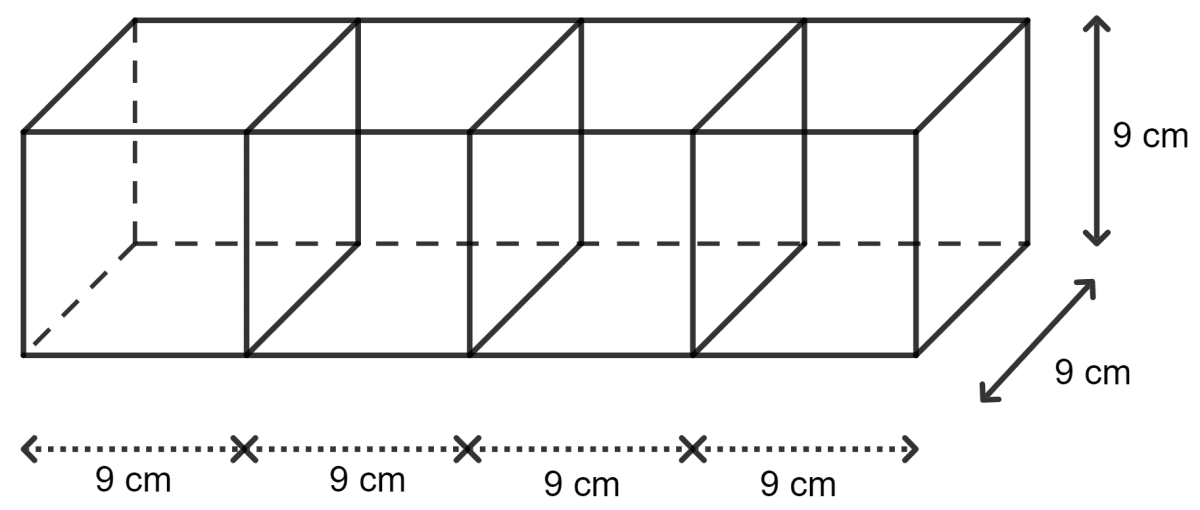
Write the dimensions of the cuboid obtained. Also, find total surface area and volume.
Answer
Since the length (l) of the cuboid = 4 x 9 cm = 36 cm,
its breadth (b) = 9 cm and its height (h) = 9 cm
As we know, the total surface area of the cuboid = 2(l x b + b x h + h x l)
= 2(36 x 9 + 9 x 9 + 9 x 36) cm2
= 2(324 + 81 + 324) cm2
= 2 x 729 cm2
= 1,458 cm2
As we know, the volume of cuboid = l x b x h
= 36 x 9 x 9 cm3
= 2,916 cm3
Hence, the dimensions of the cuboid are 36 cm, 9cm and 9 cm, the total surface area is 1,458 cm2 and the volume is 2,916 cm3.
What is the maximum length of a rod which can be kept in a rectangular box with internal dimensions 32 cm x 24 cm x 8 cm.
Answer
Given:
The length of the rectangular box = 32 cm
The breadth of the rectangular box = 24 cm
The height of the rectangular box = 8 cm
Maximum length of the rod = Length of diagonal
Length of diagonal =
Hence, the maximum length of a rod that can be kept in the rectangular box is 40.79 cm.
The diagonal of a cube is m. Find its surface area.
Answer
Given:
The diagonal of a cube = m
Let s be the side of cube.
As we know that the diagonal of the cube = x side
As we know, the surface area of cube = 6 x side2
= 6 x (25)2 m2
= 6 x 625 m2
= 3,750 m2
Hence, the surface area of the cube is 3,750 m2.
A rectangular room is 4.5 m long, 4 m wide and 3 m high. Find the cost of white washing its walls and the roof at ₹ 15 per square metre.
Answer
Given:
The length of the rectangular room = 4.5 m
The breadth of the rectangular room = 4 m
The height of the rectangular room = 3 m
Area of white washing its walls and the roof = l x b + 2(l + b)h m2
= 4.5 x 4 + 2(4.5 + 4)3 m2
= 18 + 2 x 8.5 x 3 m2
= 18 + 51 m2
= 69 m2
Rate of white wash = ₹ 15 per square metre
Total cost of white washing = Area x Rate of white wash
= ₹ 69 x 15
= ₹ 1,035
Hence, the cost of white washing walls and roof of rectangular room is ₹ 1,035.
The dimensions of a hall are 40 m x 25 m x 5 m. The number of persons which can be accommodated in the hall is (each person requires 5 m3 of air) :
1000
2000
5000
2500
Answer
Given:
The dimensions of a hall are 40 m x 25 m x 5 m.
As we know that volume of hall = length x breadth x height
= 40 x 25 x 5 m3
= 5000 m3
Air required by each person = 5 m3
Let a be the total number of persons.
Volume of the hall = number of persons x air required by each person
⇒ 5000 = a x 5
⇒ a =
⇒ a = 1000
Hence, option 1 is the correct option.
The external dimensions of a closed rectangular box are 82 cm x 47 cm x 60 cm. If it is made of wood of 1 cm thickness, the internal dimensions of the box are :
80 cm x 47 cm x 60 cm
82 cm x 45 cm x 60 cm
82 cm x 47 cm x 58 cm
80 cm x 45 cm x 58 cm
Answer
Given:
Outer length of the box = 82 cm
Outer width of the box = 47 cm
Outer height of the box = 60 cm
Thickness of wood = 1 cm
Internal length = 82 - 1 - 1 cm = 82 - 2 cm = 80 cm
Internal width = 47 - 1 - 1 cm = 47 - 2 cm = 45 cm
Internal height = 60 - 1 - 1 cm = 60 - 2 cm = 58 cm
Hence, option 4 is the correct option.
The outer dimensions of a closed small box are 12 cm x 12 cm x 10 cm. If it is made of 1 cm thick walls, its capacity is :
1440 cm3
1000 cm3
640 cm3
800 cm3
Answer
Given:
Outer length of the box = 12 cm
Outer width of the box = 12 cm
Outer height of the box = 10 cm
Thickness of wood = 1 cm
Internal length = 12 - 1 - 1 cm = 12 - 2 cm = 10 cm
Internal width = 12 - 1 - 1 cm = 12 - 2 cm = 10 cm
Internal height = 10 - 1 - 1 cm = 10 - 2 cm = 8 cm
Volume of internal box = l x b x h
= 10 x 10 x 8 cm3
= 800 cm3
Hence, option 4 is the correct option.
A room is 3 m long, 2 m broad and 2 m high. It has one door 2 m x 1 m; two windows each 1 m x 0.5 m; the remaining area of the walls is :
16 m2
17 m2
20 m2
5 m2
Answer
Given:
Dimensions of the room are 3 m long, 2 m broad and 2 m high.
Dimensions of the door are 2 m x 1 m.
Dimensions of the windows are 1 m x 0.5 m.
Remaining area = Total surface area of room - (Area of door + Area of window)
Total surface area of room = 2(l + b)h
= 2(3 + 2)2 m2
= 2 x 5 x 2 m2
= 20 m2
Area of door = l x b
= 2 x 1 m2
= 2 m2
Area of window = l x b
Area of two window = 2 x l x b
= 2 x 1 x 0.5 m2
= 1 m2
Remaining area = 20 - (2 + 1) m2
= 20 - 3 m2
= 17 m2
Hence, option 2 is the correct option.
A room 5 m long, 4.5 m wide and 3.6 m high has one door 1.5 m by 2.4 m and two windows, each 1 m by 0.75 m. Find :
(i) the area of its walls, excluding doors and windows.
(ii) the cost of distempering its walls at the rate of ₹ 4.50 per m2.
(iii) the cost of painting its roof at the rate of ₹ 9 per m2.
Answer
(i) Given:
Dimensions of the room are 5 m long, 4.5 m wide and 3.6 m high.
Dimensions of the door are 1.5 m by 2.4 m.
Dimensions of the windows are 1 m by 0.75 m.
Remaining area = Total surface area of room - (Area of door + Area of window)
Total surface area of room = 2(l + b)h
= 2(5 + 4.5)3.6 m2
= 2 x 9.5 x 3.6 m2
= 68.4 m2
Area of door = l x b
= 1.5 x 2.4 m2
= 3.6 m2
Area of window = l x b
Area of two window = 2 x l x b
= 2 x 1 x 0.75 m2
= 1.5 m2
Remaining area = 68.4 - (3.6 + 1.5) m2
= 68.4 - 5.1 m2
= 63.3 m2
Hence, the area of room's walls, excluding doors and windows is 63.3 m2.
(ii) The rate of distempering = ₹ 4.50 per m2
Total cost = Area of wall x rate of distempering
= ₹ 63.3 x 4.50
= ₹ 284.85
Hence, the cost of distempering the walls of the room is ₹ 284.85.
(iii) The rate of painting = ₹ 9 per m2.
Area of roof = l x b
= 5 x 4.5 m2
= 22.5 m2
Total cost = Area of roof x Rate of painting
= ₹ 22.5 x 9
= ₹ 202.5
Hence, the cost of painting the roof of the room is ₹ 202.5.
The dining hall of a hotel is 75 m long, 60 m broad and 16 m high. It has five doors 4 m by 3 m each and four windows 3 m by 1.6 m each. Find the cost of :
(i) papering its walls at the rate of ₹ 12 per m2;
(ii) carpeting its floor at the rate of ₹ 25 per m2.
Answer
(i) Given:
Dimensions of the room are 75 m long, 60 m broad and 16 m high.
Dimensions of the door are 4 m by 3 m.
Dimensions of the windows are 3 m by 1.6 m.
Remaining area = Total surface area of room - (Area of door + Area of window)
Total surface area of room = 2(l + b)h
= 2(75 + 60)16 m2
= 2 x 135 x 16 m2
= 4,320 m2
Area of door = l x b
Area of 5 doors = 5 x l x b
= 5 x 4 x 3 m2
= 60 m2
Area of window = l x b
Area of four window = 4 x l x b
= 4 x 3 x 1.6 m2
= 19.2 m2
Remaining area = 4,320 - (60 + 19.2) m2
= 4,320 - 79.2 m2
= 4,240.8 m2
The rate of papering = ₹ 12 per m2
Total cost = Area of wall x rate of papering
= ₹ 4,240.8 x 12
= ₹ 50,889.6
Hence, the cost of papering walls of dining hall is ₹ 50,889.6.
(ii) The rate of carpeting = ₹ 25 per m2.
Area of floor = l x b
= 75 x 60 m2
= 4500 m2
Total cost = Area of floor x Rate of carpeting
= ₹ 4500 x 25
= ₹ 112,500
Hence, the cost of carpeting the floor of dining hall is ₹ 112,500.
Find the volume of wood required to make a closed box of external dimensions 80 cm, 75 cm and 60 cm, the thickness of walls of the box being 2 cm throughout.
Answer
Given:
Outer length of the box = 80 cm
Outer width of the box = 75 cm
Outer height of the box = 60 cm
Volume of box = l x b x h
= 80 x 75 x 60 cm3
= 360,000 cm3
Thickness of wood = 2 cm
Internal length = 80 - 2 - 2 cm = 80 - 4 cm = 76 cm
Internal width = 75 - 2 - 2 cm = 75 - 4 cm = 71 cm
Internal height = 60 - 2 - 2 cm = 60 - 4 cm = 56 cm
Volume of internal box = l x b x h
= 76 x 71 x 56 cm3
= 302,176 cm3
Volume of wood required = 360,000 - 302,176 cm3
= 57,824 cm3
Hence, the volume of wood required is 57,824 cm3.
A closed box measures 66 cm, 36 cm and 21 cm from outside. If its walls are made of metal sheet, 0.5 cm thick, find :
(i) the capacity of the box;
(ii) volume of metal sheet used and
(iii) weight of the box, if 1 cm3 of metal weighs 3.6 g.
Answer
(i) Given:
Outer length of the box = 66 cm
Outer width of the box = 36 cm
Outer height of the box = 21 cm
Volume of box = l x b x h
= 66 x 36 x 21 cm3
= 49,896 cm3
Thickness of metal sheet = 0.5 cm
Internal length = 66 - 0.5 - 0.5 cm = 66 - 1 cm = 65 cm
Internal width = 36 - 0.5 - 0.5 cm = 36 - 1 cm = 35 cm
Internal height = 21 - 0.5 - 0.5 cm = 21 - 1 cm = 20 cm
Volume of internal box = l x b x h
= 65 x 35 x 20 cm3
= 45,500 cm3
Hence, the capacity of the box is 45,500 cm3.
(ii) Volume of metal sheet required = 49,896 - 45,500 cm3
= 4,396 cm3
Hence, the volume of metal sheet used is 4,396 cm3.
(iii) Weight of 1 cm3 box = 3.6 g
Weight of 4,396 cm3 box = 3.6 x 4,396 g
= 15,825.6 g
Hence, the weight of the box is 15,825.6 g.
The external length, breadth and height of a closed box are 1 m, 80 cm and 25 cm respectively. If its sides are made of 2.5 cm thick wood, find :
(i) the capacity of the box
(ii) the volume of wood used to make the box.
Answer
(i) Given:
Outer length of the box (L) = 1 m = 100 cm
Outer width of the box (B) = 80 cm
Outer height of the box (H) = 25 cm
Thickness of wood = 2.5 cm
Internal length (l) = 100 - 2.5 - 2.5 cm = 100 - 5 cm = 95 cm
Internal width (b) = 80 - 2.5 - 2.5 cm = 80 - 5 cm = 75 cm
Internal height (h) = 25 - 2.5 - 2.5 cm = 25 - 5 cm = 20 cm
Volume of internal box = l x b x h
= 95 x 75 x 20 cm3
= 142,500 cm3
Hence, the capacity of the box is 142,500 cm3.
(ii) Volume of external box = L x B x H
= 100 x 80 x 25 cm3
= 200,000 cm3
Volume of wood used = Volume of external box - Volume of internal box
200,000 - 142,500 cm3
= 57,500 cm3
Hence, the volume of wood used is 57,500 cm3.
Find the area of metal sheet required to make an open tank of length = 10 m, breadth = 7.5 m and depth = 3.8 m.
Answer
Given:
Length of the tank = 10 m
Breadth of the tank = 7.5 m
Height of the tank = 3.8 m
Area of metal sheet = Area of 4 walls of the tank + area of its base
= 2(l + b)h + l x b
= 2(10 + 7.5)3.8 + 10 x 7.5
= 2 x 17.5 x 3.8 + 75
= 133 + 75
= 208 m2
Hence, the area of metal sheet required to make an open tank is 208 m2.
A tank 30 m long, 24 m wide and 4.5 m deep is to be made. It is open from the top. Find the cost of iron sheet required, at the rate of ₹ 65 per m2, to make the tank.
Answer
Given:
Length of the tank = 30 m
Breadth of the tank = 24 m
Height of the tank = 4.5 m
Area of 4 sides = 2(l + b)h
= 2(30 + 24)4.5 m2
= 2 x 54 x 4.5 m2
= 486 m2
Area of floor = l x b
= 30 x 24 m2
= 720 m2
Total area = 486 m2 + 720 m2
= 1,206 m2
Rate of sheet required = ₹ 65 per m2
= ₹ 65 x 1206
= ₹ 78,390
Hence, the total cost of iron sheet required to make tank is ₹ 78,390.
The edges of three solid cubes are 6 cm, 8 cm and 10 cm. These cubes are melted and recasted into a single cube. Find the edge of the resulting cube.
Answer
Volume of resulting cube = Volume of three cubes.
Volume of the cube = side3
Sides of three solid cubes are 6 cm, 8 cm and 10 cm.
Let R be the side of resulting cube.
So,
R3 = 63 + 83 + 103
⇒ R3 = 216 + 512 + 1,000
⇒ R3 = 1,728
⇒ R =
⇒ R = 12 cm
Hence, the edge of resulting cube is 12 cm.
The ratio between the lengths of the edges of two cubes are in the ratio 3 : 2. Find the ratio between their :
(i) total surface area
(ii) volume.
Answer
It is given that the ratio between the lengths of the edges of two cubes are in the ratio 3 : 2.
Let the edges of two cubes be 3a and 2a.
As we know that total surface area of cube = 6 x side2
Ratio of total surface area of two cubes =
Hence, the ratio of total surface area of 2 cubs is 9 : 4.
(ii) As we know that volume of cube = side3
Ratio of volume of two cubes =
Hence, the ratio of volume of 2 cubes is 27 : 8.
The length, breadth and height of a cuboid (rectangular solid) are 4 : 3 : 2.
(i) If its surface area is 2548 cm2, find its volume.
(ii) If its volume is 3000 m3, find its surface area.
Answer
(i) It is given that the length, breadth and height of a cuboid are 4 : 3 : 2.
The surface area = 2,548 cm2.
Let the length, breadth and height of a cuboid be 4a, 3a and 2a.
As we know that surface area of cuboid = 2(l x b + b x h + h x l)
⇒ 2(4a x 3a + 3a x 2a + 2a x 4a) = 2,548
⇒ 2(12a2 + 6a2 + 8a2) = 2,548
⇒ 2 x 26a2 = 2,548
⇒ 52a2 = 2,548
⇒ a2 =
⇒ a2 = 49
⇒ a =
⇒ a = 7 cm
Thus, length of the cuboid = 4a = 4 x 7 cm = 28 cm
Breadth of the cuboid = 3a = 3 x 7 cm = 21 cm
Height of the cuboid = 2a = 2 x 7 cm = 14 cm
Volume of the cube = l x b x h
= 28 x 21 x 14 cm3
= 8,232 cm3
Hence, the volume of the cube is 8,232 cm3.
(ii) The volume of the cube = 3,000 m3
As we know that volume of cube = l x b x h
⇒ 4a x 3a x 2a = 3,000
⇒ 24a3 = 3,000
⇒ a3 =
⇒ a3 = 125
⇒ a =
⇒ a = 5 m
Thus, length of the cuboid = 4a = 4 x 5 m = 20 m
Breadth of the cuboid = 3a = 3 x 5 m = 15 m
Height of the cuboid = 2a = 2 x 5 m = 10 m
The surface area of cuboid = 2(l x b + b x h + h x l)
= 2(20 x 15 + 15 x 10 + 10 x 20) m2
= 2(300 + 150 + 200) cm2
= 2 x 650 cm2
= 1,300 m2
Hence, the surface area of the cuboid is 1,300 m2.
The curved surface area of a cylinder, with length 10 cm and radius 7 cm, is :
22 cm2
308 cm2
44 cm2
440 cm2
Answer
Given:
Radius of cylinder = 7 cm
Height of cylinder = 10 cm
As we know that curved surface area of cylinder = 2πrh
Hence, option 4 is the correct option.
Radius of the base of a solid cylinder is 1 cm and its length is 7 cm. Its volume is :
11 cm3
22 cm3
33 cm3
44 cm3
Answer
Given:
Radius of cylinder = 1 cm
Height of cylinder = 7 cm
As we know that volume of cylinder = πr2h
Hence, option 2 is the correct option.
The radius and the length of a cylindrical rod are 5 cm and 10 cm respectively. Its lateral surface area is :
10 cm2
50 cm2
75 cm2
none of these
Answer
Given:
Radius of cylinder = 5 cm
Height of cylinder = 10 cm
As we know that lateral surface area of cylinder = 2πrh
Hence, option 4 is the correct option.
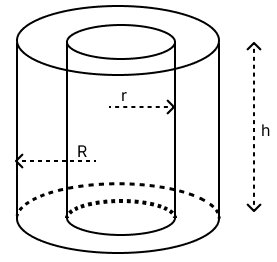
The formula for the volume of the material contained in the given cylindrical pipe is :
π(R + r) h
π(R - r)h
π(R2 + r2)h
π(R2 - r2)h
Answer
Let R be the outer radius of the cylinder.
Let r be the inner radius of the cylinder.
And, h be the height of the cylinder.
As we know that volume of cylinder = πr2h
Volume of outer cylinder = πR2h
Volume of inner cylinder = πr2h
So, volume of the cylindrical pipe = Volume of outer cylinder - Volume of inner cylinder
= πR2h - πr2h
= π(R2 - r2)h
Hence, option 4 is the correct option.
A rectangular piece of paper 10 cm by 8 cm is rolled along its width to get the cylinder of largest size. The curved surface area of the cylinder formed is :
44 cm2
20 cm2
80 cm2
80 cm2
Answer
Clearly, width of the rectangular sheet = Circumference of the base of the cylinder
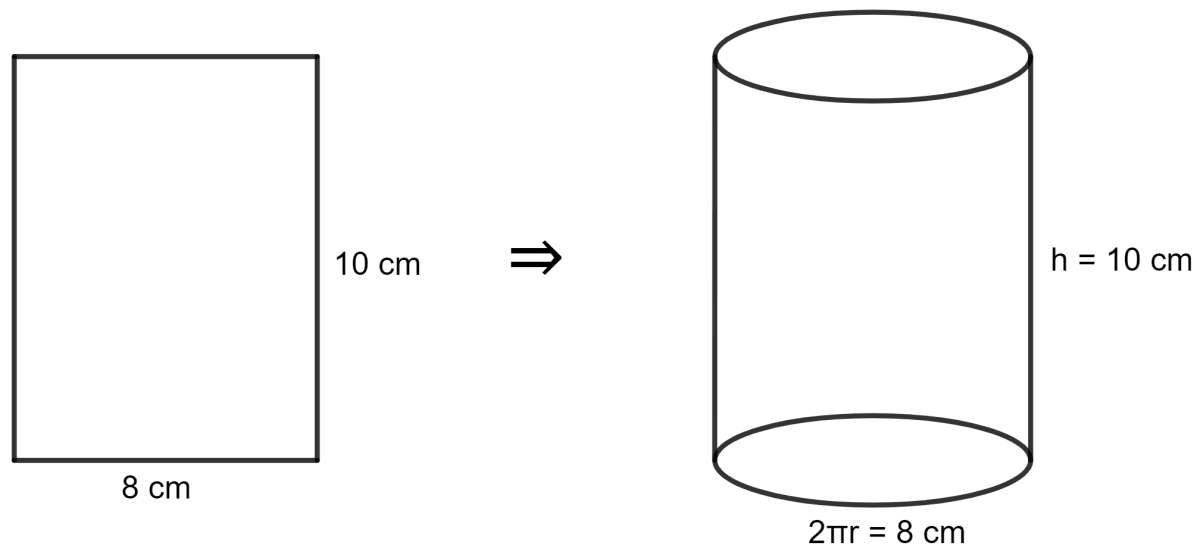
The circumference of a circle = 2πr
⇒ 2πr = 8
Height of the cylinder formed = Length of the sheet
⇒ h = 10 cm
Curved surface area of cylinder = 2πrh
Hence, option 3 is the correct option.
Find the height of the cylinder whose radius is 7 cm and the total surface area is 1100 cm2.
Answer
Given:
Radius of the cylinder = 7 cm
Total surface area of the cylinder = 1100 cm2
Let h be the height of the cylinder.
The total surface area of cylinder = 2πr(r + h)
Hence, the height of the cylinder is 18 cm.
The ratio between the curved surface area and the total surface area of a cylinder is 1 : 2. Find the ratio between the height and the radius of the cylinder.
Answer
It is given that the ratio between the curved surface area and the total surface area of a cylinder is 1 : 2.
Hence, the ratio between the height and radius of the cylinder is 1 : 1.
The total surface area of a cylinder is 6512 cm2 and the circumference of its base is 88 cm. Find :
(i) its radius
(ii) its volume
Answer
(i) Given:
The total surface area of the cylinder is 6512 cm2.
The circumference of its base is 88 cm
Circumference of circle = 2πr
Hence, the radius of the cylinder is 14 cm.
(ii) Total surface area of cylinder = 6512 cm2
Height of the cylinder = 60 cm
Volume of the cylinder = πr2h
Hence, the volume of the cylinder is 36,960 cm3.
The sum of the radius and the height of a cylinder is 37 cm and the total surface area of the cylinder is 1628 cm2. Find the height and the volume of the cylinder.
Answer
Given:
The sum of the radius and the height of a cylinder is 37 cm.
Total surface area of the cylinder = 1628 cm2
Let r be the radius and h be the height of cylinder.
So, r + h = 37
As we know that total surface area of cylinder = 2πr(r + h)
It is given that r + h = 37
⇒ 7 + h = 37
⇒ h = 37 - 7
⇒ h = 30
Height of the cylinder is 30 cm.
Volume of the cylinder = πr2h
Hence, the height of the cylinder is 30 cm and the volume is 4,620 cm3.
A cylindrical pillar has radius 21 cm and height 4 m. Find :
(i) the curved surface area of the pillar
(ii) the cost of polishing 36 such cylindrical pillars at the rate of ₹ 12 per m2.
Answer
(i) Given:
Radius of cylindrical pillar = 21 cm
Height = 4 m = 400 cm
As we know that curved surface area of the cylinder = 2πrh
Hence, the curved surface area of the cylindrical pillar is 52,800 cm2 = 5.28 m2.
(ii) Curved surface area of 1 pillar = 5.28 m2
Curved surface area of 36 pillar = 5.28 m2 x 36
= 190.08
Rate of polishing = ₹ 12 per m2
Total cost = Curved surface area of 36 pillar x Rate of polishing
= 190.08 x ₹ 12
= ₹ 2,280.96
Hence, the total cost of polishing 36 cylindrical pillars is ₹ 2,280.96.
If the radii of two cylinders are in the ratio 4 : 3 and their heights are in the ratio 5 : 6, find the ratio of their curved surfaces.
Answer
Given:
The radii of two cylinders are in the ratio 4 : 3.
The heights of two cylinders are in the ratio 5 : 6.
The curved surface area of the cylinder = 2πrh
Ratio of curved surface area of cylinders =
Hence, the ratio of the curved surface areas of two cylinders is 10 : 9.
A thin rectangular card board has dimensions 44 cm x 22 cm. It is rolled along its length to get a hollow cylinder of largest size. Find the volume of the cylinder formed.
Answer
Clearly, length of the rectangular sheet = Circumference of the base of the cylinder formed
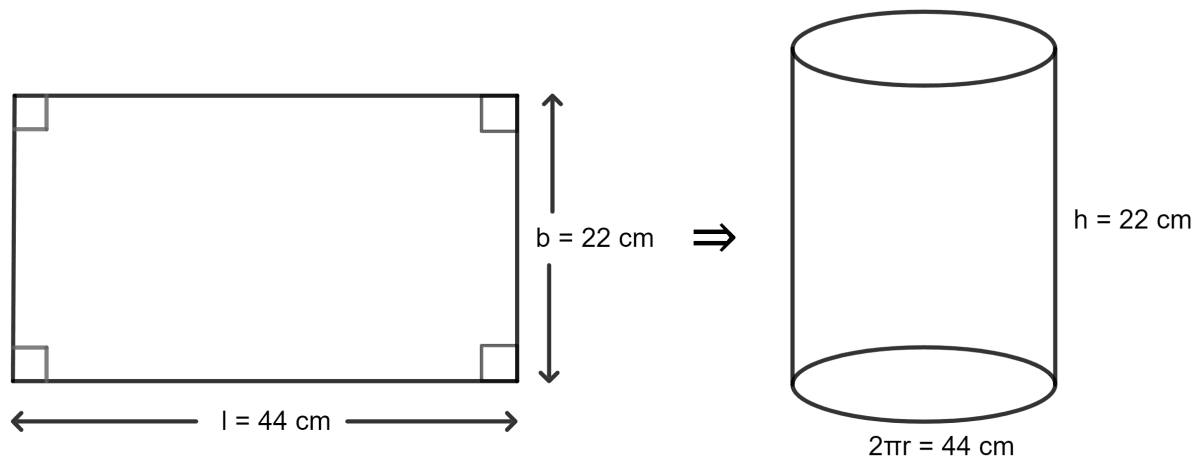
Also, height of the cylinder formed = Breadth of the sheet
⇒ h = 22 cm
Volume of the cylinder formed = πr2h
Hence, the volume of the cylinder is 3,388 cm3.
The ratio between the curved surface area and the total surface area of a right circular cylinder is 3 : 5. Find the ratio between the height and the radius of the cylinder.
Answer
It is given that the ratio between the curved surface area and the total surface area of a right circular cylinder is 3 : 5.
Hence, the ratio between the height and the radius of the cylinder is 3 : 2.
If radii of two circular cylinders are in the ratio 3 : 4 and their heights are in the ratio 6 : 5, find the ratio of their curved surface areas.
Answer
Given:
The radii of two circular cylinders are in the ratio 3 : 4.
The heights of two circular cylinders are in the ratio 6 : 5.
Hence, the ratio of the curved surface areas of two cylinders is 9 : 10.
The lateral surface area of a cube is 100 cm2; then its volume is :
25 cm3
125 cm3
625 cm3
none of these
Answer
Given:
Lateral surface area of cube is 100 cm2.
Let s be the side of cube.
As we know lateral surface area of cube = 4 x (side)2
⇒ 4 x s2 = 100 cm2
⇒ s2 = cm2
⇒ s2 = 25 cm2
⇒ s = cm
⇒ s = 5 cm
Volume of the cube = (side)3
= 53 cm3
= 125 cm3
Hence, option 2 is the correct option.
The length, the breadth and the height of a cuboid are doubled, the ratio between the volumes of the new cuboid and the original cuboid is :
4 : 1
1 : 4
8 : 1
1 : 8
Answer
Let l be the length, b be the breadth and h be the height of the original cuboid.
It is given that the length, breadth and height are doubled.
As we know, the volume of cuboid = length x breadth x height
The Ratio of the volume of the new cuboid to the original cuboid is:
Hence, option 3 is the correct option.
The radius of a cylinder is doubled and its height is halved; then the new volume is :
same
2 times
4 times
8 times
Answer
Let r be the radius and h be the height of original cylinder.
It is given that radius of cylinder is doubled and its height is halved.
Thus, radius of new cylinder = 2r and height =
As we know, the volume of cylinder = πr2h
Volume of original cylinder
Volume of new cylinder:
The new volume is 2 times the original volume.
Hence, option 2 is the correct option.
The dimensions of a solid metallic cuboid are 9 cm x 8 cm x 3 cm. It is melted and recast into a cube. The edge of the cube so formed is :
6 cm
12 cm
18 cm
24 cm
Answer
It is given that the dimensions of a solid metallic cuboid are 9 cm x 8 cm x 3 cm.
The metallic cuboid is melted and recast into a cube i.e., the volume of both shapes remains the same.
Let s be the side of the cube.
Volume of cuboid = Volume of cube
⇒ l x b x h = side3
⇒ s3 = 9 x 8 x 3 cm3
⇒ s3 = 216 cm3
⇒ s = cm
⇒ s = 6 cm
The edge of the cube formed is 6 cm.
Hence, option 1 is the correct option.
The volume of a cuboid is 448 cm3. Its height is 7 cm and the base is square. Then each side of the base is :
64 cm
16 cm
4 cm
8 cm
Answer
Given:
Volume of the cuboid = 448 cm3
Height of the cuboid = 7 cm
The base is square, meaning length = breadth.
Let a be the length of the cuboid.
As we know, the volume of cuboid = l x b x h.
Since the base is square, we can write:
⇒ a x a x 7 = 448
⇒ a2 x 7 = 448
⇒ a2 =
⇒ a2 = 64
⇒ a =
⇒ a = 8 cm
The each side of the base is 8 cm.
Hence, option 4 is the correct option.
Statement 1: The volume of a right circular cylinder = Area of cross section (area of circle) x Distance between two circular parallel ends.
Statement 2: Lateral surface area of a closed cylinder is 2πr(r + h) cubic units.
Which of the following options is correct?
Both the statements are true.
Both the statements are false.
Statement 1 is true, and statement 2 is false.
Statement 1 is false, and statement 2 is true.
Answer
The volume of a right circular cylinder = Area of cross section (area of circle) x Distance between two circular parallel ends.
Area of cross section = πr2
Distance between two circular parallel ends = h
Volume = πr2h
So, statement 1 is true.
The lateral surface area of a cylinder is the area of its curved surface, excluding the top and bottom bases.
Lateral surface area = 2πrh square units.
Total surface area = 2πr(r + h) square units.
So, statement 2 is false.
∴ Statement 1 is true, and statement 2 is false.
Hence, option 3 is the correct option.
Assertion (A) : The length, breadth and height of an open cuboid are 10 cm, 12 cm and 6 cm respectively. If the thickness is 1 cm, then internal dimensions are 8 cm, 10 cm and 5 cm respectively.
Reason (R) : If l, b and h are the external dimension of an open cuboid of thickness 'x', then its internal dimension are (l - 2x), (b - 2x) and (h - x) respectively.
Both A and R are correct, and R is the correct explanation for A.
Both A and R are correct, and R is not the correct explanation for A.
A is true, but R is false.
A is false, but R is true.
Answer
l, b and h represent the external length, breadth, and height, respectively.
The wall has thickness 'x'.
The internal dimensions are reduced by the thickness of the walls.
The internal length = (l - 2x), accounting for the thickness on both sides.
The internal breadth = (b - 2x), accounting for the thickness on both sides.
The internal height = (h - x), as the thickness affects only the bottom and sides, not the open top.
So, reason (R) is true.
10 cm, 12 cm and 6 cm are the external length, breadth, and height, respectively.
The wall has thickness 1 cm.
The internal length = (10 - 2 x 1) = (10 - 2) = 8 cm.
The internal breadth = (12 - 2 x 1) = (12 - 2) = 10 cm.
The internal height = (6 - 1) = 5 cm.
So, assertion (A) is true.
∴ Both A and R are correct, and R is the correct explanation for A.
Hence, option 1 is the correct option.
Assertion (A) : Three solid silver cubes of side 6 cm, 8 cm and 10 cm are melted and recasted into a single solid cube. The side of the new cube = 2 times the side of the smallest cube.
Reason (R) : Volume of cuboid = (l x b x h) cubic units.
Both A and R are correct, and R is the correct explanation for A.
Both A and R are correct, and R is not the correct explanation for A.
A is true, but R is false.
A is false, but R is true.
Answer
When three solid cubes with edges 6 cm, 8 cm, and 10 cm are melted and recast into a single cube, the total volume is the sum of the individual volumes:
Volume of the 6 cm cube : 63 = 216 cm3
Volume of the 8 cm cube : 83 = 512 cm3
Volume of the 10 cm cube : 103 = 1000 cm3
Total volume = 216 + 512 + 1000 = 1728 cm3
Let x cm be the side of new cube formed.
⇒ x3 = 1728 cm3
⇒ x = cm
⇒ x = 12 cm
⇒ x = 2 x 6 cm
⇒ x = 2 x side of the smallest cube melted
So, assertion (A) is true.
When l, b and h represent the length, breadth, and height, respectively of the cuboid.
Volume of cuboid = (l x b x h) cubic units.
So, reason (R) is true.
∴ Both A and R are correct, and R is not the correct explanation for A.
Hence, option 2 is the correct option.
Assertion (A) : The length, breadth and height of the cuboid are 15 cm, 12 cm and 9 cm respectively. Lateral surface area of the cuboid = 846 cm2.
Reason (R) : Lateral surface area of cuboid = 2 x h x (l + b) square units.
Both A and R are correct, and R is the correct explanation for A.
Both A and R are correct, and R is not the correct explanation for A.
A is true, but R is false.
A is false, but R is true.
Answer
When l, b and h represent the length, breadth, and height, respectively of the cuboid.
By formula,
Lateral surface area = 2(l + b)h
So, reason (R) is true.
Substituting values, we get :
Lateral surface area = 2 x (15 + 12) x 9
= 2 x 27 x 9
= 486 cm2.
So, assertion (A) is false.
∴ A is false, but R is true.
Hence, option 4 is the correct option.
Assertion (A) : If radius of a right circular cylinder is double and the height is reduced to of the original, the ratio of volume of new cylinder thus formed to the volume of the original cylinder is 1 : 1.
Reason (R) : Volume of a cylinder = πr2h where r is the radius of the circular base and h is height.
Both A and R are correct, and R is the correct explanation for A.
Both A and R are incorrect.
A is true, but R is false.
A is false, but R is true.
Answer
Let originally r be the radius of the circular base and h be height of the circular cylinder, then
Volume of a cylinder (v) = πr2h.
So, reason (R) is true.
Given,
Radius of new cylinder (R) = 2r
Height of new cylinder (H) =
Ratio of volume of new cylinder thus formed to the volume of the original cylinder,
So, assertion (A) is false.
∴ A is false, but R is true.
Hence, option 4 is the correct option.
A cuboid is 8 m long, 12 m broad and 3.5 m high. Find its
(i) total surface area
(ii) lateral surface area
Answer
(i) Given:
Length of cuboid = 8 m
Breadth of cuboid = 12 m
Height of cuboid = 3.5 m
The total surface area of the cuboid = 2(l x b + b x h + h x l)
= 2 (8 x 12 + 12 x 3.5 + 3.5 x 8) m2
= 2 (96 + 42 + 28) m2
= 2 x 166 m2
= 332 m2
Hence, the total surface area of the cuboid is 332 m2.
(ii) Lateral surface area of cuboid = 2(l + b)h
= 2(8 + 12)3.5 m2
= 2 x 20 x 3.5 m2
= 140 m2
Hence, the lateral surface area of the cuboid is 140 m2.
How many bricks will be required for constructing a wall which is 16 m long, 3 m high and 22.5 cm thick, if each brick measures 25 cm x 11.25 cm x 6 cm ?
Answer
Given:
Length of the wall = 16 m
Breadth of the wall = 3 m
Height of the wall = 22.5 cm = 0.225 m
The volume of wall = length x breadth x height
= 16 x 3 x 0.225 m3
= 10.8 m3
Length of brick = 25 cm = 0.25 m.
Breadth of brick = 11.25 cm = 0.1125 m.
Height of brick = 6 cm = 0.06 m.
The volume of one brick = length x breadth x height
= 0.25 x 0.1125 x 0.06 m3
= 0.0016875 m3
Let a be the number of bricks.
Number of bricks =
⇒ a =
⇒ a =
⇒ a = 6,400
Hence, 6,400 bricks are required to construct the wall.
The length, breadth and height of a cuboid are in the ratio 6 : 5 : 3. If its total surface area is 504 cm2, find its volume.
Answer
Given:
The length, breadth and height of a cuboid are in the ratio 6 : 5 : 3.
Total surface area of cuboid = 504 cm2.
Let the length, breadth and height of cuboid be 6a, 5a and 3a.
As we know total surface area of cuboid = 2(l x b + b x h + h x l)
⇒ 2(6a x 5a + 5a x 3a + 3a x 6a) = 504
⇒ 2(30a2 + 15a2 + 18a2) = 504
⇒ 2 x 63a2 = 504
⇒ 126a2 = 504
⇒ a2 =
⇒ a2 = 4
⇒ a =
⇒ a = 2
Thus, length of cuboid = 6a = 6 x 2 cm = 12 cm
Breadth of cuboid = 5a = 5 x 2 cm = 10 cm
Height of cuboid = 3a = 3 x 2 cm = 6 cm
As we know that volume of cuboid = l x b x h
= 12 x 10 x 6 cm3
= 720 cm3
Hence, the volume of cuboid is 720 cm3.
The external dimensions of an open wooden box are 65 cm, 34 cm and 25 cm. If the box is made up of wood 2 cm thick, find the capacity of the box and the volume of wood used to make it.
Answer
Given:
Outer length of box = 65 cm
Outer width of box = 34 cm
Outer height of box = 25 cm
Volume of outer box = l x b x h
= 65 x 34 x 25 cm3
= 55,250 cm3
Thickness of wood = 2 cm
Internal length of box = 65 - 2 - 2 cm = 65 - 4 cm = 61 cm
Internal width of box = 34 - 2 - 2 cm = 34 - 4 cm = 30 cm
Internal height of box = 25 - 2 cm = 23 cm
Volume of internal box = l x b x h
= 61 x 30 x 23 cm3
= 42,090 cm3
Volume of wood = Volume of outer box - Volume of internal box
= 55,250 - 42,090 cm3
= 13,160 cm3
Hence, the capacity of the box is 42,090 cm3 and the volume of wood used is 13,160 cm3.
The curved surface area and the volume of a toy, cylindrical in shape, are 132 cm2 and 462 cm3 respectively. Find its diameter and its length.
Answer
Given:
Curved surface area of cylindrical toy = 132 cm2
Volume of cylindrical toy = 462 cm3
As we know that curved surface area cylinder = 2πrh
⇒ 2πrh = 132
⇒ πrh =
⇒ πrh = 66 ...............(1)
And, volume of cylinder = πr2h
⇒ πr2h = 462
⇒ πrh x r = 462
Putting the value of 'πrh' from equation (1), we get
⇒ 66 x r = 462
⇒ r =
⇒ r = 7 cm
Diameter = 2 x r
= 2 x 7 cm = 14 cm
Putting the value of r in equation (1),
Hence, the diameter of cylinder is 14 cm and the length is 3 cm.
The floor of a rectangular hall has a perimeter 250 m. If the cost of painting the four walls at the rate of ₹ 10 per m2 is ₹ 15,000, find the height of the hall.
Answer
Given:
Perimeter of the floor of the rectangular hall = 250 m
Total cost of painting the four walls = ₹ 15,000
Rate of painting = ₹ 10 per m2
Let l be the length, b be the breadth and h be the height of rectangular hall.
Perimeter of floor = 2(l + b)
⇒ 2(l + b) = 250
⇒ l + b =
⇒ l + b = 125 ...............(1)
The total cost of painting the four walls equals to the curved surface area of the rectangular hall.
Total cost = Curved surface area of hall x Rate of painting
⇒ 15,000 = Curved surface area x 10
⇒ Curved surface area =
⇒ Curved surface area = 1,500 m2
Curved surface area of hall = 2(l + b)h
⇒ 1,500 = 2(l + b)h
Using equation (1),
⇒ 1,500 = 2 x 125 x h
⇒ 1,500 = 250 x h
⇒ h =
⇒ h = 6
Hence, the height of the rectangular hall is 6 m.
The length of a hall is double its breadth. Its height is 3 m. The area of its four walls (including doors and windows) is 108 m2, find its volume.
Answer
Given:
Let b be the breadth of the hall.
The length l of the hall is double its breadth, so l = 2b
The height h of the hall is 3 m.
The area of the four walls is 108 m2.
The area of the four walls of a hall = 2(l + b)h
⇒ 2(l + b)h = 108
⇒ 2(2b + b) x 3 = 108
⇒ 2 x 3b x 3 = 108
⇒ 18b = 108
⇒ b =
⇒ b = 6 m
So, l = 2b = 2 x 6 m = 12 m
And, volume of hall = l x b x h
= 12 x 6 x 3 m3
= 216 m3
Hence, the volume of the hall is 216 m3.
A solid cube of side 12 cm is cut into 8 identical cubes. What will be the side of the new cube? Also, find the ratio between the surface area of the original cube and the total surface area of all the small cubes formed.
Answer
Side of the original cube = 12 cm
Let s be the side of each smaller cube.
As we know, the volume of a cube = side3
Volume of the original cube = Volume of 8 identical cubes
⇒ (12)3 = 8 x s3
⇒ 1,728 = 8 x s3
⇒ s3 =
⇒ s3 = 216
⇒ s =
⇒ s = 6 cm
The surface area of a cube = 6 x side2
Ratio of the total surface area of the original cube to the total surface area of all the smaller cubes =
Hence, the side of each smaller cube is 6 cm and the ratio of the total surface area of the original cube to that of all the smaller cubes is 1 : 2.
The diameter of a garden roller is 1.4 m and it is 2 m long. Find the maximum area covered by it in 50 revolutions ?
Answer
Given:
Diameter of the roller = 1.4 m
Length of the roller = 2 m
Number of Revolutions = 50
Radius of the roller = = 0.7 m
As we know, the curved surface area of cylinder = 2πrh
The curved surface area of cylinder is 8.8 m2.
Maximum area covered by the roller = Curved surface area x Number of revolutions
= 8.8 x 50
= 440 m2
Hence, the maximum area covered by the garden roller in 50 revolutions is 440 m2.
In a building, there are 24 cylindrical pillars. For each pillar, radius is 28 cm and height is 4 m. Find the total cost of painting the curved surface area of the pillars at the rate of ₹ 8 per m2.
Answer
Given:
Number of cylindrical pillars = 24
Radius of each pillar = 28 cm = 0.28 m
Height of each pillar = 4 m
As we know, the curved surface area of cylinder = 2πrh
Curved surface area of 1 pillar =
Total curved surface area for 24 pillar = 24 x curved surface of 1 pillar
= 24 x 7.04 m2
= 168.96 m2
Rate of painting = ₹ 8 per m2
Total cost = Total curved surface area x Rate of painting
= 168.96 x ₹ 8
= ₹ 1,351.68
Hence, the total cost of painting the pillars is ₹ 1,351.68.
The ratio between the curved surface area and the total surface area of a cylinder is 1 : 2. Find the volume of the cylinder, given its total surface area is 616 cm2.
Answer
Given:
The ratio between the curved surface area and the total surface area of a cylinder is 1 : 2.
Total surface area of cylinder = 616 cm2
And,
Using r = h
And, volume of the cylinder = πr2h
Hence, the volume of the cylinder is 1,078 cm3.
The areas of three adjacent faces of a box are 120 cm2, 72 cm2 and 60 cm2. Find the volume of the box.
Answer
It is given that the areas of three adjacent faces of a box are 120 cm2, 72 cm2 and 60 cm2.
Let l be the length, b be the breadth and h be the height of box.
So, l x b = 120 cm2 ...............(1)
b x h = 72 cm2 ...............(2)
h x l = 60 cm2 ...............(3)
Multiplying equation (1), (2) and (3), we get
(l x b) x (b x h) x (h x l) = 120 x 72 x 60 cm6
⇒ l2 x b2 x h2 = 518400 cm6
⇒ l x b x h = cm3
⇒ l x b x h = 720 cm3
As we know that volume of box = l x b x h
Volume of box = 720 cm3
Hence, the volume of the box is 720 cm3.
Eight identical cubes, each of edge 5 cm, are joined end to end. Find the total surface area and the volume of the resulting cuboid.
Answer
The length (l) of cuboid = 8 x 5 cm = 40 cm
The breadth (b) of cuboid = 5 cm
The height (h) of cuboid = 5 cm
As we know total surface area of the cuboid = 2(l x b + b x h + h x l)
= 2(40 x 5 + 5 x 5 + 5 x 40) cm2
= 2(200 + 25 + 200) cm2
= 2 x 425 cm2
= 850 cm2
As we know, volume of the cuboid = l x b x h
= 40 x 5 x 5 cm3
= 1,000 cm3
Hence, the total surface area of the cuboid is 850 cm2 and the volume is 1,000 cm3.
A rectangular swimming pool 20 m long, 10 m wide and 2 m deep is to be tiled. If each tile is 40 cm x 40 cm, find the number of tiles required.
Answer
Given:
Length of the swimming pool (l) = 20 m.
Breadth of the swimming pool (b) = 10 m.
Height of the swimming pool (h) = 2 m.
As we know that area of base of the swimming pool = l x b
= 20 x 10 m2
= 200 m2
The area of the four walls of the pool = 2 (l + b) h
= 2 (20 + 10) 2 m2
= 2 x 30 x 2 m2
= 120 m2
Total area of pool = Area of base + Area of four walls
Total area of pool = 200 + 120 m2
= 320 m2
Dimensions of each tile:
Length = 40 cm = 0.4 m
Width = 40 cm = 0.4 m
Area of one tile = Length x Width
= 0.4 x 0.4 m2
= 0.16 m2
Let a be the number of tiles required.
a =
⇒ a =
⇒ a =
⇒ a = 2,000
Hence, 2,000 tiles are required to tile the pool.