
Chemistry
The diagram below shows a circuit used to electrolyse aqueous sodium argento cyanide. Which arrow indicates the movement of the silver ions in the electrolyte and of the electrons in the external circuit?
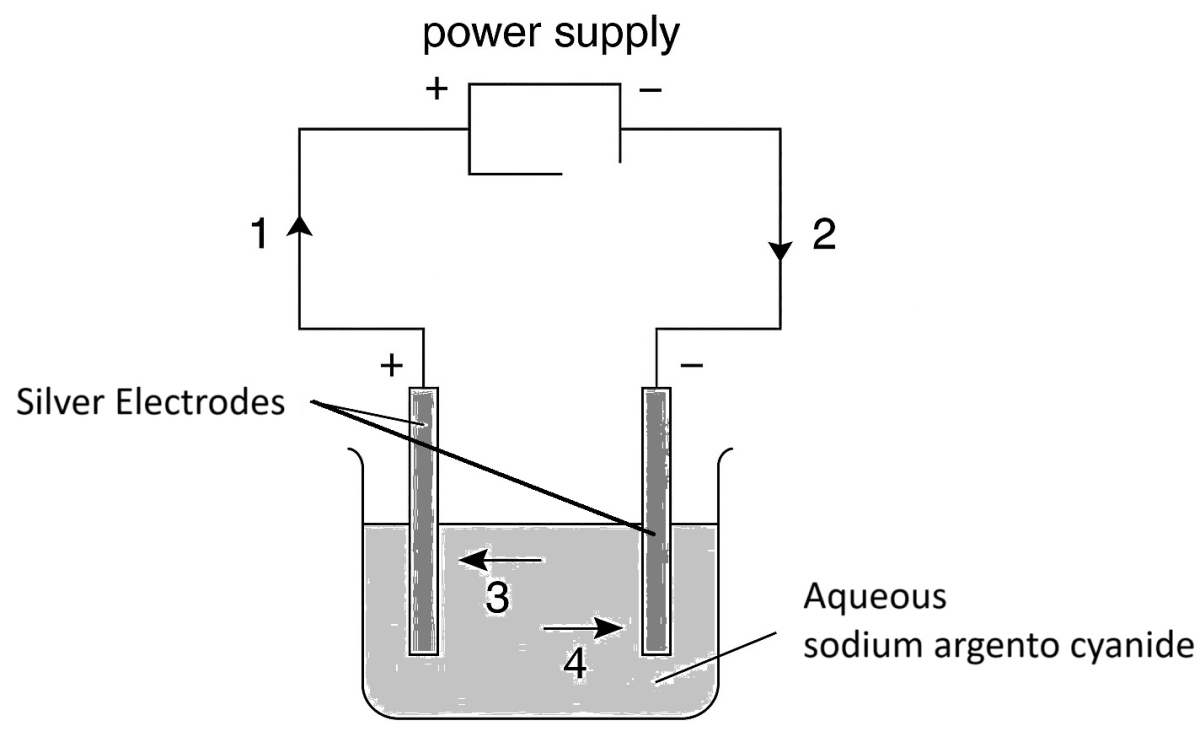
| Silver ions | Electrons | |
|---|---|---|
| 1. | 3 | 1 |
| 2. | 3 | 2 |
| 3. | 2 | 4 |
| 4. | 4 | 1 |
Electrolysis
14 Likes
Answer
4,1
Reason — The silver ions are released and passed into solution from the active anode electrode, and they migrate towards the cathode. Hence, the direction of movement of silver ions will be 4.
The direction of current in the external circuit will be from positive terminal of the power supply to the negative terminal. The movement of electrons in the external circuit will in the opposite direction of current. Hence, the direction of movement of electrons is 1.
Answered By
6 Likes
Related Questions
The picture given below shows an apparatus that a teacher used for demonstrating the properties of ionic substances. The teacher heats a sample of lead bromide in a crucible which contains two electrodes which are part of the circuit shown. The bulb does not light up. What is the best explanation for this?
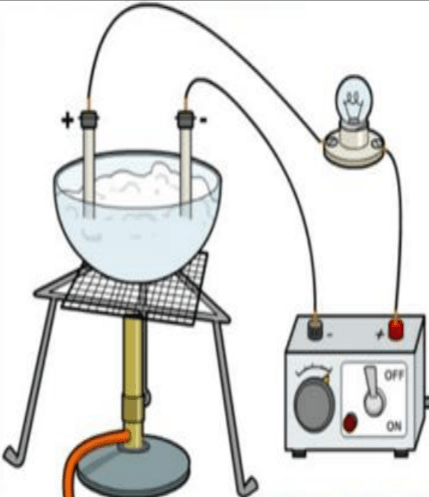
- The circuit is complete.
- Molten lead bromide does not conduct electricity.
- The sample of lead bromide was not heated up to the melting point by the teacher.
- The DC power supply was set up correctly.
Element Y is in Group IIA of the Periodic Table. Y reacts with element Q to form an ionic compound. Which equation shows the process that takes place when Y forms ions?
- Y + 2e- ⟶ Y2+
- Y - 2e- ⟶ Y2-
- Y + 2e- ⟶ Y2-
- Y - 2e- ⟶ Y2+
The relative atomic mass of nitrogen is 14, and that of hydrogen is 1. This means that (i) …………… of nitrogen has the same mass as (ii) …………… of hydrogen.
(i) (ii) 1. An atom 28 molecules 2. An atom 7 molecules 3. A molecule 14 atoms 4. A molecule 7 atoms Which words correctly complete the gaps?
A student reacts copper turnings with cold dilute nitric acid in a test tube. He tests the gas given off with moist red and blue litmus paper. What is the name of the gas that evolved and what is the final colour of the litmus paper?
Gas Final colour of the litmus paper 1. NO No change in blue and red litmus paper 2. NO2 Blue litmus turns red and no change in red litmus 3. N2 No change in blue and red litmus paper 4. N2O No change in blue and red litmus paper