
Chemistry
A student reacts copper turnings with cold dilute nitric acid in a test tube. He tests the gas given off with moist red and blue litmus paper. What is the name of the gas that evolved and what is the final colour of the litmus paper?
| Gas | Final colour of the litmus paper | |
|---|---|---|
| 1. | NO | No change in blue and red litmus paper |
| 2. | NO2 | Blue litmus turns red and no change in red litmus |
| 3. | N2 | No change in blue and red litmus paper |
| 4. | N2O | No change in blue and red litmus paper |
Nitric Acid
12 Likes
Answer
NO, No change in blue and red litmus paper
Reason — Nitric oxide is evolved when cold and dilute HNO3 is added to copper. It is neither acidic nor basic so, it does not change the colour of red or blue litmus paper
3Cu + 8HNO3 ⟶ 3Cu(NO3)2 + 4H2O + 2NO
Answered By
4 Likes
Related Questions
The diagram below shows a circuit used to electrolyse aqueous sodium argento cyanide. Which arrow indicates the movement of the silver ions in the electrolyte and of the electrons in the external circuit?
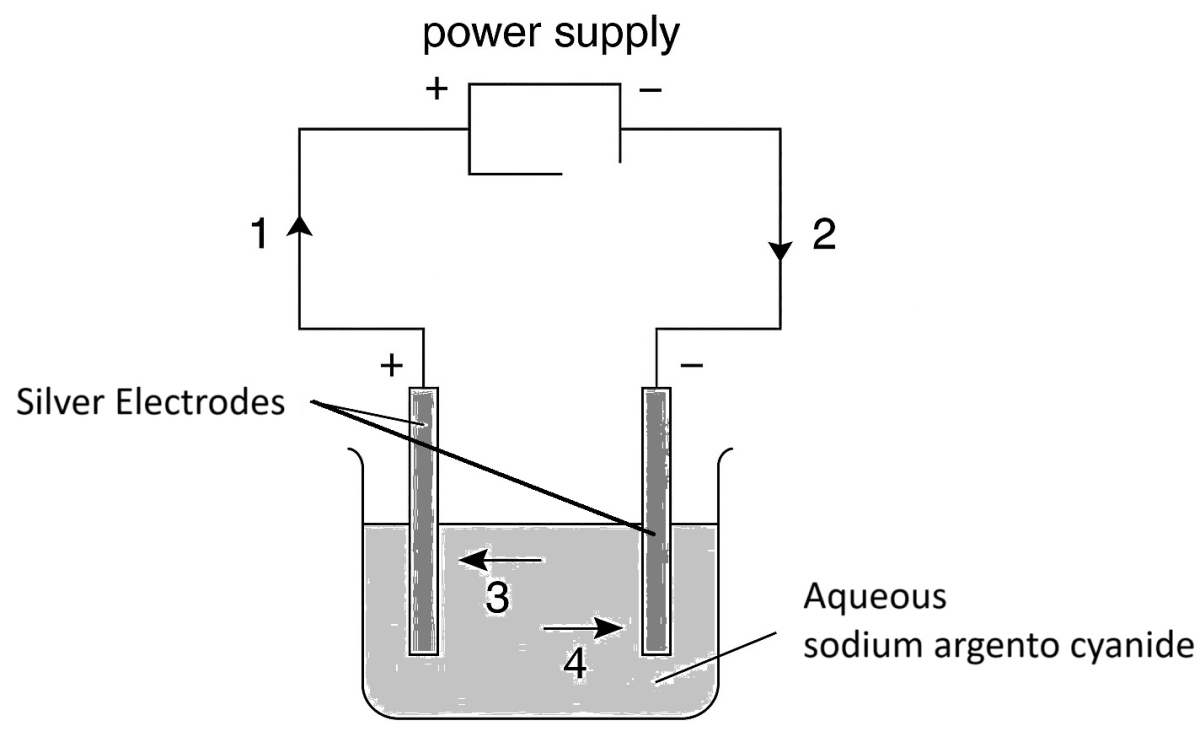
Silver ions Electrons 1. 3 1 2. 3 2 3. 2 4 4. 4 1 The relative atomic mass of nitrogen is 14, and that of hydrogen is 1. This means that (i) …………… of nitrogen has the same mass as (ii) …………… of hydrogen.
(i) (ii) 1. An atom 28 molecules 2. An atom 7 molecules 3. A molecule 14 atoms 4. A molecule 7 atoms Which words correctly complete the gaps?
Which element forms a stable ion with the same electronic configuration as argon?
- Magnesium
- Fluorine
- Chlorine
- Sodium
The diagram below represents the molecule of an organic compound. What is the name of this compound?

- Pentanol
- Butanol
- Butanoic acid
- Pentanoic acid