
History & Civics
Study the picture and answer the questions that follow:

(a) Identify the event in the picture and state how it became the immediate cause of the First World War.
(b) State any three other causes of the First World War.
(c) Mention any three clauses of the Treaty of Versailles.
1ˢᵗ World War
40 Likes
Answer
(a) The picture shows the assassination of Archduke Francis Ferdinand, the Crown Prince of Austria and his wife at Sarajevo, by Gavrilo Princep, an Austrian subject. It became the immediate cause of the First World War.
- Though the assassin, Gavrilo Princep was an Austrian subject, the assassination had been planned in Serbia by a secret society of patriotic terrorists called 'Black Hand'.
- Serbia was blamed for Archduke's assassination.
- Austria presumed that Princep and fellow conspirators had received their guns and bombs in the Serbian Capital with the help of Serbian officials.
- Austria sent a stiff ultimatum to Serbia for apprehending the criminals and handing them over to Austrian government.
- She sought a ban on all anti-Austrian publications, anti-Austrian schools and anti-Austrian meetings.
- They were also required to take steps to suppress all revolutionary movements against the territorial integrity of the Austrian Government.
- The Serbian government refused to accept some of the demands of the ultimatum on the ground that they involved violation of its sovereignty, i.e., its authority to govern itself.
- Austria declared war on Serbia on 28 July, 1914.
- Russia supported Serbia, Germany declared war on Russia and Great Britain declared war on Germany.
- Italy left the Triple Alliance and joined the war against Germany.
(b) Three causes that led to the war were as follows-
- Race for Armaments — Germany had acquired colonies in Africa and a few islands in the Pacific. In order to protect her colonies Germany began to build a powerful navy. The Germans dug the Kiel Canal deeper so that battle ships could find shelter in its waters. There was an arms race and the peculiar feature of such a race is that if one country increases its armaments, other countries are compelled to do the same. Such a race for armaments could end only in a war.
- Division of Europe into two armed camps — In 1879, Germany and Austria-Hungary had signed a Treaty to help each other in case of enemy attack. Three years later Italy joined the Pact, which came to be known as the Triple Alliance. As opposed to the Triple Alliance emerged the Triple Entente comprising Britain, France and Russia in 1907 to control German expansionism. Thus Europe was divided into two major camps.
- Imperialism — By the end of the 19th century, England and France had built up a huge colonial empire in Asia and Africa. Britain had India, Sri Lanka, Myanmar, Egypt, South Africa, Caribbean Islands and many parts of Africa as its colonies. It grew rich from its success in trade in foreign resources, markets, territories and people. Some other countries of the world like Germany, Italy, Russia and Japan also wanted to increase their sphere of influence and create their colonies in Asia and Africa. These colonies were essential for their progress as they could provide raw materials for their industries and markets for their finished products. Besides, acquiring colonies would add to the power and prestige of these countries. This led to a clash of interest among these countries. They began to scramble for colonies which resulted in rivalries and wars.
(c) Three clauses of the Treaty of Versailles were-
- The area of the Rhine Valley was to be demilitarised and the German territory west of Rhine was to be occupied by the Allied Troops for 15 years.
- Germany lost Alsace Lorraine to France; Eupen-et-Malmedy to Belgium, Schleswig to Denmark. Danzig became a Free Port in the Polish territory.
- Germany ceded parts of her pre-War territory to Denmark, Belgium, Poland, Czechoslovakia and France.
Answered By
22 Likes
Related Questions
Look at the newspaper clipping given on the right and answer the questions that follow:

(a) What was the immediate impact of the incident mentioned in newspaper above? Who organised the assassination? What was the objectives behind the assassination?
(b) Besides the incident mentioned in the newspaper, state three other reasons that led to a turning point in the history of the world.
(c) Name the treaty that was designed to prevent Germany from going to war again. State any three clauses of this treaty.
Look at the newspaper excerpt given on the right and answer the questions that follow:
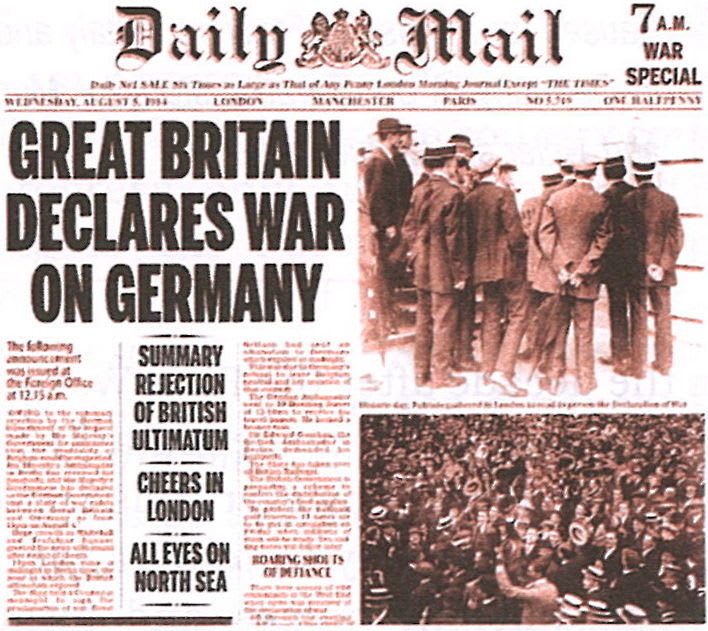
(a) Who summarily rejected British ultimatum? Why?
(b) Why did Great Britain declare war on Germany?
(c) What was the final outcome of the war that began after Great Britain declared war on Germany? How did it affect both the countries?
More than national pride, it was the greed to acquire colonies and thereby, more money and resources that led to the First World War. Explain.
Do you think the First World War could be avoided? Give reasons to support your answer.