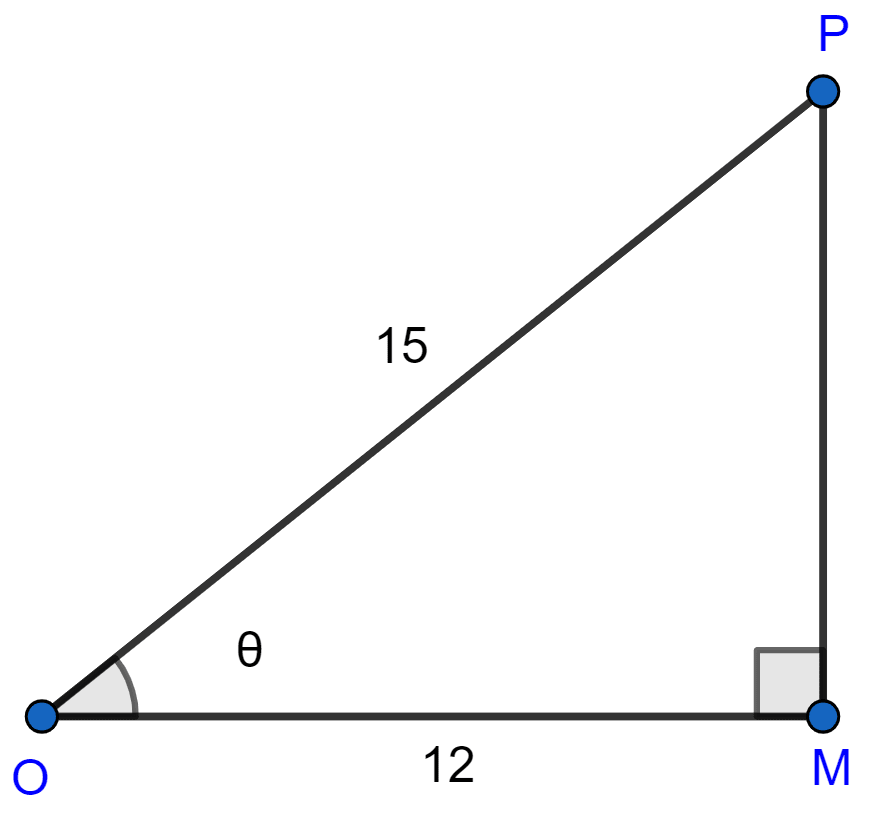
From the figure (1) given below, find the values of:
(i) sin θ
(ii) cos θ
(iii) tan θ
(iv) cot θ
(v) sec θ
(vi) cosec θ
Answer
In right-angled triangle OMP,
By Pythagoras theorem, we get
⇒ OP2 = OM2 + MP2
⇒ MP2 = OP2 - OM2
⇒ MP2 = (15)2 - (12)2
⇒ MP2 = 225 - 144
⇒ MP2 = 81
⇒ MP = 81 \sqrt{81} 81
(i) sin θ = Perpendicular Hypotenuse \dfrac{\text{Perpendicular}}{\text{Hypotenuse}} Hypotenuse Perpendicular
= M P O P = 9 15 = 3 5 \dfrac{MP}{OP} = \dfrac{9}{15} = \dfrac{3}{5} OP MP = 15 9 = 5 3
Hence, sin θ = 3 5 \dfrac{3}{5} 5 3
(ii) cos θ = Base Hypotenuse \dfrac{\text{Base}}{\text{Hypotenuse}} Hypotenuse Base
= O M O P = 12 15 = 4 5 \dfrac{OM}{OP} = \dfrac{12}{15} = \dfrac{4}{5} OP OM = 15 12 = 5 4
Hence, cos θ = 4 5 \dfrac{4}{5} 5 4
(iii) tan θ = Perpendicular Base \dfrac{\text{Perpendicular}}{\text{Base}} Base Perpendicular
= M P O M = 9 12 = 3 4 \dfrac{MP}{OM} = \dfrac{9}{12} = \dfrac{3}{4} OM MP = 12 9 = 4 3
Hence, tan θ = 3 4 \dfrac{3}{4} 4 3
(iv) cot θ = Base Perpendicular \dfrac{\text{Base}}{\text{Perpendicular}} Perpendicular Base
= O M M P = 12 9 = 4 3 \dfrac{OM}{MP} = \dfrac{12}{9} = \dfrac{4}{3} MP OM = 9 12 = 3 4
Hence, cot θ = 4 3 \dfrac{4}{3} 3 4
(v) sec θ = Hypotenuse Base \dfrac{\text{Hypotenuse}}{\text{Base}} Base Hypotenuse
= O P O M = 15 12 = 5 4 \dfrac{OP}{OM} = \dfrac{15}{12} = \dfrac{5}{4} OM OP = 12 15 = 4 5
Hence, sec θ = 5 4 \dfrac{5}{4} 4 5
(vi) cosec θ = Hypotenuse Perpendicular \dfrac{\text{Hypotenuse}}{\text{Perpendicular}} Perpendicular Hypotenuse
= O P M P = 15 9 = 5 3 \dfrac{OP}{MP} = \dfrac{15}{9} = \dfrac{5}{3} MP OP = 9 15 = 3 5
Hence, cosec θ = 5 3 \dfrac{5}{3} 3 5
From the figure (2) given below, find the values of :
(i) sin A
(ii) cos A
(iii) sin2 A + cos2 A
(iv) sec2 A - tan2 A
Answer
In right-angled triangle ABC,
By Pythagoras theorem, we get
⇒ AB2 = AC2 + BC2
⇒ AB2 = (12)2 + (5)2
⇒ AB2 = 144 + 25
⇒ AB2 = 169
⇒ AB = 169 \sqrt{169} 169
(i) sin A = Perpendicular Hypotenuse \dfrac{\text{Perpendicular}}{\text{Hypotenuse}} Hypotenuse Perpendicular
= B C A B = 5 13 \dfrac{BC}{AB} = \dfrac{5}{13} A B BC = 13 5
Hence, sin A = 5 13 \dfrac{5}{13} 13 5
(ii) cos A = Base Hypotenuse \dfrac{\text{Base}}{\text{Hypotenuse}} Hypotenuse Base
= A C A B = 12 13 \dfrac{AC}{AB} = \dfrac{12}{13} A B A C = 13 12
Hence, cos A = 12 13 \dfrac{12}{13} 13 12
(iii) Substituting values of sin A and cos A in sin2 A + cos2 A :
⇒ sin2 A + cos2 A = ( 5 13 ) 2 + ( 12 13 ) 2 \Big(\dfrac{5}{13}\Big)^2 + \Big(\dfrac{12}{13}\Big)^2 ( 13 5 ) 2 + ( 13 12 ) 2
= 25 169 + 144 169 \dfrac{25}{169} + \dfrac{144}{169} 169 25 + 169 144
= 169 169 \dfrac{169}{169} 169 169
Hence, sin2 A + cos2 A = 1.
(iv) sec2 A - tan2 A = ( A B A C ) 2 − ( B C A C ) 2 \Big(\dfrac{AB}{AC}\Big)^2 - \Big(\dfrac{BC}{AC}\Big)^2 ( A C A B ) 2 − ( A C BC ) 2
= ( 13 12 ) 2 − ( 5 12 ) 2 \Big(\dfrac{13}{12}\Big)^2 - \Big(\dfrac{5}{12}\Big)^2 ( 12 13 ) 2 − ( 12 5 ) 2
= 169 144 − 25 144 \dfrac{169}{144} - \dfrac{25}{144} 144 169 − 144 25
= 144 144 \dfrac{144}{144} 144 144
Hence, sec2 A - tan2 A = 1.
From the figure (1) given below, find the values of:
(i) sin B
(ii) cos C
(iii) sin B + sin C
(iv) sin B cos C + sin C cos B.
Answer
In right-angled triangle ABC,
By Pythagoras theorem, we get
⇒ BC2 = AC2 + AB2
⇒ AC2 = BC2 - AB2
⇒ AC2 = (10)2 - (6)2
⇒ AC2 = 100 - 36
⇒ AC2 = 64
⇒ AC = 64 \sqrt{64} 64
⇒ AC = 8.
(i) sin B = Perpendicular Hypotenuse \dfrac{\text{Perpendicular}}{\text{Hypotenuse}} Hypotenuse Perpendicular
= A C B C = 8 10 = 4 5 \dfrac{AC}{BC} = \dfrac{8}{10} = \dfrac{4}{5} BC A C = 10 8 = 5 4
Hence, sin B = 4 5 \dfrac{4}{5} 5 4
(ii) cos C = Base Hypotenuse \dfrac{\text{Base}}{\text{Hypotenuse}} Hypotenuse Base
= A C B C = 8 10 = 4 5 . \dfrac{AC}{BC} = \dfrac{8}{10} = \dfrac{4}{5}. BC A C = 10 8 = 5 4 .
Hence, cos C = 4 5 \dfrac{4}{5} 5 4
(iii) sin C = Perpendicular Hypotenuse \dfrac{\text{Perpendicular}}{\text{Hypotenuse}} Hypotenuse Perpendicular
= A B B C = 6 10 = 3 5 \dfrac{AB}{BC} = \dfrac{6}{10} = \dfrac{3}{5} BC A B = 10 6 = 5 3
Substituting values of sin B and sin C in sin B + sin C we get :
⇒ sin B + sin C = 4 5 + 3 5 = 7 5 \dfrac{4}{5} + \dfrac{3}{5} = \dfrac{7}{5} 5 4 + 5 3 = 5 7
Hence, sin B + sin C = 7 5 \dfrac{7}{5} 5 7
(iv) sin B = 4 5 \dfrac{4}{5} 5 4 3 5 \dfrac{3}{5} 5 3 4 5 \dfrac{4}{5} 5 4
cos B = Base Hypotenuse \dfrac{\text{Base}}{\text{Hypotenuse}} Hypotenuse Base
= A B B C = 6 10 = 3 5 \dfrac{AB}{BC} = \dfrac{6}{10} = \dfrac{3}{5} BC A B = 10 6 = 5 3
Substituting values in equation sin B cos C + sin C cos B we get :
= 4 5 × 4 5 + 3 5 × 3 5 = 16 25 + 9 25 = 25 25 = 1. = \dfrac{4}{5} \times \dfrac{4}{5} + \dfrac{3}{5} \times \dfrac{3}{5} \\[1em] = \dfrac{16}{25} + \dfrac{9}{25} \\[1em] = \dfrac{25}{25} = 1. = 5 4 × 5 4 + 5 3 × 5 3 = 25 16 + 25 9 = 25 25 = 1.
Hence, sin B cos C + sin C cos B = 1.
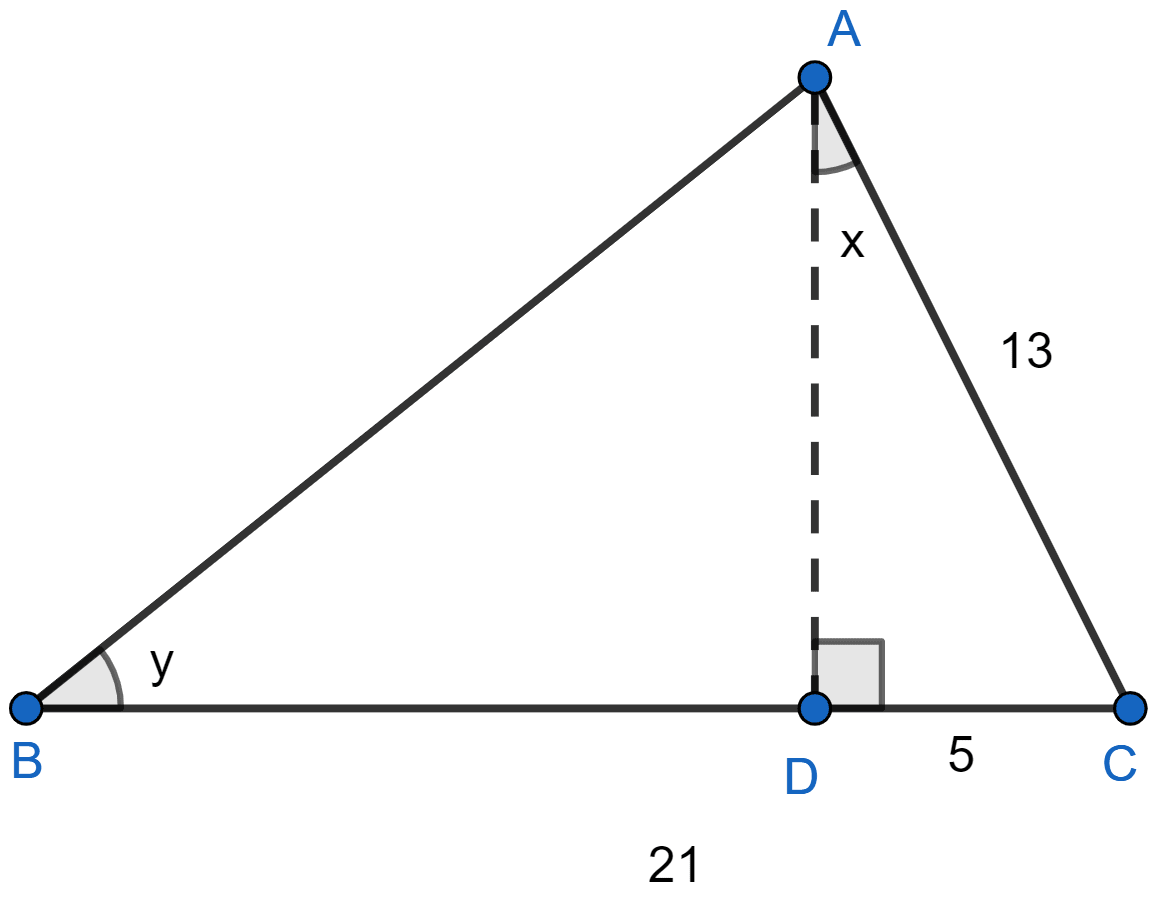
From the figure (2) given below, find the values of :
(i) tan x
(ii) cos y
(iii) cosec2 y - cot2 y
(iv) 5 sin x + 3 sin y − 3 cot y \dfrac{5}{\text{sin x}} + \dfrac{3}{\text{sin y}} - 3\text{ cot y} sin x 5 + sin y 3 − 3 cot y
Answer
From Figure,
BD = BC - CD = 21 - 5 = 16.
In right-angled ∆ACD,
By pythagoras theorem we get,
⇒ AC2 = AD2 + CD2
⇒ AD2 = AC2 - CD2
⇒ AD2 = (13)2 - (5)2
⇒ AD2 = 169 - 25
⇒ AD2 = 144
⇒ AD = 144 \sqrt{144} 144
⇒ AD = 12.
In right-angled ∆ABD,
By pythagoras theorem we get,
⇒ AB2 = AD2 + BD2
⇒ AB2 = 122 + 162
⇒ AB2 = 144 + 256
⇒ AB2 = 400
⇒ AB = 400 \sqrt{400} 400
⇒ AB = 20.
(i) In right-angled ∆ACD,
tan x = Perpendicular Base \dfrac{\text{Perpendicular}}{\text{Base}} Base Perpendicular
= C D A D = 5 12 \dfrac{CD}{AD} = \dfrac{5}{12} A D C D = 12 5
Hence, tan x = 5 12 \dfrac{5}{12} 12 5
(ii) In right-angled ∆ABD,
cos y = Base Hypotenuse \dfrac{\text{Base}}{\text{Hypotenuse}} Hypotenuse Base
= B D A B = 16 20 = 4 5 \dfrac{BD}{AB} = \dfrac{16}{20} = \dfrac{4}{5} A B B D = 20 16 = 5 4
Hence, cos y = 4 5 \dfrac{4}{5} 5 4
(iii) In right-angled ∆ABD,
cosec y = Hypotenuse Perpendicular \dfrac{\text{Hypotenuse}}{\text{Perpendicular}} Perpendicular Hypotenuse
= A B A D = 20 12 = 5 3 \dfrac{AB}{AD} = \dfrac{20}{12} = \dfrac{5}{3} A D A B = 12 20 = 3 5
cot y = Base Perpendicular \dfrac{\text{Base}}{\text{Perpendicular}} Perpendicular Base
= B D A D = 16 12 = 4 3 \dfrac{BD}{AD} = \dfrac{16}{12} = \dfrac{4}{3} A D B D = 12 16 = 3 4
Substituting values in cosec2 y - cot2 y
= ( 5 3 ) 2 − ( 4 3 ) 2 = 25 9 − 16 9 = 9 9 = 1. = \Big(\dfrac{5}{3}\Big)^2 - \Big(\dfrac{4}{3}\Big)^2 \\[1em] = \dfrac{25}{9} - \dfrac{16}{9} \\[1em] = \dfrac{9}{9} = 1. = ( 3 5 ) 2 − ( 3 4 ) 2 = 9 25 − 9 16 = 9 9 = 1.
Hence, cosec2 y - cot2 y = 1.
(iv) In right-angled ∆ACD,
sin x = Perpendicular Hypotenuse \dfrac{\text{Perpendicular}}{\text{Hypotenuse}} Hypotenuse Perpendicular
= C D A C = 5 13 \dfrac{CD}{AC} = \dfrac{5}{13} A C C D = 13 5
In right-angled ∆ABD,
sin y = Perpendicular Hypotenuse \dfrac{\text{Perpendicular}}{\text{Hypotenuse}} Hypotenuse Perpendicular
= A D A B = 12 20 = 3 5 \dfrac{AD}{AB} = \dfrac{12}{20} = \dfrac{3}{5} A B A D = 20 12 = 5 3
Substituting values in 5 sin x + 3 sin y − 3 cot y \dfrac{5}{\text{sin x}} + \dfrac{3}{\text{sin y}} - 3\text{ cot y} sin x 5 + sin y 3 − 3 cot y
= 5 5 13 + 3 3 5 − 3 × 4 3 = 13 + 5 − 4 = 14. = \dfrac{5}{\dfrac{5}{13}} + \dfrac{3}{\dfrac{3}{5}} - 3 \times \dfrac{4}{3} \\[1em] = 13 + 5 - 4 \\[1em] = 14. = 13 5 5 + 5 3 3 − 3 × 3 4 = 13 + 5 − 4 = 14.
Hence, 5 sin x + 3 sin y − 3 cot y = 14 \dfrac{5}{\text{sin x}} + \dfrac{3}{\text{sin y}} - 3\text{ cot y} = 14 sin x 5 + sin y 3 − 3 cot y = 14
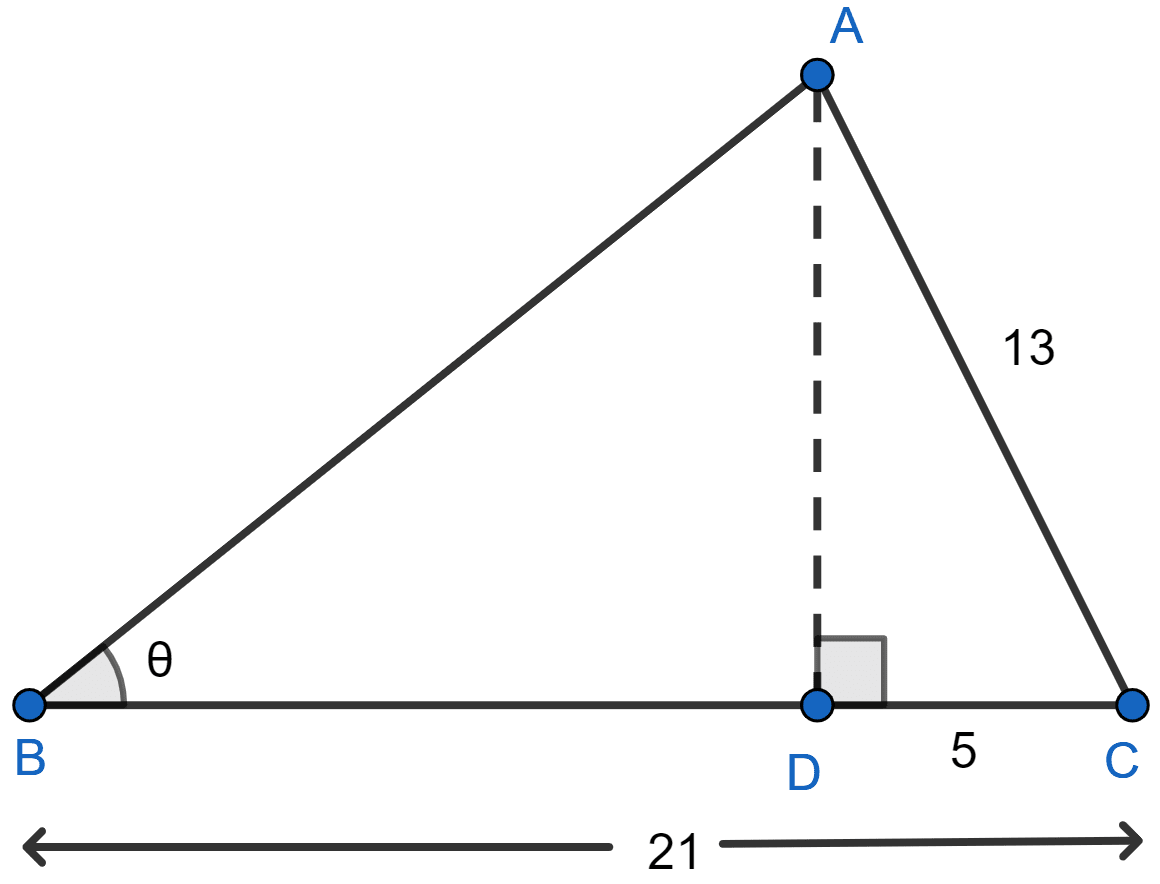
From the figure (1) given below, find the value of sec θ.
Answer
From figure,
⇒ BD = BC - CD = 21 - 5 = 16.
In △ADC,
⇒ AC2 = AD2 + DC2 [By pythagoras theorem]
⇒ AD2 = AC2 - DC2
⇒ AD2 = 132 - 52
⇒ AD2 = 169 - 25
⇒ AD2 = 144
⇒ AD = 144 \sqrt{144} 144
⇒ AD = 12.
In △ABD,
⇒ AB2 = AD2 + BD2 [By pythagoras theorem]
⇒ AB2 = 122 + 162
⇒ AB2 = 144 + 256
⇒ AB2 = 400
⇒ AB = 400 \sqrt{400} 400
⇒ AB = 20.
By formula,
sec θ = Hypotenuse Base \dfrac{\text{Hypotenuse}}{\text{Base}} Base Hypotenuse
= A B B D = 20 16 = 5 4 \dfrac{AB}{BD} = \dfrac{20}{16} = \dfrac{5}{4} B D A B = 16 20 = 4 5
Hence, sec θ = 5 4 \dfrac{5}{4} 4 5
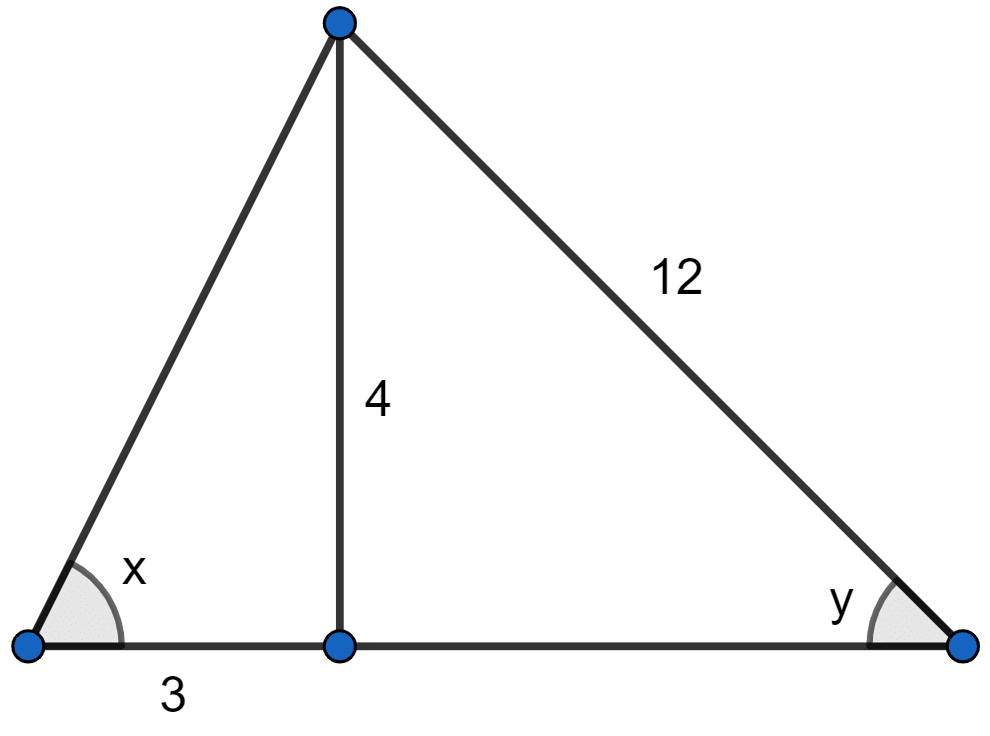
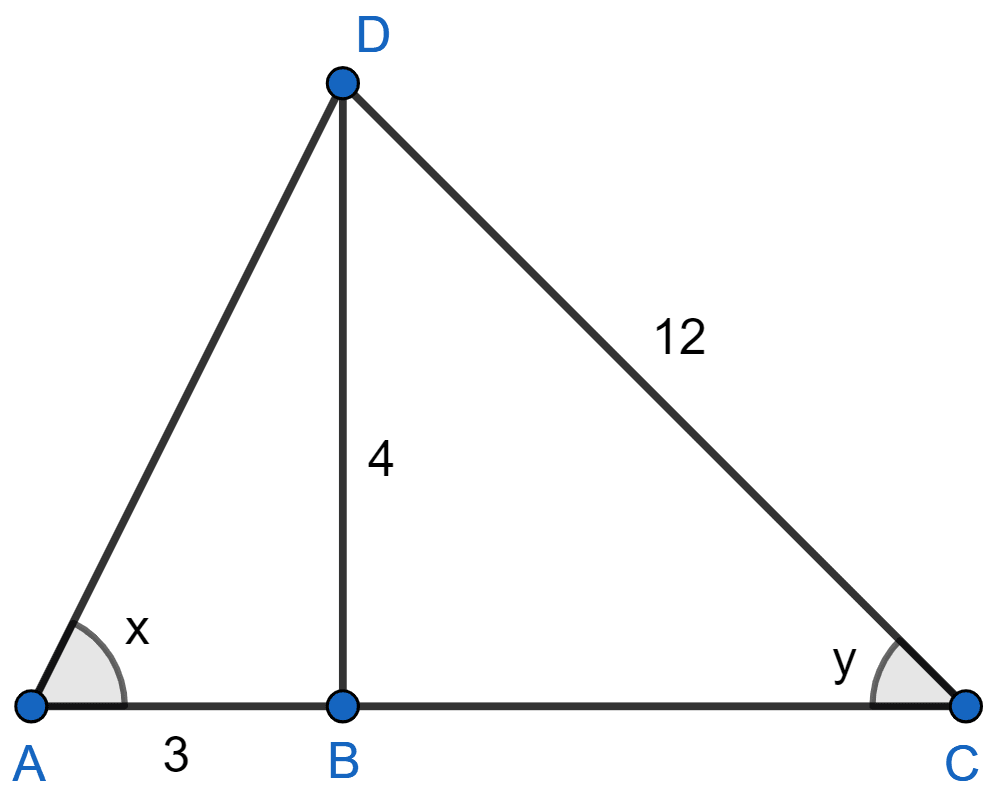
From the figure (2) given below, find the value of :
(i) sin x
(ii) cot x
(iii) cot2 x - cosec2 x
(iv) sec y
(v) tan2 y - 1 cos 2 y \dfrac{1}{\text{cos}^2 y} cos 2 y 1
Answer
In right angled ∆ABD,
By pythagoras theorem we get,
⇒ AD2 = AB2 + BD2
⇒ AD2 = 32 + 42
⇒ AD2 = 9 + 16
⇒ AD2 = 25
⇒ AD = 25 \sqrt{25} 25
⇒ AD = 5
In right angled triangle DBC,
By pythagoras theorem we get,
⇒ DC2 = DB2 + BC2
⇒ 122 = 42 + BC2
⇒ BC2 = 122 - 42
⇒ BC2 = 144 - 16
⇒ BC2 = 128
⇒ BC = 128 \sqrt{128} 128
⇒ BC = 8 2 8\sqrt{2} 8 2
(i) sin x = Perpendicular Hypotenuse \dfrac{\text{Perpendicular}}{\text{Hypotenuse}} Hypotenuse Perpendicular
= B D A D = 4 5 \dfrac{BD}{AD} = \dfrac{4}{5} A D B D = 5 4
Hence, sin x = 4 5 \dfrac{4}{5} 5 4
(ii) cot x = Base Perpendicular \dfrac{\text{Base}}{\text{Perpendicular}} Perpendicular Base
= A B B D = 3 4 \dfrac{AB}{BD} = \dfrac{3}{4} B D A B = 4 3
Hence, cot x = 3 4 \dfrac{3}{4} 4 3
(iii) cosec x = Hypotenuse Perpendicular \dfrac{\text{Hypotenuse}}{\text{Perpendicular}} Perpendicular Hypotenuse
= A D B D = 5 4 \dfrac{AD}{BD} = \dfrac{5}{4} B D A D = 4 5
Substituting values in cot2 x - cosec2 x we get :
= ( 3 4 ) 2 − ( 5 4 ) 2 = 9 16 − 25 16 = − 16 16 = − 1. = \Big(\dfrac{3}{4}\Big)^2 - \Big(\dfrac{5}{4}\Big)^2 \\[1em] = \dfrac{9}{16} - \dfrac{25}{16} \\[1em] = -\dfrac{16}{16} \\[1em] = -1. = ( 4 3 ) 2 − ( 4 5 ) 2 = 16 9 − 16 25 = − 16 16 = − 1.
Hence, cot2 x - cosec2 x = -1.
(iv) sec y = Hypotenuse Base \dfrac{\text{Hypotenuse}}{\text{Base}} Base Hypotenuse
= C D B C = 12 8 2 = 3 2 2 \dfrac{CD}{BC} = \dfrac{12}{8\sqrt{2}} = \dfrac{3}{2\sqrt{2}} BC C D = 8 2 12 = 2 2 3
Hence, sec y = 3 2 2 \dfrac{3}{2\sqrt{2}} 2 2 3
(v) tan y = Perpendicular Base \dfrac{\text{Perpendicular}}{\text{Base}} Base Perpendicular
= B D B C = 4 8 2 = 1 2 2 \dfrac{BD}{BC} = \dfrac{4}{8\sqrt{2}} = \dfrac{1}{2\sqrt{2}} BC B D = 8 2 4 = 2 2 1
Given,
⇒ tan 2 y − 1 cos 2 y ⇒ ( 1 2 2 ) 2 − sec 2 y ⇒ 1 8 − ( 3 2 2 ) 2 ⇒ 1 8 − 9 8 ⇒ 1 − 9 8 ⇒ − 8 8 ⇒ − 1. \Rightarrow \text{tan}^2 y - \dfrac{1}{\text{cos}^2 y} \\[1em] \Rightarrow \Big(\dfrac{1}{2\sqrt{2}}\Big)^2 - \text{sec}^2 y \\[1em] \Rightarrow \dfrac{1}{8} - \Big(\dfrac{3}{2\sqrt{2}}\Big)^2 \\[1em] \Rightarrow \dfrac{1}{8} - \dfrac{9}{8} \\[1em] \Rightarrow \dfrac{1 - 9}{8} \\[1em] \Rightarrow \dfrac{-8}{8} \\[1em] \Rightarrow -1. ⇒ tan 2 y − cos 2 y 1 ⇒ ( 2 2 1 ) 2 − sec 2 y ⇒ 8 1 − ( 2 2 3 ) 2 ⇒ 8 1 − 8 9 ⇒ 8 1 − 9 ⇒ 8 − 8 ⇒ − 1.
Hence, tan 2 y − 1 cos 2 y = − 1 \text{tan}^2 y - \dfrac{1}{\text{cos}^2 y} = -1 tan 2 y − cos 2 y 1 = − 1
From the figure (1) given below, find the values of :
(i) 2 sin y - cos y
(ii) 2 sin x - cos x
(iii) 1 - sin x + cos y
(iv) 2 cos x - 3 sin y + 4 tan x
Answer
In right-angled ∆BCD,
Using pythagoras theorem we get,
⇒ BC2 = BD2 + CD2
⇒ BC2 = 92 + 122
⇒ BC2 = 81 + 144
⇒ BC2 = 225
⇒ BC = 225 \sqrt{225} 225
⇒ BC = 15.
In a right-angled ∆ABC,
Using pythagoras theorem
⇒ AC2 = AB2 + BC2
⇒ AB2 = AC2 - BC2
⇒ AB2 = 252 - 152
⇒ AB2 = 625 - 225 = 400
⇒ AB = 400 \sqrt{400} 400
⇒ AB = 20
(i) We know that
In right-angled ∆BCD,
sin y = Perpendicular Hypotenuse \dfrac{\text{Perpendicular}}{\text{Hypotenuse}} Hypotenuse Perpendicular
= B D B C = 9 15 = 3 5 . \dfrac{BD}{BC} = \dfrac{9}{15} = \dfrac{3}{5}. BC B D = 15 9 = 5 3 .
cos y = Base Hypotenuse \dfrac{\text{Base}}{\text{Hypotenuse}} Hypotenuse Base
= C D B C = 12 15 = 4 5 . \dfrac{CD}{BC} = \dfrac{12}{15} = \dfrac{4}{5}. BC C D = 15 12 = 5 4 .
Substituting values in 2 sin y - cos y we get :
⇒ 2 sin y - cos y = 2 × 3 5 − 4 5 = 6 5 − 4 5 = 2 5 . \Rightarrow \text{2 sin y - cos y} = 2 \times \dfrac{3}{5} - \dfrac{4}{5} \\[1em] = \dfrac{6}{5} - \dfrac{4}{5} \\[1em] = \dfrac{2}{5}. ⇒ 2 sin y - cos y = 2 × 5 3 − 5 4 = 5 6 − 5 4 = 5 2 .
Hence, 2 sin y - cos y = 2 5 \dfrac{2}{5} 5 2
(ii) In right-angled ∆ABC
sin x = Perpendicular Hypotenuse \dfrac{\text{Perpendicular}}{\text{Hypotenuse}} Hypotenuse Perpendicular
= B C A C = 15 25 = 3 5 . \dfrac{BC}{AC} = \dfrac{15}{25} = \dfrac{3}{5}. A C BC = 25 15 = 5 3 .
cos x = Base Hypotenuse \dfrac{\text{Base}}{\text{Hypotenuse}} Hypotenuse Base
= A B A C = 20 25 = 4 5 . \dfrac{AB}{AC} = \dfrac{20}{25} = \dfrac{4}{5}. A C A B = 25 20 = 5 4 .
Substituting the values in 2 sin x - cos x we get :
⇒ 2 sin x - cos x = 2 × 3 5 − 4 5 = 6 5 − 4 5 = 2 5 . \Rightarrow \text{2 sin x - cos x} = 2 \times \dfrac{3}{5} - \dfrac{4}{5} \\[1em] = \dfrac{6}{5} - \dfrac{4}{5} \\[1em] = \dfrac{2}{5}. ⇒ 2 sin x - cos x = 2 × 5 3 − 5 4 = 5 6 − 5 4 = 5 2 .
Hence, 2 sin x - cos x = 2 5 \dfrac{2}{5} 5 2
(iii) Substituting values we get :
⇒ 1 - sin x + cos y = 1 − 3 5 + 4 5 = 5 − 3 + 4 5 = 6 5 . \Rightarrow \text{1 - sin x + cos y} = 1 - \dfrac{3}{5} + \dfrac{4}{5} \\[1em] = \dfrac{5 - 3 + 4}{5} \\[1em] = \dfrac{6}{5}. ⇒ 1 - sin x + cos y = 1 − 5 3 + 5 4 = 5 5 − 3 + 4 = 5 6 .
Hence, 1 - sin x + cos y = 6 5 \dfrac{6}{5} 5 6
(iv) By formula,
tan x = sin x cos x = 3 5 4 5 = 3 4 \dfrac{\text{sin x}}{\text{cos x}} = \dfrac{\dfrac{3}{5}}{\dfrac{4}{5}} = \dfrac{3}{4} cos x sin x = 5 4 5 3 = 4 3
Substituting values we get :
⇒ 2 cos x - 3 sin y + 4 tan x = 2 × 4 5 − 3 × 3 5 + 4 × 3 4 = 8 5 − 9 5 + 3 = − 8 − 9 + 15 5 = 14 5 . \Rightarrow \text{2 cos x - 3 sin y + 4 tan x} = 2 \times \dfrac{4}{5} - 3 \times \dfrac{3}{5} + 4 \times \dfrac{3}{4}\\[1em] = \dfrac{8}{5} - \dfrac{9}{5} + 3 \\[1em] = -\dfrac{8 - 9 + 15}{5} \\[1em] = \dfrac{14}{5}. ⇒ 2 cos x - 3 sin y + 4 tan x = 2 × 5 4 − 3 × 5 3 + 4 × 4 3 = 5 8 − 5 9 + 3 = − 5 8 − 9 + 15 = 5 14 .
Hence, 2 cos x - 3 sin y + 4 tan x = 14 5 \dfrac{14}{5} 5 14
In the figure (2), given below, ΔABC is right angled at B. If sin θ = 5 13 \dfrac{5}{13} 13 5
Answer
Given, ΔABC is a right angled at B.
sin θ = 5 13 \dfrac{5}{13} 13 5
⇒ sin θ = Perpendicular Hypotenuse ⇒ 5 13 = A B A C \Rightarrow \text{sin θ} = \dfrac{\text{Perpendicular}}{\text{Hypotenuse}}\\[1em] \Rightarrow \dfrac{5}{13} = \dfrac{AB}{AC} ⇒ sin θ = Hypotenuse Perpendicular ⇒ 13 5 = A C A B
Let AB = 5k and AC = 13k.
Using pythagoras theorem,
⇒ AC2 = AB2 + BC2
⇒ (13k)2 = (5k)2 + 242
⇒ 169k2 = 25k2 + 576
⇒ 169k2 - 25k2 = 576
⇒ 144k2 = 576
⇒ k2 = 576 144 \dfrac{576}{144} 144 576
⇒ k2 = 4
⇒ k = 4 \sqrt{4} 4
⇒ k = ± 2
Since, length cannot be negative.
⇒ k = 2
So, AB = 5k = 5 x 2 = 10 cm,
and AC = 13k = 13 x 2 = 26 cm.
Hence, AB = 10 cm and AC = 26 cm.
In a right-angled triangle, it is given that angle A is an acute angle and that tan A = 5 12 \dfrac{5}{12} 12 5
(i) cos A
(ii) cosec A - cot A.
Answer
Let ABC be a right angled triangle with ∠B = 90°.
Given,
tan A = 5 12 \dfrac{5}{12} 12 5
By formula,
tan A = Perpendicular Base = B C A B = 5 12 \dfrac{\text{Perpendicular}}{\text{Base}} = \dfrac{BC}{AB} = \dfrac{5}{12} Base Perpendicular = A B BC = 12 5
Let BC = 5x and AB = 12x.
From right-angled ∆ABC
By pythagoras theorem, we get
⇒ AC2 = BC2 + AB2
⇒ AC2 = (5x)2 + (12x)2
⇒ AC2 = 25x2 + 144x2
⇒ AC2 = 169x2
⇒ AC = 169 x 2 \sqrt{169x^2} 169 x 2
⇒ AC = 13x.
(i) By formula,
cos A = Base Hypotenuse \dfrac{\text{Base}}{\text{Hypotenuse}} Hypotenuse Base
= A B A C = 12 x 13 x = 12 13 \dfrac{AB}{AC} = \dfrac{12x}{13x} = \dfrac{12}{13} A C A B = 13 x 12 x = 13 12
Hence, cos A = 12 13 \dfrac{12}{13} 13 12
(ii) By formula,
cosec A = Hypotenuse Perpendicular \dfrac{\text{Hypotenuse}}{\text{Perpendicular}} Perpendicular Hypotenuse
= A C B C = 13 x 5 x = 13 5 \dfrac{AC}{BC} = \dfrac{13x}{5x} = \dfrac{13}{5} BC A C = 5 x 13 x = 5 13
cot A = Base Perpendicular \dfrac{\text{Base}}{\text{Perpendicular}} Perpendicular Base
= A B B C \dfrac{AB}{BC} BC A B 12 x 5 x \dfrac{12x}{5x} 5 x 12 x 12 5 \dfrac{12}{5} 5 12
Substituting values in cosec A - cot A, we get :
⇒ cosec A - cot A = 13 5 − 12 5 = 1 5 . \Rightarrow \text{cosec A - cot A} = \dfrac{13}{5} - \dfrac{12}{5} \\[1em] = \dfrac{1}{5}. ⇒ cosec A - cot A = 5 13 − 5 12 = 5 1 .
Hence, cosec A - cot A = 1 5 \dfrac{1}{5} 5 1
In ∆ABC, ∠A = 90°. If AB = 7 cm and BC - AC = 1 cm, find :
(i) sin C
(ii) tan B
Answer
(a) In right ∆ABC
∠A = 90°
AB = 7 cm
BC - AC = 1 cm
⇒ BC = 1 + AC
We know that,
⇒ BC2 = AB2 + AC2 [By pythagoras theorem]
⇒ (1 + AC)2 = AB2 + AC2
⇒ 1 + AC2 + 2AC = 72 + AC2
⇒ 1 + AC2 + 2AC = 49 + AC2
⇒ 2AC = 49 - 1
⇒ 2AC = 48
⇒ AC = 48 2 \dfrac{48}{2} 2 48
∴ BC = 1 + AC = 25 cm.
(i) sin C = Perpendicular Hypotenuse \dfrac{\text{Perpendicular}}{\text{Hypotenuse}} Hypotenuse Perpendicular
= A B B C = 7 25 \dfrac{AB}{BC} = \dfrac{7}{25} BC A B = 25 7
Hence, sin C = 7 25 \dfrac{7}{25} 25 7
(ii) tan B = Perpendicular Base \dfrac{\text{Perpendicular}}{\text{Base}} Base Perpendicular
= A C A B = 24 7 \dfrac{AC}{AB} = \dfrac{24}{7} A B A C = 7 24
Hence, tan B = 24 7 \dfrac{24}{7} 7 24
In △PQR, ∠Q = 90°. If PQ = 40 cm and PR + QR = 50 cm, find :
(i) sin P
(ii) cos P
(iii) tan R
Answer
In right ∆PQR,
∠Q = 90°
PQ = 40 cm
Given,
⇒ PR + QR = 50 cm
⇒ PR = 50 - QR
Using Pythagoras theorem we get,
⇒ PR2 = PQ2 + QR2
⇒ (50 - QR)2 = (40)2 + QR2
⇒ 502 + QR2 - 100QR = 1600 + QR2
⇒ QR2 - QR2 - 100QR = 1600 - 2500
⇒ -100QR = -900
⇒ 100QR = 900
⇒ QR = 900 100 \dfrac{900}{100} 100 900
∴ PR = 50 - QR = 50 - 9 = 41.
(i) sin P = Perpendicular Hypotenuse \dfrac{\text{Perpendicular}}{\text{Hypotenuse}} Hypotenuse Perpendicular
= Q R P R = 9 41 \dfrac{QR}{PR} = \dfrac{9}{41} PR QR = 41 9
Hence, sin P = 9 41 \dfrac{9}{41} 41 9
(ii) cos P = Base Hypotenuse \dfrac{\text{Base}}{\text{Hypotenuse}} Hypotenuse Base
= P Q P R = 40 41 \dfrac{PQ}{PR} = \dfrac{40}{41} PR PQ = 41 40
Hence, cos P = 40 41 \dfrac{40}{41} 41 40
(iii) tan R = Perpendicular Base \dfrac{\text{Perpendicular}}{\text{Base}} Base Perpendicular
= P Q Q R = 40 9 \dfrac{PQ}{QR} = \dfrac{40}{9} QR PQ = 9 40
Hence, tan R = 40 9 \dfrac{40}{9} 9 40
In △ABC, AB = AC = 15 cm, BC = 18 cm. Find
(i) cos ∠ABC
(ii) sin ∠ACB.
Answer
Draw AD perpendicular to BC.
D is mid-point of BC [∵ Perpendicular drawn to the unequal side of an isosceles triangle from the apex vertex bisects the side]
∴ BD = DC = 9 cm.
In right-angled triangle ABD,
⇒ AB2 = AD2 + BD2
⇒ 152 = AD2 + 92
⇒ AD2 = (15)2 - (9)2
⇒ AD2 = 225 - 81
⇒ AD2 = 144
⇒ AD = 144 \sqrt{144} 144
(i) cos ∠ABC = B D A B \dfrac{BD}{AB} A B B D
= 9 15 = 3 5 \dfrac{9}{15} = \dfrac{3}{5} 15 9 = 5 3
Hence, cos ∠ABC = 3 5 \dfrac{3}{5} 5 3
(ii) sin ∠ACB = A D A C \dfrac{AD}{AC} A C A D
= 12 15 = 4 5 \dfrac{12}{15} = \dfrac{4}{5} 15 12 = 5 4
Hence, sin ∠ACB = 4 5 \dfrac{4}{5} 5 4
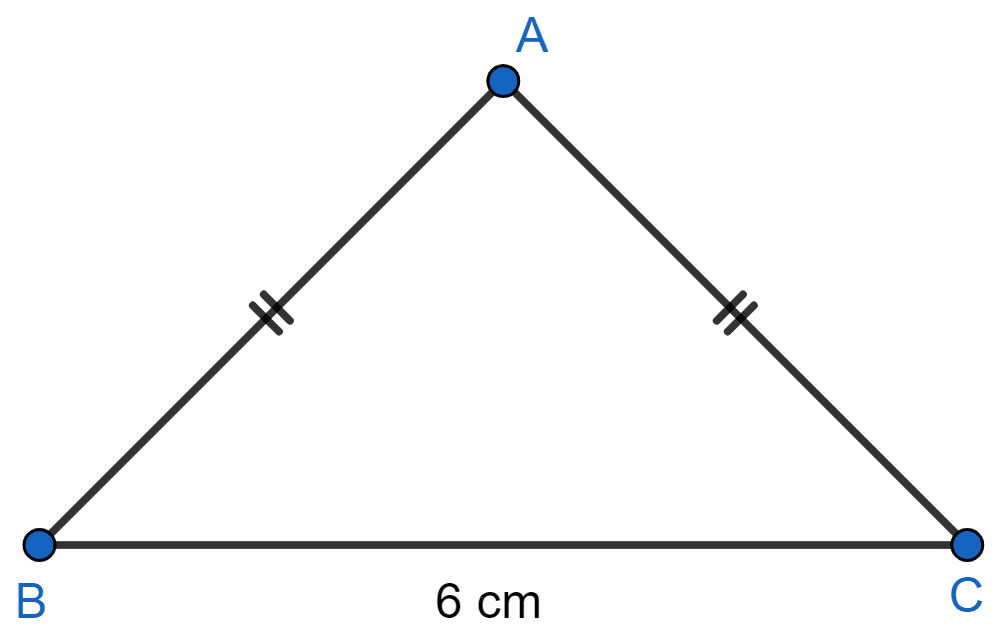
In the figure (1) given below, ∆ABC is isosceles with AB = AC = 5 cm and BC = 6 cm. Find
(i) sin C
(ii) tan B
(iii) tan C - cot B.
Answer
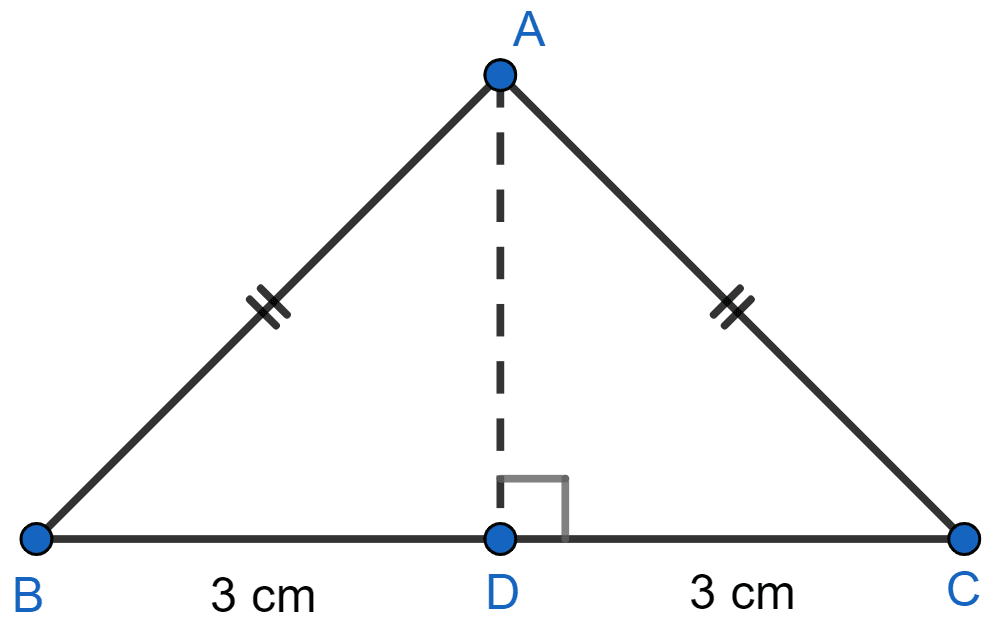
Draw AD perpendicular to BC.
D is the mid point of BC [∵ Perpendicular drawn to the unequal side of an isosceles triangle from the apex vertex bisects the side]
So, BD = CD = 3 cm.
In right-angled ∆ABD,
Using pythagoras theorem we get :
⇒ AB2 = AD2 + BD2
⇒ AD2 = AB2 - BD2
⇒ AD2 = 52 - 32
⇒ AD2 = 25 - 9
⇒ AD2 = 16
⇒ AD = 16 \sqrt{16} 16
⇒ AD = 4 cm.
(i) In right-angled ∆ACD,
sin C = Perpendicular Hypotenuse \dfrac{\text{Perpendicular}}{\text{Hypotenuse}} Hypotenuse Perpendicular
= A D A C = 4 5 \dfrac{AD}{AC} = \dfrac{4}{5} A C A D = 5 4
Hence, sin C = 4 5 \dfrac{4}{5} 5 4
(ii) In right-angled ∆ABD,
tan B = Perpendicular Base \dfrac{\text{Perpendicular}}{\text{Base}} Base Perpendicular
= A D B D = 4 3 \dfrac{AD}{BD} = \dfrac{4}{3} B D A D = 3 4
Hence, tan B = 4 3 \dfrac{4}{3} 3 4
(iii) In right-angled ∆ACD,
tan C = Perpendicular Base \dfrac{\text{Perpendicular}}{\text{Base}} Base Perpendicular
= A D C D = 4 3 \dfrac{AD}{CD} = \dfrac{4}{3} C D A D = 3 4
In right-angled ∆ABD,
cot B = base Perpendicular \dfrac{\text{base}}{\text{Perpendicular}} Perpendicular base
= B D A D = 3 4 \dfrac{BD}{AD} = \dfrac{3}{4} A D B D = 4 3
Substituting values in tan C - cot B we get :
tan C − cot B = 4 3 − 3 4 = 16 − 9 12 = 7 12 . \text{tan C} - \text{cot B} = \dfrac{4}{3} - \dfrac{3}{4} \\[1em] = \dfrac{16 - 9}{12} \\[1em] = \dfrac{7}{12}. tan C − cot B = 3 4 − 4 3 = 12 16 − 9 = 12 7 .
Hence, tan C - cot B = 7 12 \dfrac{7}{12} 12 7
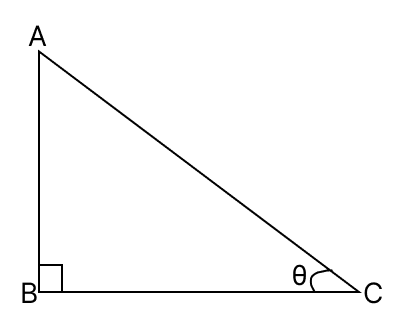
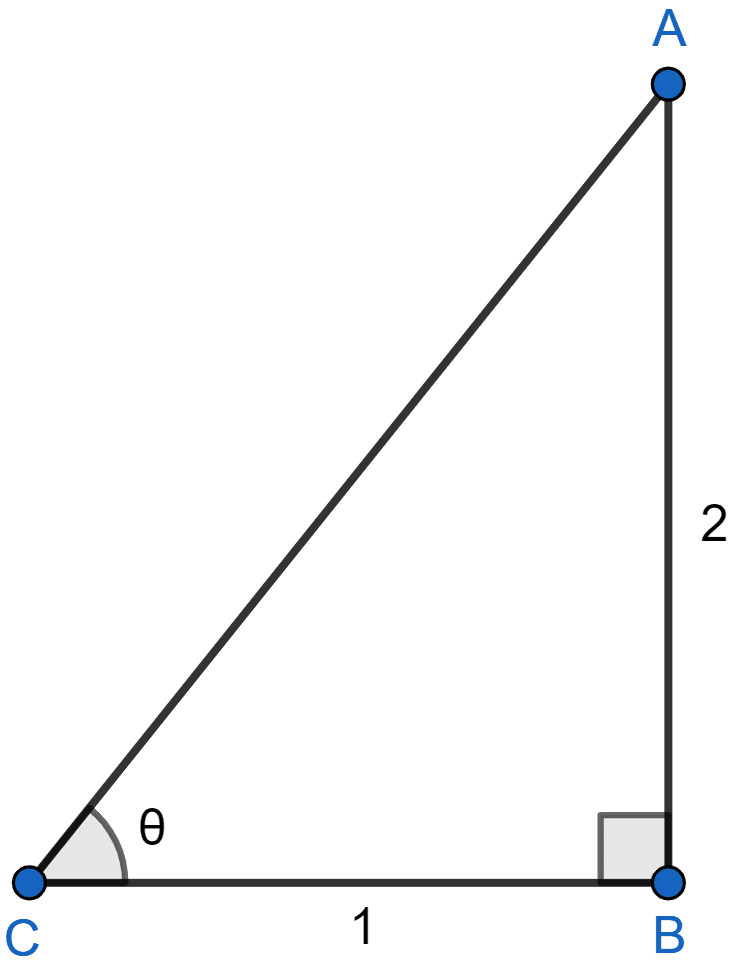
In the figure (2) given below, △ABC is right-angled at B. Given that ∠ACB = θ, side AB = 2 units and side BC = 1 unit, find the value of sin2 θ + tan2 θ.
Answer
In right angle triangle ABC,
⇒ AC2 = AB2 + BC2
⇒ AC2 = (2)2 + (1)2
⇒ AC2 = 4 + 1 = 5
⇒ AC = 5 \sqrt{5} 5
Calculating sin θ, we get :
sin θ = Perpendicular Hypotenuse = A B A C = 2 5 . \text{sin θ} = \dfrac{\text{Perpendicular}}{\text{Hypotenuse}} \\[1em] = \dfrac{AB}{AC} \\[1em] = \dfrac{2}{\sqrt{5}}. sin θ = Hypotenuse Perpendicular = A C A B = 5 2 .
Calculating tan θ, we get :
tan θ = Perpendicular Base = A B B C = 2 1 = 2. \text{tan θ} = \dfrac{\text{Perpendicular}}{\text{Base}} \\[1em] = \dfrac{AB}{BC} \\[1em] = \dfrac{2}{1} = 2. tan θ = Base Perpendicular = BC A B = 1 2 = 2.
Substituting value of sin θ and tan θ in sin2 θ + tan2 θ, we get :
sin 2 θ + tan 2 θ = ( 2 5 ) 2 + 2 2 = 4 5 + 4 = 4 + 20 5 = 24 5 = 4 4 5 . \text{sin}^2 \text{ θ} + \text{tan}^2 \text{ θ} = \Big(\dfrac{2}{\sqrt{5}}\Big)^2 + 2^2 \\[1em] = \dfrac{4}{5} + 4 \\[1em] = \dfrac{4 + 20}{5} \\[1em] = \dfrac{24}{5} = 4\dfrac{4}{5}. sin 2 θ + tan 2 θ = ( 5 2 ) 2 + 2 2 = 5 4 + 4 = 5 4 + 20 = 5 24 = 4 5 4 .
Hence, sin2 θ + tan2 θ = 4 4 5 4\dfrac{4}{5} 4 5 4
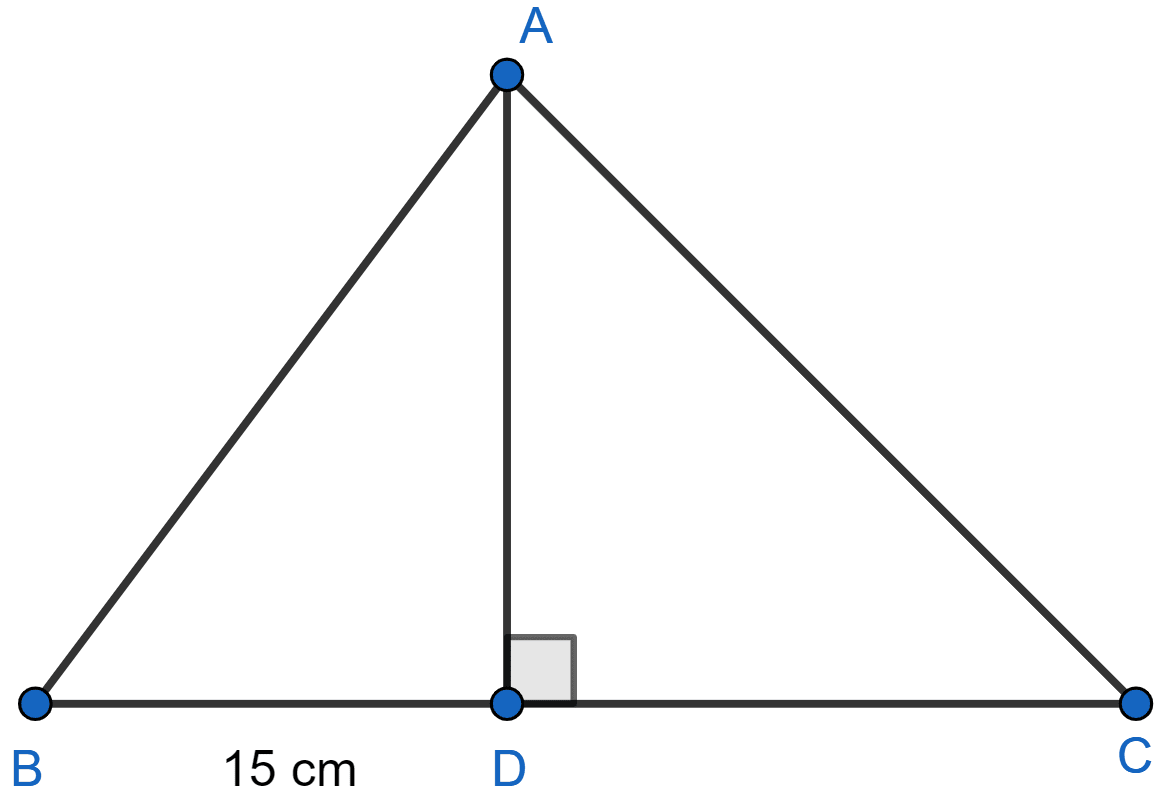
In the figure (3) given below, AD is perpendicular to BC, BD = 15 cm, sin B = 4 5 \dfrac{4}{5} 5 4
(i) Calculate the lengths of AD, AB, DC and AC.
(ii) Show that tan 2 B − 1 cos 2 B \text{tan}^2 \text{ B} - \dfrac{1}{\text{cos}^2 \text{ B}} tan 2 B − cos 2 B 1
Answer
(i) From figure,
tan C = Perpendicular Base \dfrac{\text{Perpendicular}}{\text{Base}} Base Perpendicular A D D C \dfrac{AD}{DC} D C A D
⇒ 1 = A D D C \dfrac{AD}{DC} D C A D
⇒ AD = DC.
sin B = Perpendicular Hypotenuse \dfrac{\text{Perpendicular}}{\text{Hypotenuse}} Hypotenuse Perpendicular A D A B \dfrac{AD}{AB} A B A D
⇒ 4 5 \dfrac{4}{5} 5 4 A D A B \dfrac{AD}{AB} A B A D
Let AD = 4k and AB = 5k.
In right angle triangle ABD,
⇒ AB2 = AD2 + BD2
⇒ (5k)2 = (4k)2 + 152
⇒ 25k2 = 16k2 + 225
⇒ 9k2 = 225
⇒ k2 = 225 9 \dfrac{225}{9} 9 225
⇒ k = 25 \sqrt{25} 25
AD = 4k = 4 × 5 = 20
AB = 5k = 5 × 5 = 25.
DC = AD = 20.
In right angle triangle ADC,
⇒ AC2 = AD2 + DC2
⇒ AC2 = 202 + 202
⇒ AC2 = 400 +400
⇒ AC2 = 800
⇒ AC = 800 = 20 2 \sqrt{800} = 20\sqrt{2} 800 = 20 2
Hence, AD = 20, AB = 25, DC = 20 and AC = 20 2 20\sqrt{2} 20 2
(ii) Calculating tan B, we get :
tan B = Perpendicular Base = A D B D = 20 15 = 4 3 . \text{tan B} = \dfrac{\text{Perpendicular}}{\text{Base}} \\[1em] = \dfrac{AD}{BD} \\[1em] = \dfrac{20}{15} = \dfrac{4}{3}. tan B = Base Perpendicular = B D A D = 15 20 = 3 4 .
Calculating cos B, we get :
cos B = Base Hypotenuse = B D A B = 15 25 = 3 5 . \text{cos B} = \dfrac{\text{Base}}{\text{Hypotenuse}} \\[1em] = \dfrac{BD}{AB} \\[1em] = \dfrac{15}{25} = \dfrac{3}{5}. cos B = Hypotenuse Base = A B B D = 25 15 = 5 3 .
Substituting value of tan B and cos B in L.H.S. of the equation, tan 2 B − 1 cos 2 B \text{tan}^2 \text{ B} - \dfrac{1}{\text{cos}^2 \text{ B}} tan 2 B − cos 2 B 1
⇒ tan 2 B − 1 cos 2 B = ( 4 3 ) 2 − 1 ( 3 5 ) 2 = 16 9 − 1 9 25 = 16 9 − 25 9 = − 9 9 = − 1. \Rightarrow \text{tan}^2 B - \dfrac{1}{\text{cos}^2 B} = \Big(\dfrac{4}{3}\Big)^2 - \dfrac{1}{\Big(\dfrac{3}{5}\Big)^2} \\[1em] = \dfrac{16}{9} - \dfrac{1}{\dfrac{9}{25}} \\[1em] = \dfrac{16}{9} - \dfrac{25}{9} \\[1em] = \dfrac{-9}{9} \\[1em] = -1. ⇒ tan 2 B − cos 2 B 1 = ( 3 4 ) 2 − ( 5 3 ) 2 1 = 9 16 − 25 9 1 = 9 16 − 9 25 = 9 − 9 = − 1.
Hence, proved that tan2 B - 1 cos 2 B \dfrac{1}{\text{cos}^2 B} cos 2 B 1
If sin θ = 3 5 \dfrac{3}{5} 5 3
(i) cos θ
(ii) tan θ.
Answer
(i) By formula,
⇒ sin2 θ + cos2 θ = 1
Substituting values we get,
⇒ ( 3 5 ) 2 + cos 2 θ = 1 ⇒ cos 2 θ = 1 − 9 25 ⇒ cos 2 θ = 25 − 9 25 ⇒ cos 2 θ = 16 25 ⇒ cos θ = 16 25 ⇒ cos θ = ± 4 5 . \Rightarrow \Big(\dfrac{3}{5}\Big)^2 + \text{cos}^2 \text{ θ} = 1 \\[1em] \Rightarrow \text{cos}^2 \text{ θ} = 1 - \dfrac{9}{25} \\[1em] \Rightarrow \text{cos}^2 \text{ θ} = \dfrac{25 - 9}{25} \\[1em] \Rightarrow \text{cos}^2 \text{ θ} = \dfrac{16}{25} \\[1em] \Rightarrow \text{cos θ} = \sqrt{\dfrac{16}{25}} \\[1em] \Rightarrow \text{cos θ} = \pm \dfrac{4}{5}. ⇒ ( 5 3 ) 2 + cos 2 θ = 1 ⇒ cos 2 θ = 1 − 25 9 ⇒ cos 2 θ = 25 25 − 9 ⇒ cos 2 θ = 25 16 ⇒ cos θ = 25 16 ⇒ cos θ = ± 5 4 .
Since, θ is an acute angle and value of cos is positive in first quadrant.
∴ cos θ = 4 5 \dfrac{4}{5} 5 4
Hence, cos θ = 4 5 \dfrac{4}{5} 5 4
(ii) By formula,
tan θ = sin θ cos θ \dfrac{\text{sin θ}}{\text{cos θ}} cos θ sin θ
= 3 5 4 5 = 3 4 \dfrac{\dfrac{3}{5}}{\dfrac{4}{5}} = \dfrac{3}{4} 5 4 5 3 = 4 3
Hence, tan θ = 3 4 \dfrac{3}{4} 4 3
Given that tan θ = 5 12 \dfrac{5}{12} 12 5
Answer
By formula,
sec2 θ = 1 + tan2 θ
Substituting values we get,
⇒ sec 2 θ = 1 + ( 5 12 ) 2 ⇒ sec 2 θ = 1 + 25 144 ⇒ sec 2 θ = 144 + 25 144 ⇒ sec 2 θ = 169 144 ⇒ sec θ = 169 144 ⇒ sec θ = ± 13 12 . \Rightarrow \text{sec}^2 \text{ θ} = 1 + \Big(\dfrac{5}{12}\Big)^2 \\[1em] \Rightarrow \text{sec}^2 \text{ θ} = 1 + \dfrac{25}{144} \\[1em] \Rightarrow \text{sec}^2 \text{ θ} = \dfrac{144 + 25}{144} \\[1em] \Rightarrow \text{sec}^2 \text{ θ} = \dfrac{169}{144} \\[1em] \Rightarrow \text{sec θ} = \sqrt{\dfrac{169}{144}} \\[1em] \Rightarrow \text{sec θ} = \pm \dfrac{13}{12}. ⇒ sec 2 θ = 1 + ( 12 5 ) 2 ⇒ sec 2 θ = 1 + 144 25 ⇒ sec 2 θ = 144 144 + 25 ⇒ sec 2 θ = 144 169 ⇒ sec θ = 144 169 ⇒ sec θ = ± 12 13 .
Since, θ is an acute angle and value of sec is positive in first quadrant.
∴ sec θ = 13 12 \dfrac{13}{12} 12 13
By formula,
cos θ = 1 sec θ = 1 13 12 = 12 13 . \dfrac{1}{\text{sec θ}} = \dfrac{1}{\dfrac{13}{12}} = \dfrac{12}{13}. sec θ 1 = 12 13 1 = 13 12 .
sin2 θ + cos2 θ = 1
Substituting values we get,
⇒ sin 2 θ + ( 12 13 ) 2 = 1 ⇒ sin 2 θ = 1 − ( 12 13 ) 2 ⇒ sin 2 θ = 1 − 144 169 ⇒ sin 2 θ = 169 − 144 169 ⇒ sin 2 θ = 25 169 ⇒ sin θ = 25 169 ⇒ sin θ = ± 5 13 . \Rightarrow \text{sin}^2 \text{ θ} + \Big(\dfrac{12}{13}\Big)^2 = 1 \\[1em] \Rightarrow \text{sin}^2 \text{ θ} = 1 - \Big(\dfrac{12}{13}\Big)^2\\[1em] \Rightarrow \text{sin}^2 \text{ θ} = 1 - \dfrac{144}{169} \\[1em] \Rightarrow \text{sin}^2 \text{ θ} = \dfrac{169 - 144}{169} \\[1em] \Rightarrow \text{sin}^2 \text{ θ} = \dfrac{25}{169} \\[1em] \Rightarrow \text{sin θ} = \sqrt{\dfrac{25}{169}} \\[1em] \Rightarrow \text{sin θ} = \pm \dfrac{5}{13}. ⇒ sin 2 θ + ( 13 12 ) 2 = 1 ⇒ sin 2 θ = 1 − ( 13 12 ) 2 ⇒ sin 2 θ = 1 − 169 144 ⇒ sin 2 θ = 169 169 − 144 ⇒ sin 2 θ = 169 25 ⇒ sin θ = 169 25 ⇒ sin θ = ± 13 5 .
Since, θ is an acute angle and value of sin is positive in first quadrant.
∴ sin θ = 5 13 \dfrac{5}{13} 13 5
Hence, sin θ = 5 13 \dfrac{5}{13} 13 5 12 13 \dfrac{12}{13} 13 12
If sin θ = 6 10 \dfrac{6}{10} 10 6
Answer
Given,
⇒ sin θ = 6 10 ⇒ sin 2 θ = 36 100 ⇒ 1 − cos 2 θ = 36 100 ⇒ cos 2 θ = 1 − 36 100 ⇒ cos 2 θ = 100 − 36 100 ⇒ cos 2 θ = 64 100 ⇒ cos θ = 64 100 ⇒ cos θ = 8 10 tan θ = sin θ cos θ = 6 10 8 10 = 6 8 . \Rightarrow \text{sin θ} = \dfrac{6}{10} \\[1em] \Rightarrow \text{sin}^2 \text{ θ} = \dfrac{36}{100} \\[1em] \Rightarrow 1 - \text{cos}^2 \text{ θ} = \dfrac{36}{100} \\[1em] \Rightarrow \text{cos}^2 \text{ θ} = 1 - \dfrac{36}{100} \\[1em] \Rightarrow \text{cos}^2 \text{ θ} = \dfrac{100 - 36}{100} \\[1em] \Rightarrow \text{cos}^2 \text{ θ} = \dfrac{64}{100} \\[1em] \Rightarrow \text{cos θ} = \sqrt{\dfrac{64}{100}} \\[1em] \Rightarrow \text{cos θ} = \dfrac{8}{10} \\[1.5em] \text{tan θ} = \dfrac{\text{sin θ}}{\text{cos θ}} \\[1em] = \dfrac{\dfrac{6}{10}}{\dfrac{8}{10}} = \dfrac{6}{8}. ⇒ sin θ = 10 6 ⇒ sin 2 θ = 100 36 ⇒ 1 − cos 2 θ = 100 36 ⇒ cos 2 θ = 1 − 100 36 ⇒ cos 2 θ = 100 100 − 36 ⇒ cos 2 θ = 100 64 ⇒ cos θ = 100 64 ⇒ cos θ = 10 8 tan θ = cos θ sin θ = 10 8 10 6 = 8 6 .
Substituting values in cos θ + tan θ we get,
cos θ + tan θ = 8 10 + 6 8 = 32 + 30 40 = 62 40 = 31 20 = 1 11 20 \text{cos θ + tan θ }= \dfrac{8}{10} + \dfrac{6}{8} \\[1em] = \dfrac{32 + 30}{40} \\[1em] = \dfrac{62}{40} \\[1em] = \dfrac{31}{20} \\[1em] = 1\dfrac{11}{20} cos θ + tan θ = 10 8 + 8 6 = 40 32 + 30 = 40 62 = 20 31 = 1 20 11
Hence, cos θ + tan θ = 1 11 20 . 1\dfrac{11}{20}. 1 20 11 .
If tan θ = 4 3 \dfrac{4}{3} 3 4
Answer
Given,
⇒ tan θ = 4 3 ⇒ tan 2 θ = 16 9 ⇒ sec 2 θ = 1 + tan 2 θ ⇒ sec 2 θ = 1 + 16 9 ⇒ sec 2 θ = 9 + 16 9 ⇒ sec 2 θ = 25 9 ⇒ 1 cos 2 θ = 25 9 ⇒ cos 2 θ = 9 25 ⇒ cos θ = 9 25 ⇒ cos θ = ± 3 5 ⇒ cos θ = 3 5 [ Given, cos θ is positive. ] . \phantom{\Rightarrow} \text{tan θ} = \dfrac{4}{3} \\[1em] \Rightarrow \text{tan}^2 \text{ θ} = \dfrac{16}{9} \\[1em] \phantom{\Rightarrow} \text{sec}^2 \text{ θ} = 1 + \text{tan}^2 θ \\[1em] \Rightarrow \text{sec}^2 \text{ θ} = 1 + \dfrac{16}{9} \\[1em] \Rightarrow \text{sec}^2 \text{ θ} = \dfrac{9 + 16}{9} \\[1em] \Rightarrow \text{sec}^2 \text{ θ} = \dfrac{25}{9} \\[1em] \Rightarrow \dfrac{1}{\text{cos}^2 \text{ θ}} = \dfrac{25}{9} \\[1em] \Rightarrow \text{cos}^2 \text{ θ} = \dfrac{9}{25} \\[1em] \Rightarrow \text{cos θ} = \sqrt{\dfrac{9}{25}} \\[1em] \Rightarrow \text{cos θ} = \pm\dfrac{3}{5} \\[1em] \Rightarrow \text{cos θ} = \dfrac{3}{5} [\text{Given, cos θ is positive.}]. ⇒ tan θ = 3 4 ⇒ tan 2 θ = 9 16 ⇒ sec 2 θ = 1 + tan 2 θ ⇒ sec 2 θ = 1 + 9 16 ⇒ sec 2 θ = 9 9 + 16 ⇒ sec 2 θ = 9 25 ⇒ cos 2 θ 1 = 9 25 ⇒ cos 2 θ = 25 9 ⇒ cos θ = 25 9 ⇒ cos θ = ± 5 3 ⇒ cos θ = 5 3 [ Given, cos θ is positive. ] .
By formula,
sin2 θ + cos2 θ = 1
Substituting values in sin2 θ + cos2 θ = 1 we get :
⇒ sin 2 θ + ( 3 5 ) 2 = 1 ⇒ sin 2 θ = 1 − 9 25 ⇒ sin 2 θ = 25 − 9 25 ⇒ sin 2 θ = 16 25 ⇒ sin θ = 16 25 ⇒ sin θ = ± 4 5 ⇒ sin θ = 4 5 [ Given, sin θ is positive. ] . \Rightarrow \text{sin}^2 \text{ θ} + \Big(\dfrac{3}{5}\Big)^2 = 1 \\[1em] \Rightarrow \text{sin}^2 \text{ θ} = 1 - \dfrac{9}{25} \\[1em] \Rightarrow \text{sin}^2 \text{ θ} = \dfrac{25 - 9}{25} \\[1em] \Rightarrow \text{sin}^2 \text{ θ} = \dfrac{16}{25} \\[1em] \Rightarrow \text{sin θ} = \sqrt{\dfrac{16}{25}} \\[1em] \Rightarrow \text{sin θ} = \pm\dfrac{4}{5} \\[1em] \Rightarrow \text{sin θ} = \dfrac{4}{5} \space [\text{Given, sin θ is positive.}]. ⇒ sin 2 θ + ( 5 3 ) 2 = 1 ⇒ sin 2 θ = 1 − 25 9 ⇒ sin 2 θ = 25 25 − 9 ⇒ sin 2 θ = 25 16 ⇒ sin θ = 25 16 ⇒ sin θ = ± 5 4 ⇒ sin θ = 5 4 [ Given, sin θ is positive. ] .
Substituting values in sin θ + cos θ we get :
sin θ + cos θ = 4 5 + 3 5 = 7 5 = 1 2 5 . \dfrac{4}{5} + \dfrac{3}{5} = \dfrac{7}{5} = 1\dfrac{2}{5}. 5 4 + 5 3 = 5 7 = 1 5 2 .
Hence, sin θ + cos θ = 1 2 5 1\dfrac{2}{5} 1 5 2
If cosec θ = 5 \sqrt{5} 5
Answer
Let ABC be a right angle triangle with ∠C = θ and ∠B = 90°.
By formula,
cosec θ = Hypotenuse Perpendicular = A C A B \dfrac{\text{Hypotenuse}}{\text{Perpendicular}} = \dfrac{AC}{AB} Perpendicular Hypotenuse = A B A C
Substituting values we get :
⇒ 5 1 = A C A B \Rightarrow \dfrac{\sqrt{5}}{1} = \dfrac{AC}{AB} ⇒ 1 5 = A B A C
Let AC = 5 \sqrt{5} 5
In right angle triangle ABC,
⇒ AC2 = AB2 + BC2
⇒ (5 \sqrt{5} 5 2 = BC2 + k2
⇒ 5k2 = BC2 + k2
⇒ BC2 = 5k2 - k2
⇒ BC2 = 4k2
⇒ BC = 4 k 2 \sqrt{4\text{k}^2} 4 k 2
⇒ BC = 2k.
cot θ = Base Perpendicular \dfrac{\text{Base}}{\text{Perpendicular}} Perpendicular Base
= B C A B \dfrac{BC}{AB} A B BC 2 k k \dfrac{2k}{k} k 2 k 2 1 \dfrac{2}{1} 1 2
cos θ = Base Hypotenuse \dfrac{\text{Base}}{\text{Hypotenuse}} Hypotenuse Base
= B C A C \dfrac{BC}{AC} A C BC 2 k 5 k \dfrac{2k}{\sqrt{5}k} 5 k 2 k 2 5 \dfrac{2}{\sqrt{5}} 5 2
∴ cot θ - cos θ = 2 1 − 2 5 = 2 5 − 2 5 = 2 ( 5 − 1 ) 5 . \therefore \text{cot θ - cos θ} = \dfrac{2}{1} - \dfrac{2}{\sqrt{5}} \\[1em] = \dfrac{2\sqrt{5} - 2}{\sqrt{5}} \\[1em] = \dfrac{2(\sqrt{5} - 1)}{\sqrt{5}}. ∴ cot θ - cos θ = 1 2 − 5 2 = 5 2 5 − 2 = 5 2 ( 5 − 1 ) .
Hence, cot θ - cos θ = 2 ( 5 − 1 ) 5 . \dfrac{2(\sqrt{5} - 1)}{\sqrt{5}}. 5 2 ( 5 − 1 ) .
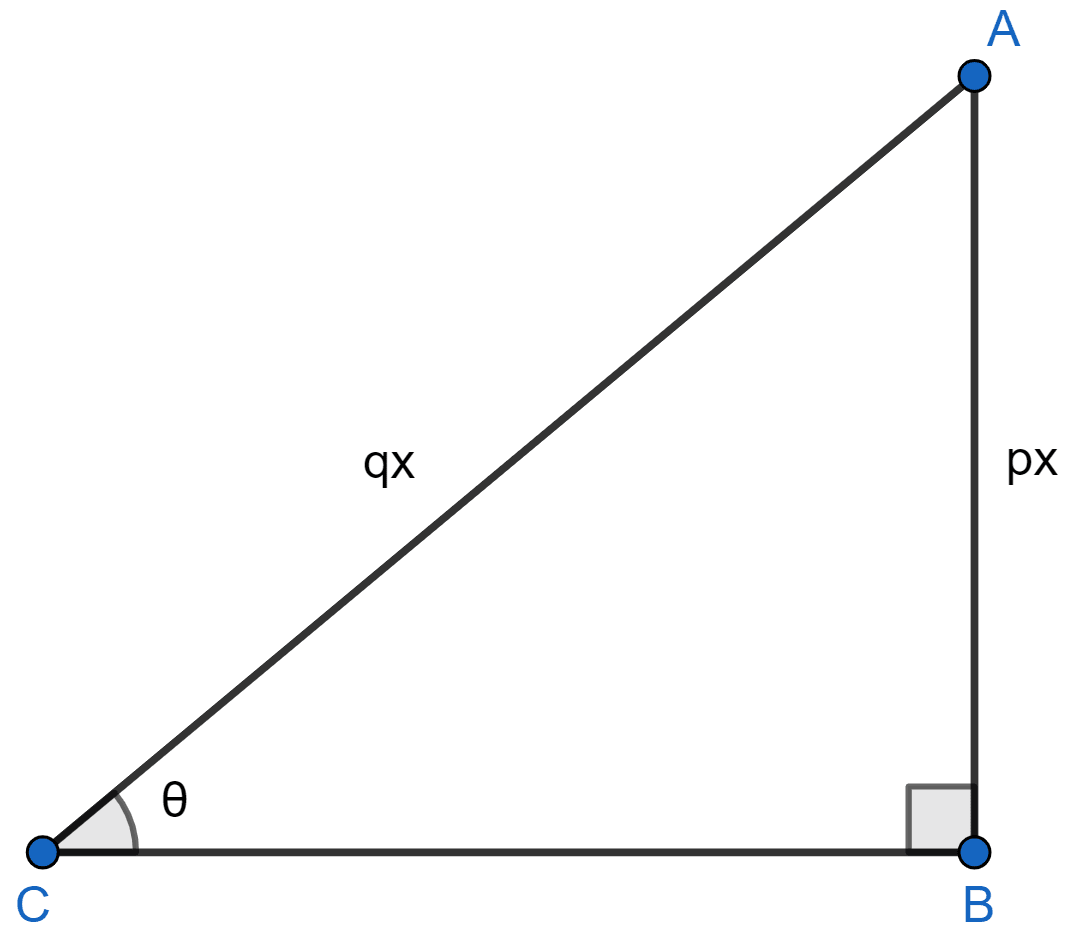
Given sin θ = p q \dfrac{p}{q} q p
Answer
Let ABC be a right angle triangle with ∠C = θ and ∠B = 90°.
By formula,
sin θ = Perpendicular Hypotenuse = A B A C \dfrac{\text{Perpendicular}}{\text{Hypotenuse}} = \dfrac{AB}{AC} Hypotenuse Perpendicular = A C A B
Given,
sin θ = p q \dfrac{p}{q} q p
From (1) and (2) we get,
A B A C = p q \dfrac{AB}{AC} = \dfrac{p}{q} A C A B = q p
Let AB = px and AC = qx.
In right angled triangle ABC,
By pythagoras theorem,
⇒ AC2 = AB2 + BC2
⇒ BC2 = AC2 - AB2
⇒ BC2 = (qx)2 - (px)2
⇒ BC2 = q2 x2 - p2 x2
⇒ BC2 = x2 (q2 - p2 )
⇒ BC = x 2 ( q 2 − p 2 ) \sqrt{x^2(q^2 - p^2)} x 2 ( q 2 − p 2 )
⇒ BC = x ( q 2 − p 2 ) x\sqrt{(q^2 - p^2)} x ( q 2 − p 2 )
In right angled triangle ABC,
By formula,
cos θ = Base Hypotenuse \dfrac{\text{Base}}{\text{Hypotenuse}} Hypotenuse Base
= B C A C = x q 2 − p 2 q x = q 2 − p 2 q \dfrac{BC}{AC} = \dfrac{x\sqrt{q^2 - p^2}}{qx} = \dfrac{\sqrt{q^2 - p^2}}{q} A C BC = q x x q 2 − p 2 = q q 2 − p 2
Substituting values in cos θ + sin θ we get,
⇒ cos θ + sin θ = q 2 − p 2 q + p q = p + q 2 − p 2 q . \Rightarrow \text{cos θ + sin θ} = \dfrac{\sqrt{q^2 - p^2}}{q} + \dfrac{p}{q} \\[1em] = \dfrac{p + \sqrt{q^2 - p^2}}{q}. ⇒ cos θ + sin θ = q q 2 − p 2 + q p = q p + q 2 − p 2 .
Hence, cos θ + sin θ = p + q 2 − p 2 q . \dfrac{p + \sqrt{q^2 - p^2}}{q}. q p + q 2 − p 2 .
If θ is an acute angle and tan θ = 8 15 \dfrac{8}{15} 15 8
Answer
Given,
tan θ = 8 15 \dfrac{8}{15} 15 8
Let ABC be a right angle triangle with ∠C = θ and ∠B = 90°.
By formula,
tan θ = Perpendicular Base = A B B C \dfrac{\text{Perpendicular}}{\text{Base}} = \dfrac{AB}{BC} Base Perpendicular = BC A B
From (1) and (2) we get,
A B B C = 8 15 \dfrac{AB}{BC} = \dfrac{8}{15} BC A B = 15 8
Let AB = 8x and BC = 15x.
In right angle triangle ABC,
⇒ AC2 = AB2 + BC2
⇒ AC2 = (8x)2 + (15x)2
⇒ AC2 = 64x2 + 225x2
⇒ AC2 = 289x2
⇒ AC = 289 x 2 \sqrt{289x^2} 289 x 2
⇒ AC = 17x.
By formula,
sec θ = Hypotenuse Base \dfrac{\text{Hypotenuse}}{\text{Base}} Base Hypotenuse
= A C B C = 17 x 15 x = 17 15 \dfrac{AC}{BC} = \dfrac{17x}{15x} = \dfrac{17}{15} BC A C = 15 x 17 x = 15 17
cosec θ = Hypotenuse Perpendicular \dfrac{\text{Hypotenuse}}{\text{Perpendicular}} Perpendicular Hypotenuse
= A C A B = 17 x 8 x = 17 8 \dfrac{AC}{AB} = \dfrac{17x}{8x} = \dfrac{17}{8} A B A C = 8 x 17 x = 8 17
Substituting value in sec θ + cosec θ we get :
⇒ sec θ + cosec θ = 17 15 + 17 8 = 136 + 255 120 = 391 120 = 3 31 120 . \Rightarrow \text{sec θ + cosec θ} = \dfrac{17}{15} + \dfrac{17}{8} \\[1em] = \dfrac{136 + 255}{120} \\[1em] = \dfrac{391}{120} \\[1em] = 3\dfrac{31}{120}. ⇒ sec θ + cosec θ = 15 17 + 8 17 = 120 136 + 255 = 120 391 = 3 120 31 .
Hence, sec θ + cosec θ = 3 31 120 3\dfrac{31}{120} 3 120 31
Given A is an acute angle and 13 sin A = 5, evaluate :
5 sin A - 2 cos A tan A \dfrac{\text{5 sin A - 2 cos A}}{\text{tan A}} tan A 5 sin A - 2 cos A
Answer
Let triangle ABC be a right-angled triangle at B and A is an acute angle.
Given,
⇒ 13 sin A = 5
⇒ sin A = 5 13 \dfrac{5}{13} 13 5
⇒ B C A C = 5 13 \dfrac{BC}{AC} = \dfrac{5}{13} A C BC = 13 5
Let BC = 5k and AC = 13k.
In right angled triangle ABC,
Using pythagoras theorem,
⇒ AC2 = AB2 + BC2
⇒ AB2 = AC2 - BC2
⇒ AB2 = (13k)2 - (5k)2
⇒ AB2 = 169k2 - 25k2
⇒ AB2 = 144k2
⇒ AB = 144 k 2 \sqrt{144k^2} 144 k 2
⇒ AB = 12k.
By formula,
cos A = Base Hypotenuse \dfrac{\text{Base}}{\text{Hypotenuse}} Hypotenuse Base
= A B A C = 12 k 13 k = 12 13 \dfrac{AB}{AC} = \dfrac{12k}{13k} = \dfrac{12}{13} A C A B = 13 k 12 k = 13 12
tan A = Perpendicular Base \dfrac{\text{Perpendicular}}{\text{Base}} Base Perpendicular
= B C A B = 5 k 12 k = 5 12 \dfrac{BC}{AB} = \dfrac{5k}{12k} = \dfrac{5}{12} A B BC = 12 k 5 k = 12 5
Substituting values we get,
= 5 sin A - 2 cos A tan A = 5 × 5 13 − 2 × 12 13 5 12 = 25 13 − 24 13 5 12 = 1 13 5 12 = 12 65 . \phantom{=} \dfrac{\text{5 sin A - 2 cos A}}{\text{tan A}} \\[1em] = \dfrac{5 \times \dfrac{5}{13} - 2 \times \dfrac{12}{13}}{\dfrac{5}{12}} \\[1em] = \dfrac{\dfrac{25}{13} - \dfrac{24}{13}}{\dfrac{5}{12}} \\[1em] = \dfrac{\dfrac{1}{13}}{\dfrac{5}{12}} \\[1em] = \dfrac{12}{65}. = tan A 5 sin A - 2 cos A = 12 5 5 × 13 5 − 2 × 13 12 = 12 5 13 25 − 13 24 = 12 5 13 1 = 65 12 .
Hence, 5 sin A - 2 cos A tan A = 12 65 \dfrac{\text{5 sin A - 2 cos A}}{\text{tan A}} = \dfrac{12}{65} tan A 5 sin A - 2 cos A = 65 12
Given A is an acute angle and cosec A = 2 \sqrt{2} 2
2 sin 2 A + 3 cot 2 A tan 2 A − cos 2 A \dfrac{\text{2 sin}^2 A + 3\text{ cot}^2 A}{\text{tan}^2 A - \text{cos}^2 A} tan 2 A − cos 2 A 2 sin 2 A + 3 cot 2 A
Answer
Let triangle ABC be a right-angled at B and A is a acute angle.
Given,
cosec A = 2 \sqrt{2} 2
⇒ cosec A = Hypotenuse Perpendicular \dfrac{\text{Hypotenuse}}{\text{Perpendicular}} Perpendicular Hypotenuse
= A C B C = 2 1 \dfrac{AC}{BC} = \dfrac{\sqrt{2}}{1} BC A C = 1 2
Let AC = 2 \sqrt{2} 2
In right angled triangle ABC,
By using pythagoras theorem,
AC2 = AB2 + BC2
(2 k \sqrt{2}k 2 k 2 = AB2 + k2
2k2 = AB2 + k2
AB2 = 2k2 - k2
AB2 = k2
AB = k \sqrt{\text{k}} k
By formula,
sin A = Perpendicular Hypotenuse \dfrac{\text{Perpendicular}}{\text{Hypotenuse}} Hypotenuse Perpendicular
= B C A C = k 2 k = 1 2 \dfrac{BC}{AC} = \dfrac{k}{\sqrt{2}k} = \dfrac{1}{\sqrt{2}} A C BC = 2 k k = 2 1
tan A = Perpendicular Base \dfrac{\text{Perpendicular}}{\text{Base}} Base Perpendicular
= B C A B = k k = 1 \dfrac{BC}{AB} = \dfrac{k}{k} = 1 A B BC = k k = 1
cot A = 1 tan A = 1 1 = 1 \dfrac{1}{\text{tan A}} = \dfrac{1}{1} = 1 tan A 1 = 1 1 = 1
cos A = Base Hypotenuse \dfrac{\text{Base}}{\text{Hypotenuse}} Hypotenuse Base
= A B A C = k 2 k = 1 2 \dfrac{AB}{AC} = \dfrac{k}{\sqrt{2}k} = \dfrac{1}{\sqrt{2}} A C A B = 2 k k = 2 1
Substituting these values in 2 sin 2 A + 3 cot 2 A tan 2 A − cos 2 A \dfrac{\text{2 sin}^2 A + 3\text{ cot}^2 A}{\text{tan}^2 A - \text{cos}^2 A} tan 2 A − cos 2 A 2 sin 2 A + 3 cot 2 A
⇒ 2 × ( 1 2 ) 2 + 3 × 1 2 1 2 − ( 1 2 ) 2 ⇒ 2 × 1 2 + 3 × 1 1 − 1 2 ⇒ 1 + 3 1 2 ⇒ 4 × 2 ⇒ 8. \Rightarrow \dfrac{2 \times \Big(\dfrac{1}{\sqrt{2}}\Big)^2 + 3 \times 1^2}{1^2 - \Big(\dfrac{1}{\sqrt{2}}\Big)^2} \\[1em] \Rightarrow \dfrac{2 \times \dfrac{1}{2} + 3 \times 1}{1 - \dfrac{1}{2}} \\[1em] \Rightarrow \dfrac{1 + 3}{\dfrac{1}{2}} \\[1em] \Rightarrow 4 \times 2 \\[1em] \Rightarrow 8. ⇒ 1 2 − ( 2 1 ) 2 2 × ( 2 1 ) 2 + 3 × 1 2 ⇒ 1 − 2 1 2 × 2 1 + 3 × 1 ⇒ 2 1 1 + 3 ⇒ 4 × 2 ⇒ 8.
Hence, 2 sin 2 A + 3 cot 2 A tan 2 A − cos 2 A \dfrac{\text{2 sin}^2 A + 3\text{ cot}^2 A}{\text{tan}^2 A - \text{cos}^2 A} tan 2 A − cos 2 A 2 sin 2 A + 3 cot 2 A
The diagonals AC and BD of a rhombus ABCD meet at O. If AC = 8 cm and BD = 6 cm, find sin ∠OCD.
Answer
Since, diagonals of rhombus bisect each other.
∴ O is the mid point of AC.
In right angled ∆COD,
⇒ CD2 = OC2 + OD2 [By pythagoras theorem]
⇒ CD2 = 42 + 32
⇒ CD2 = 16 + 9
⇒ CD2 = 25
⇒ CD = 25 \sqrt{25} 25
⇒ CD = 5 cm.
sin ∠OCD = Perpendicular Hypotenuse \dfrac{\text{Perpendicular}}{\text{Hypotenuse}} Hypotenuse Perpendicular
sin ∠OCD = O D C D = 3 5 \dfrac{OD}{CD} = \dfrac{3}{5} C D O D = 5 3
Hence, sin ∠OCD = 3 5 \dfrac{3}{5} 5 3
If tan θ = 5 12 \dfrac{5}{12} 12 5 (cos θ + sin θ) (cos θ - sin θ) \dfrac{\text{(cos θ + sin θ)}}{\text{(cos θ - sin θ)}} (cos θ - sin θ) (cos θ + sin θ)
Answer
Solving,
⇒ (cos θ + sin θ) (cos θ - sin θ) [ Dividing numerator and denominator by cos θ ] ⇒ (cos θ + sin θ) cos θ (cos θ - sin θ) cos θ ⇒ cos θ cos θ + sin θ cos θ cos θ cos θ − sin θ cos θ ⇒ 1 + tan θ 1 − tan θ [ As tan θ = sin θ cos θ ] Substituting values we get ⇒ 1 + 5 12 1 − 5 12 ⇒ 12 + 5 12 12 − 5 12 ⇒ 17 12 7 12 ⇒ 17 7 = 2 3 7 . \Rightarrow \dfrac{\text{(cos θ + sin θ)}}{\text{(cos θ - sin θ)}} \\[1em] [\text{Dividing numerator and denominator by cos θ}] \\[1em] \Rightarrow \dfrac{\dfrac{\text{(cos θ + sin θ)}}{\text{cos θ}}}{\dfrac{\text{(cos θ - sin θ)}}{\text{cos θ}}} \\[1em] \Rightarrow \dfrac{\dfrac{\text{cos θ}}{\text{cos θ}} + \dfrac{\text{sin θ}}{\text{cos θ}}}{\dfrac{\text{cos θ}}{\text{cos θ}} - \dfrac{\text{sin θ}}{\text{cos θ}}} \\[1em] \Rightarrow \dfrac{1 + \text{tan θ}}{1 - \text{tan θ}} [\text{As tan θ} = \dfrac{\text{sin θ}}{\text{cos θ}}] \\[1em] \text{Substituting values we get} \\[1em] \Rightarrow \dfrac{1 + \dfrac{5}{12}}{1 - \dfrac{5}{12}} \\[1em] \Rightarrow \dfrac{\dfrac{12 + 5}{12}}{\dfrac{12 - 5}{12}} \\[1em] \Rightarrow \dfrac{\dfrac{17}{12}}{\dfrac{7}{12}} \\[1em] \Rightarrow \dfrac{17}{7} = 2\dfrac{3}{7}. ⇒ (cos θ - sin θ) (cos θ + sin θ) [ Dividing numerator and denominator by cos θ ] ⇒ cos θ (cos θ - sin θ) cos θ (cos θ + sin θ) ⇒ cos θ cos θ − cos θ sin θ cos θ cos θ + cos θ sin θ ⇒ 1 − tan θ 1 + tan θ [ As tan θ = cos θ sin θ ] Substituting values we get ⇒ 1 − 12 5 1 + 12 5 ⇒ 12 12 − 5 12 12 + 5 ⇒ 12 7 12 17 ⇒ 7 17 = 2 7 3 .
Hence, (cos θ + sin θ) (cos θ - sin θ) = 2 3 7 \dfrac{\text{(cos θ + sin θ)}}{\text{(cos θ - sin θ)}} = 2\dfrac{3}{7} (cos θ - sin θ) (cos θ + sin θ) = 2 7 3
Given 5 cos A - 12 sin A = 0, find the value of sin A + cos A 2 cos A - sin A \dfrac{\text{sin A + cos A}}{\text{2 cos A - sin A}} 2 cos A - sin A sin A + cos A
Answer
Given,
⇒ 5 cos A - 12 sin A = 0
⇒ 5 cos A = 12 sin A
⇒ sin A cos A = 5 12 \dfrac{\text{sin A}}{\text{cos A}} = \dfrac{5}{12} cos A sin A = 12 5
⇒ tan A = 5 12 \dfrac{5}{12} 12 5
We need to find the value of
(sin A + cos A) (2cos A - sin A) [ Dividing numerator and denominator by cos θ ] ⇒ (sin A + cos A) cos A (2cos A - sin A) cos A ⇒ sin A cos A + cos A cos A 2cos A cos A − sin A cos A ⇒ tan A + 1 2 − tan A [ ∵ tan A = sin A cos A ] Substituting values we get ⇒ 5 12 + 1 2 − 5 12 ⇒ 5 + 12 12 24 − 5 12 ⇒ 17 12 19 12 ⇒ 17 × 12 12 × 19 ⇒ 17 19 . \dfrac{\text{(sin A + cos A)}}{\text{(2cos A - sin A)}} \\[1em] [\text{Dividing numerator and denominator by cos θ}] \\[1em] \Rightarrow \dfrac{\dfrac{\text{(sin A + cos A)}}{\text{cos A}}}{\dfrac{\text{(2cos A - sin A)}}{\text{cos A}}} \\[1em] \Rightarrow \dfrac{\dfrac{\text{sin A}}{\text{cos A}} + \dfrac{\text{cos A}}{\text{cos A}}}{\dfrac{\text{2cos A}}{\text{cos A}} - \dfrac{\text{sin A}}{\text{cos A}}} \\[1em] \Rightarrow \dfrac{\text{tan A + 1}}{{2 - \text{tan A}}} \space [\because \text{tan A} = \dfrac{\text{sin A}}{\text{cos A}}] \\[1em] \text{Substituting values we get} \\[1em] \Rightarrow \dfrac{\dfrac{5}{12} + 1}{2 - \dfrac{5}{12}} \\[1em] \Rightarrow \dfrac{\dfrac{5 + 12}{12}}{\dfrac{24 - 5}{12}} \\[1em] \Rightarrow \dfrac{\dfrac{17}{12}}{\dfrac{19}{12}} \\[1em] \Rightarrow \dfrac{17 \times 12}{12 \times 19} \\[1em] \Rightarrow \dfrac{17}{19}. (2cos A - sin A) (sin A + cos A) [ Dividing numerator and denominator by cos θ ] ⇒ cos A (2cos A - sin A) cos A (sin A + cos A) ⇒ cos A 2cos A − cos A sin A cos A sin A + cos A cos A ⇒ 2 − tan A tan A + 1 [ ∵ tan A = cos A sin A ] Substituting values we get ⇒ 2 − 12 5 12 5 + 1 ⇒ 12 24 − 5 12 5 + 12 ⇒ 12 19 12 17 ⇒ 12 × 19 17 × 12 ⇒ 19 17 .
Hence, sin A + cos A 2 cos A - sin A = 17 19 \dfrac{\text{sin A + cos A}}{\text{2 cos A - sin A}} = \dfrac{17}{19} 2 cos A - sin A sin A + cos A = 19 17
If tan θ = p q \dfrac{p}{q} q p ( p sin θ - q cos θ ) ( p sin θ + q cos θ) \dfrac{(\text{p sin θ - q cos θ})}{(\text{p sin θ + q cos θ)}} ( p sin θ + q cos θ) ( p sin θ - q cos θ )
Answer
Given,
( p sin θ - q cos θ ) ( p sin θ + q cos θ) [ Dividing numerator and denominator by cos θ ] ⇒ ( p sin θ - q cos θ ) cos θ ( p sin θ + q cos θ) cos θ ⇒ p sin θ cos θ − q cos θ cos θ p sin θ cos θ + q cos θ cos θ ⇒ p tan θ - q p tan θ + q [ ∵ tan θ = sin θ cos θ ] Substituting values we get ⇒ p × p q − q p × p q + q ⇒ p 2 q − q p 2 q + q ⇒ p 2 − q 2 q p 2 + q 2 q ⇒ p 2 − q 2 p 2 + q 2 . \dfrac{(\text{p sin θ - q cos θ})}{(\text{p sin θ + q cos θ)}} \\[1em] [\text{Dividing numerator and denominator by cos θ}] \\[1em] \Rightarrow \dfrac{\dfrac{(\text{p sin θ - q cos θ})}{\text{cos θ}}}{\dfrac{(\text{p sin θ + q cos θ)}}{\text{cos θ}}} \\[1em] \Rightarrow \dfrac{\dfrac{\text{p sin θ}}{\text{cos θ}} - \dfrac{\text{q cos θ}}{\text{cos θ}}}{\dfrac{\text{p sin θ}}{\text{cos θ}} + \dfrac{\text{q cos θ}}{\text{cos θ}}} \\[1em] \Rightarrow \dfrac{\text{p tan θ - q}}{{\text{p tan θ + q}}} \space [\because \text{tan θ} = \dfrac{\text{sin θ}}{\text{cos θ}}] \\[1em] \text{Substituting values we get} \\[1em] \Rightarrow \dfrac{p \times \dfrac{p}{q} - q}{p \times \dfrac{p}{q} + q} \\[1em] \Rightarrow \dfrac{\dfrac{p^2}{q} - q}{\dfrac{p^2}{q} + q} \\[1em] \Rightarrow \dfrac{\dfrac{p^2 - q^2}{q}}{\dfrac{p^2 + q^2}{q}} \\[1em] \Rightarrow \dfrac{p^2 - q^2}{p^2 + q^2}. ( p sin θ + q cos θ) ( p sin θ - q cos θ ) [ Dividing numerator and denominator by cos θ ] ⇒ cos θ ( p sin θ + q cos θ) cos θ ( p sin θ - q cos θ ) ⇒ cos θ p sin θ + cos θ q cos θ cos θ p sin θ − cos θ q cos θ ⇒ p tan θ + q p tan θ - q [ ∵ tan θ = cos θ sin θ ] Substituting values we get ⇒ p × q p + q p × q p − q ⇒ q p 2 + q q p 2 − q ⇒ q p 2 + q 2 q p 2 − q 2 ⇒ p 2 + q 2 p 2 − q 2 .
Hence, ( p sin θ - q cos θ ) ( p sin θ + q cos θ) = p 2 − q 2 p 2 + q 2 . \dfrac{(\text{p sin θ - q cos θ})}{(\text{p sin θ + q cos θ)}} = \dfrac{p^2 - q^2}{p^2 + q^2}. ( p sin θ + q cos θ) ( p sin θ - q cos θ ) = p 2 + q 2 p 2 − q 2 .
If 3 cot θ = 4, find the value of 5 sin θ - 3 cos θ 5 sin θ + 3 cos θ \dfrac{\text{5 sin θ - 3 cos θ}}{\text{5 sin θ + 3 cos θ}} 5 sin θ + 3 cos θ 5 sin θ - 3 cos θ
Answer
Given,
⇒ 3 cot θ = 4
⇒ cot θ = 4 3 \dfrac{4}{3} 3 4
5 sin θ - 3 cos θ 5 sin θ + 3 cos θ [ Dividing numerator and denominator by sin θ ] ⇒ (5 sin θ - 3 cos θ) sin θ (5 sin θ + 3 cos θ) sin θ ⇒ 5 sin θ sin θ − 3 cos θ sin θ 5 sin θ sin θ + 3 cos θ sin θ ⇒ 5 - 3 cot θ 5 + 3 cot θ [ ∵ cot θ = cos θ sin θ ] Substituting values we get ⇒ 5 − 3 × 4 3 5 + 3 × 4 3 ⇒ 5 − 4 5 + 4 ⇒ 1 9 . \dfrac{\text{5 sin θ - 3 cos θ}}{\text{5 sin θ + 3 cos θ}} \\[1em] [\text{Dividing numerator and denominator by sin θ}] \\[1em] \Rightarrow \dfrac{\dfrac{\text{(5 sin θ - 3 cos θ)}}{\text{sin θ}}}{\dfrac{\text{(5 sin θ + 3 cos θ)}}{\text{sin θ}}} \\[1em] \Rightarrow \dfrac{\dfrac{\text{5 sin θ}}{\text{sin θ}} - \dfrac{\text{3 cos θ}}{\text{sin θ}}}{\dfrac{\text{5 sin θ}}{\text{sin θ}} + \dfrac{\text{3 cos θ}}{\text{sin θ}}} \\[1em] \Rightarrow \dfrac{\text{5 - 3 cot θ}}{{5 + \text{3 cot θ}}} \space [\because \text{cot θ} = \dfrac{\text{cos θ}}{\text{sin θ}}] \\[1em] \text{Substituting values we get} \\[1em] \Rightarrow \dfrac{5 - 3 \times \dfrac{4}{3}}{5 + 3\times \dfrac{4}{3}} \\[1em] \Rightarrow \dfrac{5 - 4}{5 + 4} \\[1em] \Rightarrow \dfrac{1}{9}. 5 sin θ + 3 cos θ 5 sin θ - 3 cos θ [ Dividing numerator and denominator by sin θ ] ⇒ sin θ (5 sin θ + 3 cos θ) sin θ (5 sin θ - 3 cos θ) ⇒ sin θ 5 sin θ + sin θ 3 cos θ sin θ 5 sin θ − sin θ 3 cos θ ⇒ 5 + 3 cot θ 5 - 3 cot θ [ ∵ cot θ = sin θ cos θ ] Substituting values we get ⇒ 5 + 3 × 3 4 5 − 3 × 3 4 ⇒ 5 + 4 5 − 4 ⇒ 9 1 .
Hence, 5 sin θ - 3 cos θ 5 sin θ + 3 cos θ = 1 9 \dfrac{\text{5 sin θ - 3 cos θ}}{\text{5 sin θ + 3 cos θ}} = \dfrac{1}{9} 5 sin θ + 3 cos θ 5 sin θ - 3 cos θ = 9 1
If 5 cos θ - 12 sin θ = 0, find the value of sin θ + cos θ 2 cos θ - sin θ \dfrac{\text{sin θ + cos θ}}{\text{2 cos θ - sin θ}} 2 cos θ - sin θ sin θ + cos θ
Answer
(i) Given,
⇒ 5 cos θ - 12 sin θ = 0
⇒ 5 cos θ = 12 sin θ
⇒ sin θ cos θ = 5 12 \dfrac{\text{sin θ}}{\text{cos θ}} = \dfrac{5}{12} cos θ sin θ = 12 5
⇒ tan θ = 5 12 \dfrac{5}{12} 12 5
⇒ (sin θ + cos θ) (2 cos θ - sin θ) [ Dividing numerator and denominator by cos θ ] ⇒ (sin θ + cos θ) cos θ (2 cos θ - sin θ) cos θ ⇒ sin θ cos θ + cos θ cos θ 2 cos θ cos θ − sin θ cos θ ⇒ tan θ + 1 2 − tan θ [ ∵ tan θ = sin θ cos θ ] Substituting values we get ⇒ 5 12 + 1 2 − 5 12 ⇒ 5 + 12 12 24 − 5 12 ⇒ 17 12 19 12 ⇒ 17 19 . \Rightarrow \dfrac{\text{(sin θ + cos θ)}}{\text{(2 cos θ - sin θ)}} \\[1em] [\text{Dividing numerator and denominator by cos θ}] \\[1em] \Rightarrow \dfrac{\dfrac{\text{(sin θ + cos θ)}}{\text{cos θ}}}{\dfrac{\text{(2 cos θ - sin θ)}}{\text{cos θ}}} \\[1em] \Rightarrow \dfrac{\dfrac{\text{sin θ}}{\text{cos θ}} + \dfrac{\text{cos θ}}{\text{cos θ}}}{\dfrac{\text{2 cos θ}}{\text{cos θ}} - \dfrac{\text{sin θ}}{\text{cos θ}}} \\[1em] \Rightarrow \dfrac{\text{tan θ} + 1}{2 - \text{tan θ}} \space [\because \text{tan θ} = \dfrac{\text{sin θ}}{\text{cos θ}}] \\[1em] \text{Substituting values we get} \\[1em] \Rightarrow \dfrac{\dfrac{5}{12} + 1}{2 - \dfrac{5}{12}} \\[1em] \Rightarrow \dfrac{\dfrac{5 + 12}{12}}{\dfrac{24 - 5}{12}} \Rightarrow \dfrac{\dfrac{17}{12}}{\dfrac{19}{12}} \\[1em] \Rightarrow \dfrac{17}{19}. ⇒ (2 cos θ - sin θ) (sin θ + cos θ) [ Dividing numerator and denominator by cos θ ] ⇒ cos θ (2 cos θ - sin θ) cos θ (sin θ + cos θ) ⇒ cos θ 2 cos θ − cos θ sin θ cos θ sin θ + cos θ cos θ ⇒ 2 − tan θ tan θ + 1 [ ∵ tan θ = cos θ sin θ ] Substituting values we get ⇒ 2 − 12 5 12 5 + 1 ⇒ 12 24 − 5 12 5 + 12 ⇒ 12 19 12 17 ⇒ 19 17 .
Hence, (sin θ + cos θ) (2 cos θ - sin θ) = 17 19 \dfrac{\text{(sin θ + cos θ)}}{\text{(2 cos θ - sin θ)}} = \dfrac{17}{19} (2 cos θ - sin θ) (sin θ + cos θ) = 19 17
If cosec θ = 13 12 \dfrac{13}{12} 12 13 2 sin θ - 3 cos θ 4 sin θ - 9 cos θ \dfrac{\text{2 sin θ - 3 cos θ}}{\text{4 sin θ - 9 cos θ}} 4 sin θ - 9 cos θ 2 sin θ - 3 cos θ
Answer
Given,
cosec θ = 13 12 \dfrac{13}{12} 12 13
By formula,
⇒ cot2 θ = cosec2 θ - 1
cot 2 θ = ( 13 12 ) 2 − 1 = 169 144 − 1 = 169 − 144 144 = 25 144 ⇒ cot θ = 25 144 = 5 12 \text{cot}^2 \text{ θ} = \Big(\dfrac{13}{12}\Big)^2 - 1 \\[1em] = \dfrac{169}{144} - 1 \\[1em] = \dfrac{169 - 144}{144} \\[1em] = \dfrac{25}{144} \\[1em] \Rightarrow \text{cot θ} = \sqrt{\dfrac{25}{144}} = \dfrac{5}{12} cot 2 θ = ( 12 13 ) 2 − 1 = 144 169 − 1 = 144 169 − 144 = 144 25 ⇒ cot θ = 144 25 = 12 5
Solving,
⇒ 2 sin θ - 3 cos θ 4 sin θ - 9 cos θ [ Dividing numerator and denominator by sin θ ] ⇒ (2 sin θ - 3 cos θ) sin θ (4 sin θ - 9 cos θ) sin θ ⇒ 2 sin θ sin θ − 3 cos θ sin θ 4 sin θ sin θ − 9 cos θ sin θ ⇒ 2 - 3 cot θ 4 − 9 cot θ [ ∵ cot θ = cos θ sin θ ] Substituting values we get ⇒ 2 − 3 × 5 12 4 − 9 × 5 12 ⇒ 2 − 5 4 4 − 15 4 ⇒ 8 − 5 4 16 − 15 4 ⇒ 3 4 1 4 ⇒ 3. \Rightarrow \dfrac{\text{2 sin θ - 3 cos θ}}{\text{4 sin θ - 9 cos θ}} \\[1em] [\text{Dividing numerator and denominator by sin θ}] \\[1em] \Rightarrow \dfrac{\dfrac{\text{(2 sin θ - 3 cos θ)}}{\text{sin θ}}}{\dfrac{\text{(4 sin θ - 9 cos θ)}}{\text{sin θ}}} \\[1em] \Rightarrow \dfrac{\dfrac{\text{2 sin θ}}{\text{sin θ}} - \dfrac{\text{3 cos θ}}{\text{sin θ}}}{\dfrac{\text{4 sin θ}}{\text{sin θ}} - \dfrac{\text{9 cos θ}}{\text{sin θ}}} \\[1em] \Rightarrow \dfrac{\text{2 - 3 cot θ}}{{4 - \text{9 cot θ}}} \space [\because \text{cot θ} = \dfrac{\text{cos θ}}{\text{sin θ}}] \\[1em] \text{Substituting values we get} \\[1em] \Rightarrow \dfrac{2 - 3 \times \dfrac{5}{12}}{4 - 9\times \dfrac{5}{12}} \\[1em] \Rightarrow \dfrac{2 - \dfrac{5}{4}}{4 - \dfrac{15}{4}} \\[1em] \Rightarrow \dfrac{\dfrac{8 - 5}{4}}{\dfrac{16 - 15}{4}} \\[1em] \Rightarrow \dfrac{\dfrac{3}{4}}{\dfrac{1}{4}} \\[1em] \Rightarrow 3. ⇒ 4 sin θ - 9 cos θ 2 sin θ - 3 cos θ [ Dividing numerator and denominator by sin θ ] ⇒ sin θ (4 sin θ - 9 cos θ) sin θ (2 sin θ - 3 cos θ) ⇒ sin θ 4 sin θ − sin θ 9 cos θ sin θ 2 sin θ − sin θ 3 cos θ ⇒ 4 − 9 cot θ 2 - 3 cot θ [ ∵ cot θ = sin θ cos θ ] Substituting values we get ⇒ 4 − 9 × 12 5 2 − 3 × 12 5 ⇒ 4 − 4 15 2 − 4 5 ⇒ 4 16 − 15 4 8 − 5 ⇒ 4 1 4 3 ⇒ 3.
Hence, 2 sin θ - 3 cos θ 4 sin θ - 9 cos θ = 3. \dfrac{\text{2 sin θ - 3 cos θ}}{\text{4 sin θ - 9 cos θ}} = 3. 4 sin θ - 9 cos θ 2 sin θ - 3 cos θ = 3.
If 5 sin θ = 3, find the value of sec θ - tan θ sec θ + tan θ \dfrac{\text{sec θ - tan θ}}{\text{sec θ + tan θ}} sec θ + tan θ sec θ - tan θ
Answer
Given,
5 sin θ = 3
⇒ sin θ = 3 5 \dfrac{3}{5} 5 3
Solving,
⇒ sec θ - tan θ sec θ + tan θ ⇒ 1 cos θ − sin θ cos θ 1 cos θ + sin θ cos θ ⇒ 1 - sin θ cos θ 1 + sin θ cos θ ⇒ 1 - sin θ 1 + sin θ ⇒ 1 − 3 5 1 + 3 5 ⇒ 5 − 3 5 5 + 3 5 ⇒ 2 5 8 5 ⇒ 2 8 ⇒ 1 4 . \Rightarrow \dfrac{\text{sec θ - tan θ}}{\text{sec θ + tan θ}} \\[1em] \Rightarrow \dfrac{\dfrac{1}{\text{cos θ}} - \dfrac{\text{sin θ}}{\text{cos θ}}}{\dfrac{1}{\text{cos θ}} + \dfrac{\text{sin θ}}{\text{cos θ}}} \\[1em] \Rightarrow \dfrac{\dfrac{\text{1 - sin θ}}{\text{cos θ}}}{\dfrac{\text{1 + sin θ}}{\text{cos θ}}} \\[1em] \Rightarrow \dfrac{\text{1 - sin θ}}{\text{1 + sin θ}} \\[1em] \Rightarrow \dfrac{1 - \dfrac{3}{5}}{1 + \dfrac{3}{5}} \\[1em] \Rightarrow \dfrac{\dfrac{5 - 3}{5}}{\dfrac{5 + 3}{5}} \\[1em] \Rightarrow \dfrac{\dfrac{2}{5}}{\dfrac{8}{5}} \\[1em] \Rightarrow \dfrac{2}{8} \\[1em] \Rightarrow \dfrac{1}{4}. ⇒ sec θ + tan θ sec θ - tan θ ⇒ cos θ 1 + cos θ sin θ cos θ 1 − cos θ sin θ ⇒ cos θ 1 + sin θ cos θ 1 - sin θ ⇒ 1 + sin θ 1 - sin θ ⇒ 1 + 5 3 1 − 5 3 ⇒ 5 5 + 3 5 5 − 3 ⇒ 5 8 5 2 ⇒ 8 2 ⇒ 4 1 .
Hence, sec θ - tan θ sec θ + tan θ = 1 4 \dfrac{\text{sec θ - tan θ}}{\text{sec θ + tan θ}} = \dfrac{1}{4} sec θ + tan θ sec θ - tan θ = 4 1
If θ is an acute angle and sin θ = cos θ, find the value of
2 tan2 θ + sin2 θ - 1.
Answer
Given,
sin θ = cos θ
⇒ sin θ cos θ = 1 \dfrac{\text{sin θ}}{\text{cos θ}} = 1 cos θ sin θ = 1
⇒ tan θ = 1.
⇒ tan θ = tan 45°
⇒ θ = 45°.
⇒ sin 45° = cos 45° = 1 2 \dfrac{1}{\sqrt{2}} 2 1
Substituting values in 2 tan2 θ + sin2 θ - 1 we get :
⇒ 2 ( 1 ) 2 + ( 1 2 ) 2 − 1 ⇒ 2 + 1 2 − 1 ⇒ 1 + 1 2 ⇒ 2 + 1 2 ⇒ 3 2 . \Rightarrow 2(1)^2 + \Big(\dfrac{1}{\sqrt{2}}\Big)^2 - 1 \\[1em] \Rightarrow 2 + \dfrac{1}{2} - 1 \\[1em] \Rightarrow 1 + \dfrac{1}{2} \\[1em] \Rightarrow \dfrac{2 + 1}{2} \Rightarrow \dfrac{3}{2}. ⇒ 2 ( 1 ) 2 + ( 2 1 ) 2 − 1 ⇒ 2 + 2 1 − 1 ⇒ 1 + 2 1 ⇒ 2 2 + 1 ⇒ 2 3 .
Hence, 2 tan2 θ + sin2 θ - 1 = 3 2 \dfrac{3}{2} 2 3
Prove the following :
cos θ tan θ = sin θ
Answer
To prove,
cos θ tan θ = sin θ
We know that,
tan θ = sin θ cos θ \text{tan θ} = \dfrac{\text{sin θ}}{\text{cos θ}} tan θ = cos θ sin θ
Substituting value in L.H.S. of cos θ tan θ = sin θ we get,
cos θ × sin θ cos θ = sin θ ⇒ sin θ = sin θ \text{cos θ} \times \dfrac{\text{sin θ}}{\text{cos θ}} = \text{sin θ} \\[1em] \Rightarrow \text{sin θ} = \text{sin θ} cos θ × cos θ sin θ = sin θ ⇒ sin θ = sin θ
Since, L.H.S. = R.H.S.
Hence proved that cos θ tan θ = sin θ.
Prove the following :
sin θ cot θ = cos θ
Answer
To prove,
sin θ cot θ = cos θ
We know that,
cot θ = cos θ sin θ \dfrac{\text{cos θ}}{\text{sin θ}} sin θ cos θ
Substituting value in L.H.S. of sin θ cot θ = cos θ we get,
sin θ × cos θ sin θ = cos θ ⇒ cos θ = cos θ \text{sin θ} \times \dfrac{\text{cos θ}}{\text{sin θ}} = \text{cos θ} \\[1em] \Rightarrow \text{cos θ} = \text{cos θ} sin θ × sin θ cos θ = cos θ ⇒ cos θ = cos θ
Since, L.H.S. = R.H.S.
Hence. proved that sin θ cot θ = cos θ.
Prove the following :
sin 2 θ cos θ + cos θ = 1 cos θ \dfrac{\text{sin}^2 \text{ θ}}{\text{cos \text{ θ}}} + \text{cos \text{ θ}} = \dfrac{1}{\text{cos \text{ θ}}} cos θ sin 2 θ + cos θ = cos θ 1
Answer
To prove,
sin 2 θ cos θ + cos θ = 1 cos θ \dfrac{\text{sin}^2 \text{ θ}}{\text{cos \text{ θ}}} + \text{cos \text{ θ}} = \dfrac{1}{\text{cos \text{ θ}}} cos θ sin 2 θ + cos θ = cos θ 1
Solving LHS of the above equation,
= sin 2 θ cos θ + cos θ = sin 2 θ + cos 2 θ cos θ = 1 cos θ [ ∵ sin 2 θ + cos 2 θ = 1 ] \phantom{=} \dfrac{\text{sin}^2 \text{ θ}}{\text{cos θ}} + \text{cos θ} \\[1em] = \dfrac{\text{sin}^2 \text{ θ} + \text{cos}^2 θ}{\text{cos θ}} \\[1em] = \dfrac{1}{\text{cos θ}} \space [\because \text{sin}^2 \text{ θ} + \text{ cos}^2 \text{ θ} = 1] = cos θ sin 2 θ + cos θ = cos θ sin 2 θ + cos 2 θ = cos θ 1 [ ∵ sin 2 θ + cos 2 θ = 1 ]
Since, L.H.S. = R.H.S.
Hence, proved that sin 2 θ cos θ + cos θ = 1 cos θ . \dfrac{\text{sin}^2 \text{ θ}}{\text{cos θ}} + \text{cos θ} = \dfrac{1}{\text{cos θ}}. cos θ sin 2 θ + cos θ = cos θ 1 .
If in ∆ABC, ∠C = 90° and tan A = 3 4 \dfrac{3}{4} 4 3
sin A cos B + cos A sin B = 1.
Answer
Let ABC be a right angled triangle with ∠C = 90°.
Given,
tan A = 3 4 \dfrac{3}{4} 4 3
By formula,
tan A = Perpendicular Base \text{tan A} = \dfrac{\text{Perpendicular}}{\text{Base}} tan A = Base Perpendicular
⇒ 3 4 = B C A C \dfrac{3}{4} = \dfrac{BC}{AC} 4 3 = A C BC
Let BC = 3x and AC = 4x.
In △ABC,
⇒ AB2 = AC2 + BC2
⇒ AB2 = (4x)2 + (3x)2
⇒ AB2 = 16x2 + 9x2
⇒ AB2 = 25x2
⇒ AB = 25 x 2 \sqrt{25x^2} 25 x 2
⇒ AB = 5x.
By formula,
sin A = Perpendicular Hypotenuse = B C A B = 3 x 5 x = 3 5 sin B = Perpendicular Hypotenuse = A C A B = 4 x 5 x = 4 5 cos A = Base Hypotenuse = A C A B = 4 x 5 x = 4 5 cos B = Base Hypotenuse = B C A B = 3 x 5 x = 3 5 . \text{sin A} = \dfrac{\text{Perpendicular}}{\text{Hypotenuse}} = \dfrac{BC}{AB} = \dfrac{3x}{5x} = \dfrac{3}{5} \\[1em] \text{sin B} = \dfrac{\text{Perpendicular}}{\text{Hypotenuse}} = \dfrac{AC}{AB} = \dfrac{4x}{5x} = \dfrac{4}{5} \\[1em] \text{cos A} = \dfrac{\text{Base}}{\text{Hypotenuse}} = \dfrac{AC}{AB} = \dfrac{4x}{5x} = \dfrac{4}{5} \\[1em] \text{cos B} = \dfrac{\text{Base}}{\text{Hypotenuse}} = \dfrac{BC}{AB} = \dfrac{3x}{5x} = \dfrac{3}{5}. sin A = Hypotenuse Perpendicular = A B BC = 5 x 3 x = 5 3 sin B = Hypotenuse Perpendicular = A B A C = 5 x 4 x = 5 4 cos A = Hypotenuse Base = A B A C = 5 x 4 x = 5 4 cos B = Hypotenuse Base = A B BC = 5 x 3 x = 5 3 .
Substituting values in L.H.S. of sin A cos B + cos A sin B = 1.
sin A cos B + cos A sin B = 3 5 × 3 5 + 4 5 × 4 5 = 9 25 + 16 25 = 9 + 16 25 = 25 25 = 1 \text{sin A cos B + cos A sin B} = \dfrac{3}{5} \times \dfrac{3}{5} + \dfrac{4}{5} \times \dfrac{4}{5} \\[1em] = \dfrac{9}{25} + \dfrac{16}{25} \\[1em] = \dfrac{9 + 16}{25} \\[1em] = \dfrac{25}{25} \\[1em] = 1 sin A cos B + cos A sin B = 5 3 × 5 3 + 5 4 × 5 4 = 25 9 + 25 16 = 25 9 + 16 = 25 25 = 1
Since, L.H.S. = R.H.S.
Hence, proved that sin A cos B + cos A sin B = 1.
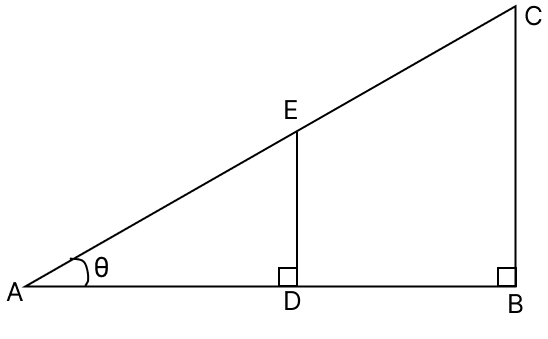
In the figure (1) given below, use trigonometry, find D E A D \dfrac{DE}{AD} A D D E B C A B = 5 12 \dfrac{BC}{AB} = \dfrac{5}{12} A B BC = 12 5
Answer
By formula, tan θ = Perpendicular Base \text{tan θ} = \dfrac{\text{Perpendicular}}{\text{Base}} tan θ = Base Perpendicular
In ΔABC,
⇒ tan θ = B C A B ⇒ tan θ = 5 12 . . . . . . . . . . . . . . . . ( 1 ) \Rightarrow \text{tan θ} = \dfrac{BC}{AB} \\[1em] \Rightarrow \text{tan θ} = \dfrac{5}{12}................(1) ⇒ tan θ = A B BC ⇒ tan θ = 12 5 ................ ( 1 )
In ΔADE,
⇒ tan θ = D E A D \Rightarrow \text{tan θ} = \dfrac{DE}{AD} ⇒ tan θ = A D D E
Substituting the value of tan θ from equation (1), we get
⇒ D E A D = 5 12 \Rightarrow \dfrac{DE}{AD} = \dfrac{5}{12} ⇒ A D D E = 12 5
Hence, D E A D = 5 12 \dfrac{DE}{AD} = \dfrac{5}{12} A D D E = 12 5
In the figure (2) given below, ∆ABC is right-angled at B and BD is perpendicular to AC. Find :
(i) cos ∠CBD
(ii) cot ∠ABD
Answer
In right angle ∆ABC,
⇒ AC2 = AB2 + BC2
⇒ AC2 = 122 + 52
⇒ AC2 = 144 + 25
⇒ AC2 = 169
⇒ AC = 169 \sqrt{169} 169
Let ∠CBD = x.
∠DBA = 90° - x
In ∆DAB,
⇒ ∠DAB + ∠ADB + ∠DBA = 180° [Angle sum property of triangle]
⇒ ∠DAB + 90° + 90° - x = 180°
⇒ ∠DAB = 180° - 180° + x
⇒ ∠DAB = x.
From figure,
∠DAB = ∠CAB = x
∴ ∠CBD = ∠CAB = x
(i) cos ∠CBD = cos ∠CAB
= A B A C = 12 13 \dfrac{AB}{AC} = \dfrac{12}{13} A C A B = 13 12
Hence, cos ∠CBD = 12 13 \dfrac{12}{13} 13 12
(ii) In ∆BCD,
⇒ ∠DBC + ∠DCB + ∠CDB = 180° [Angle sum property of triangle]
⇒ ∠DCB + x + 90° = 180°
⇒ ∠DCB = 180° - 90° - x
⇒ ∠DCB = 90° - x.
From figure,
∠DCB = ∠ACB =90° - x
∴ ∠ABD = ∠ACB = 90° - x
∴ cot ∠ABD = cot ∠ACB
= B C A B = 5 12 \dfrac{BC}{AB} = \dfrac{5}{12} A B BC = 12 5
Hence, cot ∠ABD = 5 12 \dfrac{5}{12} 12 5
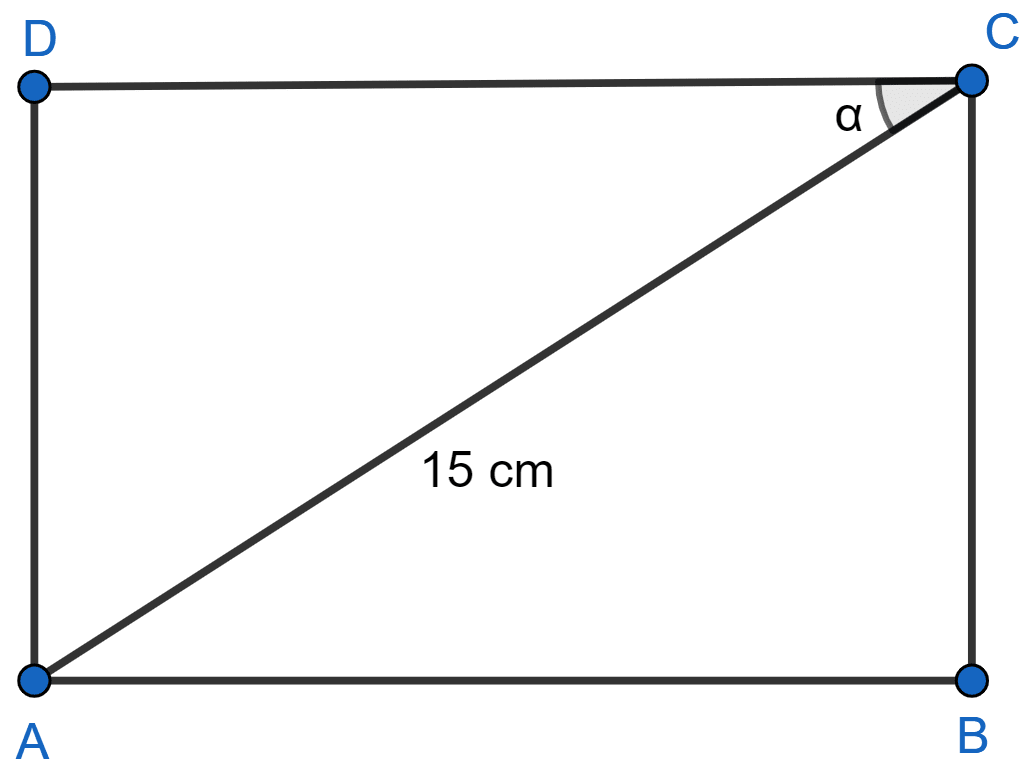
In the adjoining figure, ABCD is a rectangle. Its diagonal AC = 15 cm and ∠ACD = α. If cot α = 3 2 \dfrac{3}{2} 2 3
Answer
Given,
cot α = 3 2 \text{cot α} = \dfrac{3}{2} cot α = 2 3
cot α = Base Perpendicular = C D A D \text{cot α} = \dfrac{\text{Base}}{\text{Perpendicular}} = \dfrac{CD}{AD} cot α = Perpendicular Base = A D C D
From (1) and (2) we get,
C D A D = 3 2 \dfrac{CD}{AD} = \dfrac{3}{2} A D C D = 2 3
Let CD = 3x and AD = 2x.
In right angle triangle ADC,
⇒ A C 2 = A D 2 + C D 2 ⇒ 15 2 = ( 2 x ) 2 + ( 3 x ) 2 ⇒ 225 = 4 x 2 + 9 x 2 ⇒ 13 x 2 = 225 ⇒ x 2 = 225 13 ⇒ x = 225 13 ⇒ x = 15 13 . \Rightarrow AC^2 = AD^2 + CD^2 \\[1em] \Rightarrow 15^2 = (2x)^2 + (3x)^2 \\[1em] \Rightarrow 225 = 4x^2 + 9x^2 \\[1em] \Rightarrow 13x^2 = 225 \\[1em] \Rightarrow x^2 = \dfrac{225}{13} \\[1em] \Rightarrow x = \sqrt{\dfrac{225}{13}} \\[1em] \Rightarrow x = \dfrac{15}{\sqrt{13}}. ⇒ A C 2 = A D 2 + C D 2 ⇒ 1 5 2 = ( 2 x ) 2 + ( 3 x ) 2 ⇒ 225 = 4 x 2 + 9 x 2 ⇒ 13 x 2 = 225 ⇒ x 2 = 13 225 ⇒ x = 13 225 ⇒ x = 13 15 .
Perimeter of rectangle (P) = 2(CD + AD)
Area of rectangle (A) = CD × AD
Substituting values we get :
P = 2 × ( 3 x + 2 x ) = 2 × 5 x = 10 x = 10 × 15 13 cm . = 150 13 cm . A = 3 x × 2 x = 6 x 2 = 6 × ( 15 13 ) 2 = 6 × 225 13 = 1350 13 = 103 11 13 cm 2 . P = 2 \times (3x + 2x) \\[1em] = 2 \times 5x \\[1em] = 10x \\[1em] = 10 \times \dfrac{15}{\sqrt{13}} \text{ cm}. \\[1em] = \dfrac{150}{\sqrt{13}} \text{ cm}. \\[1em] A = 3x \times 2x \\[1em] = 6x^2 \\[1em] = 6 \times \Big(\dfrac{15}{\sqrt{13}}\Big)^2 \\[1em] = 6 \times \dfrac{225}{13} \\[1em] = \dfrac{1350}{13} \\[1em] = 103\dfrac{11}{13} \text{ cm}^2. P = 2 × ( 3 x + 2 x ) = 2 × 5 x = 10 x = 10 × 13 15 cm . = 13 150 cm . A = 3 x × 2 x = 6 x 2 = 6 × ( 13 15 ) 2 = 6 × 13 225 = 13 1350 = 103 13 11 cm 2 .
Hence, perimeter of rectangle = 150 13 \dfrac{150}{\sqrt{13}} 13 150 103 11 13 103\dfrac{11}{13} 103 13 11 2 .
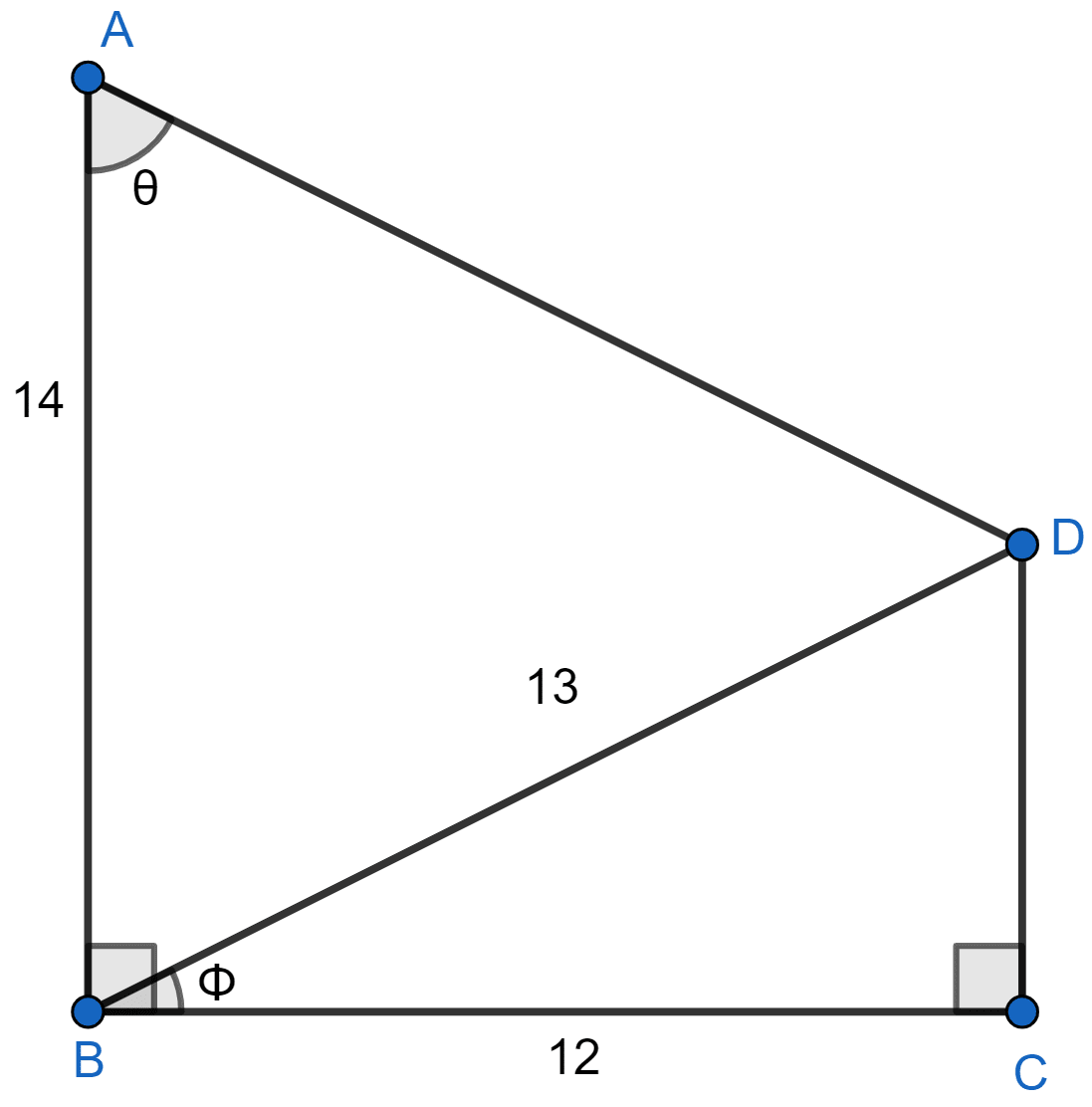
Using the measurements given in the figure alongside,
(a) Find the values of:
(i) sin Φ
(ii) tan θ.
(b) Write an expression for AD in terms of θ.
Answer
(a) In right-angled ∆BCD
Using pythagoras theorem we get :
⇒ BD2 = BC2 + CD2
⇒ CD2 = BD2 - BC2
⇒ CD2 = (13)2 - (12)2
⇒ CD2 = 169 - 144
⇒ CD2 = 25
⇒ CD = 25 \sqrt{25} 25
(i) By formula,
sin Φ = Perpendicular Hypotenuse \dfrac{\text{Perpendicular}}{\text{Hypotenuse}} Hypotenuse Perpendicular
In right-angled ∆BCD
sin Φ = C D B D = 5 13 \dfrac{CD}{BD} = \dfrac{5}{13} B D C D = 13 5
Hence, sin Φ = 5 13 \dfrac{5}{13} 13 5
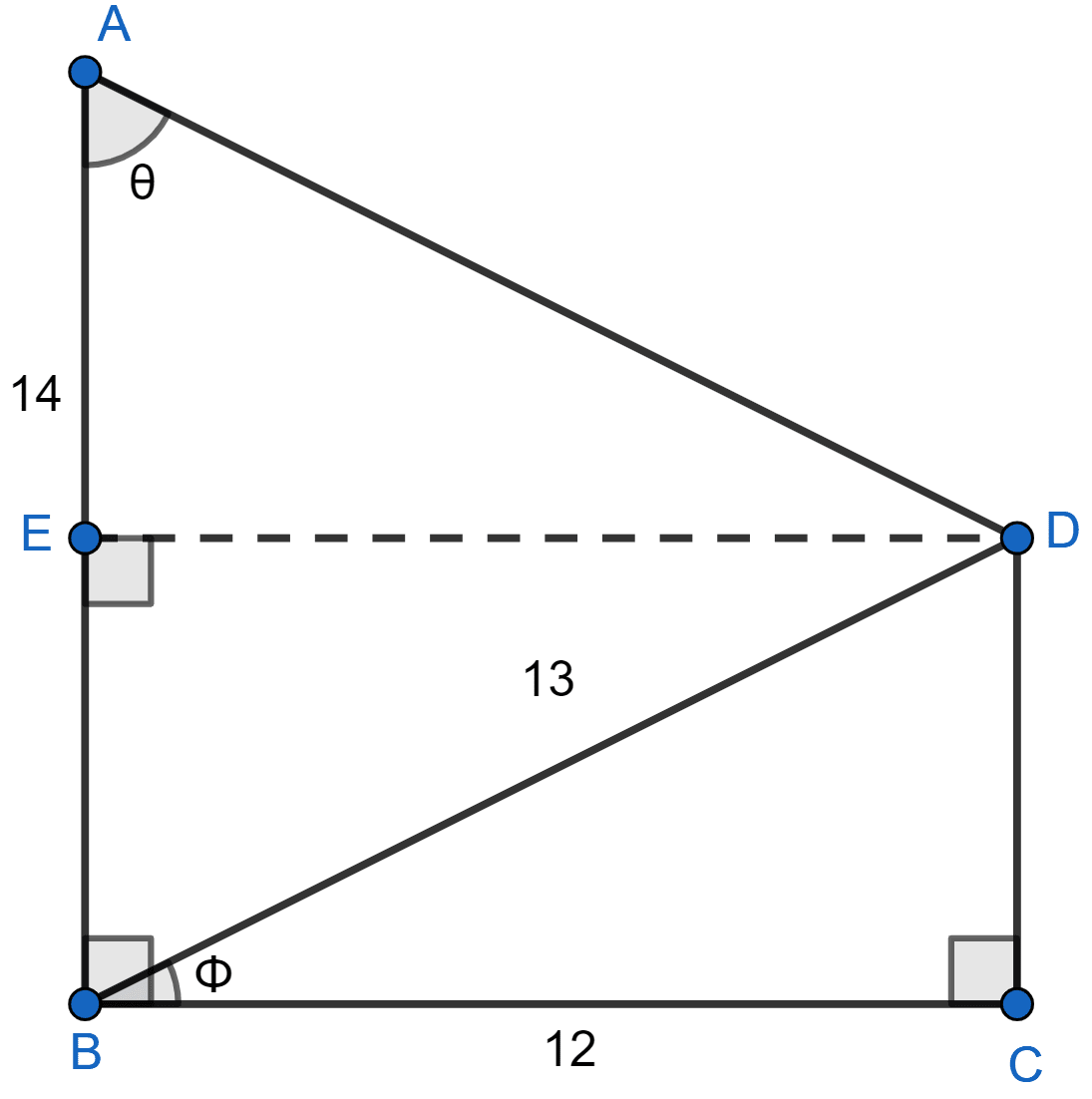
(ii) Draw DE perpendicular to AB.
From figure,
ED = BC = 12
In right-angled ∆BED
Using pythagoras theorem we get :
⇒ BD2 = ED2 + EB2
⇒ 132 = 122 + EB2
⇒ EB2 = (13)2 - (12)2
⇒ EB2 = 169 - 144
⇒ EB2 = 25
⇒ EB = 25 \sqrt{25} 25
From figure,
AE = AB - EB = 14 - 5 = 9.
By formula,
tan θ = Perpendicular Base = E D A E = 12 9 = 4 3 \dfrac{\text{Perpendicular}}{\text{Base}} = \dfrac{ED}{AE} = \dfrac{12}{9} = \dfrac{4}{3} Base Perpendicular = A E E D = 9 12 = 3 4
Hence, tan θ = 4 3 \dfrac{4}{3} 3 4
(b) In right-angled ∆AED
⇒ sin θ = Perpendicular Hypotenuse ⇒ sin θ = E D A D ⇒ sin θ = 12 A D ⇒ A D = 12 sin θ . ⇒ cos θ = Base Hypotenuse ⇒ cos θ = A E A D ⇒ cos θ = 9 A D ⇒ A D = 9 cos θ . \phantom{\Rightarrow} \text{sin θ} = \dfrac{\text{Perpendicular}}{\text{Hypotenuse}} \\[1em] \Rightarrow \text{sin θ} = \dfrac{ED}{AD} \\[1em] \Rightarrow \text{sin θ} = \dfrac{12}{AD} \\[1em] \Rightarrow AD = \dfrac{12}{\text{sin θ}}. \\[1em] \phantom{\Rightarrow} \text{cos θ} = \dfrac{\text{Base}}{\text{Hypotenuse}} \\[1em] \Rightarrow \text{cos θ} = \dfrac{AE}{AD} \\[1em] \Rightarrow \text{cos θ} = \dfrac{9}{AD} \\[1em] \Rightarrow AD = \dfrac{9}{\text{cos θ}}. ⇒ sin θ = Hypotenuse Perpendicular ⇒ sin θ = A D E D ⇒ sin θ = A D 12 ⇒ A D = sin θ 12 . ⇒ cos θ = Hypotenuse Base ⇒ cos θ = A D A E ⇒ cos θ = A D 9 ⇒ A D = cos θ 9 .
Hence, AD = 9 cos θ or 12 sin θ \dfrac{9}{\text{cos θ}} \text{ or } \dfrac{12}{\text{sin θ}} cos θ 9 or sin θ 12 .
Prove the following:
(sin A + cos A)2 + (sin A - cos A)2 = 2
Answer
Solving L.H.S. of equation : (sin A + cos A)2 + (sin A - cos A)2 = 2, we get,
⇒ (sin A + cos A)2 + (sin A - cos A)2
⇒ sin2 A + cos2 A + 2 sin A cos A + sin2 A + cos2 A - 2 sin A cos A
Since, sin2 A + cos2 A = 1.
⇒ 1 + 2 sin A cos A + 1 - 2 sin A cos A
⇒ 2.
Since, L.H.S. = R.H.S.
Hence, proved that (sin A + cos A)2 + (sin A - cos A)2 = 2.
Prove the following:
cot2 A - 1 sin 2 A \dfrac{1}{\text{sin}^2 A} sin 2 A 1
Answer
Solving L.H.S. of the equation : cot2 A - 1 sin 2 A \dfrac{1}{\text{sin}^2 A} sin 2 A 1
⇒ cos 2 A sin 2 A − 1 sin 2 A + 1 ⇒ cos 2 A − 1 + sin 2 A sin 2 A ⇒ sin 2 A + cos 2 A − 1 sin 2 A ⇒ 1 − 1 sin 2 A ⇒ 0 sin 2 A ⇒ 0. \Rightarrow \dfrac{\text{cos}^2 A}{\text{sin}^2 A} - \dfrac{1}{\text{sin}^2 A} + 1 \\[1em] \Rightarrow \dfrac{\text{cos}^2 A - 1 + \text{sin}^2 A}{\text{sin}^2 A} \\[1em] \Rightarrow \dfrac{\text{sin}^2 A + \text{cos}^2 A - 1}{\text{sin}^2 A} \\[1em] \Rightarrow \dfrac{1 - 1}{\text{sin}^2 A} \\[1em] \Rightarrow \dfrac{0}{\text{sin}^2 A} \\[1em] \Rightarrow 0. ⇒ sin 2 A cos 2 A − sin 2 A 1 + 1 ⇒ sin 2 A cos 2 A − 1 + sin 2 A ⇒ sin 2 A sin 2 A + cos 2 A − 1 ⇒ sin 2 A 1 − 1 ⇒ sin 2 A 0 ⇒ 0.
Since, L.H.S. = R.H.S.
Hence, proved that cot 2 A − 1 sin 2 A + 1 = 0 \text{cot}^2 A - \dfrac{1}{\text{sin}^2 A} + 1 = 0 cot 2 A − sin 2 A 1 + 1 = 0
Prove the following:
1 1 + tan 2 A + 1 1 + cot 2 A \dfrac{1}{\text{1 + tan}^2 A} + \dfrac{1}{\text{1 + cot}^2 A} 1 + tan 2 A 1 + 1 + cot 2 A 1
Answer
Solving L.H.S. of the equation : 1 1 + tan 2 A + 1 1 + cot 2 A \dfrac{1}{\text{1 + tan}^2 A} + \dfrac{1}{\text{1 + cot}^2 A} 1 + tan 2 A 1 + 1 + cot 2 A 1
= 1 1 + sin 2 A cos 2 A + 1 1 + cos 2 A sin 2 A = 1 cos 2 A + sin 2 A cos 2 A + 1 sin 2 A + cos 2 A sin 2 A = cos 2 A sin 2 A + cos 2 A + sin 2 A sin 2 A + cos 2 A = sin 2 A + cos 2 A sin 2 A + cos 2 A = 1. \phantom{=} \dfrac{1}{1 + \dfrac{\text{sin}^2 A}{\text{cos}^2 A}} + \dfrac{1}{1 + \dfrac{\text{cos}^2 A}{\text{sin}^2 A}} \\[1em] = \dfrac{1}{\dfrac{\text{cos}^2 A + \text{sin}^2 A}{\text{cos}^2 A}} + \dfrac{1}{\dfrac{\text{sin}^2 A + \text{cos}^2 A}{\text{sin}^2 A}} \\[1em] = \dfrac{\text{cos}^2 A}{\text{sin}^2 A + \text{cos}^2 A} + \dfrac{\text{sin}^2 A}{\text{sin}^2 A + \text{cos}^2 A} \\[1em] = \dfrac{\text{sin}^2 A + \text{cos}^2 A}{\text{sin}^2 A + \text{cos}^2 A} \\[1em] = 1. = 1 + cos 2 A sin 2 A 1 + 1 + sin 2 A cos 2 A 1 = cos 2 A cos 2 A + sin 2 A 1 + sin 2 A sin 2 A + cos 2 A 1 = sin 2 A + cos 2 A cos 2 A + sin 2 A + cos 2 A sin 2 A = sin 2 A + cos 2 A sin 2 A + cos 2 A = 1.
Since, L.H.S. = R.H.S.
Hence, proved that 1 1 + tan 2 A + 1 1 + cot 2 A \dfrac{1}{\text{1 + tan}^2 A} + \dfrac{1}{\text{1 + cot}^2 A} 1 + tan 2 A 1 + 1 + cot 2 A 1
Simplify 1 − sin 2 θ 1 − cos 2 θ \sqrt{\dfrac{1 - \text{sin}^2 \text{ θ}}{1 - \text{cos}^2 \text{ θ}}} 1 − cos 2 θ 1 − sin 2 θ
Answer
Substituting, 1 - sin2 θ = cos2 θ and 1 - cos2 θ = sin2 θ in 1 − sin 2 θ 1 − cos 2 θ \sqrt{\dfrac{1 - \text{sin}^2 \text{ θ}}{1 - \text{cos}^2 \text{ θ}}} 1 − cos 2 θ 1 − sin 2 θ
⇒ cos 2 θ sin 2 θ ⇒ cot 2 θ ⇒ cot θ . \Rightarrow \sqrt{\dfrac{\text{cos}^2 \text{ θ}}{\text{sin}^2 \text{ θ}}} \\[1em] \Rightarrow \sqrt{\text{cot}^2 \text{ θ}} \\[1em] \Rightarrow \text{cot θ}. ⇒ sin 2 θ cos 2 θ ⇒ cot 2 θ ⇒ cot θ .
Hence, 1 − sin 2 θ 1 − cos 2 θ \sqrt{\dfrac{1 - \text{sin}^2 \text{ θ}}{1 - \text{cos}^2 \text{ θ}}} 1 − cos 2 θ 1 − sin 2 θ
If sin θ + cosec θ = 2, find the value of sin2 θ + cosec2 θ.
Answer
Given,
⇒ sin θ + cosec θ = 2
Squaring both sides we get :
⇒ (sin θ + cosec θ)2 = 22
⇒ sin2 θ + cosec2 θ + 2 sin θ. cosec θ = 4
⇒ sin2 θ + cosec2 θ + 2 sin θ × 1 sin θ = 4 2\text{ sin θ} \times \dfrac{1}{\text{sin θ}} = 4 2 sin θ × sin θ 1 = 4
⇒ sin2 θ + cosec2 θ + 2 = 4
⇒ sin2 θ + cosec2 θ = 4 - 2
⇒ sin2 θ + cosec2 θ = 2.
Hence, proved that sin2 θ + cosec2 θ = 2.
If x = a cos θ + b sin θ and y = a sin θ - b cos θ, prove that x2 + y2 = a2 + b2 .
Answer
x2 + y2 = (a cos θ + b sin θ)2 + (a sin θ - b cos θ)2
⇒ x2 + y2 = a2 cos2 θ + b2 sin2 θ + 2ab cos θ. sin θ + a2 sin2 θ + b2 cos2 θ - 2ab cos θ. sin θ
⇒ x2 + y2 = a2 (sin2 θ + cos2 θ) + b2 (sin2 θ + cos2 θ)
⇒ x2 + y2 = (a2 + b2 )(sin2 θ + cos2 θ)
As, sin2 θ + cos2 θ = 1.
⇒ x2 + y2 = (a2 + b2 ).
Hence proved that x2 + y2 = (a2 + b2 ).