KnowledgeBoat Logo
|
OPEN IN APP

Chapter 11

Pythagoras Theorem

Class - 9 ML Aggarwal Understanding ICSE Mathematics


Exercise 11

Question 1

Lengths of sides of triangle are given below. Determine which of them are right triangles. In case of a right triangle, write the length of its hypotenuse:

(i) 3 cm, 8 cm, 6 cm

(ii) 13 cm, 12 cm, 5 cm

(iii) 1.4 cm, 4.8 cm, 5 cm

Answer

Choose the greatest length. Check whether the square of greatest length is equal to the sum of squares of other two lengths.

(i) Here greatest length is 8 cm and other lengths are 3 cm, 6 cm.

Note that 82 = 64 and 32 + 62 = 9 + 36 = 45.

Note that, 64 ≠ 45.

Hence, the triangle with given lengths of sides is not a right triangle.

(ii) Here greatest length is 13 cm and other lengths are 5 cm, 12 cm.

Note that 132 = 169 and 52 + 122 = 25 + 144 = 169.

Thus, 132 = 52 + 122.

Hence, the triangle with given lengths of sides is a right triangle and length of hypotenuse is 13 cm.

(iii) Here greatest length is 5 cm and other lengths are 1.4 cm, 4.8 cm.

Note that 52 = 25 and (4.8)2 + (1.4)2 = 23.04 + 1.96 = 25.

Thus, 52 = (4.8)2 + (1.4)2.

Hence, the triangle with given lengths of sides is a right triangle and length of hypotenuse is 5 cm.

Question 2

Foot of a 10 m long ladder leaning against a vertical well is 6 m away from the base of the wall. Find the height of the point on the wall where the top of the ladder reaches.

Answer

Let AB be the ladder and BC be the vertical well.

So, △ABC is right triangle.
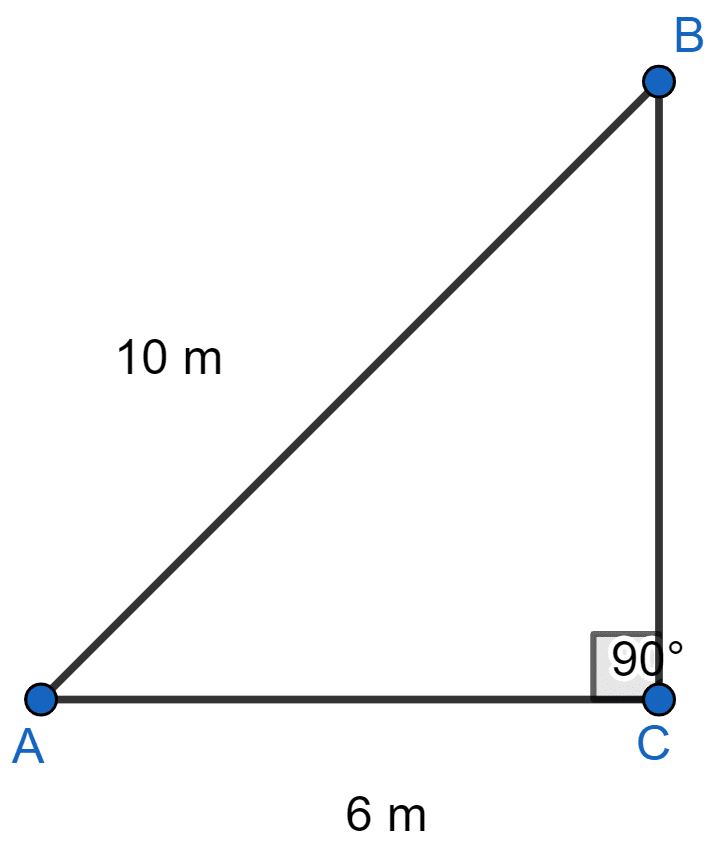
Foot of a 10 m long ladder leaning against a vertical well is 6 m away from the base of the wall. Find the height of the point on the wall where the top of the ladder reaches. Pythagoras Theorem, ML Aggarwal Understanding Mathematics Solutions ICSE Class 9.

By pythagoras theorem,

⇒ AB2 = BC2 + AC2

⇒ 102 = BC2 + (6)2

⇒ 100 = BC2 + 36

⇒ BC2 = 100 - 36 = 64

⇒ BC = 64\sqrt{64} = 8 m.

Hence, the top of the ladder reaches 8 m above the wall of well.

Question 3

A guy attached a wire 24 m long to a vertical pole of height 18 m and has a stake attached to other end. How far from the base of the pole should the stake be driven so that the wire will be taught ?

Answer

Let BC be the pole and AB be the wire and let the distance of stake from base of pole be x.

A guy attached a wire 24 m long to a vertical pole of height 18 m and has a stake attached to other end. How far from the base of the pole should the stake be driven so that the wire will be taught ? Pythagoras Theorem, ML Aggarwal Understanding Mathematics Solutions ICSE Class 9.

Since, pole is vertical so △ABC is right triangle.

By pythagoras theorem,

⇒ AB2 = BC2 + AC2

⇒ 242 = 182 + x2

⇒ 576 = x2 + 324

⇒ x2 = 576 - 324 = 252

⇒ x = 252=67\sqrt{252} = 6\sqrt{7} m.

Hence, the stake should be at a distance of 676\sqrt{7} m from the base of the pole.

Question 4

Two poles of heights 6 m and 11 m stand on a plane ground. If the distance between their feet is 12 m, find the distance between their tops.

Answer

Let AB be the smaller pole and CD the bigger pole.

Two poles of heights 6 m and 11 m stand on a plane ground. If the distance between their feet is 12 m, find the distance between their tops. Pythagoras Theorem, ML Aggarwal Understanding Mathematics Solutions ICSE Class 9.

From figure,

⇒ CE = AB = 6 m and AE = BC = 12 m

⇒ CD = CE + ED

⇒ 11 = 6 + ED

⇒ ED = 5 m

From figure,

△ADE is right triangle.

By pythagoras theorem,

⇒ AD2 = AE2 + ED2

⇒ AD2 = (12)2 + (5)2

⇒ AD2 = 144 + 25

⇒ AD2 = 169

⇒ AD = 169\sqrt{169} = 13 m.

Hence, the distance between tops of poles is 13 m.

Question 5

In a right-angled triangle, if hypotenuse is 20 cm and the ratio of the other sides is 4 : 3, find the sides.

Answer

Ratio of other two sides = 4 : 3

Let other sides be 4x cm and 3x cm.

By pythagoras theorem,

⇒ 202 = (4x)2 + (3x)2

⇒ 400 = 16x2 + 9x2

⇒ 400 = 25x2

⇒ x2 = 40025\dfrac{400}{25}

⇒ x2 = 16

⇒ x = 4

Sides ⇒ 4x = 16 cm and 3x = 12 cm.

Hence, the sides are 12 cm and 16 cm.

Question 6

If the sides of the triangle are in the ratio 3 : 4 : 5, prove that it is right-angled triangle.

Answer

Ratio of sides = 3 : 4 : 5

Let sides be 3x, 4x and 5x cm.

Here, greatest length is 5x cm and other lengths are 3x cm, 4x cm.

Note that (5x)2 = 25x2 and (3x)2 + (4x)2 = 9x2 + 16x2 = 25x2.

Thus, (5x)2 = (3x)2 + (4x)2.

Hence, proved that triangle having sides in the ratio 3 : 4 : 5 is a right-angle triangle.

Question 7

For going to a city B from the city A, there is route via city C such that AC ⊥ CB. AC = 2x km and CB = 2(x + 7) km. It is proposed to construct a 26 km highway which directly connects the two cities A and B. Find how much distance will be saved in reaching city B from city A after the construction of highway.

Answer

From figure,

For going to a city B from the city A, there is route via city C such that AC ⊥ CB. AC = 2x km and CB = 2(x + 7) km. It is proposed to construct a 26 km highway which directly connects the two cities A and B. Find how much distance will be saved in reaching city B from city A after the construction of highway. Pythagoras Theorem, ML Aggarwal Understanding Mathematics Solutions ICSE Class 9.

△ABC is right triangle.

By pythagoras theorem,

⇒ AB2 = AC2 + BC2

⇒ 262 = (2x)2 + [2(x + 7)]2

⇒ 676 = 4x2 + (2x + 14)2

⇒ 676 = 4x2 + 4x2 + 196 + 56x

⇒ 676 - 196 = 8x2 + 56x

⇒ 8x2 + 56x = 480

⇒ 8(x2 + 7x) = 480

⇒ x2 + 7x = 60

⇒ x2 + 7x - 60 = 0

⇒ x2 + 12x - 5x - 60 = 0

⇒ x(x + 12) - 5(x + 12) = 0

⇒ (x - 5)(x + 12) = 0

⇒ x = 5 or x = -12.

Since, distance cannot be negative so, x ≠ -12.

Distance taken to reach from B to A without highway = BC + AC

= 2(x + 7) + 2x

= 2x + 14 + 2x

= 4x + 14

= 4(5) + 14

= 20 + 14 = 34 km

Distance taken to reach from B to A through highway = 26 km

Distance saved = 34 - 26 = 8 km.

Hence, 8 km will be saved in reaching city A from B after construction of highway.

Question 8

The hypotenuse of a right triangle is 6 m more than twice the shortest side. If the third side is 2m less than the hypotenuse, find the sides of the triangle.

Answer

Let the shortest side be x meters.

Hypotenuse = 2x + 6 meters

Third side = 2x + 6 - 2 = 2x + 4 meters.

Since, the sides are of a right triangle.

By pythagoras theorem,

⇒ (Hypotenuse)2 = (First Side)2 + (Second side)2

⇒ (2x + 6)2 = (x)2 + (2x + 4)2

⇒ 4x2 + 36 + 24x = x2 + 4x2 + 16 + 16x

⇒ 4x2 + 36 + 24x = 5x2 + 16 + 16x

⇒ 5x2 - 4x2 + 16x - 24x + 16 - 36 = 0

⇒ x2 - 8x - 20 = 0

⇒ x2 - 10x + 2x - 20 = 0

⇒ x(x - 10) + 2(x - 10) = 0

⇒ (x + 2)(x - 10) = 0

⇒ x = -2 or x = 10.

Since, side cannot be negative,

x ≠ -2.

Shortest side = 10 m

Hypotenuse = 2x + 6 = 2(10) + 6 = 26 m

Third side = 2x + 4 = 2(10) + 6 = 24 m.

Hence, sides of triangle = 10 m, 24 m and 26 m.

Question 9

ABC is an isosceles triangle right angled at C. Prove that AB2 = 2AC2.

Answer

Since, the triangle is right triangle.

Hence, the side opposite to right angle will be hypotenuse and will be the greatest side.
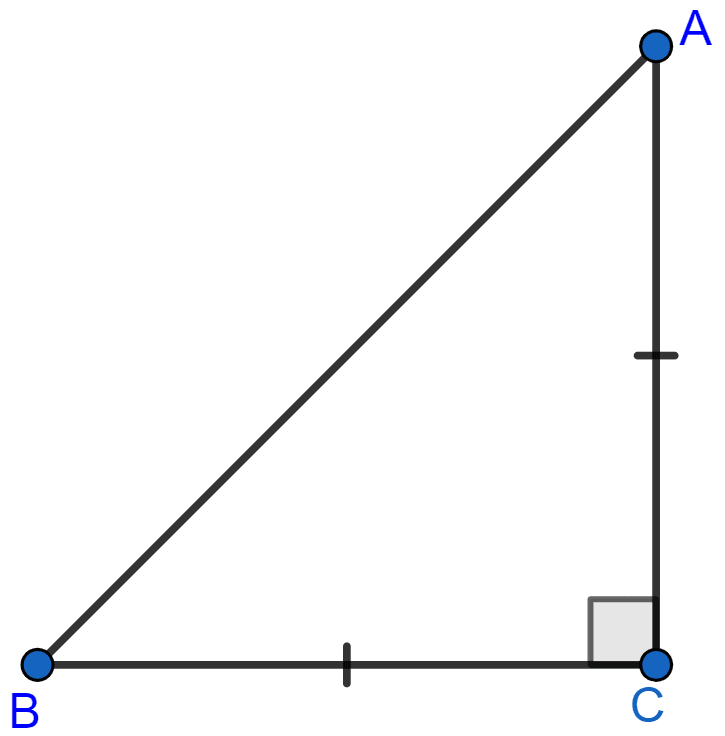
ABC is an isosceles triangle  right angled at C. Prove that AB^2 = 2AC^2. Pythagoras Theorem, ML Aggarwal Understanding Mathematics Solutions ICSE Class 9.

From figure,

Hypotenuse = AB.

The other two sides will be equal as the triangle is also isosceles i.e. (AC = BC)

By pythagoras theorem,

⇒ (AB)2 = (AC)2 + (BC)2

⇒ (AB)2 = (AC)2 + (AC)2

⇒ (AB)2 = 2AC2.

Hence, proved that (AB)2 = 2AC2.

Question 10

In a triangle ABC, AD is perpendicular to BC. Prove that AB2 + CD2 = AC2 + BD2.

Answer

From figure,
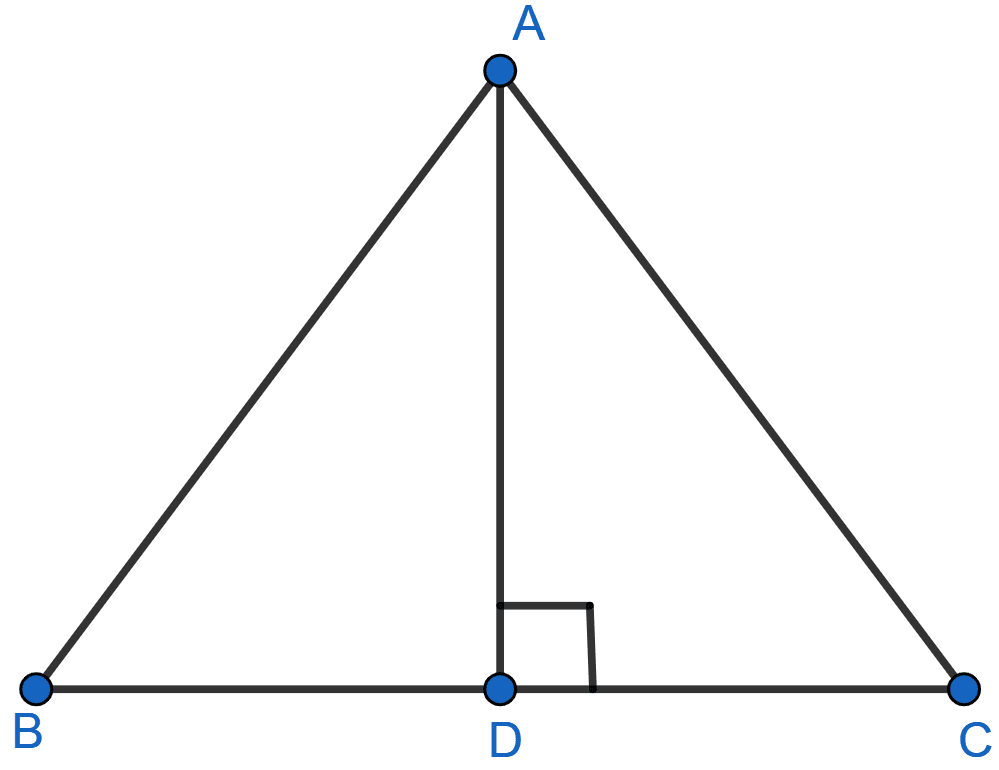
In a triangle ABC, AD is perpendicular to BC. Prove that AB^2 + CD^2 = AC^2 + BD^2. Pythagoras Theorem, ML Aggarwal Understanding Mathematics Solutions ICSE Class 9.

Considering right triangle ABD,

By pythagoras theorem,

AB2 = AD2 + BD2 .......(1)

Considering right triangle ACD,

By pythagoras theorem,

AC2 = AD2 + CD2 .......(2)

Subtracting eqn. 2 from 1 we get,

⇒ AB2 - AC2 = AD2 + BD2 - AD2 - CD2

⇒ AB2 - AC2 = BD2 - CD2

⇒ AB2 + CD2 = BD2 + AC2.

Hence, proved that AB2 + CD2 = AC2 + BD2.

Question 11

In △PQR, PD ⊥ QR such that D lies on QR. If PQ = a, PR = b, QD = c and DR = d, prove that (a + b)(a - b) = (c + d)(c - d).

Answer

In right angle △PDQ,
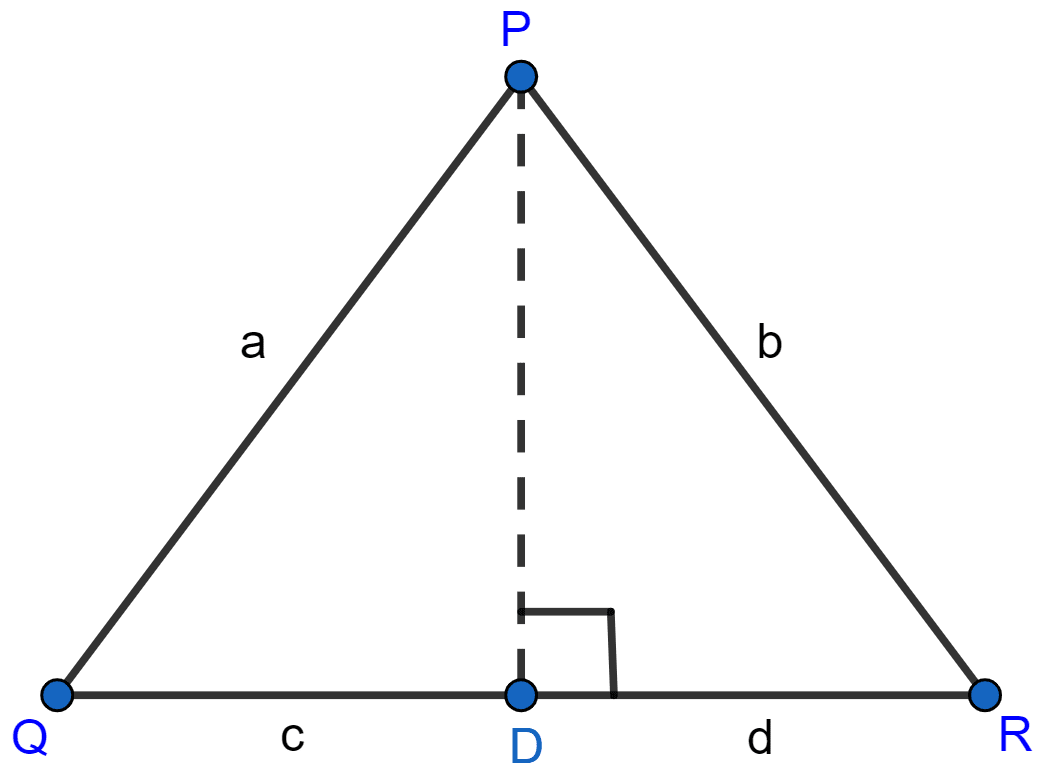
In △PQR, PD ⊥ QR such that D lies on QR. If PQ = a, PR = b, QD = c and DR = d, prove that (a + b)(a - b) = (c + d)(c - d). Pythagoras Theorem, ML Aggarwal Understanding Mathematics Solutions ICSE Class 9.

By pythagoras theorem we get,

⇒ PQ2 = PD2 + QD2

⇒ a2 = PD2 + c2

⇒ PD2 = a2 - c2 ........(i)

In right angle △PDR,

By pythagoras theorem we get,

⇒ PR2 = PD2 + DR2

⇒ b2 = PD2 + d2

PD2 = b2 - d2 ........(ii)

From (i) and (ii) we get,

⇒ a2 - c2 = b2 - d2

⇒ a2 - b2 = c2 - d2

⇒ (a - b)(a + b) = (c - d)(c + d).

Hence, proved that (a - b)(a + b) = (c - d)(c + d).

Question 12

ABC is an isosceles triangle with AB = AC = 12 cm and BC = 8 cm. Find the altitude on BC and hence calculate its area.

Answer

Let AD be altitude on BC and BD = x cm and CD = (8 - x) cm.
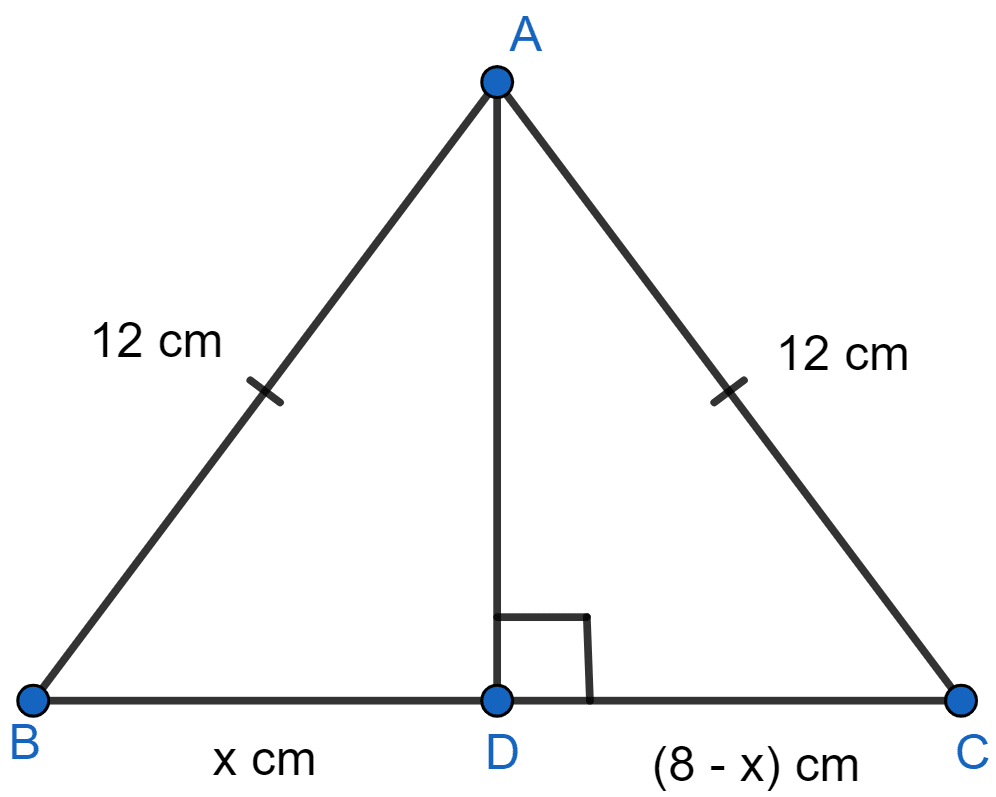
ABC is an isosceles triangle with AB = AC = 12 cm and BC = 8 cm. Find the altitude on BC and hence calculate its area. Pythagoras Theorem, ML Aggarwal Understanding Mathematics Solutions ICSE Class 9.

From figure,

In right angle △ABD,

By pythagoras theorem,

AB2 = AD2 + BD2

122 = AD2 + x2

AD2 = 122 - x2 ........(i)

In right angle △ADC,

By pythagoras theorem,

AC2 = AD2 + DC2

122 = AD2 + (8 - x)2

AD2 = 122 - (8 - x)2 ........(ii)

From (i) and (ii) we get,

122 - x2 = 122 - (8 - x)2

144 - x2 = 144 - (64 + x2 - 16x)

144 - x2 = 144 - 64 - x2 + 16x

144 - 144 - x2 + x2 + 64 = 16x

16x = 64

x = 4.

Substituting value of x in (i) we get,

AD2 = 122 - x2 = 144 - (4)2 = 144 - 16 = 128

AD2 = 128

AD = 128=82\sqrt{128} = 8\sqrt{2} cm.

Area = 12×AD×BC=12×82×8=322\dfrac{1}{2} \times AD \times BC = \dfrac{1}{2} \times 8\sqrt{2} \times 8 = 32\sqrt{2} cm2.

Hence, AD = 828\sqrt{2} cm and area = 32232\sqrt{2} cm2.

Question 13

Find the area and the perimeter of a square whose diagonal is 10 cm long.

Answer

Let each side of square be a cm.

Find the area and the perimeter of a square whose diagonal is 10 cm long. Pythagoras Theorem, ML Aggarwal Understanding Mathematics Solutions ICSE Class 9.

Since, sides of square are perpendicular to each other,

In right angle △ABC,

By pythagoras theorem,

⇒ AC2 = AB2 + BC2

⇒ 102 = a2 + a2

⇒ 100 = 2a2

⇒ a2 = 50

⇒ a = 50=52\sqrt{50} = 5\sqrt{2} cm.

Perimeter = 4a = 20220\sqrt{2} cm.

Area = a2 = 50 cm2.

Hence, perimeter = 20220\sqrt{2} cm and area = 50 cm2.

Question 14(a)

In figure given below, ABCD is a quadrilateral in which AD = 13 cm, DC = 12 cm, BC = 3 cm, ∠ABD = ∠BCD = 90°. Calculate the length of AB.

In figure, ABCD is a quadrilateral in which AD = 13 cm, DC = 12 cm, BC = 3 cm, ∠ABD = ∠BCD = 90°. Calculate the length of AB. Pythagoras Theorem, ML Aggarwal Understanding Mathematics Solutions ICSE Class 9.

Answer

In right angle △DBC,

By pythagoras theorem,

⇒ DB2 = DC2 + BC2

⇒ DB2 = 122 + 32

⇒ DB2 = 144 + 9

⇒ DB2 = 153.

⇒ DB = 153\sqrt{153}.

In right angle △ABD,

By pythagoras theorem,

⇒ AD2 = AB2 + DB2

⇒ 132 = AB2 + 153

⇒ 169 - 153 = AB2

⇒ AB2 = 16

⇒ AB = 16\sqrt{16} = 4 cm.

Hence, AB = 4 cm.

Question 14(b)

In figure given below, ABCD is a quadrilateral in which AB = AD, ∠A = 90° = ∠C, BC = 8 cm and CD = 6 cm. Find AB and calculate the area of △ABD.
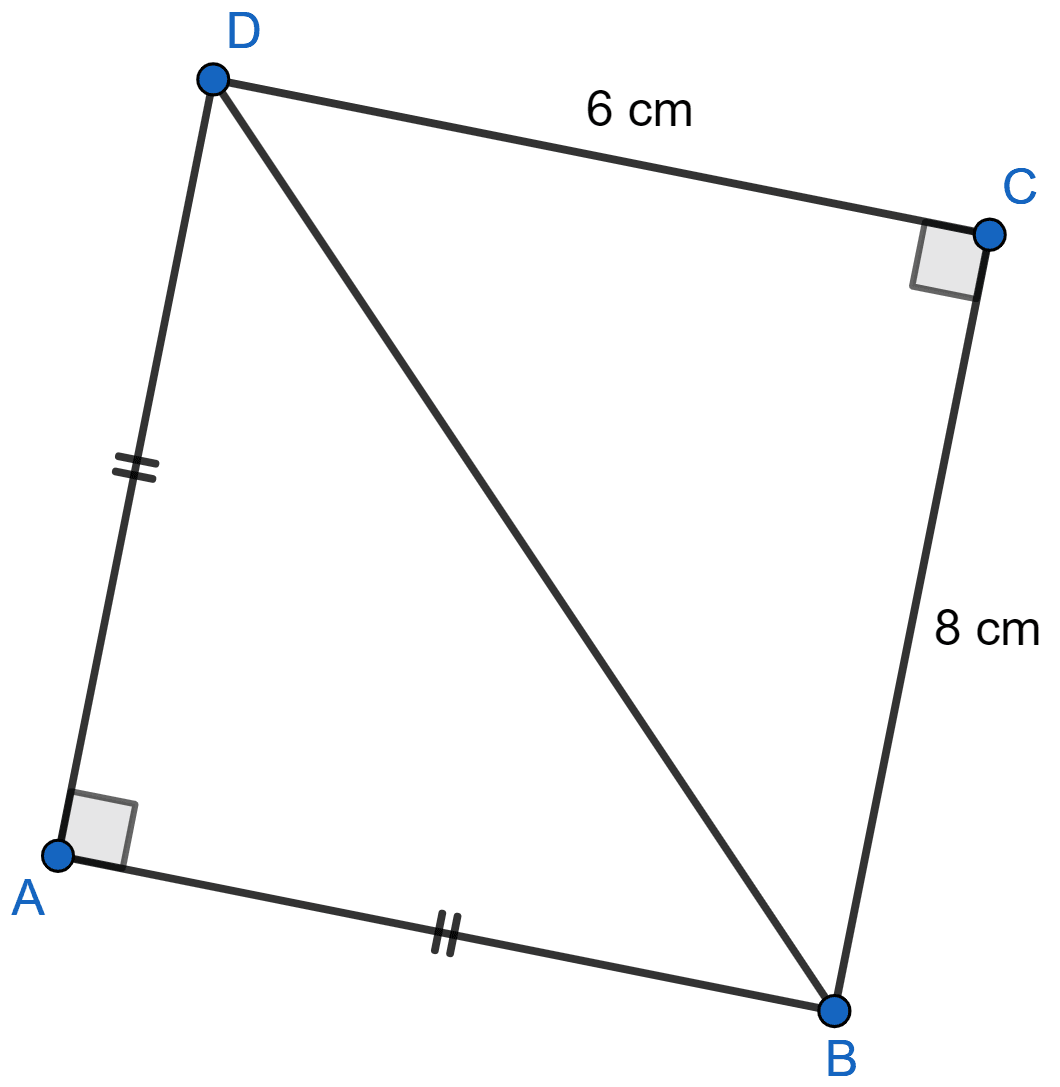
In figure, ABCD is a quadrilateral in which AB = AD, ∠A = 90° = ∠C, BC = 8 cm and CD = 6 cm. Find AB and calculate the area of △ABD. Pythagoras Theorem, ML Aggarwal Understanding Mathematics Solutions ICSE Class 9.

Answer

Let AB = AD = x cm.

In right angle △BCD,

By pythagoras theorem,

⇒ BD2 = BC2 + CD2

⇒ BD2 = 82 + 62

⇒ BD2 = 64 + 36

⇒ BD2 = 100

⇒ BD = 100\sqrt{100} = 10 cm.

In right angle △ABD,

By pythagoras theorem,

⇒ BD2 = AB2 + AD2

⇒ 102 = x2 + x2

⇒ 100 = 2x2

⇒ x2 = 50

⇒ x = 50=52\sqrt{50} = 5\sqrt{2} cm.

Area of right angle △ABD

=12×base× height=12×AB×AD=12×52×52=25 cm2.= \dfrac{1}{2} \times \text{base} \times \text{ height} \\[1em] = \dfrac{1}{2} \times AB \times AD \\[1em] = \dfrac{1}{2} \times 5\sqrt{2} \times 5\sqrt{2} \\[1em] = 25 \text{ cm}^2.

Hence, AB = 525\sqrt{2} cm and area of right angle △ABD = 25 cm2.

Question 15(a)

In figure given below, AB = 12 cm, AC = 13 cm, CE = 10 cm and DE = 6 cm. Calculate the length of BD.

In figure, AB = 12 cm, AC = 13 cm, CE = 10 cm and DE = 6 cm. Calculate the length of BD. Pythagoras Theorem, ML Aggarwal Understanding Mathematics Solutions ICSE Class 9.

Answer

In right angle △ABC,

By pythagoras theorem,

⇒ AC2 = AB2 + BC2

⇒ 132 = 122 + BC2

⇒ BC2 = 132 - 122

⇒ BC2 = 169 - 144 = 25

⇒ BC = 25\sqrt{25} = 5 cm.

In right angle △CDE,

By pythagoras theorem,

⇒ CE2 = CD2 + DE2

⇒ 102 = CD2 + 62

⇒ CD2 = 102 - 62

⇒ CD2 = 100 - 36 = 64

⇒ CD = 64\sqrt{64} = 8 cm.

From figure,

BD = BC + CD = 5 + 8 = 13 cm.

Hence, BD = 13 cm.

Question 15(b)

In figure given below, ∠PSR = 90°, PQ = 10 cm, QS = 6 cm and RQ = 9 cm. Calculate the length of PR.

In figure, ∠PSR = 90°, PQ = 10 cm, QS = 6 cm and RQ = 9 cm. Calculate the length of PR. Pythagoras Theorem, ML Aggarwal Understanding Mathematics Solutions ICSE Class 9.

Answer

In right angle △PQS,

By pythagoras theorem,

⇒ PQ2 = PS2 + QS2

⇒ 102 = PS2 + 62

⇒ PS2 = 102 - 62

⇒ PS2 = 100 - 36 = 64

⇒ PS = 64\sqrt{64} = 8 cm.

From figure,

RS = RQ + QS = 9 + 6 = 15 cm.

In right angle △PRS,

By pythagoras theorem,

⇒ PR2 = RS2 + PS2

⇒ PR2 = 152 + 82

⇒ PR2 = 225 + 64

⇒ PR2 = 289

⇒ PR = 289\sqrt{289} = 17 cm.

Hence, PR = 17 cm.

Question 15(c)

In figure given below, ∠D = 90°, AB = 16 cm, BC = 12 cm and CA = 6 cm. Find CD.

In figure, ∠D = 90°, AB = 16 cm, BC = 12 cm and CA = 6 cm. Find CD. Pythagoras Theorem, ML Aggarwal Understanding Mathematics Solutions ICSE Class 9.

Answer

Let CD be x cm.

In right angle △ACD,

By pythagoras theorem,

⇒ AC2 = AD2 + CD2

⇒ 62 = AD2 + x2

⇒ AD2 = 36 - x2 .......(i)

In right angle △ABD,

By pythagoras theorem,

⇒ AB2 = AD2 + BD2

⇒ 162 = (36 - x2) + (12 + x)2

⇒ 256 = 36 - x2 + 144 + x2 + 24x

⇒ 256 = 180 + 24x

⇒ 24x = 76

⇒ x = 7624=316\dfrac{76}{24} = 3\dfrac{1}{6} cm.

Hence, CD = 3163\dfrac{1}{6} cm.

Question 16(a)

In figure given below, BC = 5 cm, ∠B = 90°, AB = 5AE, CD = 2AE and AC = ED. Calculate the lengths of EA, CD, AB and AC.
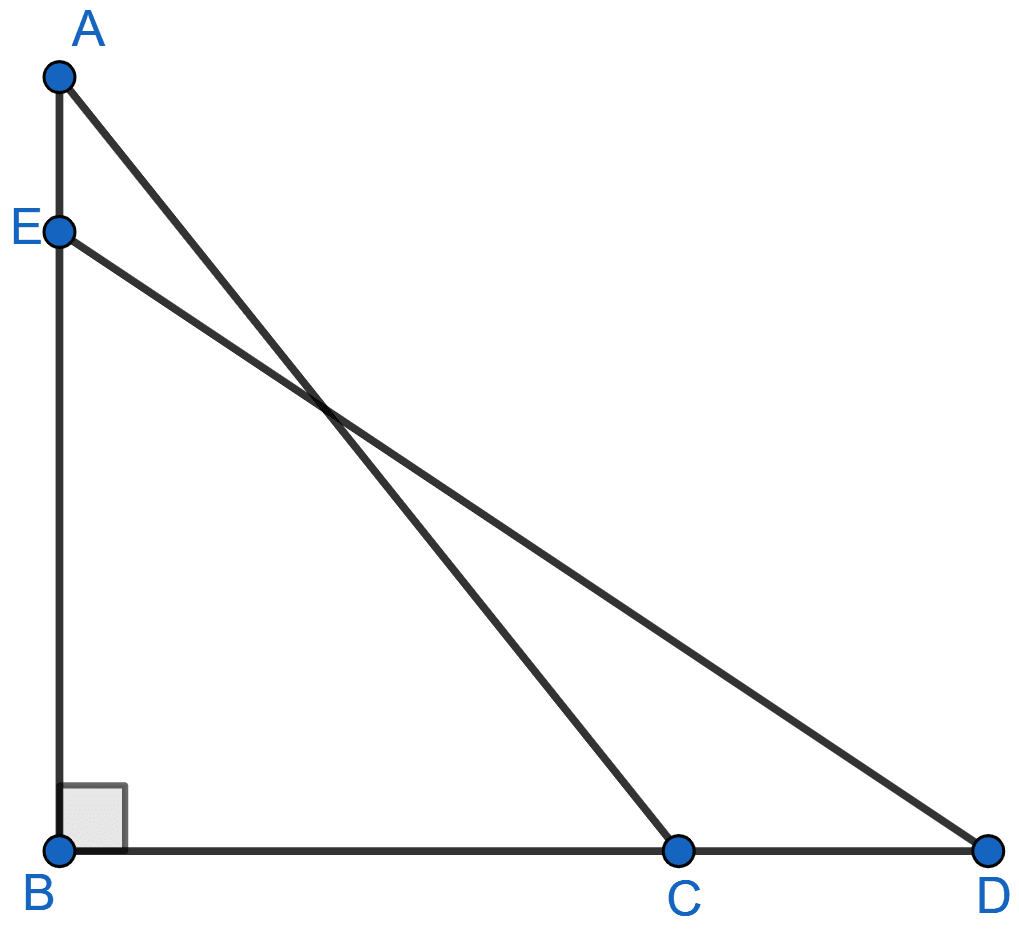
In figure, BC = 5 cm, ∠B = 90°, AB = 5AE, CD = 2AE and AC = ED. Calculate the lengths of EA, CD, AB and AC. Pythagoras Theorem, ML Aggarwal Understanding Mathematics Solutions ICSE Class 9.

Answer

In right angle △ABC,

By pythagoras theorem,

⇒ AC2 = AB2 + BC2

⇒ AC2 = (5AE)2 + 52

⇒ AC2 = 25AE2 + 25

⇒ AC2 = 25(AE2 + 1) .......(i)

From figure,

EB = AB - AE = 5AE - AE = 4AE.

In right angle △BED,

⇒ ED2 = EB2 + BD2

⇒ ED2 = (4AE)2 + (5 + 2AE)2

⇒ ED2 = 16AE2 + 25 + 4AE2 + 20AE

⇒ ED2 = 20AE2 + 20AE + 25 .......(ii)

Given, AC = ED.

∴ From (i) and (ii) we get,

⇒ 25(AE2 + 1) = 20AE2 + 20AE + 25

⇒ 25AE2 + 25 = 20AE2 + 20AE + 25

⇒ 25AE2 - 20AE2 - 20AE + 25 - 25 = 0

⇒ 5AE2 - 20AE = 0

⇒ 5AE(AE - 4) = 0

⇒ 5AE = 0 or AE - 4 = 0

⇒ AE = 0 or AE = 4 cm.

Since, side cannot be 0 so AE ≠ 0.

AE = 4 cm,

CD = 2AE = 8 cm,

AB = 5AE = 20 cm,

Substituting value of AE in (i) we get,

⇒ AC2 = 25(AE2 + 1)

⇒ AC2 = 25(42 + 1)

⇒ AC2 = 25(16 + 1) = 25 × 17 = 425

⇒ AC = 425=517\sqrt{425} = 5\sqrt{17} cm.

Hence, EA = 4 cm, CD = 8 cm, AB = 20 cm and AC = 5175\sqrt{17} cm.

Question 16(b)

In figure given below, ABC is a right triangle right angled at C. If D is mid-point of BC, prove that AB2 = 4AD2 - 3AC2.
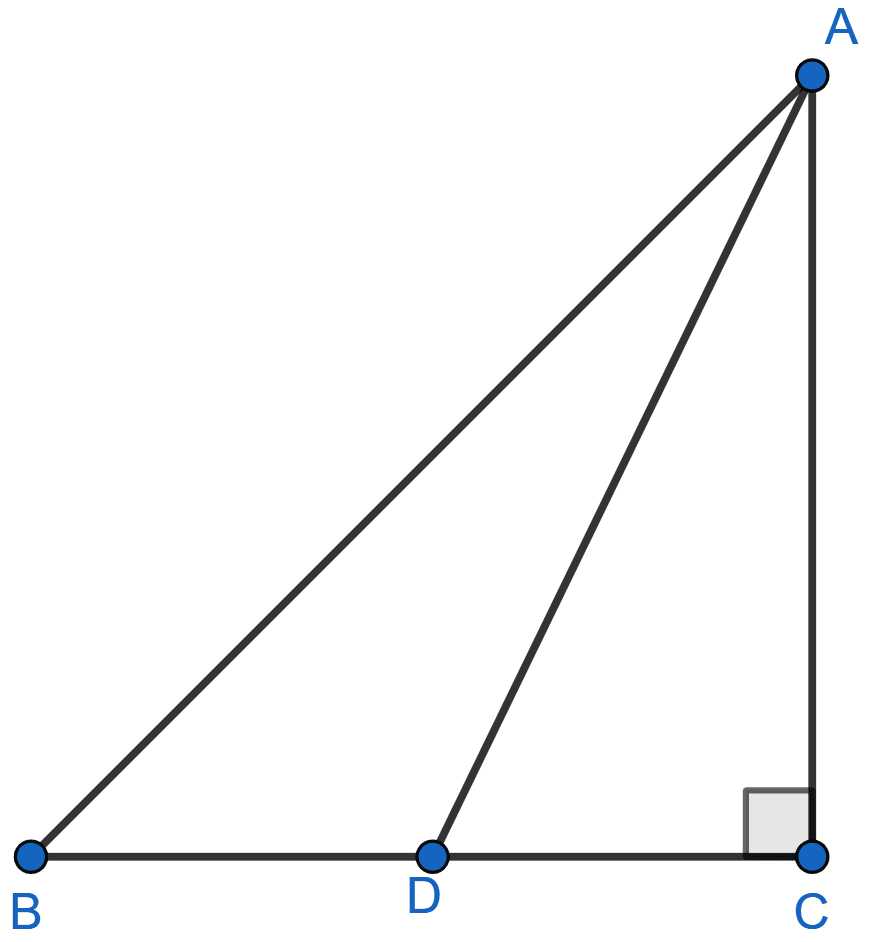
In figure, ABC is a right triangle right angled at C. If D is mid-point of BC, prove that AB^2 = 4AD^2 - 3AC^2. Pythagoras Theorem, ML Aggarwal Understanding Mathematics Solutions ICSE Class 9.

Answer

Since, D is mid-point of BC so we get,

DC = BC2\dfrac{BC}{2}.

ABC is a right triangle.

By pythagoras theorem,

⇒ AB2 = AC2 + BC2 .......(i)

ADC is a right triangle.

By pythagoras theorem,

⇒ AD2 = AC2 + DC2 .......(ii)

⇒ AC2 = AD2 - DC2

⇒ AC2 = AD2 - (12BC)2\Big(\dfrac{1}{2}\text{BC}\Big)^2

⇒ AC2 = AD2 - 14BC2\dfrac{1}{4}\text{BC}^2

⇒ AC2 = 4AD2BC24\dfrac{4\text{AD}^2 - \text{BC}^2}{4}

⇒ 4AC2 = 4AD2 - BC2

⇒ AC2 + 3AC2 = 4AD2 - BC2

⇒ AC2 + BC2 = 4AD2 - 3AC2

⇒ AB2 = 4AD2 - 3AC2 [....From (i)]

Hence, proved that AB2 = 4AD2 - 3AC2.

Question 17

In △ABC, AB = AC = x, BC = 10 cm and the area of △ABC is 60 cm2. Find x.

Answer

Let AD be the altitude. In isosceles triangle, the altitude to base bisects the base.

∴ BD = CD = 5 cm.

From figure,
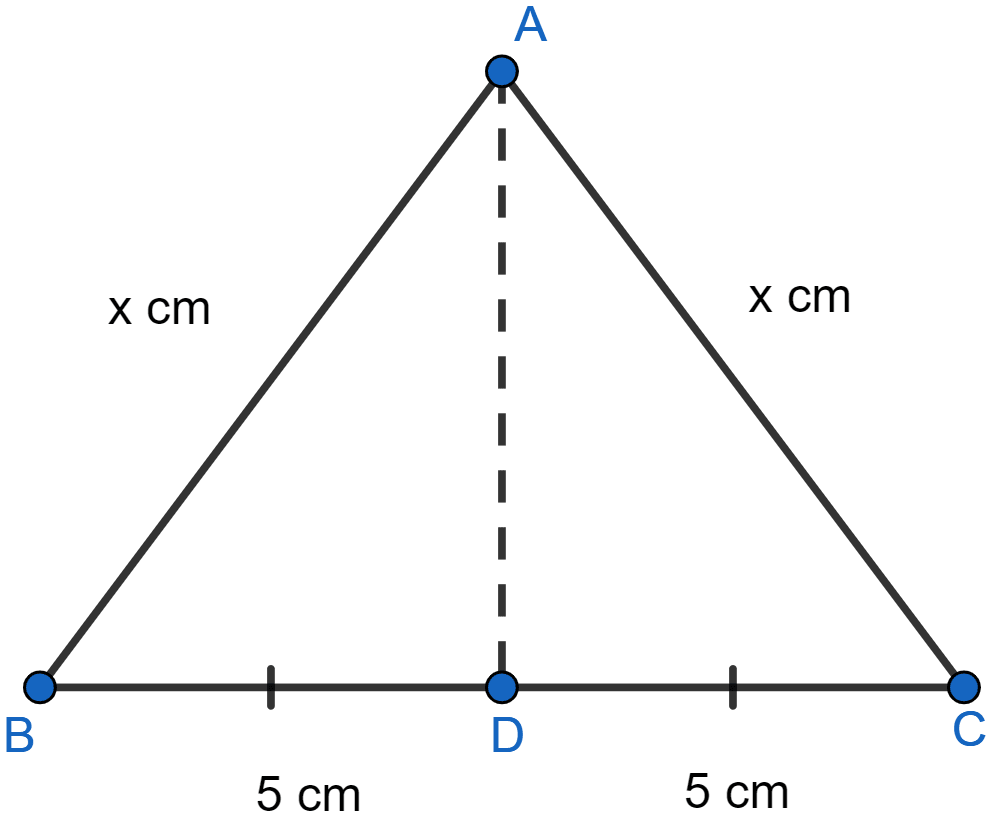
In △ABC, AB = AC = x, BC = 10 cm and the area of △ABC is 60 cm2. Find x. Pythagoras Theorem, ML Aggarwal Understanding Mathematics Solutions ICSE Class 9.

In right triangle ABD,

AB2 = AD2 + BD2

x2 = AD2 + 52

AD2 = x2 - 25.

AD = x225\sqrt{x^2 - 25}

Area of △ABC =12×AD×BC60=12×x225×10120=10x225x225=12x225=144x2=169x=169=13.\text{Area of △ABC } = \dfrac{1}{2} \times \text{AD} \times \text{BC} \\[1em] \Rightarrow 60 = \dfrac{1}{2} \times \sqrt{x^2 - 25} \times 10 \\[1em] \Rightarrow 120 = 10\sqrt{x^2 - 25} \\[1em] \Rightarrow \sqrt{x^2 - 25} = 12 \\[1em] \Rightarrow x^2 - 25 = 144 \\[1em] \Rightarrow x^2 = 169 \\[1em] \Rightarrow x = \sqrt{169} = 13.

Hence, x = 13 cm.

Question 18

In rhombus if diagonals are 30 cm and 40 cm, find its perimeter.

Answer

Let AC = 30 cm and BD = 40 cm.
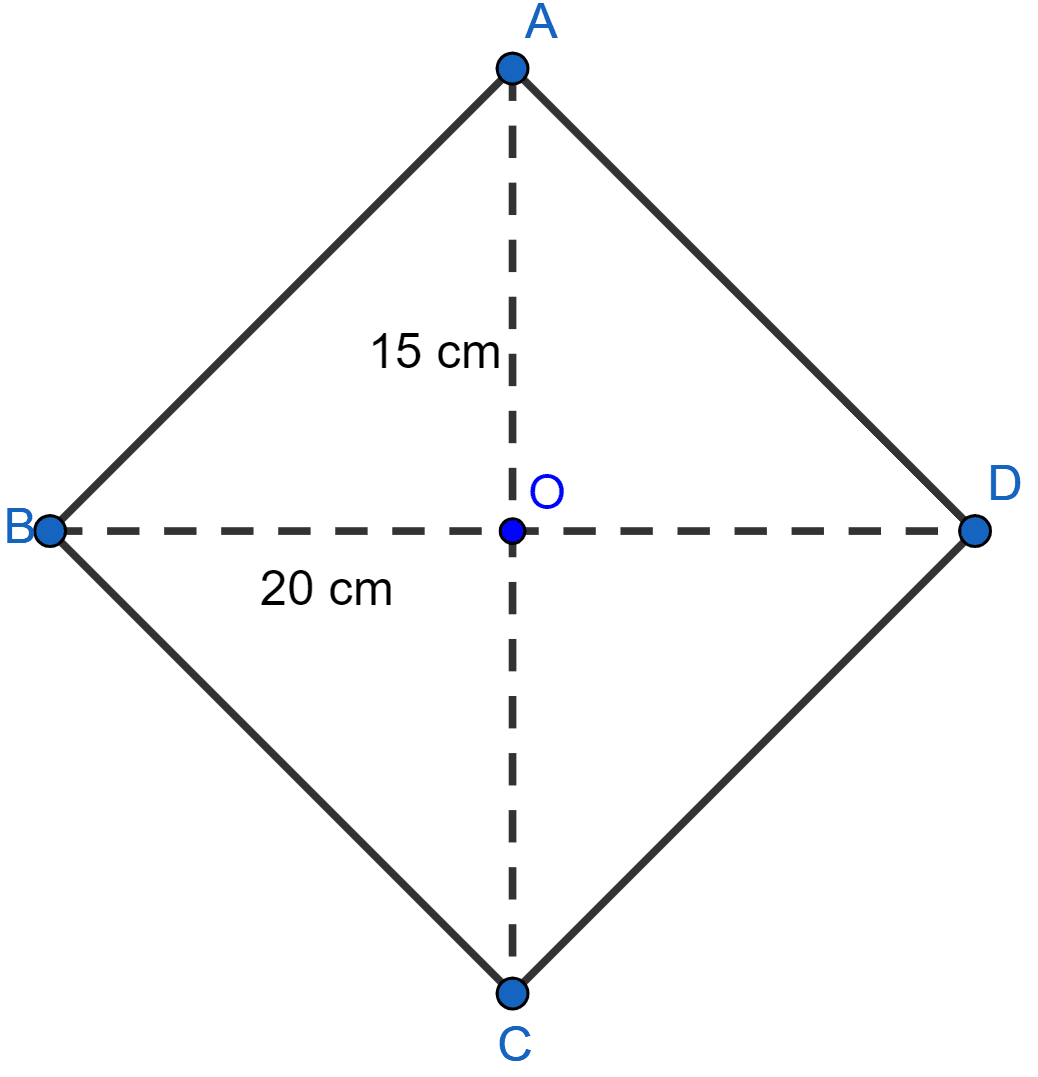
In rhombus if diagonals are 30 cm and 40 cm, find its perimeter. Pythagoras Theorem, ML Aggarwal Understanding Mathematics Solutions ICSE Class 9.

We know that,

Diagonals of rhombus are perpendicular and bisect each other,

OB = 12BD\dfrac{1}{2}BD = 20 cm and AO = 12\dfrac{1}{2}AC = 15 cm.

In right triangle AOB,

By pythagoras theorem we get,

⇒ AB2 = AO2 + OB2

⇒ AB2 = 152 + 202

⇒ AB2 = 225 + 400

⇒ AB2 = 625

⇒ AB = 25 cm.

Hence, each side of rhombus is 25 cm as all sides of rhombus are equal.

Perimeter = 4(Side) = 100 cm.

Hence, perimeter of rhombus = 100 cm.

Question 19(a)

In figure given below, AB || DC, BC = AD = 13 cm, AB = 22 cm and DC = 12 cm. Calculate the height of the trapezium ABCD.

In figure, AB || DC, BC = AD = 13 cm, AB = 22 cm and DC = 12 cm. Calculate the height of the trapezium ABCD. Pythagoras Theorem, ML Aggarwal Understanding Mathematics Solutions ICSE Class 9.

Answer

From figure,

In figure, AB || DC, BC = AD = 13 cm, AB = 22 cm and DC = 12 cm. Calculate the height of the trapezium ABCD. Pythagoras Theorem, ML Aggarwal Understanding Mathematics Solutions ICSE Class 9.

EF = DC = 12 cm

Since,

AD = BC and DE = CF = h (height)

∴ AE = FB = x.

⇒ AB = AE + EF + FB

⇒ 22 = x + 12 + x

⇒ 2x = 22 - 12

⇒ 2x = 10

⇒ x = 5 cm.

In right triangle ADE,

By pythagoras theorem,

⇒ AD2 = DE2 + AE2

⇒ 132 = h2 + 52

⇒ 169 - 25 = h2

⇒ h2 = 144

⇒ h = 12 cm.

Hence, height = 12 cm.

Question 19(b)

In figure given below, AB || DC, ∠A = 90°, DC = 7 cm, AB = 17 cm and AC = 25 cm. Calculate BC.

In figure, AB || DC, ∠A = 90°, DC = 7 cm, AB = 17 cm and AC = 25 cm. Calculate BC. Pythagoras Theorem, ML Aggarwal Understanding Mathematics Solutions ICSE Class 9.

Answer

Since, AB || DC

∠D = ∠A = 90°

In figure, AB || DC, ∠A = 90°, DC = 7 cm, AB = 17 cm and AC = 25 cm. Calculate BC. Pythagoras Theorem, ML Aggarwal Understanding Mathematics Solutions ICSE Class 9.

In right angle triangle ACD,

By pythagoras theorem,

⇒ AC2 = AD2 + CD2

⇒ 252 = AD2 + 72

⇒ 625 = AD2 + 49

⇒ AD2 = 625 - 49

⇒ AD2 = 576

⇒ AD = 576\sqrt{576} = 24 cm.

From figure,

CE = AD = 24 cm

In right angle triangle ACE,

By pythagoras theorem,

⇒ AC2 = AE2 + CE2

⇒ 252 = AE2 + 242

⇒ 625 = AE2 + 576

⇒ AE2 = 625 - 576

⇒ AE2 = 49

⇒ AE = 49\sqrt{49} = 7 cm.

So, EB = AB - AE = 17 - 7 = 10 cm.

In right angle triangle BCE,

By pythagoras theorem,

⇒ BC2 = CE2 + EB2

⇒ BC2 = 242 + 102

⇒ BC2 = 576 + 100

⇒ BC2 = 676

⇒ BC = 676\sqrt{676} = 26 cm.

Hence, BC = 26 cm.

Question 19(c)

In the figure given below, ABCD is a square of side 7 cm. If

AE = FC = CG = HA = 3 cm,

(i) prove that EFGH is a rectangle.

(ii) find the area and perimeter of EFGH.
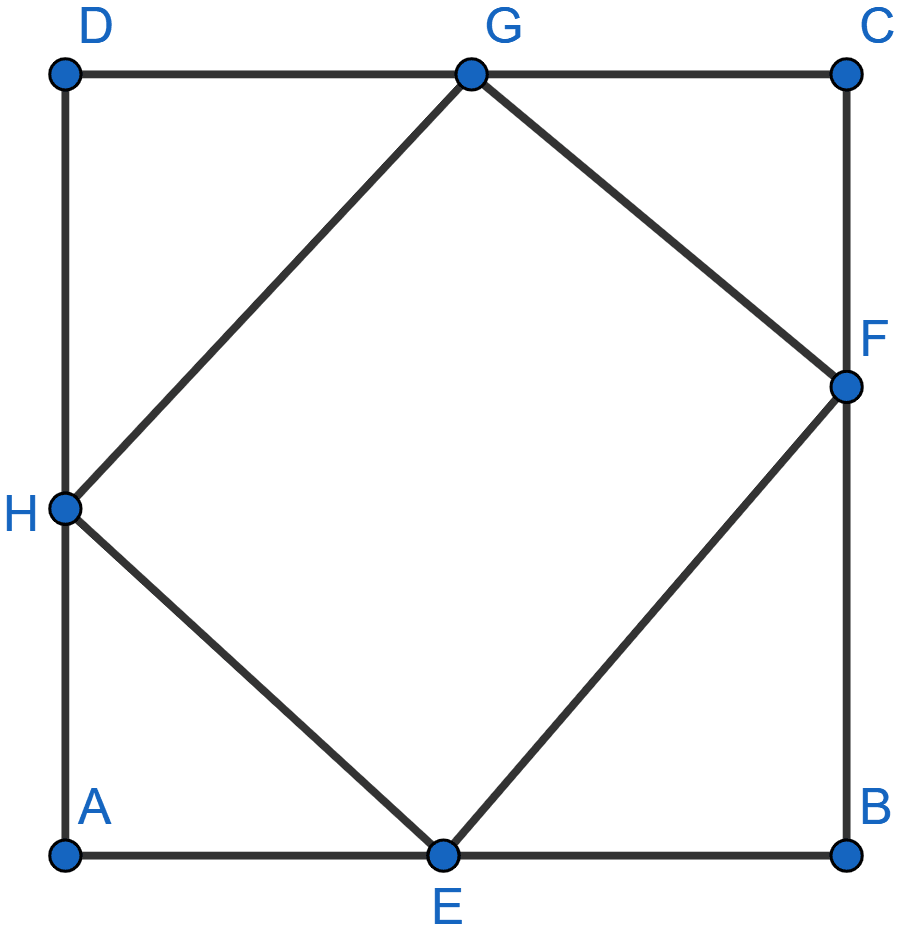
In the figure, ABCD is a square of side 7 cm. If AE = FC = CG = HA = 3 cm, (i) prove that EFGH is a rectangle (ii) find the area and perimeter of EFGH. Pythagoras Theorem, ML Aggarwal Understanding Mathematics Solutions ICSE Class 9.

Answer

(i) Given, ABCD is a square of side 7 cm and AE = FC = CG = HA = 3 cm.

From figure,

DH = DA - HA = 7 - 3 = 4 cm,

GD = DC - CG = 7 - 3 = 4 cm,

EB = AB - AE = 7 - 3 = 4 cm,

FB = BC - FC = 7 - 3 = 4 cm.

Since in square, sides are perpendicular to each other,

By pythagoras theorem,

In right angle triangle HAE,

⇒ HE2 = HA2 + AE2

⇒ HE2 = 32 + 32

⇒ HE2 = 9 + 9

⇒ HE2 = 18

⇒ HE = 18=32\sqrt{18} = 3\sqrt{2} cm.

In right angle triangle FCG,

⇒ GF2 = GC2 + FC2

⇒ GF2 = 32 + 32

⇒ GF2 = 9 + 9

⇒ GF2 = 18

⇒ GF = 18=32\sqrt{18} = 3\sqrt{2} cm.

In right angle triangle GDH,

⇒ GH2 = GD2 + DH2

⇒ GH2 = 42 + 42

⇒ GH2 = 16 + 16

⇒ GH2 = 32

⇒ GH = 32=42\sqrt{32} = 4\sqrt{2} cm.

In right angle triangle EBF,

⇒ EF2 = EB2 + FB2

⇒ EF2 = 42 + 42

⇒ EF2 = 16 + 16

⇒ EF2 = 32

⇒ EF = 32=42\sqrt{32} = 4\sqrt{2} cm.

In isosceles triangle AEH,

∠E = ∠H = x (let) (As angles opposite to equal side in isosceles triangle are equal).

So, ∠A + ∠E + ∠H = 180°

90° + x + x = 180°

2x = 90°

x = 45°

Similar is the case for triangles EBF, GDH, FCG.

From figure,

∠AEH + ∠HEF + ∠FEB = 180° (Linear pairs)

45° + ∠HEF + 45° = 180°

∠HEF = 90°

Since, angles of EFGH = 90° and EH = GF and HG = EF.

Hence, proved that EFGH is a rectangle.

(ii) Area of EFGH = EF × GF = 42×324\sqrt{2} \times 3\sqrt{2} = 24 cm2.

Perimeter of EFGH = 2(EF + GF) = 2(42+32)=1422(4\sqrt{2} + 3\sqrt{2}) = 14\sqrt{2} cm.

Hence, area = 24 cm2 and perimeter = 14214\sqrt{2} cm.

Question 20

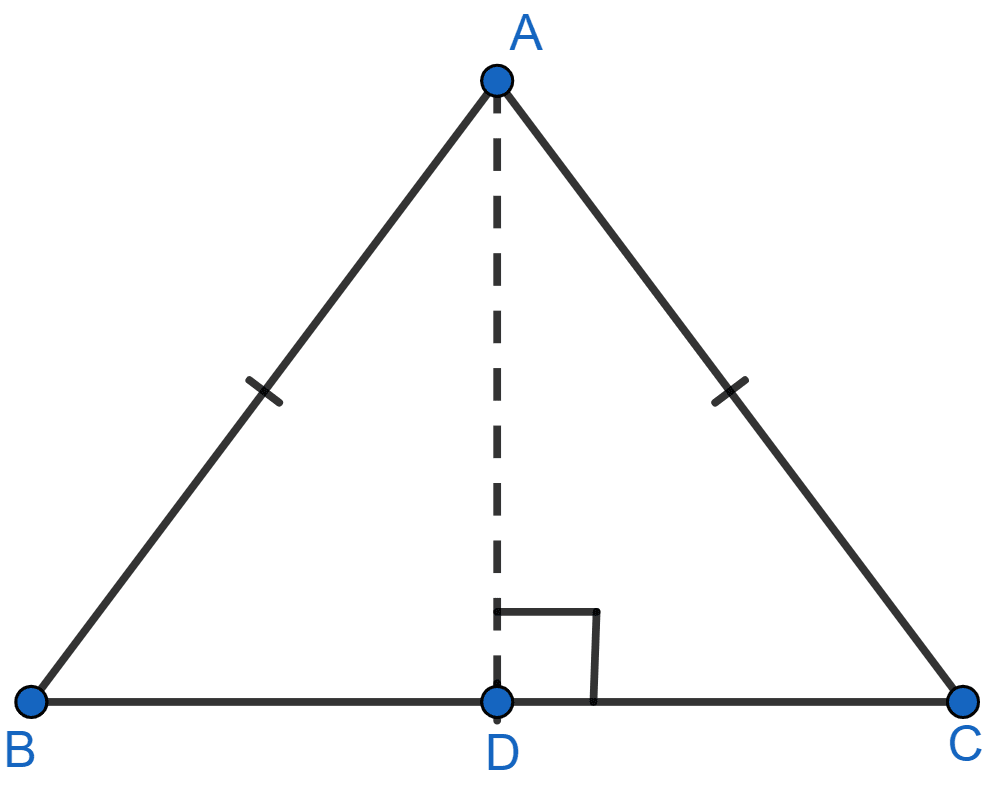
AD is perpendicular to the side BC of an equilateral △ABC. Prove that 4AD2 = 3AB2.

Answer

Given, AD ⊥ BC and AB = BC = CA (Equilateral triangle).

The perpendicular to base in equilateral triangle bisects the base.

∴ BD = BC2\dfrac{BC}{2}.

From figure,

AD is perpendicular to the side BC of an equilateral △ABC. Prove that 4AD^2 = 3AB^2. Pythagoras Theorem, ML Aggarwal Understanding Mathematics Solutions ICSE Class 9.

In right triangle ABD,

By pythagoras theorem,

⇒ AB2 = AD2 + BD2

⇒ AB2 = AD2 + (BC2)2\Big(\dfrac{BC}{2}\Big)^2

⇒ AB2 = AD2 + BC24\dfrac{BC^2}{4}

⇒ AB2 = 4AD2+BC24\dfrac{4\text{AD}^2 + \text{BC}^2}{4}

⇒ 4AB2 = 4AD2 + BC2

⇒ 4AB2 = 4AD2 + AB2 (∵ BC = AB)

⇒ 4AD2 = 3AB2.

Hence, proved that 4AD2 = 3AB2.

Question 21

In the adjoining figure, D and E are mid-points of the sides BC and CA respectively of a △ABC, right angled at C. Prove that :

(i) 4AD2 = 4AC2 + BC2

(ii) 4BE2 = 4BC2 + AC2

(iii) 4(AD2 + BE2) = 5AB2
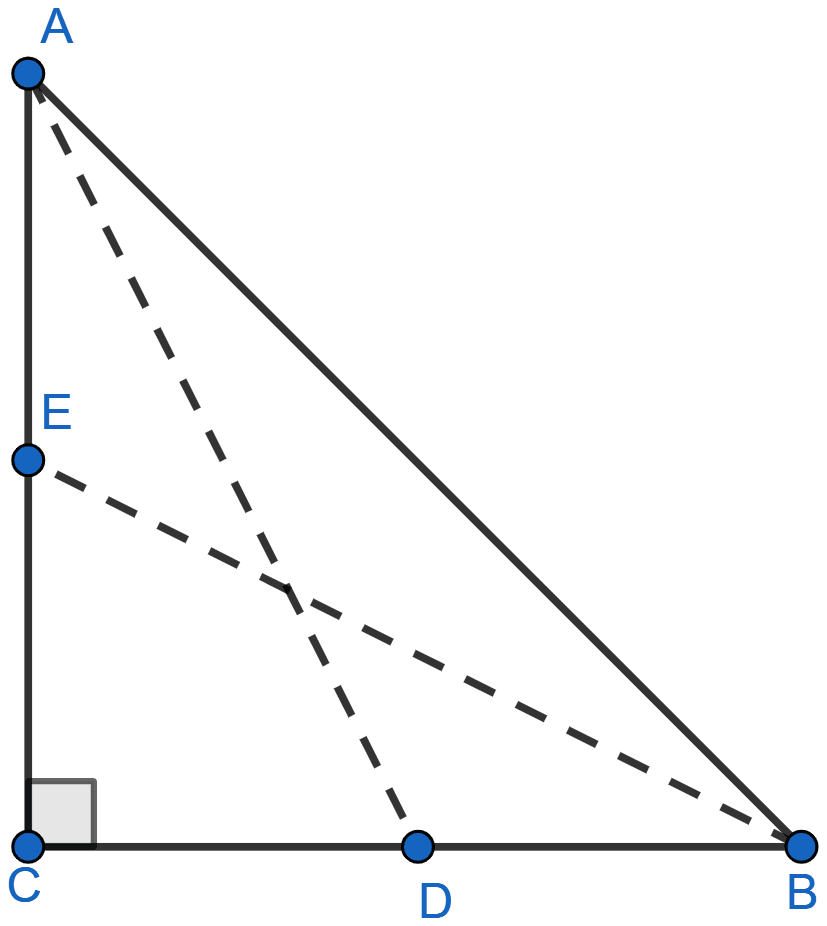
In the figure, D and E are mid-points of the sides BC and CA respectively of a △ABC, right angled at C. Prove that (i) 4AD^2 = 4AC^2 + BC^2 (ii) 4BE^2 = 4BC^2 + AC^2 (iii) 4(AD^2 + BE^2) = 5AB^2. Pythagoras Theorem, ML Aggarwal Understanding Mathematics Solutions ICSE Class 9.

Answer

(i) Since, D is mid-point of BC,

∴ CD = BC2\dfrac{BC}{2}

In right triangle ACD,

By pythagoras theorem,

⇒ AD2 = AC2 + CD2

⇒ AD2 = AC2 + (BC2)2\Big(\dfrac{BC}{2}\Big)^2

⇒ AD2 = AC2 + BC24\dfrac{BC^2}{4}

⇒ AD2 = 4AC2+BC24\dfrac{4\text{AC}^2 + \text{BC}^2}{4}

⇒ 4AD2 = 4AC2 + BC2 .....(1)

Hence, proved that 4AD2 = 4AC2 + BC2.

(ii) As E is mid-point of AC,

∴ CE = AC2\dfrac{AC}{2}

⇒ AC = 2CE

BCE is right triangle,

By pythagoras theorem,

⇒ BE2 = BC2 + CE2

Multiplying both sides by 4 we get,

⇒ 4BE2 = 4BC2 + 4CE2

⇒ 4BE2 = 4BC2 + (2CE)2

⇒ 4BE2 = 4BC2 + AC2 ......(2)

Hence, proved that 4BE2 = 4BC2 + AC2.

(iii) As, ABC is a right triangle,

By pythagoras theorem we get,

⇒ AB2 = AC2 + BC2

Adding 1 and 2 from above parts we get,

⇒ 4AD2 + 4BE2 = 4AC2 + BC2 + 4BC2 + AC2

⇒ 4(AD2 + BE2) = 5AC2 + 5BC2

⇒ 4(AD2 + BE2) = 5(AC2 + BC2)

⇒ 4(AD2 + BE2) = 5AB2.

Hence, proved that 4(AD2 + BE2) = 5AB2.

Question 22

If AD, BE and CF are medians of △ABC, prove that

3(AB2 + BC2 + CA2) = 4(AD2 + BE2 + CF2).

Answer

Draw AP perpendicular to BC.

If AD, BE and CF are medians of △ABC, prove that 3(AB^2 + BC^2 + CA^2) = 4(AD^2 + BE^2 + CF^2). Pythagoras Theorem, ML Aggarwal Understanding Mathematics Solutions ICSE Class 9.

In right triangle APD,

By pythagoras theorem,

AD2 = AP2 + PD2 .......(i)

In right triangle APB,

By pythagoras theorem,

⇒ AB2 = AP2 + BP2

⇒ AB2 = AP2 + (BD - PD)2

⇒ AB2 = AP2 + BD2 + PD2 - 2BD.PD

Since, BD = BC2\dfrac{\text{BC}}{2} as AD is median of BC.

⇒ AB2 = AP2 + PD2 + (BC2)2\Big(\dfrac{\text{BC}}{2}\Big)^2 - 2 x BC2\dfrac{\text{BC}}{2} x PD

⇒ AB2 = AD2 + BC24\dfrac{\text{BC}^2}{4} - BC.PD ....(ii) (From i)

In right triangle APC,

By pythagoras theorem,

⇒ AC2 = AP2 + PC2

⇒ AC2 = AP2 + (PD + DC)2

⇒ AC2 = AP2 + PD2 + DC2 + 2PD.DC

Since, DC = BC2\dfrac{BC}{2}

⇒ AC2 = AD2 + DC2 + 2PD.DC [....From (i)]

⇒ AC2 = AD2 + (BC2)2\Big(\dfrac{\text{BC}}{2}\Big)^2 + 2 x PD x BC2\dfrac{\text{BC}}{2}

⇒ AC2 = AD2 + BC24\dfrac{\text{BC}^2}{4} + PD.BC ....(iii)

Adding (ii) and (iii) we get,

⇒ AB2 + AC2 = AD2 + BC24\dfrac{\text{BC}^2}{4} - BC.PD + AD2 + BC24\dfrac{\text{BC}^2}{4} + PD.BC

⇒ AB2 + AC2 = 2AD2 + BC22\dfrac{\text{BC}^2}{2} ....(iv)

Draw BQ perpendicular to AC,

In right triangle BQE,

By pythagoras theorem,

BE2 = BQ2 + QE2 .......(v)

In right triangle ABQ,

By pythagoras theorem,

⇒ AB2 = BQ2 + AQ2

⇒ AB2 = BQ2 + (AE - QE)2

⇒ AB2 = BQ2 + QE2 + AE2 - 2AE.QE

Since, AE = AC2\dfrac{\text{AC}}{2} as BE is median of AC.

⇒ AB2 = BE2 + (AC2)2\Big(\dfrac{\text{AC}}{2}\Big)^2 - 2 x AC2\dfrac{\text{AC}}{2} x QE (From v)

⇒ AB2 = BE2 + AC24\dfrac{\text{AC}^2}{4} - AC.QE ....(vi)

In right triangle BQC,

By pythagoras theorem,

⇒ BC2 = BQ2 + QC2

⇒ BC2 = BQ2 + (QE + EC)2

⇒ BC2 = BQ2 + QE2 + EC2 + 2QE.EC

Since, EC = AC2\dfrac{AC}{2} as BE is median of AC.

⇒ BC2 = BE2 + EC2 + 2QE.EC [....From (v)]

⇒ BC2 = BE2 + (AC2)2\Big(\dfrac{\text{AC}}{2}\Big)^2 + 2 x QE x AC2\dfrac{\text{AC}}{2}

⇒ BC2 = BE2 + AC24\dfrac{\text{AC}^2}{4} + QE.AC ....(vii)

Adding (vi) and (vii) we get,

⇒ AB2 + BC2 = BE2 + AC24\dfrac{\text{AC}^2}{4} - AC.QE + BE2 + AC24\dfrac{\text{AC}^2}{4} + QE.AC

⇒ AB2 + BC2 = 2BE2 + AC22\dfrac{\text{AC}^2}{2} ....(viii)

Draw CR perpendicular to AB,

In right triangle CFR,

By pythagoras theorem,

CF2 = CR2 + FR2 .......(ix)

In right triangle CBR,

By pythagoras theorem,

⇒ CB2 = CR2 + RB2

⇒ CB2 = CR2 + (BF - FR)2

⇒ CB2 = CR2 + FR2 + BF2 - 2BF.FR

Since, BF = AB2\dfrac{\text{AB}}{2} as CF is median of AB.

⇒ CB2 = CF2 + (AB2)2\Big(\dfrac{\text{AB}}{2}\Big)^2 - 2 x AB2\dfrac{\text{AB}}{2} x FR (From ix)

⇒ CB2 = CF2 + AB24\dfrac{\text{AB}^2}{4} - AB.FR ....(x)

In right triangle ACR,

By pythagoras theorem,

⇒ AC2 = RC2 + AR2

⇒ AC2 = RC2 + (AF + FR)2

⇒ AC2 = RC2 + FR2 + AF2 + 2AF.FR

Since, AF = AB2\dfrac{\text{AB}}{2} as CF is median of AB.

⇒ AC2 = CF2 + AF2 + 2AF.FR [....From (ix)]

⇒ AC2 = CF2 + (AB2)2\Big(\dfrac{\text{AB}}{2}\Big)^2 + 2 x FR x AB2\dfrac{\text{AB}}{2}

⇒ AC2 = CF2 + AB24\dfrac{\text{AB}^2}{4} + FR.AB ....(xi)

Adding (x) and (xi) we get,

⇒ CB2 + AC2 = CF2 + AB24\dfrac{\text{AB}^2}{4} - AB.FR + CF2 + AB24\dfrac{\text{AB}^2}{4} + FR.AB

⇒ CB2 + AC2 = 2CF2 + AB22\dfrac{\text{AB}^2}{2} ....(xii)

On adding (iv), (viii) and (xii) we get,

AB2 + AC2 + AB2 + BC2 + CB2 + AC2 = 2AD2 + BC22\dfrac{\text{BC}^2}{2} + 2BE2 + AC22\dfrac{\text{AC}^2}{2} + 2CF2 + AB22\dfrac{\text{AB}^2}{2}

⇒ 2(AB2 + BC2 + CA2) = 2(AD2 + BE2 + CF2) + 12\dfrac{1}{2}(AB2 + BC2 + CA2)

⇒ 2(AB2 + BC2 + CA2) - 12\dfrac{1}{2}(AB2 + BC2 + CA2) = 2(AD2 + BE2 + CF2)

32\dfrac{3}{2}(AB2 + BC2 + CA2) = 2(AD2 + BE2 + CF2)

33(AB2 + BC2 + CA2) = 4(AD2 + BE2 + CF2)

Hence, proved that 3(AB2 + BC2 + CA2) = 4(AD2 + BE2 + CF2).

Question 23

In the adjoining figure, the diagonals AC and BD of a quadrilateral ABCD intersect at O, at right angles. Prove that AB2 + CD2 = AD2 + BC2.
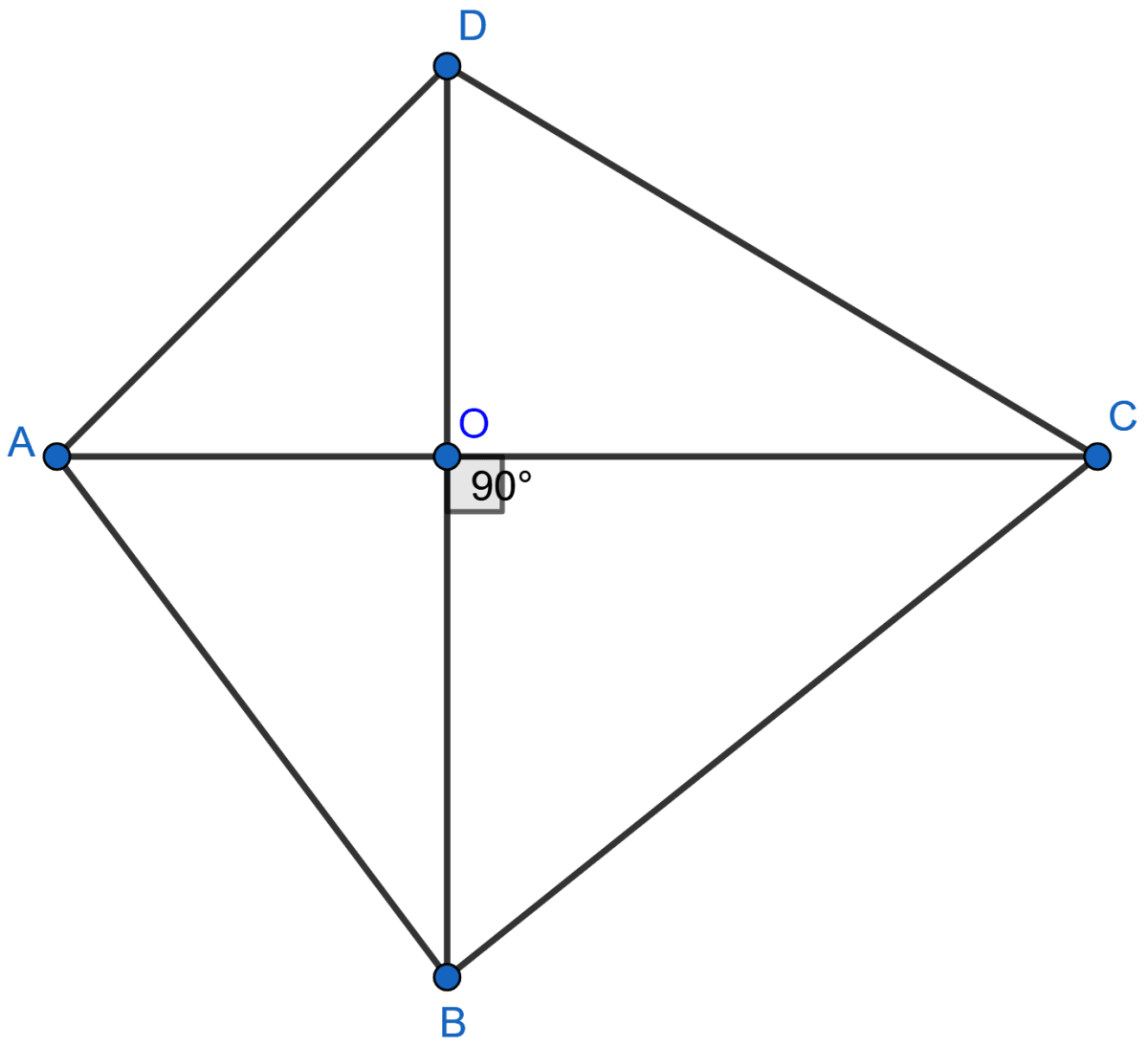
In the figure, the diagonals AC and BD of a quadrilateral ABCD intersect at O, at right angles. Prove that AB^2 + CD^2 = AD^2 + BC^2. Pythagoras Theorem, ML Aggarwal Understanding Mathematics Solutions ICSE Class 9.

Answer

By pythagoras theorem,

In right angle triangle AOB,

AB2 = OB2 + OA2 .......(i)

In right angle triangle COD,

CD2 = OC2 + OD2 .......(ii)

In right angle triangle AOD,

AD2 = AO2 + OD2 .......(iii)

In right angle triangle BOC,

BC2 = OB2 + OC2 .......(iv)

Adding (i), (ii) we get,

AB2 + CD2 = OB2 + OA2 + OC2 + OD2

AB2 + CD2 = (OA2 + OD2) + (OC2 + OB2)

Substituting value from (iii) and (iv) in above equation we get,

AB2 + CD2 = AD2 + BC2.

Hence, proved that AB2 + CD2 = AD2 + BC2.

Question 24

In a quadrilateral ABCD, ∠B = 90° = ∠D. Prove that

2AC2 - BC2 = AB2 + AD2 + DC2.

Answer

Given, ∠B = 90° = ∠D
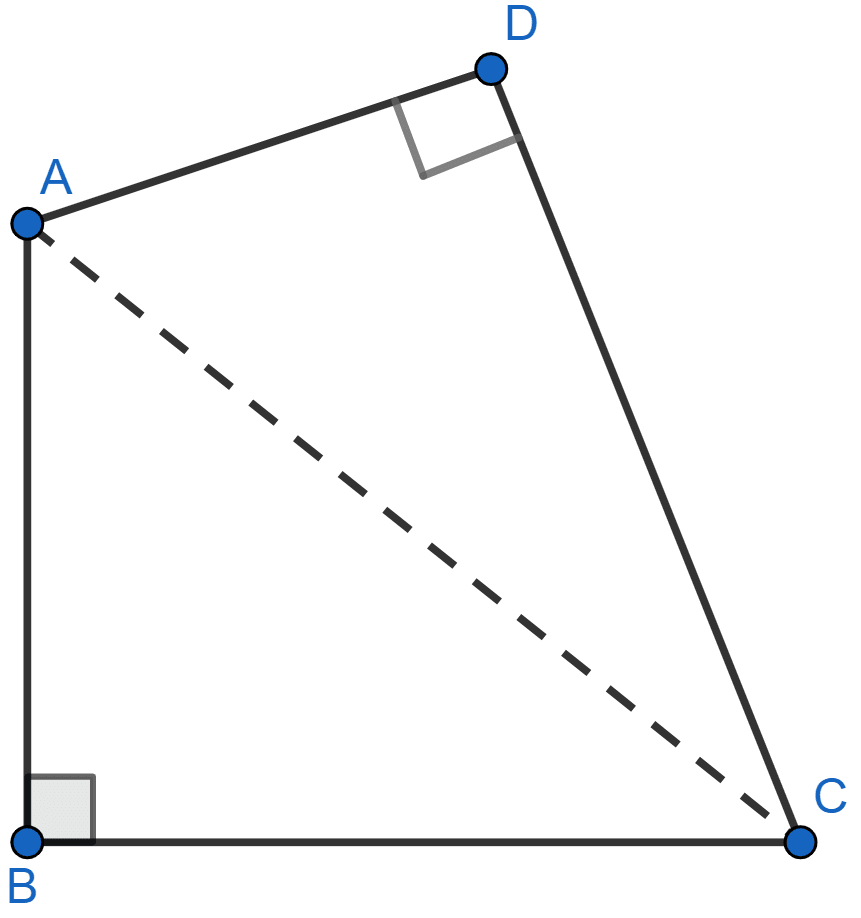
In a quadrilateral ABCD, ∠B = 90° = ∠D. Prove that 2AC^2 - BC^2 = AB^2 + AD^2 + DC^2. Pythagoras Theorem, ML Aggarwal Understanding Mathematics Solutions ICSE Class 9.

By pythagoras theorem,

In right angle triangle ABC,

AC2 = AB2 + BC2 ......(i)

By pythagoras theorem,

In right angle triangle ADC,

AC2 = AD2 + DC2 ......(ii)

Adding (i) and (ii) we get,

2AC2 = AB2 + BC2 + AD2 + DC2

2AC2 - BC2 = AB2 + AD2 + DC2.

Hence, proved that 2AC2 - BC2 = AB2 + AD2 + DC2.

Question 25

In a △ABC, ∠A = 90°, CA = AB and D is a point on AB produced. Prove that

DC2 - BD2 = 2AB × AD.

Answer

In right angle triangle ACD,
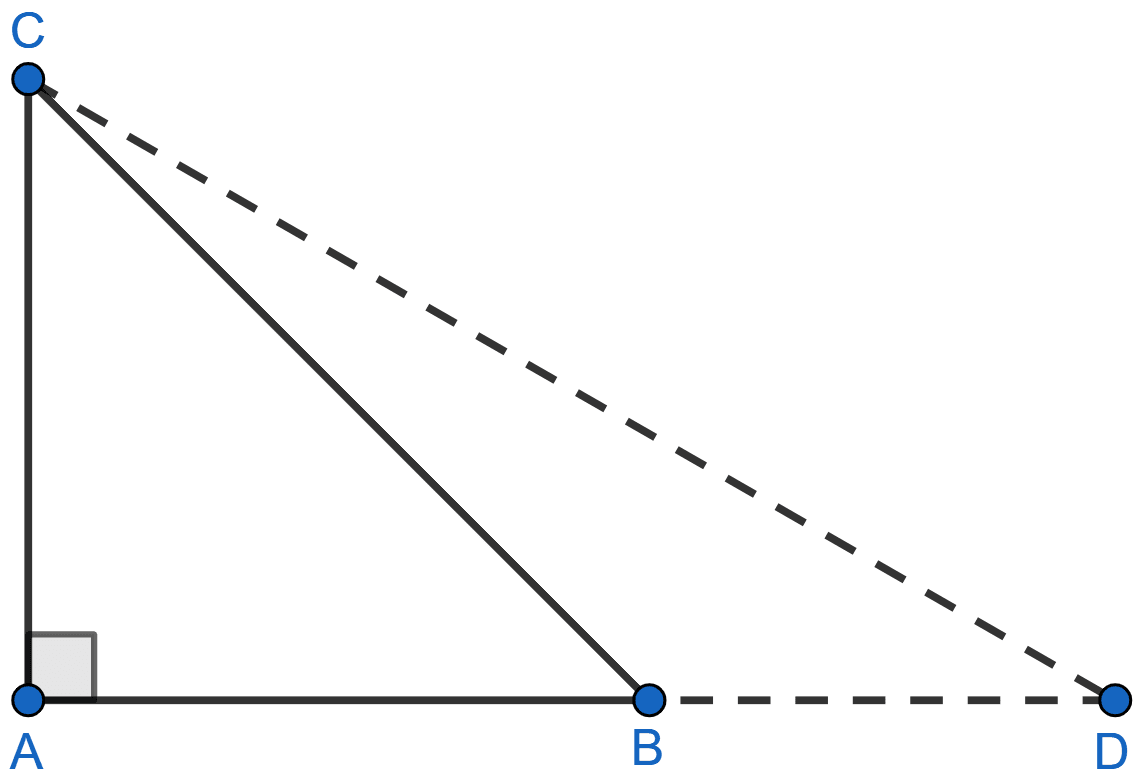
In a △ABC, ∠A = 90°, CA = AB and D is a point on AB produced. Prove that DC^2 - BD^2 = 2AB × AD. Pythagoras Theorem, ML Aggarwal Understanding Mathematics Solutions ICSE Class 9.

DC2 = CA2 + AD2 (Pythagoras theorem)

DC2 = CA2 + (AB + BD)2

DC2 = CA2 + AB2 + BD2 + 2AB.BD

DC2 - BD2 = AB2 + AB2 + 2AB.BD [∵ CA = AB]

DC2 - BD2 = 2AB2 + 2AB.BD

DC2 - BD2 = 2AB(AB + BD)

From figure, AB + BD = AD

DC2 - BD2 = 2AB.AD

Hence, proved that DC2 - BD2 = 2AB.AD.

Question 26

In an isosceles triangle ABC, AB = AC and D is a point on BC produced. Prove that AD2 = AC2 + BD × CD.

Answer

Draw AP ⊥ BC.

APD is right triangle
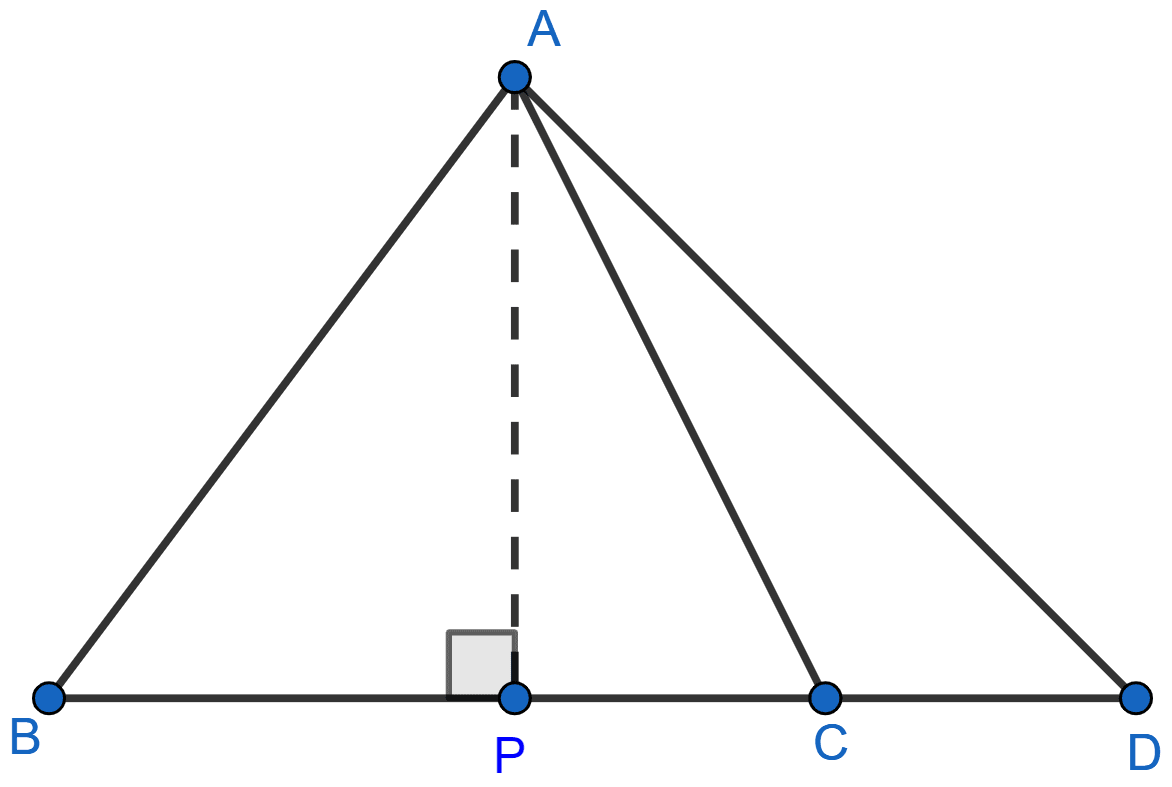
In an isosceles triangle ABC, AB = AC and D is a point on BC produced. Prove that AD^2 = AC^2 + BD × CD. Pythagoras Theorem, ML Aggarwal Understanding Mathematics Solutions ICSE Class 9.

By pythagoras theorem we get,

⇒ AD2 = AP2 + PD2

⇒ AD2 = AP2 + (PC + CD)2

⇒ AD2 = AP2 + PC2 + CD2 + 2PC.CD ......(i)

APC is right triangle,

By pythagoras theorem we get,

⇒ AC2 = AP2 + PC2 ......(ii)

Substituting the value of AP2 + PC2 from (ii) in (i) we get,

⇒ AD2 = AC2 + CD2 + 2PC.CD .......(iii)

Since, ABC is an isosceles triangle,

⇒ PC = BC2\dfrac{\text{BC}}{2} [∵ altitude to the base of an isosceles triangle bisects the base]

⇒ AD2 = AC2 + CD2 + 2×12×BC×CD2 \times \dfrac{1}{2} \times \text{BC} \times \text{CD}

⇒ AD2 = AC2 + CD2 + BC.CD

⇒ AD2 = AC2 + CD(CD + BC)

From figure, CD + BC = BD

⇒ AD2 = AC2 + CD.BD

Hence, proved that AD2 = AC2 + BD × CD.

Multiple Choice Questions

Question 1

In a △ABC, if AB = 636\sqrt{3} cm, BC = 6 cm and AC = 12 cm, then ∠B is

  1. 120°

  2. 90°

  3. 60°

  4. 45°

Answer

Here greatest length is 12 cm and other lengths are 6 cm, 636\sqrt{3} cm.

In a △ABC, if AB = 6√3 cm, BC = 6 cm and AC = 12 cm, then ∠B is? Pythagoras Theorem, ML Aggarwal Understanding Mathematics Solutions ICSE Class 9.

Note that 122 = 144 and 62 + (63)2(6\sqrt{3})^2 = 36 + 108 = 144.

Thus, 122 = 62 + (63)2(6\sqrt{3})^2.

Hence, ABC is right triangle with hypotenuse = AC = 12 cm.

So, angle opposite to AC i.e. ∠B = 90°.

Hence, Option 2 is the correct option.

Question 2

If the sides of a rectangular plot are 15 m and 8 m, then the length of its diagonal is

  1. 17 m

  2. 23 m

  3. 21 m

  4. 17 cm

Answer

As sides of rectangle are perpendicular to each other so △ABC is a right angle triangle.

If the sides of a rectangular plot are 15 m and 8 m, then the length of its diagonal is? Pythagoras Theorem, ML Aggarwal Understanding Mathematics Solutions ICSE Class 9.

In right angle triangle ABC,

⇒ AC2 = AB2 + BC2

⇒ AC2 = 82 + 152

⇒ AC2 = 64 + 225

⇒ AC2 = 289

⇒ AC = 289\sqrt{289} = 17 m.

Hence, Option 1 is the correct option.

Question 3

The lengths of the diagonals of a rhombus are 16 cm and 12 cm. The length of the side of rhombus is

  1. 9 cm

  2. 10 cm

  3. 8 cm

  4. 20 cm

Answer

Let AC = 16 cm and BD = 12 cm.

The lengths of the diagonals of a rhombus are 16 cm and 12 cm. The length of the side of rhombus is? Pythagoras Theorem, ML Aggarwal Understanding Mathematics Solutions ICSE Class 9.

We know that,

Diagonals of rhombus are perpendicular and bisect each other,

OB = 12BD\dfrac{1}{2}BD = 6 cm and AO = 12\dfrac{1}{2}AC = 8 cm.

In right triangle AOB,

By pythagoras theorem we get,

⇒ AB2 = AO2 + OB2

⇒ AB2 = 82 + 62

⇒ AB2 = 64 + 36

⇒ AB2 = 100

⇒ AB = 100\sqrt{100} = 10 cm.

Hence, Option 2 is the correct option.

Question 4

If a side of a rhombus is 10 cm and one of the diagonals is 16 cm, then the length of the other diagonal is

  1. 6 cm

  2. 12 cm

  3. 20 cm

  4. 12 cm

Answer

Let AC = 16 cm.

If a side of a rhombus is 10 cm and one of the diagonals is 16 cm, then the length of the other diagonal is? Pythagoras Theorem, ML Aggarwal Understanding Mathematics Solutions ICSE Class 9.

We know that,

Diagonals of rhombus are perpendicular and bisect each other,

AO = 12\dfrac{1}{2}AC = 8 cm.

In right triangle AOB,

By pythagoras theorem we get,

⇒ AB2 = AO2 + OB2

⇒ 102 = 82 + OB2

⇒ 100 = 64 + OB2

⇒ OB2 = 100 - 64 = 36

⇒ OB = 36\sqrt{36} = 6 cm.

BD = 2OB = 12 cm.

Hence, Option 2 is the correct option.

Question 5

If a ladder 10 m long reaches a window 8 m above the ground, then the distance of the foot of the ladder from the base of the wall is

  1. 18 m

  2. 8 m

  3. 6 m

  4. 4 m

Answer

Let AB be the ladder and B be the point of window.

If a ladder 10 m long reaches a window 8 m above the ground, then the distance of the foot of the ladder from the base of the wall is? Pythagoras Theorem, ML Aggarwal Understanding Mathematics Solutions ICSE Class 9.

In right triangle ACB,

By pythagoras theorem,

⇒ AB2 = AC2 + BC2

⇒ 102 = AC2 + 82

⇒ AC2 = 100 - 64

⇒ AC2 = 36

⇒ AC = 36\sqrt{36} = 6 m.

Hence, Option 3 is the correct option.

Question 6

A girl walks 200 m towards East and then she walks 150 m towards North. The distance of the girl from starting point is

  1. 350 m

  2. 250 m

  3. 300 m

  4. 225 m

Answer

Let A be starting point and B is the end point.

A girl walks 200 m towards East and then she walks 150 m towards North. The distance of the girl from starting point is? Pythagoras Theorem, ML Aggarwal Understanding Mathematics Solutions ICSE Class 9.

In right triangle ACB,

By pythagoras theorem we get,

AB2 = AC2 + CB2

AB2 = (200)2 + (150)2

AB2 = 40000 + 22500

AB2 = 62500

AB = 62500\sqrt{62500} = 250 m.

Hence, Option 2 is the correct option.

Question 7

A ladder reaches a window 12 m above the ground on one side of the street. Keeping its foot at the same point, the ladder is turned to the other side of the street to reach a window 9 m high. If the length of the ladder is 15 m, then the width of the street is

  1. 30 m

  2. 24 m

  3. 21 m

  4. 18 m

Answer

In right triangle AEB,

A girl walks 200 m towards East and then she walks 150 m towards North. The distance of the girl from starting point is? Pythagoras Theorem, ML Aggarwal Understanding Mathematics Solutions ICSE Class 9.

By pythagoras theorem we get,

⇒ EB2 = EA2 + AB2

⇒ 152 = 92 + AB2

⇒ 225 = 81 + AB2

⇒ AB2 = 144

⇒ AB = 144\sqrt{144} = 12 m

In right triangle BCD,

By pythagoras theorem we get,

⇒ BD2 = BC2 + CD2

⇒ 152 = BC2 + 122

⇒ 225 = BC2 + 144

⇒ 225 - 144 = BC2

⇒ BC2 = 81

⇒ BC = 81\sqrt{81} = 9 m

⇒ AC = AB + BC = 12 + 9 = 21 m.

Hence, Option 3 is the correct option.

Question 8

Consider the following two statements:

Statement 1: The area of a square whose diagonal is 6 cm is 36 cm2.

Statement 2: A diagonal of a square divides it into two right angled isosceles triangle.

Which of the following is valid?

  1. Both the statements are true.

  2. Both the statements are false.

  3. Statement 1 is true, and Statement 2 is false.

  4. Statement 1 is false, and Statement 2 is true.

Answer

Let's consider a square ABCD with diagonal AC.

The area of a square whose diagonal is 6 cm is 36 cm2.  A diagonal of a square divides it into two right angled isosceles triangle. Which of the following is valid? Pythagoras Theorem, ML Aggarwal Understanding Mathematics Solutions ICSE Class 9.

A square is a quadrilateral with four right angles.

Therefore, ∠A = ∠B = ∠C = ∠D = 90°.

AC divides the square into two triangles: △ABC and △ADC.

Both these triangles contain a right angle (at B and D respectively). Thus, they are right-angled triangles.

A square has all four sides equal in length. So, AB = BC = CD = DA.

In △ABC, the two sides AB and BC are equal (sides of the square).

In △ADC, the two sides AD and CD are equal (sides of the square).

Thus, AC divides the square into two right angled isosceles triangles.

∴ Statement 2 is true.

In triangle ABC,

By the Pythagorean theorem:

⇒ AC2 = AB2 + BC2

Let length of each side of square be a cm and length of diagonal equal to 6 cm (given).

⇒ 62 = a2 + a2

⇒ 36 = 2a2

⇒ a2 = 362\dfrac{36}{2} = 18 cm2

As we know that area of square = a2

Thus, area = 18 cm2.

∴ Statement 1 is false.

∴ Statement 1 is false, and Statement 2 is true.

Hence, option 4 is the correct option.

Assertion Reason Type Questions

Question 1

Assertion (A): If the sides of a rectangular plot are 80 m and 60 m, then the length of its diagonal is 100 m.

Reason (R): In a rectangle, all angles are 90°.

  1. Assertion (A) is true, Reason (R) is false.

  2. Assertion (A) is false, Reason (R) is true.

  3. Both Assertion (A) and Reason (R) are true, and Reason (R) is the correct reason for Assertion (A).

  4. Both Assertion (A) and Reason (R) are true, but Reason (R) is not the correct reason (or explanation) for Assertion (A).

Answer

A rectangle is a quadrilateral with four right angles.

Let ABCD be the rectangular plot.

If the sides of a rectangular plot are 80 m and 60 m, then the length of its diagonal is 100 m. Pythagoras Theorem, ML Aggarwal Understanding Mathematics Solutions ICSE Class 9.

Thus, in a rectangle, all angles are 90°.

∴ Reason (R) is true.

Given:

Side 1 (AB) = 80 m

Side 2 (BC) = 60 m

Let d be the length of the diagonal (AC). Using pythagoras theorem in triangle ABC,

⇒ AC2 = AB2 + BC2

⇒ d2 = 802 + 602

⇒ d2 = 6400 + 3600

⇒ d2 = 10000

⇒ d = 10000\sqrt{10000}

⇒ d = ± 100 m

Since, length cannot be negative, so, diagonal = 100 m.

∴ Assertion (A) is true.

∴ Both Assertion (A) and Reason (R) are true, and Reason (R) is the correct reason (or explanation) for Assertion (A).

Hence, option 3 is the correct option.

Question 2

Assertion (A): If triangle ABC is isosceles with AC = BC and AB2 = 2AC2, then triangle ABC is right angled.

Reason (R): If in a triangle ABC, we have AB2 = 2AC2 then we can conclude that it is right angled triangle.

  1. Assertion (A) is true, Reason (R) is false.

  2. Assertion (A) is false, Reason (R) is true.

  3. Both Assertion (A) and Reason (R) are true, and Reason (R) is the correct reason for Assertion (A).

  4. Both Assertion (A) and Reason (R) are true, but Reason (R) is not the correct reason (or explanation) for Assertion (A).

Answer

Given, triangle ABC is isosceles with AC = BC and, AB2 = 2AC2

⇒ AB2 = AC2 + AC2

⇒ AB2 = AC2 + BC2

This equation AB2 = AC2 + BC2 is the form of the Pythagorean Theorem where AB is the hypotenuse and AC and BC are the other sides of te triangle.

Since, pythagoras theorem is satisfied, thus ABC is a right angle triangle.

∴ Assertion (A) is true.

Alone with the relation, AB2 = 2AC2, we cannot conclude that it is right angled triangle because there is no mention of the third side BC.

∴ Reason (R) is false.

∴ Assertion (A) is true, Reason (R) is false.

Hence, option 1 is the correct option.

Question 3

Assertion (A): A triangle with sides 2 cm, 3 cm, 4 cm is not a right angled triangle.

Reason (R): A triangle with sides 2 cm, 3 cm, 4 cm is a scalene triangle.

  1. Assertion (A) is true, Reason (R) is false.

  2. Assertion (A) is false, Reason (R) is true.

  3. Both Assertion (A) and Reason (R) are true, and Reason (R) is the correct reason for Assertion (A).

  4. Both Assertion (A) and Reason (R) are true, but Reason (R) is not the correct reason (or explanation) for Assertion (A).

Answer

Given the sides: a = 2 cm, b = 3 cm, c = 4 cm.

The longest side is c = 4 cm.

Let's check if c2 = a2 + b2

Taking L.H.S.,

c2 = 42 = 16.

Taking R.H.S.,

a2 + b2 = 22 + 32

= 4 + 9

= 13.

Since 16 ≠ 13, the condition for a right-angled triangle is not met.

Therefore, the triangle with sides 2 cm, 3 cm, 4 cm is not a right-angled triangle.

∴ Assertion (A) is true.

A scalene triangle is defined as a triangle in which all three sides have different lengths.

Given the side lengths are 2 cm, 3 cm, and 4 cm. All three lengths are distinct.

∴ Reason (R) is true.

∴ Both Assertion (A) and Reason (R) are true, but Reason (R) is not the correct reason (or explanation) for Assertion (A).

Hence, option 4 is the correct option.

Chapter Test

Question 1

In the figure given below, AD ⊥ BC, AB = 25 cm, AC = 17 cm and AD = 15 cm. Find the length of BC.

In the figure, AD ⊥ BC, AB = 25 cm, AC = 17 cm and AD = 15 cm. Find the length of BC. Pythagoras Theorem, ML Aggarwal Understanding Mathematics Solutions ICSE Class 9.

Answer

By pythagoras theorem,

In right angle triangle ADB,

⇒ AB2 = AD2 + BD2

⇒ 252 = 152 + BD2

⇒ 625 = 225 + BD2

⇒ BD2 = 625 - 225 = 400

⇒ BD = 400\sqrt{400} = 20 cm

In right angle triangle ADC,

⇒ AC2 = AD2 + DC2

⇒ 172 = 152 + DC2

⇒ 289 = 225 + DC2

⇒ DC2 = 289 - 225 = 64

⇒ DC =64\sqrt{64} = 8 cm

From figure,

⇒ BC = BD + DC = 20 + 8 = 28 cm.

Hence, BC = 28 cm.

Question 1(b)

In the figure given below, ∠BAC = 90°, ADC = 90°, AD = 6 cm, CD = 8 cm and BC = 26 cm. Find

(i) AC

(ii) AB

(iii) area of the shaded region.

In the figure given below, ∠BAC = 90°, ADC = 90°, AD = 6 cm, CD = 8 cm and BC = 26 cm. Find AC AB area of the shaded region. Pythagoras Theorem, ML Aggarwal Understanding Mathematics Solutions ICSE Class 9.

Answer

(i) By pythagoras theorem,

In right angle triangle ADC,

⇒ AC2 = AD2 + DC2

⇒ AC2 = 62 + 82

⇒ AC2 = 36 + 64

⇒ AC2 = 100

⇒ AC = 100\sqrt{100} = 10 cm.

Hence, AC = 10 cm.

(ii) By pythagoras theorem,

In right angle triangle ABC,

⇒ BC2 = AB2 + AC2

⇒ 262 = AB2 + 102

⇒ AB2 = 676 - 100

⇒ AB2 = 576

⇒ AB = 576\sqrt{576} = 24 cm.

Hence, AB = 24 cm.

(iii) Area of shaded region = Area of △ABC - Area of △ADC

=12×AB×AC12×AD×DC=12×24×1012×6×8=12024=96 cm2.= \dfrac{1}{2} \times AB \times AC - \dfrac{1}{2} \times AD \times DC \\[1em] = \dfrac{1}{2} \times 24 \times 10 - \dfrac{1}{2} \times 6 \times 8 \\[1em] = 120 - 24 \\[1em] = 96 \text{ cm}^2.

Hence, area of shaded region = 96 cm2.

Question 1(c)

In figure given below, triangle ABC is right angled at B. Given that AB = 9 cm, AC = 15 cm and D, E are mid-points of the sides AB and AC respectively, calculate (i) the length of BC (ii) the area of △ADE.

In figure, triangle ABC is right angled at B. Given that AB = 9 cm, AC = 15 cm and D, E are mid-points of the sides AB and AC respectively, calculate (i) the length of BC (ii) the area of △ADE. Pythagoras Theorem, ML Aggarwal Understanding Mathematics Solutions ICSE Class 9.

Answer

(i) In right angle triangle ABC,

By pythagoras theorem,

⇒ AC2 = AB2 + BC2

⇒ 152 = 92 + BC2

⇒ BC2 = 225 - 81

⇒ BC2 = 144

⇒ BC = 144\sqrt{144} = 12 cm.

Hence, BC = 12 cm.

(ii) Given, D and E are midpoints of AB and AC.

∴ By mid-point theorem,

DE = 12BC\dfrac{1}{2}BC = 6 cm.

Area of △ADE = 12×AD×DE=12×4.5×6\dfrac{1}{2} \times AD \times DE = \dfrac{1}{2} \times 4.5 \times 6 = 13.5 cm2

Hence, area of △ADE = 13.5 cm2.

Question 2

If in △ABC, AB > AC and AD ⊥ BC, prove that AB2 - AC2 = BD2 - CD2.

Answer

From figure,

If in △ABC, AB > AC and AD ⊥ BC, prove that AB^2 - AC^2 = BD^2 - CD^2. Pythagoras Theorem, ML Aggarwal Understanding Mathematics Solutions ICSE Class 9.

In right angle △ADB,

By pythagoras theorem we get,

AB2 = AD2 + BD2 ........(i)

In right angle △ADC,

By pythagoras theorem we get,

AC2 = AD2 + CD2 ........(ii)

Subtracting (ii) from (i),

AB2 - AC2 = AD2 + BD2 - (AD2 + CD2)

AB2 - AC2 = BD2 - CD2.

Hence, proved that AB2 - AC2 = BD2 - CD2.

Question 3

In a right angled triangle ABC, right angled at C, P and Q are the points on the sides CA and CB respectively which divide these sides in the ratio 2 : 1. Prove that

(i) 9AQ2 = 9AC2 + 4BC2

(ii) 9BP2 = 9BC2 + 4AC2

(iii) 9(AQ2 + BP2) = 13AB2

Answer

(i) In right angle triangle ACQ,

In a right angled triangle ABC, right angled at C, P and Q are the points on the sides CA and CB respectively which divide these sides in the ratio 2 : 1. Prove that (i) 9AQ^2 = 9AC^2 + 4BC^2 (ii) 9BP^2 = 9BC^2 + 4AC^2. Pythagoras Theorem, ML Aggarwal Understanding Mathematics Solutions ICSE Class 9.

By pythagoras theorem we get,

⇒ AQ2 = AC2 + CQ2

Multiplying both sides by 9 we get,

⇒ 9AQ2 = 9AC2 + 9CQ2

⇒ 9AQ2 = 9AC2 + (3CQ)2 .......(i)

Given, BQ : CQ = 1 : 2

CQBC=CQBQ+CQ=21+2=23CQBC=233CQ=2BC\Rightarrow \dfrac{CQ}{BC} = \dfrac{CQ}{BQ + CQ} \\[1em] = \dfrac{2}{1 + 2} = \dfrac{2}{3} \\[1em] \Rightarrow \dfrac{CQ}{BC} = \dfrac{2}{3} \\[1em] \Rightarrow 3CQ = 2BC

Substituting above value in (i) we get,

⇒ 9AQ2 = 9AC2 + (2BC)2

⇒ 9AQ2 = 9AC2 + 4BC2.

Hence, proved that 9AQ2 = 9AC2 + 4BC2.

(ii) In right angle triangle BPC,

By pythagoras theorem we get,

⇒ BP2 = BC2 + CP2

Multiplying both sides by 9 we get,

⇒ 9BP2 = 9BC2 + 9CP2

⇒ 9BP2 = 9BC2 + (3CP)2 .......(ii)

Given, AP : PC = 1 : 2

CPAC=CPAP+PC=21+2=23CPAC=233CP=2AC\Rightarrow \dfrac{CP}{AC} = \dfrac{CP}{AP + PC} \\[1em] = \dfrac{2}{1 + 2} = \dfrac{2}{3} \\[1em] \Rightarrow \dfrac{CP}{AC} = \dfrac{2}{3} \\[1em] \Rightarrow 3CP = 2AC

Substituting above value in (ii) we get,

⇒ 9BP2 = 9BC2 + (2AC)2

⇒ 9BP2 = 9BC2 + 4AC2.

Hence, proved that 9BP2 = 9BC2 + 4AC2.

(iii) In right angle triangle ABC,

By pythagoras theorem we get,

⇒ AB2 = AC2 + BC2 ......(iii)

Adding resultants from part (i) and (ii) we get,

9AQ2 + 9BP2 = 9AC2 + 4BC2 + 9BC2 + 4AC2

9(AQ2 + BP2) = 13AC2 + 13BC2

9(AQ2 + BP2) = 13(AC2 + BC2)

9(AQ2 + BP2) = 13AB2 [From (iii)].

Hence, proved that 9(AQ2 + BP2) = 13AB2.

Question 4

In the adjoining figure, △PQR is right angled at Q and points S and T trisect side QR. Prove that

8PT2 = 3PR2 + 5PS2.

In the figure, △PQR is right angled at Q and points S and T trisect side QR. Prove that 8PT^2 = 3PR^2 + 5PS^2. Pythagoras Theorem, ML Aggarwal Understanding Mathematics Solutions ICSE Class 9.

Answer

Let RT = TS = SQ = x

In the figure, △PQR is right angled at Q and points S and T trisect side QR. Prove that 8PT^2 = 3PR^2 + 5PS^2. Pythagoras Theorem, ML Aggarwal Understanding Mathematics Solutions ICSE Class 9.

In right angle triangle PQR,

By pythagoras theorem we get,

⇒ PR2 = QR2 + PQ2

⇒ PR2 = (3x)2 + PQ2

⇒ PR2 = 9x2 + PQ2

Multiplying above equation by 3 we get,

⇒ 3PR2 = 27x2 + 3PQ2 .......(i)

In right angle triangle PTQ,

By pythagoras theorem we get,

⇒ PT2 = QT2 + PQ2

⇒ PT2 = (2x)2 + PQ2

⇒ PT2 = 4x2 + PQ2

Multiplying above equation by 8 we get,

⇒ 8PT2 = 32x2 + 8PQ2 .......(ii)

In right angle triangle PSQ,

By pythagoras theorem we get,

⇒ PS2 = SQ2 + PQ2

⇒ PS2 = (x)2 + PQ2

⇒ PS2 = x2 + PQ2

Multiplying above equation by 5 we get,

⇒ 5PS2 = 5x2 + 5PQ2 .......(iii)

Adding (i) and (iii) we get,

⇒ 3PR2 + 5PS2 = 27x2 + 5x2 + 3PQ2 + 5PQ2

⇒ 3PR2 + 5PS2 = 32x2 + 8PQ2

From (ii) we get,

⇒ 3PR2 + 5PS2 = 8PT2.

Hence, proved that 8PT2 = 3PR2 + 5PS2.

Question 5

In a quadrilateral ABCD, ∠B = 90°. If AD2 = AB2 + BC2 + CD2, Prove that ∠ACD = 90°.

Answer

In right angle triangle ABC,

In a quadrilateral ABCD, ∠B = 90°. If AD^2 = AB^2 + BC^2 + CD^2, Prove that ∠ACD = 90°. Pythagoras Theorem, ML Aggarwal Understanding Mathematics Solutions ICSE Class 9.

By pythagoras theorem,

AC2 = AB2 + BC2 .......(i)

Given,

AD2 = AB2 + BC2 + CD2

Putting value of AB2 + BC2 from eqn (i) we get,

AD2 = AC2 + CD2

∴ △ACD is a right angled triangle.

In △ACD,

∠ACD = 90° i.e. angle opposite to hypotenuse = 90° (By converse of pythagoras theorem.)

Hence, proved that ∠ACD = 90°.

Question 6

In the adjoining figure, find the length of AD in terms of b and c.

In the figure, find the length of AD in terms of b and c. Pythagoras Theorem, ML Aggarwal Understanding Mathematics Solutions ICSE Class 9.

Answer

In right angle triangle ABC,

By pythagoras theorem,

BC2 = AB2 + AC2

BC2 = c2 + b2

BC = b2+c2\sqrt{b^2 + c^2}.

From figure,

Area of △ABC = Area of △ABD + Area of △ADC

12\dfrac{1}{2} x AB x AC = 12\dfrac{1}{2} x AD x BD + 12\dfrac{1}{2} x AD x CD

12\dfrac{1}{2}(AB.AC) = 12\dfrac{1}{2}(AD.BD + AD.CD)

⇒ AB.AC = AD.BD + AD.CD

⇒ AB.AC = AD(BD + CD)

⇒ AB.AC = AD.BC [∵ BD + CD = BC]

⇒ AD = AB.ACBC\dfrac{\text{AB.AC}}{\text{BC}}

Putting values of AB, AC and BC in above equation we get,

AD = c.bb2+c2\dfrac{c.b}{\sqrt{b^2 + c^2}}

Hence, AD = bcb2+c2\dfrac{bc}{\sqrt{b^2 + c^2}}.

Question 7

ABCD is a square, F is mid-point of AB and BE is one third of BC. If area of △FBE is 108 cm2, find the length of AC.

Answer

Let x cm be the side of each square.

ABCD is a square, F is mid-point of AB and BE is one third of BC. If area of △FBE is 108 cm2, find the length of AC. Pythagoras Theorem, ML Aggarwal Understanding Mathematics Solutions ICSE Class 9.

Since, F is midpoint of AB so, FB = x2\dfrac{x}{2} cm

BE is one third of BC, BE = x3\dfrac{x}{3}.

Given, area of △FBE is 108 cm2

12×FB×BE=10812×x2×x3=108x212=108x2=1296x=1296=36.\therefore \dfrac{1}{2} \times FB \times BE = 108 \\[1em] \Rightarrow \dfrac{1}{2} \times \dfrac{x}{2} \times \dfrac{x}{3} = 108 \\[1em] \Rightarrow \dfrac{x^2}{12} = 108 \\[1em] \Rightarrow x^2 = 1296 \\[1em] \Rightarrow x = \sqrt{1296} = 36.

Length of diagonal of square = 2\sqrt{2} Side = 36236\sqrt{2} cm.

Hence, length of diagonal of square = 36236\sqrt{2} cm.

Question 8

In a triangle ABC, AB = AC and D is a point on side AC such that BC2 = AC × CD.

Prove that BD = BC.

Answer

Draw BE ⊥ AC.

In a triangle ABC, AB = AC and D is a point on side AC such that BC<sup>2</sup> = AC × CD. Prove that BD = BC. Pythagoras Theorem, ML Aggarwal Understanding Mathematics Solutions ICSE Class 9.

In right triangle BEC,

By pythagoras theorem,

⇒ BC2 = BE2 + EC2

⇒ BC2 = BE2 + (AC - AE)2

⇒ BC2 = BE2 + AC2 + AE2 - 2AC.AE .........(i)

In right triangle ABE,

By pythagoras theorem,

⇒ AB2 = BE2 + AE2.........(ii)

Substituting value of BE2 + AE2 from (ii) in (i) we get,

⇒ BC2 = AB2 + AC2 - 2AC.CE

⇒ BC2 = AC2 + AC2 - 2AC.AE [∵ AB = AC]

⇒ BC2 = 2AC2 - 2AC.AE

⇒ BC2 = 2AC(AC - AE)

⇒ BC2 = 2AC × EC .........(iii)

Given, BC2 = AC × CD ..........(iv)

Comparing (iii) and (iv) we get,

⇒ 2AC × EC = AC × CD

⇒ 2EC = CD or EC = CD2\dfrac{\text{CD}}{2}

So, we can say that ED = EC as E is mid-point of CD.

In △BDE and △BCE,

BE = BE (Common)

ED = EC

∠BED = ∠BEC = 90°

△BDE ≅ △BCE by SAS axiom of congruency.

We know that corresponding parts of congruent triangle are equal.

∴ BD = BC.

Hence, proved that BD = BC.

PrevNext